Kazan Conservatory, graduating in 1954; Peiko and Shebalin in Moscow
Home
Moscow until 1992; then Appen, near Hamburg
Partners
Gidon Kremer · Friedrich Lips · Vladimir Tonkha · Anne-Sophie Mutter
Materials
Bayan bellows, string harmonics, borrowed chorales and Fibonacci numbers
Life
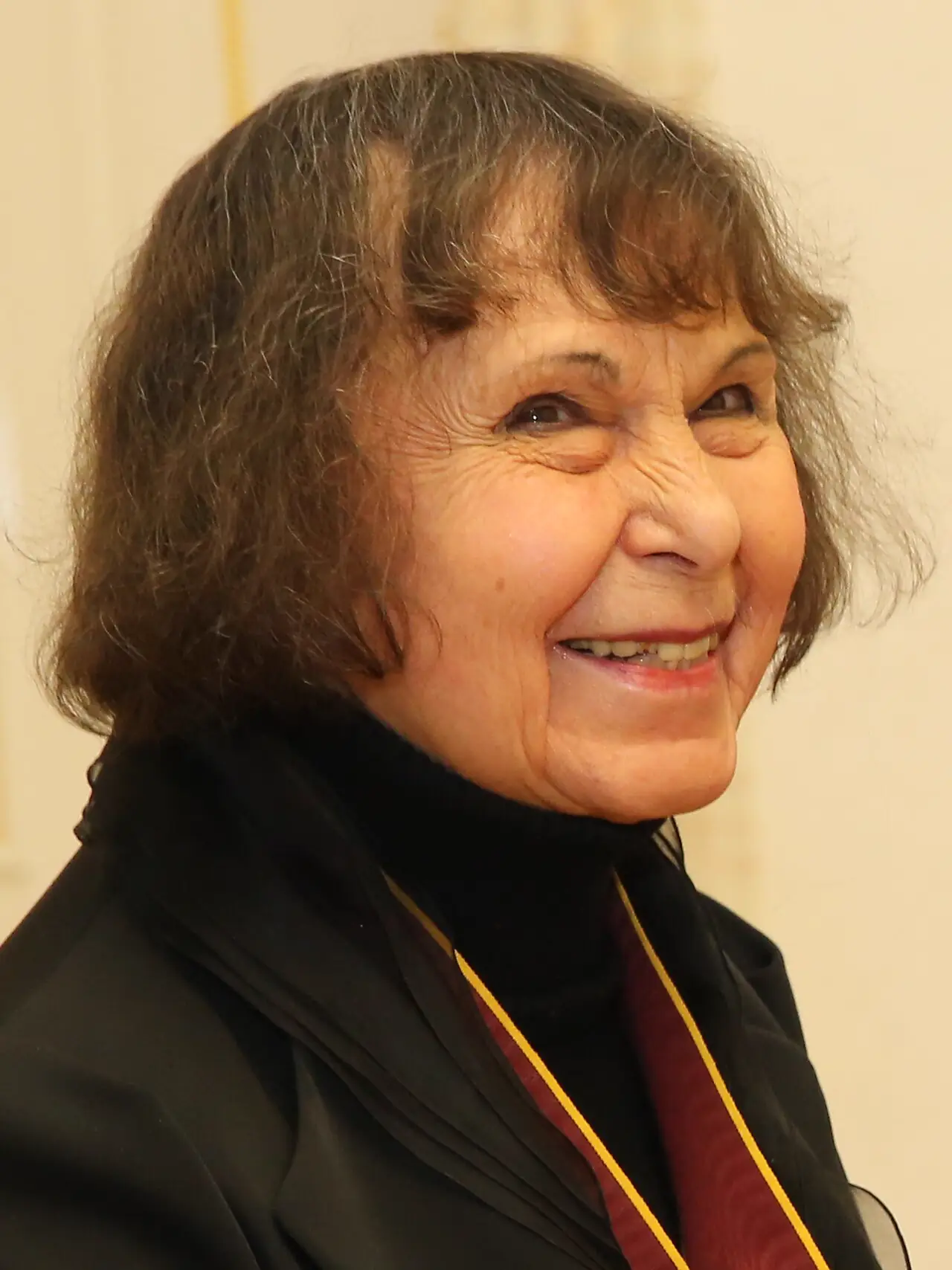
At the family piano in Kazan, Vera Gubaidulina played the keys while her sister Sofia experimented with the strings inside. Their parents had bought a poor instrument, and the children used it in more than one way. Sofia had been born in Chistopol on 24 October 1931 to a Volga Tatar surveyor and a mother of Russian and Polish descent. The family spoke Russian and moved to Kazan during her childhood. In a 2013 interview with Stuart Jeffries she described her early ambition: “I was convinced there was too little music in the world. We needed more.”
She studied piano and composition at the Kazan Conservatory, graduating in 1954, then went to Moscow to work with Nikolai Peiko and Vissarion Shebalin. She finished her studies in 1961. While still a student, she played her symphony at the piano for Shostakovich. His advice, as she recalled it to Jeffries, was: “My wish for you is that you should continue on your own incorrect path.”
MoscowCinema and the Composers’ Union
Membership of the Composers’ Union made a freelance livelihood possible. Film scores paid most of her bills for the next thirty years, and in the cinema she could hear her orchestral music soon after she had written it. She credited this practical schooling with teaching her to handle an orchestra. Getting her music into concerts was harder. In 1979 the Union’s secretary, Tikhon Khrennikov, denounced seven composers whose music had been performed at a festival in Cologne. Gubaidulina’s name was on the list, alongside those of her friends Viktor Suslin and Vyacheslav Artyomov.
Her Chaconne (1962), commissioned by the pianist Marina Mdivani, begins with B minor chords and works its opening harmony through increasingly busy eight-bar stretches. The titles of the fourteen Musical Toys (1969) include Mechanical Accordion, The Woodpecker and The Echo. The bassoon concerto of 1975, written for Valery Popov, brought into her music the persecuted little man of Gogol’s The Overcoat, set against a crowd of low instruments.
That same year she formed Astreja with Suslin and Artyomov, following the example of the percussionist Mark Pekarsky’s ensemble. They improvised on folk instruments from Russia, the Caucasus and Central Asia, and on other objects that produced sounds. Piano, violin and cello were excluded because familiar instruments would tempt the players back into learned phrases. Most sessions were private, with an audience present only occasionally. In 2012 Gubaidulina described the group to Nolan Gasser as a place to discover sounds before committing them to paper.
1978–82Friedrich Lips and the bayan
Friedrich Lips remembered meeting Gubaidulina at a Composers’ Union hearing in the winter of 1974–75, after he had played a sonata by Vladislav Zolotaryov. She wanted to write for his bayan and asked him to teach her how it worked. She visited his classroom and his home and asked about details that experienced players took for granted. In 1978 she arrived with De profundis and played it to him on a grand piano. Lips suggested adding a pitch-bending glissando. The finished piece is built from low clusters, sustained notes and the sound of air escaping through the instrument’s bellows.
In Seven Words (1982), Lips and the cellist Vladimir Tonkha helped her find further ways for instruments to represent the Crucifixion. A held cello note is crossed by a glissando on the neighbouring string; the bayan bends one pitch against another. The string orchestra replies in the manner of a choir. Across the first six movements the tension increases, until the cellist plays on the bridge. In the seventh the bow passes beyond it. Gubaidulina thanked the two players for discoveries she could build into the score, including the cello’s double harmonics.
OffertoriumOffertorium and Gidon Kremer
Gidon Kremer gave her music its decisive opening abroad. He introduced Offertorium in Vienna on 30 May 1981, with Leif Segerstam conducting the ORF Symphony Orchestra. The concerto begins with the royal theme from Bach’s Musical Offering, passed between instruments as in Webern’s orchestration of the six-part ricercar, with its final note left out. At each later statement Gubaidulina removes notes from both ends, until little of the theme is left. After a long section for the solo violin, the theme is rebuilt from its centre outwards. At the end the violin plays it backwards.
Kremer played the concerto in Western concert halls, and in 1988 recorded it with Charles Dutoit and the Boston Symphony Orchestra in Boston during the American–Soviet cultural exchange. The work is built on the idea of a piece of music offered up note by note. The original theme was familiar enough for its disappearance to be noticed. At its return the violinist plays a newly assembled melody.
1986Stimmen… verstummen…
Stimmen… verstummen…, her twelve-movement symphony, begins with the three notes of D major. The strings change their manner of playing them, the winds enter and the organ holds the chord underneath. More restless movements interrupt this music. The work was written for the conductor Gennady Rozhdestvensky, and its ninth movement gives him a solo: after the percussion stops, he goes on conducting in silence, his hands marking out carefully proportioned spans while the orchestra does not play.
AppenAppen and the late works
In 1992 she settled in Appen, outside Hamburg, where she could walk in the woods and work away from city noise. Her commissions grew larger, and she continued to write for particular players. For Yuri Bashmet she wrote the Viola Concerto (1996), first performed in Chicago in 1997. Its opening grows from a single note into a semitone; an additional string quartet is tuned a quarter-tone below the orchestra. In Sonnengesang (1997), written for Mstislav Rostropovich, she set St Francis of Assisi’s praise of creation for cello with voices and percussion.
The Johannes-Passion (2000), commissioned by the Bachakademie Stuttgart for the 250th anniversary of Bach’s death, joined two Russian biblical texts, the Gospel of John and Revelation. She had intended to include the Resurrection, but the Passion grew so large that she wrote a separate companion, Johannes-Ostern (2001). Valery Gergiev conducted the complete pair in Hamburg’s St Michael’s Church on 16 March 2002.
For Anne-Sophie Mutter’s In tempus praesens (2007), she removed all the orchestral violins. The soloist faces fifteen violas, twelve cellos and nine double basses, with heavy brass and percussion behind them. In Boston in 2017, Baiba Skride, Harriet Krijgh and Elsbeth Moser introduced the Triple Concerto for violin, cello and bayan under Andris Nelsons. The Wrath of God received its first performance in 2020. Gubaidulina died in Appen on 13 March 2025, aged ninety-three. She was still working on Prologue, an orchestral commission shared by the Boston Symphony and Leipzig Gewandhaus orchestras.
Where to hear it
Offertorium1980; revised 1982, 1986
Gidon Kremer (violin), Boston Symphony Orchestra, Charles Dutoit (conductor) · Deutsche Grammophon 427 336-2 · April 1988, Symphony Hall, Boston
This violin concerto takes Bach’s royal theme apart, removing notes from each end; after the violent middle section the theme is rebuilt and stated backwards at the close. Kremer, the dedicatee, plays with great intensity, and Dutoit keeps the changing instrumental groups distinct, in the recording that won Gubaidulina the 1989 Koussevitzky International Recording Award.
Boris Pergamenschikow (cello), Elsbeth Moser (bayan), Münchener Kammerorchester, Christoph Poppen (conductor) · ECM New Series 1775 · January 2001, Himmelfahrtskirche Sendling, Munich
Cello, bayan (the Russian button accordion) and strings set Christ’s last sayings from the Cross. Moser and Pergamenschikow blend the two solo instruments against the strings of the Munich Chamber Orchestra.
Anne-Sophie Mutter (violin), London Symphony Orchestra, Valery Gergiev (conductor) · Deutsche Grammophon 477 7450 · February 2008, AIR Studios, Lyndhurst Hall, London
The orchestra has no violins apart from the soloist; its string section consists of fifteen violas, twelve cellos and nine double basses. Mutter, the concerto’s dedicatee and first soloist, made its first recording with Gergiev and the London Symphony Orchestra, setting the violin against the low brass and percussion. The album couples the work with two Bach concertos.
The bayan can let air escape without sounding a note. In De profundis, this sound of escaping air is used alongside low clusters and sustained pitches. Friedrich Lips helped Gubaidulina explore the instrument’s bellows and registers, and suggested the pitch-bending glissando. A note can drop in pitch under bellows pressure, and the performer sustains the sound by moving the bellows with the arms.
𝄞Crossings
Two sounding lines can form a cross. In Seven Words, a cello holds one note while a neighbouring string slides across it; the bayan produces a related crossing by pressure on an adjacent button. In In croce, cello and organ exchange high and low positions over the course of the piece, so the players carry out the crossing named in the title.
𝅗𝅥Proportion
She measured the time around a phrase as carefully as its notes. In Stimmen… verstummen… the lengths of passages and rests, including the conductor’s silent cadenza, are taken from Fibonacci numbers. In her 2012 answers to Nolan Gasser, she explained that proportion helped her contain the music she imagined. She could spend a long time reconciling a phrase with the span allotted to it.
♮Triads
A plain major chord can occupy an entire movement. The opening movement of Stimmen… verstummen… holds D–F♯–A while the strings and winds change its sound; D♭ major sounds against it at the end. The following movement brings sliding strings and wide leaps.
𝄋The solo player
In several of her concertos the seating plan sets the soloist apart. In tempus praesens has no orchestral violins, so Mutter’s instrument is the only violin, above a string section that begins with violas. The Viola Concerto adds a string quartet tuned a quarter-tone low.
Works
A selection from the composer’s works.
1962
ChaconnePiano
Written at Marina Mdivani’s request. The piece opens with B minor chords; repeated eight-bar spans become busier, with moving octaves and semiquavers spreading the harmony across the keyboard.
1969
Musical ToysPiano
Fourteen small pieces for children, beginning with Mechanical Accordion and ending with Forest Musicians. Other pieces depict a woodpecker, an echo and a drummer.
1975
Concerto for Bassoon and Low InstrumentsSolo bassoon and low instrumental ensemble
The bassoon part is associated with Valery Popov. Gogol’s The Overcoat lies behind the work, and the low instruments surround the solo bassoon.
1978
De profundisSolo bayan
A psalm for bellows and reeds, written with Friedrich Lips, who suggested the pitch-bending glissando. Clusters and audible air are used for the cry from the depths, which is made a physical effort.
1980; revised 1982, 1986
OffertoriumViolin and orchestra
Kremer’s concerto opens with Bach’s royal theme, and at each successive return notes are removed from both ends. The melody is then rebuilt from the middle, and at the end the violin plays it backwards.
1982
Seven WordsCello, bayan and strings
Seven instrumental movements on the last sayings of Christ. Tonkha and Lips helped devise the crossings and strained harmonics. In the last movement the cello bow passes beyond the bridge.
1986
Stimmen… verstummen…Large orchestra
Across twelve movements, music in D major alternates with sliding, unstable music. In the ninth movement the instruments stop and the conductor goes on conducting.
1996
Viola ConcertoViola and orchestra
Written for Yuri Bashmet. A single note widens to a semitone. A separate string quartet, tuned a quarter-tone below the orchestra, provides a second set of strings.
2000
Johannes-PassionVocal soloists, two mixed choirs, organ and orchestra
A Russian-language Passion setting the Gospel of John with Revelation. The planned Resurrection became a separate work, Johannes-Ostern; Gergiev first conducted the complete pair in Hamburg in 2002.
2007
In tempus praesensViolin and orchestra without orchestral violins
Apart from Mutter’s solo violin, the orchestra has no violins. It has fifteen violas, twelve cellos and nine double basses. Gubaidulina conceived the central crisis of the concerto as a ritual sacrifice.
In the score
Short examples, engraved and playable.
Proportion — schematicDurations of 2, 3, 5 and 8 units
Schematic durations on a repeated C: two, three, five and eight quavers. After the first two, each span is the sum of its predecessors. The bar lines divide unequal lengths and do not impose a regular metre. These invented notes illustrate a proportion Gubaidulina used and do not quote a work.
In croce — schematicCrossing of two registers
A schematic of the crossing in In croce (1979), originally for cello and organ. The organ descends and the cello rises until they exchange positions in bar 3. The pitches and the four-bar design are invented for this example and show only the high-to-low and low-to-high paths of the two instruments.
Sister arts
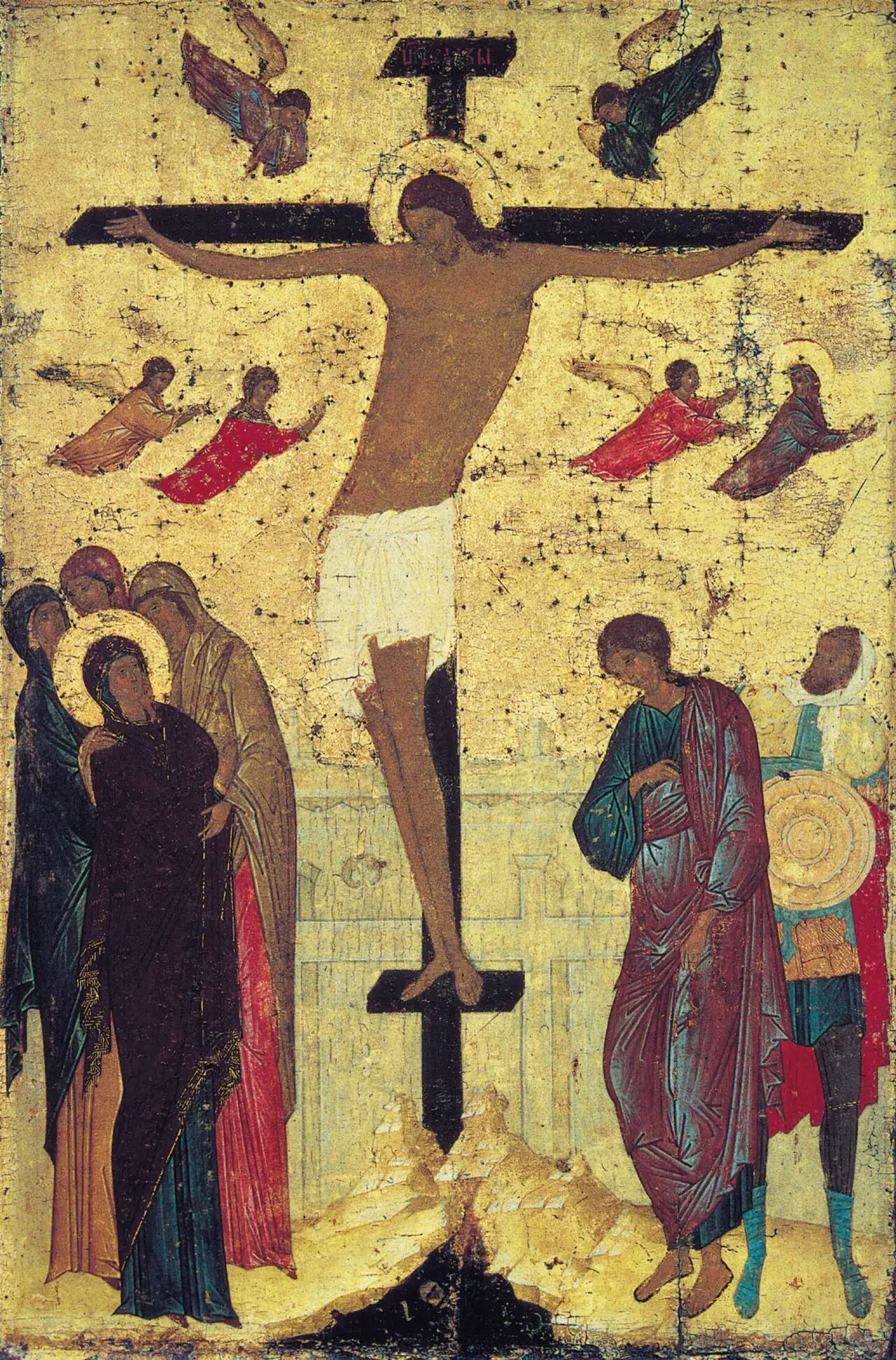
DionisiusCrucifixion, 1500Tempera on wood · State Tretyakov Gallery, Moscow
Dionisius painted this icon for the iconostasis of the Trinity Cathedral at Pavlo-Obnorsky Monastery in 1500. Mary stands with the women on one side of the cross, and John and the centurion Longinus stand on the other. Gubaidulina’s Seven Words takes the same Crucifixion as its subject. She sets the two solo players against strings whose writing resembles choral singing.
Psalm 130, verses 1–3; Latin Vulgate
De profundis
Ancient psalm; late-antique Latin version
LatinDe profundis clamavi ad te, Domine;
Domine, exaudi vocem meam.
Fiant aures tuae intendentes
in vocem deprecationis meae.
Si iniquitates observaveris, Domine,
Domine, quis sustinebit?
Our translationFrom the depths I have cried to you, Lord;
Lord, hear my voice.
Let your ears be attentive
to the voice of my pleading.
If you take account of wrongs, Lord,
Lord, who will stand?
The psalm opens with a cry from the depths, followed by a plea to be heard. Its Latin opening gives the title of Gubaidulina’s De profundis (1978), written for Friedrich Lips, a bayan player. The poem is Psalm 129 in the Vulgate and Psalm 130 in the Hebrew numbering.
Recommended recordings
Seven Words · In croce · SilenzioElsbeth Moser, Maria Kliegel, Camerata Transsylvanica, György SelmecziNaxosA recording of the bayan in three settings: with a cello, in a trio and with chamber strings. The main work is In croce for cello and bayan, though Kliegel’s soft-edged tone takes some bite out of its confrontations.
Passed toContemporary bayan repertoireFriedrich LipsElsbeth Moser
Asked about her models by Nolan Gasser in 2012, Gubaidulina named Bach, Webern and Shostakovich. She cited Bach for joining invention to intuition, Webern for clear construction and Shostakovich for tragedy. Offertorium draws on the first two in a single borrowed theme. Friedrich Lips and Elsbeth Moser, as performers, helped bring her work for the bayan into its concert repertoire.