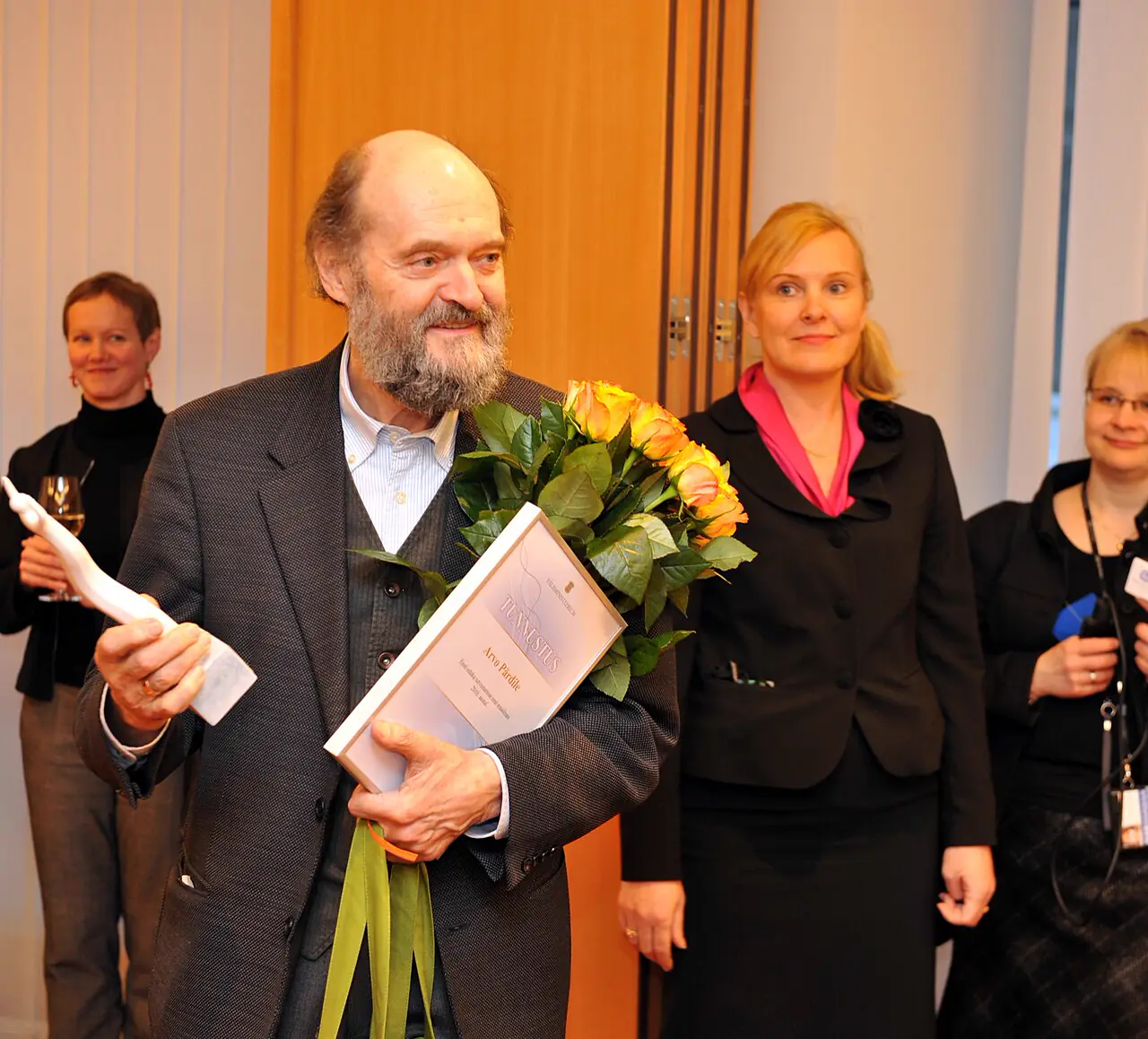
Heino Eller, Tallinn Conservatoire; graduated 1963
At work
Estonian Radio sound engineer, 1958–67; film scores helped support him during the years of searching
Homes
Estonia · Vienna, 1980 · Berlin, 1981 · back in Estonia from 2010
Turning point
Für Alina, February 1976: the first tintinnabuli piece
Life
On 16 November 1968, in Tallinn’s Estonia Concert Hall, Neeme Järvi conducted a new work that the printed programme did not explain. Pärt’s Credo set a Christian declaration for a Soviet radio choir. At the piano, Mart Lille played Bach’s C major Prelude; around it, the orchestra broke into loud, dissonant noise, then grew quiet again. The officials who should have heard the work beforehand were away in Moscow. The audience demanded that the whole work be played again. Later performances were stopped.
1935–68Tallinn Conservatoire and Estonian Radio
Pärt was born in Paide in 1935 and grew up in Rakvere, where he learned the piano with Ille Martin. After a brief period of study with Veljo Tormis and two years of military service, he entered Heino Eller’s class at the Tallinn Conservatoire in 1957. He graduated in 1963. By then he had written Nekrolog, the first twelve-note orchestral work in Estonian music, and Perpetuum mobile. From 1958 to 1967 he worked as a sound engineer at Estonian Radio, where his work involved microphones and tape.
The young composer tried out the newest techniques with conspicuous success and growing dissatisfaction. In Collage über B-A-C-H (1964), Baroque music is set beside sounds that could tear it apart. Credo took this approach further. Its text set the command to take an eye for an eye against Christ’s refusal of retaliation; its orchestra built a violent heap of fifths and then dismantled it.
1968–76Gregorian chant and Für Alina
He began again with a single line. “I just wanted a simple musical line, internally alive and breathing,” he told Enzo Restagno in conversations published in 2010. A Tallinn church gave him a Liber usualis, the collection of Gregorian chant, and he sang and played his way through it. He studied the early polyphony of Notre Dame and Renaissance sacred music. The Third Symphony of 1971 drew on these studies in an orchestral score. In 1972 he married Nora and joined the Orthodox Church.
In February 1976 he wrote Für Alina. The piano plays a melody whose phrases gain a note at a time, grow to eight notes, then shrink. Beside it runs a second line confined to the B minor triad. Every melodic note has its prescribed partner. Once, the second line steps outside the triad onto C♯, and the pedal lifts. Rein Rannap first played the piece as an unannounced encore in Tallinn on 23 March.
Pärt called the method tintinnabuli, from the Latin for a little bell. The melody can move up and down a scale while the other voice keeps returning to its three notes. A note in one part may clash with its neighbour in the other. Für Alina is written for two hands.
1977–78Cantus, Fratres and Tabula rasa
When the radio announced Britten’s death in December 1976, Pärt’s hope of meeting him ended. Pärt had been struck by the tenderness he heard in Britten’s music. Cantus in Memory of Benjamin Britten (1977) begins with three bars of written silence and a tolling bell. The strings descend through A minor at different speeds, their lines lengthening as they go, until they arrive at a low chord. The bell goes on ringing after the strings have stopped.
Fratres, written the same year for the early-music players of Hortus Musicus, had no fixed instrumentation. Its recurring three-part theme, over a low drone, could be played by different instruments; in 1980 Pärt added a demanding violin part for Gidon Kremer. In Spiegel im Spiegel (1978), commissioned by Vladimir Spivakov, the violin repeatedly returns to A. Each departure takes it one note further away, while the piano keeps up its three-note accompaniment.
Kremer also asked for Tabula rasa, a double concerto for himself and Tatjana Grindenko, with prepared piano and strings. Its scales and triads baffled the players in rehearsal. The first movement, Ludus, consists of eight variations and a cadenza; in Silentium, the bass moves fastest and the first solo violin slowest. At the première on 30 September 1977, in the assembly hall of the Tallinn Polytechnic Institute, the performance came together. “Never again have I experienced the silence that took over the assembly hall after the premiere,” Nora recalled to Immo Mihkelson for Estonian radio in 2005.
1980–84Emigration and the ECM New Series
A Central Committee official visited the Pärts at home in autumn 1979 and suggested they leave. “It was supposed to look like a voluntary decision,” Nora told Restagno in the conversations published in 2010. In January 1980 they left with their two sons, settling first in Vienna and moving to Berlin on a DAAD scholarship in 1981. At the railway border station at Brest, guards searching their luggage had played a recording of Cantus.
Manfred Eicher first heard Tabula rasa on a car radio, without knowing its title or composer. In 1984 he made it the first release of ECM’s New Series. Kremer and Grindenko played the concerto, with the composer Alfred Schnittke at the prepared piano; elsewhere on the album Kremer played Fratres with Keith Jarrett. Another partnership began that January on a train from London’s Victoria station to Gatwick: Paul Hillier and Pärt used the airport trip to discuss the music that the Hilliard Ensemble would soon be singing.
Passion and prayerPassio and later choral works
Passio (1982) sets St John’s account of the arrest, trial and crucifixion in Latin. Punctuation governs the lengths of sung notes; Jesus is given slower note values than the people questioning him. The Hilliards’ performances restored Pärt’s confidence in a score he had doubted. Te Deum (1984–85) is scored for three choirs, strings and prepared piano above a recorded wind harp. A sustained D and A are held beneath the singers throughout.
For Kanon pokajanen (1997), he set the Church Slavonic Canon of Repentance for unaccompanied choir. Tõnu Kaljuste and the Estonian Philharmonic Chamber Choir gave its première in Cologne Cathedral in 1998. Jordi Savall commissioned the much shorter Da pacem Domine (2004), in which the old chant runs through the alto part and three new voices surround it. At its first performance in Barcelona, Savall dedicated the concert to the victims of that March’s Madrid bombings.
Pärt’s ties with Estonia were renewed after independence in 1991, and Kaljuste and his Estonian musicians became important recording partners. In 2010 Arvo and Nora returned to live there permanently and founded the Arvo Pärt Centre at Laulasmaa. The archive holds his working papers, including sketches and diagrams.
Where to hear it
Tabula rasa1977
Gidon Kremer and Tatjana Grindenko (violins); Alfred Schnittke (prepared piano); Lithuanian Chamber Orchestra; Saulius Sondeckis (conductor) · ECM New Series · November 1977, live
Two solo violins lead this double concerto through eight variations before the slow “Silentium”, in which the voices move at different speeds. Kremer and Grindenko, the violin soloists at the première, are joined by Alfred Schnittke on prepared piano on the album that launched ECM’s New Series, released in 1984. It is the recording to start with, and Kremer and Keith Jarrett’s Fratres opens the same album.
Vladimir Spivakov (violin); Sergej Bezrodny (piano) · ECM New Series · July 1995
The violin’s phrases lengthen above three-note piano arpeggios, returning each time to A. Spivakov, the work’s dedicatee, and Bezrodny open the album Alina with this version, recorded in Frankfurt’s Festeburgkirche with Pärt and Manfred Eicher present. The 1999 album has two works, with Alexander Malter’s long performances of Für Alina between three accounts of Spiegel im Spiegel; Malter and Dietmar Schwalke are the other players.
Passio Domini nostri Jesu Christi secundum Joannem1982
The Hilliard Ensemble; Michael George (bass); John Potter (tenor); Christopher Bowers-Broadbent (organ); The Western Wind Chamber Choir; Paul Hillier (conductor) · ECM New Series · March 1988
Four singers share the Evangelist’s words in Pärt’s Latin St John Passion, and an organ accompanies Jesus and Pilate. The Hilliard Ensemble’s recording with Paul Hillier, made in St Jude’s on the Hill in London, is an essential account of the long Passion. The Hilliards sing steadily with very little vibrato, so each interval is clear; the recording brought the work to international attention and convinced Pärt, after years of doubt, that the score worked.
One voice moves by step through a scale. The other uses only the three notes of a fixed chord. Pärt set how far above or below the melody that second voice must sit. The two lines can meet in a third or a second. In Für Alina, the accompanying notes come from B minor, and one C♯ stands out against them.
𝄢Counterpoint
In Cantus, five groups of strings descend at different speeds. Their lines lengthen, overlap and end on the same low A minor chord. The piece is a prolation canon, in which the notes of one line are played at several different rhythmic values. The bell tolls above the strings and is still heard after the bows have stopped.
𝅘𝅥Text
The full stops in Passio last longer than the commas. Pärt gave each speaker a basic note length and adjusted it to the words’ position in the sentence. Jesus has the slowest, lowest part; Pilate is higher and faster. Four voices share the Evangelist’s account.
𝄐Bells and piano
The piano in Tabula rasa has screws placed between its strings. The metallic rattle they produce links it to the bell in Cantus, though the piano can play a whole arpeggio at once. In the slow Silentium, its attacks interrupt long string notes.
𝄋Returning
The violin in Spiegel im Spiegel returns repeatedly to A. Each phrase adds a step to the outward walk, and each ascending phrase has a descending answer. The piano’s three-note figures mark the increasing distance. In Fratres, a three-part theme returns in a new octave over the same low drone.
Works
A selection from the composer’s works.
1968
CredoPiano, mixed choir and orchestra
Bach’s C major Prelude is set against an orchestral eruption, around a text from the Creed and St Matthew. The Tallinn audience demanded an immediate repeat; further performances were stopped.
1976
Für AlinaPiano
The first tintinnabuli piece reached the public as Rein Rannap’s unannounced encore in Tallinn. Its companion voice leaves the B minor triad for one exposed C♯.
1977
FratresVarious authorised instrumental versions
First written without fixed instrumentation for Hortus Musicus. Pärt added solo variations for violin and piano in 1980 and dedicated that version to Gidon and Elena Kremer.
1977
Cantus in Memory of Benjamin BrittenString orchestra and bell
Pärt had hoped to meet Britten. Five string lines descend at different speeds and converge on A minor, and the bell keeps ringing after the final chord.
1977
Tabula rasaTwo violins, prepared piano and string orchestra
Ludus has eight variations and a cadenza; in Silentium the lines move at different speeds. Kremer and Grindenko were the first soloists, with Helju Tauk at the prepared piano.
1978
Spiegel im SpiegelViolin and piano; later versions for other instruments
Written for Vladimir Spivakov, who first played it with Boris Bekhterev at the Moscow Conservatory. The violin’s widening phrases always return to A.
1982
PassioVocal soloists, mixed choir, instrumental quartet and organ
St John’s Passion in Latin, with four singers sharing the Evangelist. Jesus is set in longer note values than the other characters; the punctuation of the text helps set the pace.
1984–85; revised 1992
Te DeumThree choirs, prepared piano, string orchestra and recorded wind harp
A recording of a wind harp holds D and A beneath the singers. The final repetitions of Sanctus are sung above a sustained string chord.
1997
Kanon pokajanenUnaccompanied mixed choir
The Church Slavonic Canon of Repentance, first sung complete in Cologne Cathedral in 1998 by Kaljuste’s Estonian Philharmonic Chamber Choir.
2004
Da pacem DomineFour vocal parts; several later arrangements
Jordi Savall commissioned this peace prayer. The alto sings the medieval chant, surrounded by three newly composed voices.
In the score
Short examples, engraved and playable.
Tintinnabuli — schematicA moving scale and a triad
A schematic in A minor. The lower melody uses the scale; for each note, the upper part takes the nearest A, C or E strictly above it. A therefore pairs with C, B with C, and C with E. The chord stays fixed while the distance between the two voices changes.
Augmentation — schematicSingle descending line at two speeds
A schematic of augmentation. Both parts descend through A minor. The upper part takes two bars and the lower part four, an octave beneath it. The upper part repeats to fill the example. Cantus uses the same kind of unequal speeds with more voices and staggered entries.
Sister arts
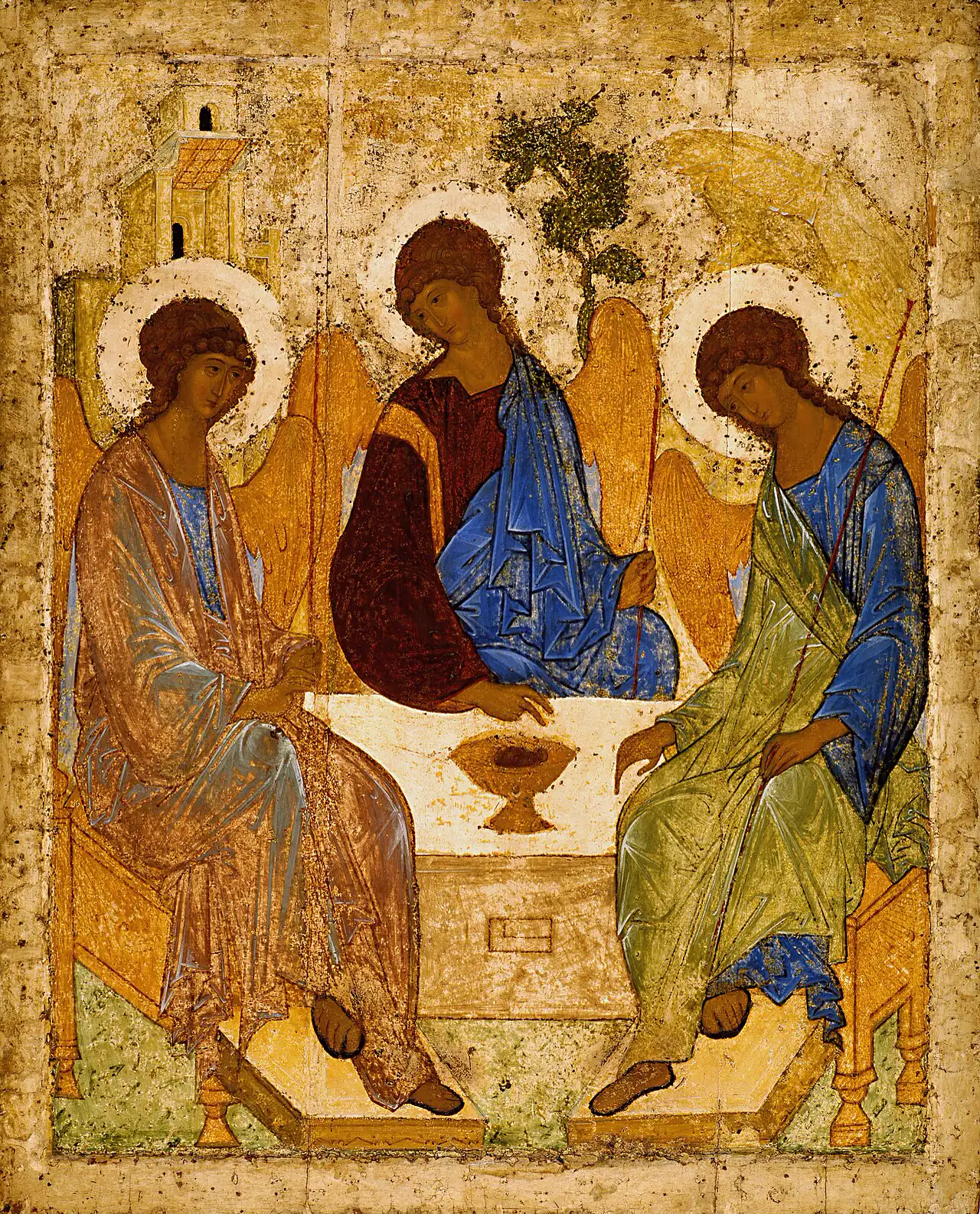
Andrei RublevThe Trinity, c. 1425–27Tempera on wood · Trinity Cathedral, Trinity–Sergius Lavra, Sergiev Posad; returned to the Lavra in 2024
Rublev’s three angels sit around a table, their heads inclined towards one another. They are the visitors received by Abraham in Genesis, understood as an image of the Trinity. The icon belongs to the Orthodox tradition Pärt entered in 1972.
Anonymous Latin antiphon
Da pacem Domine
Ninth century
LatinDa pacem, Domine,
in diebus nostris,
quia non est alius
qui pugnet pro nobis
nisi tu, Deus noster.
Our translationGrant peace, Lord,
in our days,
for there is no other
who may fight on our behalf
but you, our God.
Jordi Savall asked Pärt for this prayer for a peace concert. The alto sings the melody of the ninth-century antiphon, and Pärt wrote three new parts around it. Savall conducted the first performance in Barcelona in July 2004, at a concert dedicated to those killed in the Madrid train bombings that March.
Recommended recordings
Te DeumEstonian Philharmonic Chamber Choir, Tallinn Chamber Orchestra, Tõnu KaljusteECM New Series · 1993A good introduction to Pärt’s larger choral works. The wind-harp drone lies beneath the voices, and the climaxes are loud and full. The programme also includes Magnificat, Silouan’s Song and Berliner Messe.
Lineage
Drew fromJohann Sebastian BachHeino EllerGregorian chantNotre Dame polyphonyRenaissance sacred music
Pärt
Passed toContemporary choral repertoireFilm and concert uses of tintinnabuli
Heino Eller taught Pärt in Tallinn. Bach supplied the prelude at the centre of Credo. A borrowed chant book later helped Pärt arrive at his own melodic line. The canons of Cantus draw on older counterpoint; the pairing of scale and triad was his own invention. Performers took the music further, among them Kremer on the violin, Hillier with the Hilliards and Kaljuste with his Estonian choir. Film-makers have used Fratres, Cantus and Spiegel im Spiegel many times.