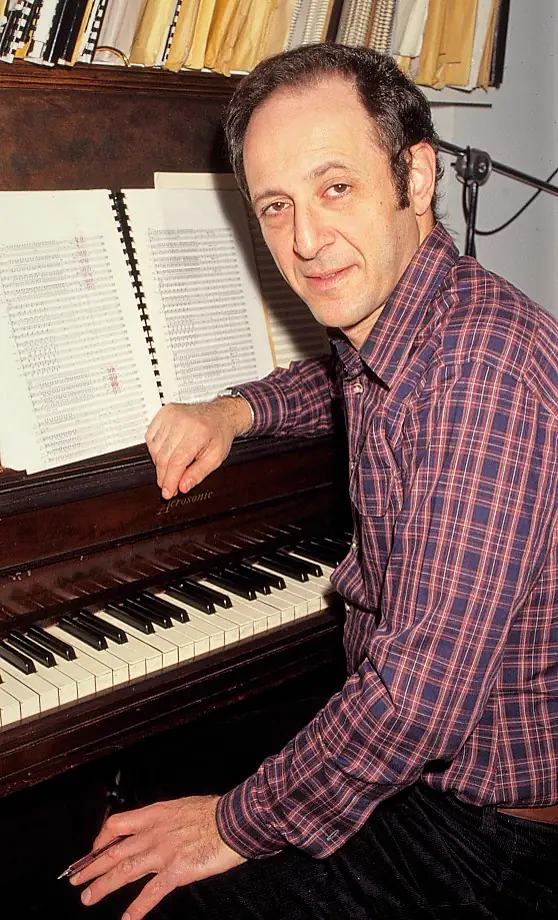
Composer who built music from two tape machines drifting out of time with each other, and later applied the same phasing process to pianists, drummers and singers.
Philosophy at Cornell, 1957; composition with Hall Overton, at Juilliard and at Mills
Studied further
Ewe drumming in Ghana; Balinese gamelan; Hebrew cantillation
Performed
Piano and percussion with his own ensemble, Steve Reich and Musicians
Starting points
A preacher’s voice · two pairs of clapping hands · eleven pulsing chords
Life
In late 1964, Reich took a tape recorder to Union Square in San Francisco. A young Pentecostal preacher who called himself Brother Walter was telling the story of Noah and the Flood. His warning became It’s Gonna Rain (1965). “Sometimes when people speak, they almost sing,” Reich told Terry Gross on Fresh Air in 1999. Reich cut a few words from the sermon into loops and put them on two machines, so that the one voice formed a round without anyone singing a second part.
Reich had been born in New York in 1936. His parents separated when he was one. His father, a lawyer, stayed in New York, and his mother, a singer and songwriter, moved to Los Angeles. From 1939 to 1942 he crossed America by train with his governess, Virginia. At fourteen he heard records of Bach’s Fifth Brandenburg Concerto, Stravinsky’s Rite of Spring, Charlie Parker and Miles Davis. He took up drums, and he listened to Kenny Clarke’s playing.
He graduated in philosophy from Cornell in 1957. William Austin’s music-history classes took him from chant to Bach, then jumped to Stravinsky and Duke Ellington. Composition lessons with Hall Overton followed, then Juilliard and Mills College, where he studied with Luciano Berio and Darius Milhaud, receiving his master’s degree in 1963. San Francisco brought experimental film and Terry Riley. Reich played in the first performance of Riley’s In C in 1964, among musicians repeating short phrases.
1965–67Tape loops and Piano Phase
Reich arrived at the process in It’s Gonna Rain through two cheap tape recorders that did not run at quite the same speed. He started identical loops together on both. At first the voice sounded as though it sat in the middle of his head; then one copy moved out of step with the other until the words overlapped. The piece consists of this slow separation.
Back in New York, he made Come Out (1966) for a benefit supporting the retrial of the Harlem Six. The civil-rights activist Truman Nelson had brought him interviews to edit. Daniel Hamm described opening a bruise to show injuries inflicted by police. Reich took the fragment that supplied the title and sent it through the tape machines. Hamm’s syllables gradually crowd one another.
Late in 1966, Reich sat at a piano and tried playing against a tape loop of himself, then gradually moving ahead of it. He had thought the process used on the tape machines might be impossible for human hands, but it worked. Piano Phase (1967) begins with a figure of twelve quick notes in one piano; the second piano enters in unison, and the two then move out of phase. Dotted lines between bars direct the pianists to make each shift gradually, judging it by ear.
1970–76Drumming, Clapping Music and Music for 18 Musicians
In the summer of 1970 he went to the University of Ghana to study drumming with Gideon Alorwoyie and other Ewe musicians. He recorded lessons and wrote down the patterns. On his return he began Drumming, which starts from a single bongo stroke; beats are substituted for rests one at a time until the full pattern has been built up. Completed in 1971, it moves from tuned bongos to marimbas and glockenspiels, with voices and piccolo doubling melodic patterns that arise from the repeating notes.
Steve Reich and Musicians began touring Europe in 1971 with some 2,000 pounds of equipment. Clapping Music (1972) needed none of the marimbas, amplifiers and loudspeakers. Two people clap one pattern. One keeps it fixed while the other moves abruptly a pulse ahead, repeating each new position before moving on. Reich had tried gradual phasing, but judged its difficulty out of keeping with the bare hands that made the sound.
For Music for 18 Musicians (1974–76), Reich rented four spinet pianos and set them up in his loft. The group rehearsed over two years, learning the notes and who would signal what. Eleven chords open the piece; each then becomes the basis of a longer section. Pianos and mallets keep the pulse running while singers and clarinettists repeat notes for the length of one comfortable breath. The work was first performed at New York’s Town Hall in April 1976 and reached a wider audience through the ECM record released in 1978.
1981–84Tehillim and The Desert Music
During the 1970s Reich also studied Balinese gamelan and the chanting of Hebrew scripture. In Tehillim (1981), four women sing newly composed settings of psalm excerpts. The first voice is accompanied only by a drum and clapping; a clarinet enters, then a second voice follows in canon. The length of the bars follows the Hebrew syllables. In the last movement the singers sing together on Halleluyah, and the music ends in D major.
The words for The Desert Music, completed in December 1983 and first performed in Cologne in March 1984, are by William Carlos Williams. Reich arranged fragments of the poems into five movements for chorus and orchestra. Williams’s warning about humanity’s ability to destroy itself is set in the slow central part of the work. Reich considered using a recording of the poet; by summer 1983 he had found chords on which the chorus could sing it.
1988Different Trains
For Different Trains, Reich went back to the railway journeys of his childhood. He recorded Virginia, then in her seventies, and Lawrence Davis, a retired Pullman porter in his eighties. He also collected testimony from three Holocaust survivors of about his own age, Rachella, Paul and Rachel. In his 1988 programme note he wrote: “if I had been in Europe during this period, as a Jew I would have had to ride very different trains”.
He chose short phrases whose pitches he could write down and gave those speech melodies to the strings, so that an instrument plays the same rise and fall as the recorded voice. The three movements go from America before the war to Europe during it, then to the years after it. Kronos Quartet gave the première at Queen Elizabeth Hall in London on 2 November 1988.
1993 onwardsVideo works with Beryl Korot
Reich and the video artist Beryl Korot, whom he married in 1976, brought recorded speech into the theatre. For The Cave (1993) they filmed Israelis, Palestinians and Americans answering questions about Abraham and his family, and singers and instrumentalists respond to the interviews. Three Tales (2002) puts historical footage and interviews on one large screen, with the musicians below it. Its subjects are the Hindenburg disaster, the atomic tests at Bikini and Dolly the cloned sheep.
The instrumental Double Sextet (2007), written for eighth blackbird, won the Pulitzer Prize in 2009. It can be performed by six players against a recording of themselves; the two pianos and vibraphones interlock beneath winds and strings. Another collaboration began when Gerhard Richter showed Reich his Patterns book at a New York gallery in 2016. In Reich/Richter (2019), written for Richter and Corinna Belz’s film, narrow coloured stripes appear at the start alongside a two-note figure. As the images grow, the notes lengthen; when the stripes return, the semiquavers return with them.
Where to hear it
Music for 18 Musicians1974–76
Steve Reich Ensemble; Steve Reich (piano, marimba) · ECM Records · 1976
Eleven chords support a steady beat from pianos and mallet instruments, while voices and clarinets phrase by the length of a breath. Reich played piano and marimba on his ensemble’s 1976 New York recording, released in 1978, and James Preiss played the metallophone signals that move the group from one section to the next. It remains the recording to start with.
Kronos Quartet (David Harrington, John Sherba, Hank Dutt, Joan Jeanrenaud) · Nonesuch · 1988
Strings imitate the recorded speech of Reich’s governess, a Pullman porter and three Holocaust survivors, against train sounds from America and Europe. Kronos recorded the work in San Francisco before giving its première in London in 1988. The 1989 album, the first recording of both works, couples it with Electric Counterpoint, which Pat Metheny recorded in New York in 1987; each sets live players against recordings of themselves.
Steve Reich and Musicians · Deutsche Grammophon · 1974
A single bongo stroke is built up into a twelve-beat pattern that passes through marimbas, glockenspiels and voices. Reich played in his own ensemble on this 85-minute recording of the complete work, made at Polydor Studios, Hamburg, in January 1974; Cornelius Cardew was among the players, and Joan La Barbara and Jay Clayton sang. The set adds two 1973 scores, Six Pianos and Music for Mallet Instruments, Voices and Organ.
Two players can make a new tune by moving out of step with each other. In Piano Phase, one pianist keeps a steady tempo while the other gradually plays faster, and a single line becomes a close canon. During each shift the notes blur briefly before they fall into the next alignment. In Clapping Music the shift happens in a single jump. Both players keep the pulse, and the second player starts the pattern one quaver earlier.
𝅘𝅥Hidden melodies
Reich often adds a player to bring out notes already sounding between the other parts. In Drumming, women’s voices imitate the marimbas and sing melodies drawn from their interlocking patterns. When a singer fades out, the melody continues on the marimbas. With the higher glockenspiels, whistling and piccolo are added; each new voice matches the instrument whose patterns it brings out.
𝄾Pulse and breath
In Music for 18 Musicians the length of some phrases is set by a player’s breath. Voices and clarinets pulse on a note for one comfortable breath while pianos and mallets keep a steady beat. The strings follow the bass clarinet’s breathing. Each chord in the opening cycle lasts two breaths, and the players’ breathing therefore sets the rate at which the harmony changes.
♮Harmony
Music for 18 Musicians is built on eleven chords. Each is heard briefly at the opening, then held for a section of its own; the third chord is the basis of two sections. Later works make sharper changes of key. Double Sextet moves through areas centred on D, F, A♭ and B, or their relative minors, with abrupt changes that mark the start of each new stretch.
𝄞Speech and song
For Different Trains, Reich chose recorded phrases with pitches clear enough to transcribe, then had strings imitate them alongside the speaking voice. In Tehillim, the Hebrew words supply the rhythms for melodies he composed himself. Long sung sentences move through changing metres, and a drum and handclaps mark their rhythms.
Works
A selection from the composer’s works.
1965
It’s Gonna RainTwo-channel tape
Brother Walter’s sermon about Noah, recorded in San Francisco in 1964, is played as two loops that drift out of phase.
1967
Piano PhaseTwo pianos or two marimbas
One pianist begins a twelve-note pattern; the other joins in unison, then gradually pulls ahead until the pattern has passed through every alignment and returned to unison.
1970–71
DrummingPercussion ensemble, voices and piccolo
A single stroke is built up into the pattern that runs through all four parts. The same notes pass between bongos, marimbas and glockenspiels before the instruments play together.
1972
Clapping MusicTwo performers clapping
Written after European tours with some 2,000 pounds of equipment. One pair of hands keeps a pattern of eight claps in twelve pulses steady while the other rotates the pattern.
1974–76
Music for 18 MusiciansVoices, clarinets, violin, cello, pianos and tuned percussion
Eleven pulsing chords frame the piece and supply its individual sections. The metallophone signals changes while singers and clarinets measure phrases by their breath.
1981
TehillimFour women’s voices and ensemble; also orchestral version
Settings of passages from Psalms 19, 34, 18 and 150, with melodies composed by Reich. A solo voice, drum and handclaps open the work; the final Halleluyah brings it to D major.
1982–83; first performed 1984
The Desert MusicChorus and orchestra
Fragments of William Carlos Williams arranged into a five-movement arch. The central movement contains the poet’s warning about the destructive power of human wishes.
1987
Electric CounterpointElectric guitar with prerecorded guitars and basses
Written for Pat Metheny, who helped make the writing fit the guitar. A soloist plays against up to ten recorded guitar parts and two electric basses.
1988
Different TrainsString quartet and prerecorded sound
The quartet plays melodies taken from the speech of Reich’s governess, a Pullman porter and Holocaust survivors. Kronos Quartet introduced it in London on 2 November 1988.
2007
Double SextetTwo sextets, or one sextet with prerecorded counterpart
Two matching groups of six, each with flute, clarinet, violin, cello, vibraphone and piano; the pianos and vibraphones are paired across the groups. Written for eighth blackbird, it won the 2009 Pulitzer Prize.
In the score
Short examples, engraved and playable.
Clapping Music — schematic rotationsPattern of three, two, one, two, with rests
A schematic of eight claps in twelve pulses, shown first with both parts together, then with the lower part one pulse ahead, then two. In Reich’s score each position is repeated much longer. The Cs stand for unpitched claps, and the 12/8 signature helps count the spaces. Each shift changes which claps coincide and which fall in the other player’s rests.
Piano Phase — schematic snapshotsTwelve-note pattern, offset by one position
Schematic snapshots using the opening twelve-note pattern of Piano Phase. Both parts begin on E; halfway through, the lower part starts on F♯, one semiquaver ahead. In performance a gradual acceleration connects those positions. Here the change is made in one step, so that the new pairings can be heard; tempo and repeat counts are chosen for the example.
Sister arts
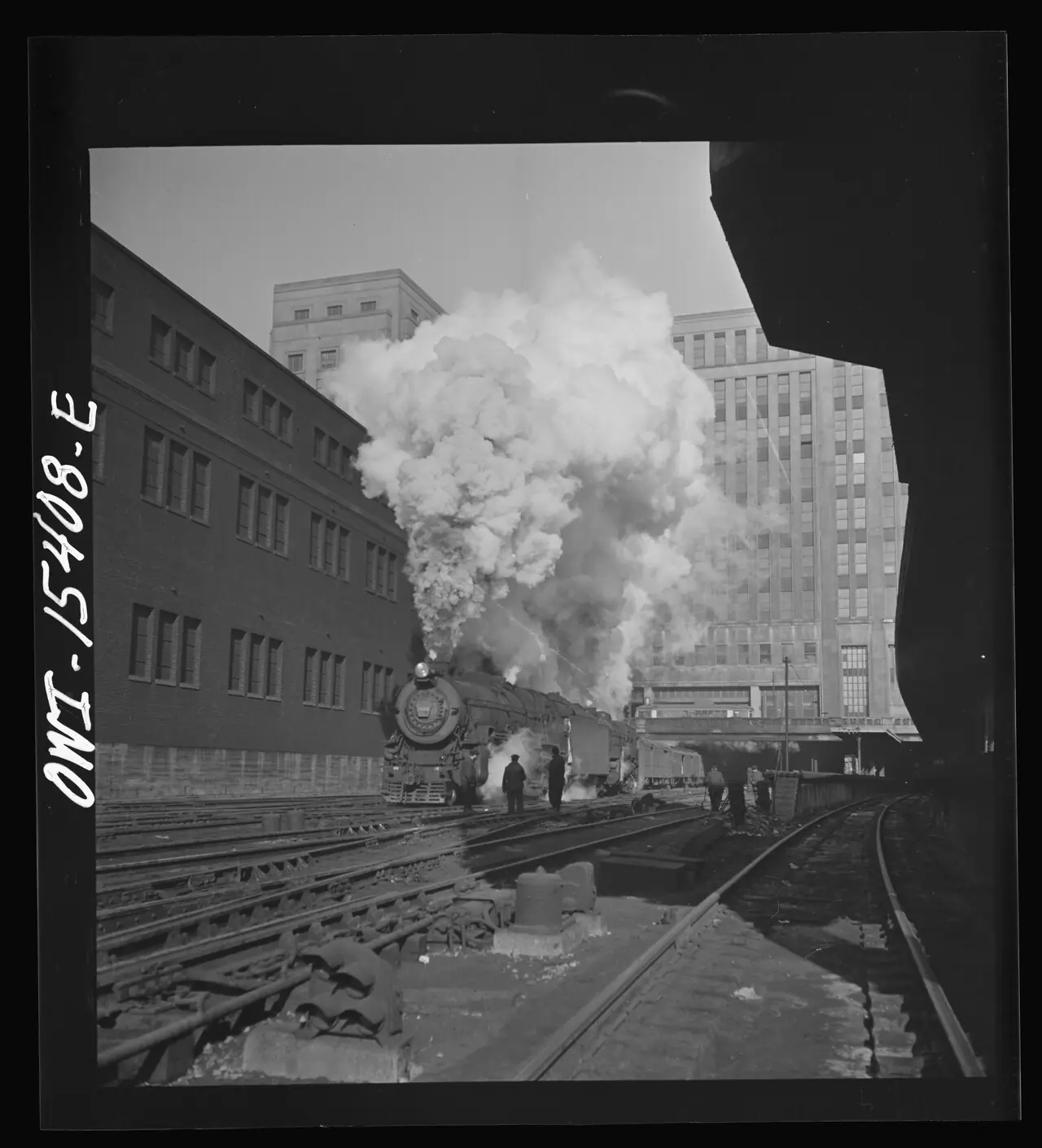
Jack DelanoPennsylvania Railroad train leaving Union Station, Chicago, January 1943Photograph; Office of War Information · Library of Congress, Washington, DC
Jack Delano photographed this train leaving Chicago’s Union Station in January 1943, shortly after the years of Reich’s childhood crossings. The photograph shows the locomotives and the large post-office building. Different Trains uses recorded memories from Virginia and Lawrence Davis’s account of his life as a Pullman porter.
Psalm 19, verses 2–3 in Hebrew numbering
The heavens tell
Ancient Hebrew text
Hebrewהשמים מספרים כבוד אל
ומעשה ידיו מגיד הרקיע
יום ליום יביע אמר
ולילה ללילה יחוה דעת
Our translationThe heavens tell the glory of God;
the vault declares the work of his hands.
Day pours out speech to day,
and night makes knowledge known to night.
Tehillim begins with these verses and continues through verse 5 of Psalm 19. A woman sings with drum and handclaps; the clarinet doubles her, then another voice follows in canon. Reich wrote the melody himself, letting the Hebrew words set the lengths of the bars.
Recommended recordings
The Desert MusicSteve Reich and Musicians, members of the Brooklyn Philharmonic, Michael Tilson ThomasNonesuch · 1985This is the recording to choose for Reich on a large choral scale. It was his Nonesuch debut, made at RCA Studio A in New York in October 1984. Tilson Thomas joined the composer’s regular players to members of the Brooklyn Philharmonic.
Passed toJohn AdamsJulia WolfeDavid LangMichael GordonElectronic dance music
Bach’s Fifth Brandenburg Concerto and Stravinsky’s Rite of Spring were records Reich knew as a teenager. Riley’s In C gave him practical experience of repeated phrases, and Ghanaian drummers showed him how independent patterns could fit together. Gradual phasing was Reich’s own contribution to minimalism. John Adams used the steady beat and repeating cells in Shaker Loops (1978), written for seven strings.