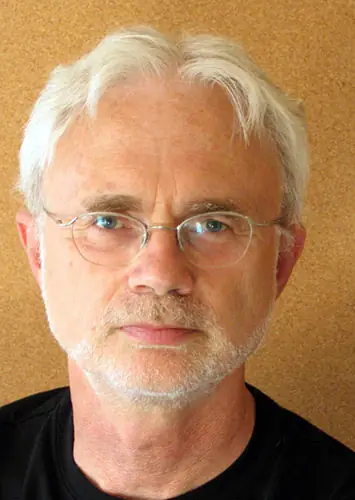
Librettist Alice Goodman and director Peter Sellars; Sellars later compiled several librettos
On stage
Nixon in Beijing · Oppenheimer at Trinity · the California Gold Rush · Antony and Cleopatra
Life
At his grandfather’s dance hall in New Hampshire, the young John Adams could stand right in front of Duke Ellington’s band. The players were down on the floor, close enough for him to feel the unamplified brass in his body. Born in Worcester, Massachusetts, in 1947, he learned clarinet from his father and watched his mother perform in amateur musicals. “Duke Ellington was given equal billing with Mozart,” he told Terry Gross on Fresh Air in November 1999. He played marching-band music with his father and listened to other music on records.
Adams arrived at Harvard in 1965 and studied composition there with Leon Kirchner. He had also studied clarinet with Felix Viscuglia, and played well enough to substitute with the Boston Symphony. In the music department students counted twelve-note rows; across the Yard, Jimi Hendrix was played loudly from dormitory windows. Adams conducted a student Marriage of Figaro directed by John Lithgow. In 1971 he packed his Volkswagen Beetle and drove to San Francisco.
1972–81San Francisco Conservatory
He taught at the San Francisco Conservatory from 1972 to 1982, directing its New Music Ensemble and experimenting with the students. He built a synthesizer and worked with tape. Terry Riley’s In C and Reich’s Drumming excited him. In both, a beat and a chord could continue while the smallest change became an event. Philip Glass supplied another model. Adams wanted the freedom to interrupt the pulse, to make it speed up or break off abruptly.
Phrygian Gates (1977) starts in A Lydian, with its raised fourth, then switches to A Phrygian, with its flattened second. The hands keep their rippling figures going while the mode changes beneath them. The Lydian sections grow shorter and the Phrygian sections longer. Shaker Loops (1978) took a less direct route. Its first version, a string quartet called Wavemaker, failed at its première. Adams kept the repeating cells, increased the scoring from four players to seven and rebuilt the piece in four connected movements. The players shake their bows and trill with their fingers. The title also refers to the Shaker community near Canterbury, New Hampshire, where Adams grew up.
Edo de Waart brought him into contact with the San Francisco Symphony. For the orchestra and chorus Adams wrote Harmonium, first performed in 1981, in a cramped third-floor studio in Haight-Ashbury. A repeated D above middle C is played quietly, neighbouring notes are added, and the notes form a chord that grows into a very large choral sound. Donne’s Negative Love is set in the first movement; Dickinson’s Because I could not stop for Death and Wild Nights follow. After the graveyard poem comes the sea, with sliding trombones in the passage depicting the waves.
1984–86Harmonielehre and Short Ride
Adams was the Symphony’s composer-in-residence from 1982 to 1985. Shortly before beginning Harmonielehre, he dreamt of a gigantic tanker rising from San Francisco Bay like a rocket. The orchestra plays repeated E minor chords. The work lasts forty minutes and draws on Mahler, Sibelius and the young Schoenberg. In The Anfortas Wound, a trumpet plays over shifting minor chords, and the second great outburst refers to Mahler’s Tenth. The finale came from another dream, in which his infant daughter Emily, nicknamed Quackie, rode on the shoulder of the mystic Meister Eckhart. A cradle song gathers speed until brass and percussion enter on a massive E♭ major.
Short Ride in a Fast Machine (1986) lasts four minutes. A woodblock plays crotchets, marked fortissimo; clarinets and keyboards begin in quavers, and the trumpets join the beat. The rest of the orchestra enters over this pulse. Adams told Gross that a relative had once taken him out in a Ferrari: “we went out onto the highway, and I wished I hadn’t.”
1987–91Nixon in China
On 22 October 1987 a replica of Air Force One brought the presidential party onto the stage of Houston Grand Opera. Peter Sellars had proposed Nixon’s 1972 visit to China as a subject; Alice Goodman wrote the verse libretto. It was Adams’s first opera and Goodman’s first libretto. “We were all really puppies,” Adams recalled to Josephine Reed in a 2016 National Endowment for the Arts interview. Nixon in China is scored for an orchestra that includes four saxophones and electronic keyboards, and it stages public ceremony on a large scale with six principal characters drawn from the figures of the 1972 visit.
Nixon’s baritone repeats the word “news” in rapid, broken syllables; Mao sings in a high tenor; Madame Mao has a coloratura part that sounds above the chorus. Pat Nixon’s phrases are longer. In the last act, after the handshakes and banquets, the characters recall their younger selves, and Chou En-lai asks what any of them has achieved.
The Wound-Dresser (1988), written for the baritone Sanford Sylvan, begins with bandages, water and a sponge. Adams cut Whitman’s introduction, so the setting opens in the Civil War hospital. A solo violin plays very high above the first lines; later a trumpet answers the singer, its measured notes becoming agitated as the wounds described grow worse. Adams kept Whitman’s long, uneven sentences.
Adams, Goodman and Sellars returned to the theatre with The Death of Klinghoffer, first staged in Brussels in 1991. Palestinian hijackers had murdered the disabled Jewish-American passenger Leon Klinghoffer aboard the Achille Lauro in 1985. The opera places choruses of Palestinian and Jewish exiles around the hijacking. Its distribution of sympathy became the subject of a bitter public dispute. Klinghoffer’s daughters objected to the portrayal; in 2014 the Metropolitan Opera staged the work but cancelled its international cinema relay.
From cartoons to TrinityChamber Symphony and later operas
While studying Schoenberg’s Chamber Symphony in his studio, Adams heard his son Sam watching old cartoons in the next room, and the two kinds of frantic music came together in his mind. His own Chamber Symphony, first performed in 1993, is scored for fifteen players, who play fast, angular lines over a drum kit. Its finale is called Roadrunner.
For On the Transmigration of Souls (2002), commissioned by the New York Philharmonic in response to the previous September’s attacks, Adams recorded names read by friends and family and mixed them with street sounds. Adult and children’s choirs sing words taken from missing-person notices and remembrances. The work won the 2003 Pulitzer Prize. Doctor Atomic followed at San Francisco Opera three years later. Sellars assembled a libretto from documents, poetry and sacred texts around the scientists waiting for the first atomic-bomb test. Oppenheimer closes Act I alone, singing Donne’s Batter my heart; in Act II the countdown runs towards the explosion.
Girls of the Golden West (2017), again with Sellars, sets miners’ ballads, immigrants’ poems and the letters of Louise Clappe in the California Gold Rush. For Antony and Cleopatra (2022), Adams adapted Shakespeare himself, with libretto consultation from Elkhanah Pulitzer and Lucia Scheckner. He also continues to conduct, including premières by younger composers. On his years as an orchestral player, he told Reed in 2016 that musicians want inspiration, but “they also don’t want to have their time wasted”.
Where to hear it
Harmonielehre1984–85
San Francisco Symphony; Edo de Waart · Nonesuch · 1985
The repeated E minor chords that open the work came from Adams’s dream of a supertanker lifting off San Francisco Bay. Edo de Waart and the San Francisco Symphony recorded it three days after the première, with the original ending, which Adams later revised.
Sanford Sylvan, James Maddalena, Thomas Hammons, John Duykers, Carolann Page, Trudy Ellen Craney; Orchestra of St. Luke’s; Edo de Waart · Nonesuch · 1987
Alice Goodman’s libretto, in verse couplets, sets Nixon’s 1972 visit to China. James Maddalena sings Nixon and Sanford Sylvan sings Chou En-lai in this original-cast recording, conducted by Edo de Waart and supervised by the composer, made in December 1987 and released in 1988. Maddalena’s Nixon is excitable and Sylvan’s Chou reflective; it is still the first choice for the words.
Orchestra of St. Luke’s; John Adams · Nonesuch · 1988
Tremolos and trills carry repeated patterns through the strings; the title also refers to a Shaker colony near Adams’s childhood home in New Hampshire. He conducts the Orchestra of St. Luke’s in the string-orchestra version, recorded in New York in 1988.
In Short Ride in a Fast Machine the woodblock plays steady crotchets throughout, while clarinets and keyboards run in quavers and the brass place accents against the beat. The woodblock has no melodic material. In the Chamber Symphony a drum kit keeps the pulse for the other fourteen players, whose lines are considerably more intricate.
♮Harmony
A chord can be held long enough for a single altered note to register as a change. Phrygian Gates switches from A Lydian to A Phrygian without a conventional approach to the new mode. Harmonielehre does the same on a larger scale. The repeated E minor chords of its opening are a semitone away from the E♭ major of its ending.
𝄞Orchestra
Adams sometimes scored a symphony orchestra so that it sounded like a big band. In Nixon in China four saxophones play alongside trumpets, trombones, pianos and a keyboard sampler in the ceremonial scenes. In The Wound-Dresser a solo violin plays high above the baritone, and a solo trumpet moves from measured calls to broken phrases.
𝄋Growth
Harmonium grows from a single repeated D. Adams adds notes and voices, changes the harmony, then increases the speed towards the climax. The first movement of Harmonielehre reverses the plan. It begins at full strength, moves into a long lyrical middle section and ends with the return of the pounding chords.
𝄾English
English speech can fall across the beat without losing a syllable. In The Wound-Dresser, Whitman’s “But a day or two more” is set as two semiquavers, a triplet and a minim, with a small melodic rise on “day or two”. Nixon in China sets Goodman’s couplets over repeated chords, and a politician repeats the word “news”.
Works
A selection from the composer’s works.
1977
Phrygian GatesPiano
About twenty-two minutes of nearly continuous movement. Successive Lydian sections grow shorter while their Phrygian partners grow longer. The piano part requires endurance and a light touch.
1978
Shaker LoopsThree violins, viola, two cellos and double bass; string-orchestra version 1983
Salvaged from the failed quartet Wavemaker and rebuilt for seven strings. The four movements are played without a break: Shaking and Trembling, Hymning Slews, Loops and Verses and A Final Shaking.
1980–81
HarmoniumMixed chorus and large orchestra
Donne’s Negative Love and two Dickinson poems, Because I could not stop for Death and Wild Nights. The choral opening was written in a tiny third-floor studio in Haight-Ashbury.
1984–85
HarmonielehreLarge orchestra with two tubas, two harps, piano and celesta
The opening E minor chords came from a dream of a tanker taking off from San Francisco Bay. The slow movement refers to Mahler’s Tenth; in the finale the composer’s infant daughter rides into the heavens on Meister Eckhart’s shoulder.
1986
Short Ride in a Fast MachineLarge orchestra, woodblock and other percussion; optional synthesizers
Michael Tilson Thomas and the Pittsburgh Symphony gave the première in Massachusetts. The piece lasts four minutes, and the woodblock plays fortissimo crotchets.
1987
Nixon in ChinaOpera in three acts; soloists, chorus and orchestra
Goodman’s verse follows the 1972 visit from the arrival and the banquet to private recollection. The original Houston staging landed a replica of Air Force One on the stage.
1988
The Wound-DresserBaritone and orchestra
Written for Sanford Sylvan, who gave the première with Adams in Saint Paul in February 1989. The setting of Whitman’s hospital rounds opens with a solo violin playing high above the voice.
2002
On the Transmigration of SoulsAdult chorus, children’s chorus, orchestra and prerecorded sounds
Names, street sounds and words from missing-person notices surround the choirs. Written for the New York Philharmonic after 11 September 2001; awarded the 2003 Pulitzer Prize.
2004–05
Doctor AtomicOpera in two acts; soloists, chorus, orchestra and sound design
The hours before the Trinity test, with Oppenheimer singing Donne’s Batter my heart at the close of Act I. Sellars’s libretto draws on documents, interviews, Baudelaire, Muriel Rukeyser and sacred texts.
2022
Antony and CleopatraOpera in two acts; soloists, chorus and orchestra
Adams adapted Shakespeare with supplementary classical texts and consultation from Elkhanah Pulitzer and Lucia Scheckner. Eun Sun Kim conducted the San Francisco première, opening the company’s centennial season.
In the score
Short examples, engraved and playable.
Short Ride in a Fast Machine — rhythmic schematicAccent pattern over four equal beats
A schematic with invented pitches and rhythms. The lower line plays four equal crotchets; the chords above group eight quavers as 3 + 3 + 2, then 2 + 3 + 3. Some accents fall between the beats. In the actual fanfare the woodblock pulse is marked fortissimo.
Shaker Loops — process schematicTwo short cells with a shared quaver
A schematic of two invented loops, three quavers long in the upper part and five in the lower. Their beginnings coincide again after fifteen quavers, across the barline. Both parts move at the same speed; the offset comes from the lengths of the patterns.
Sister arts
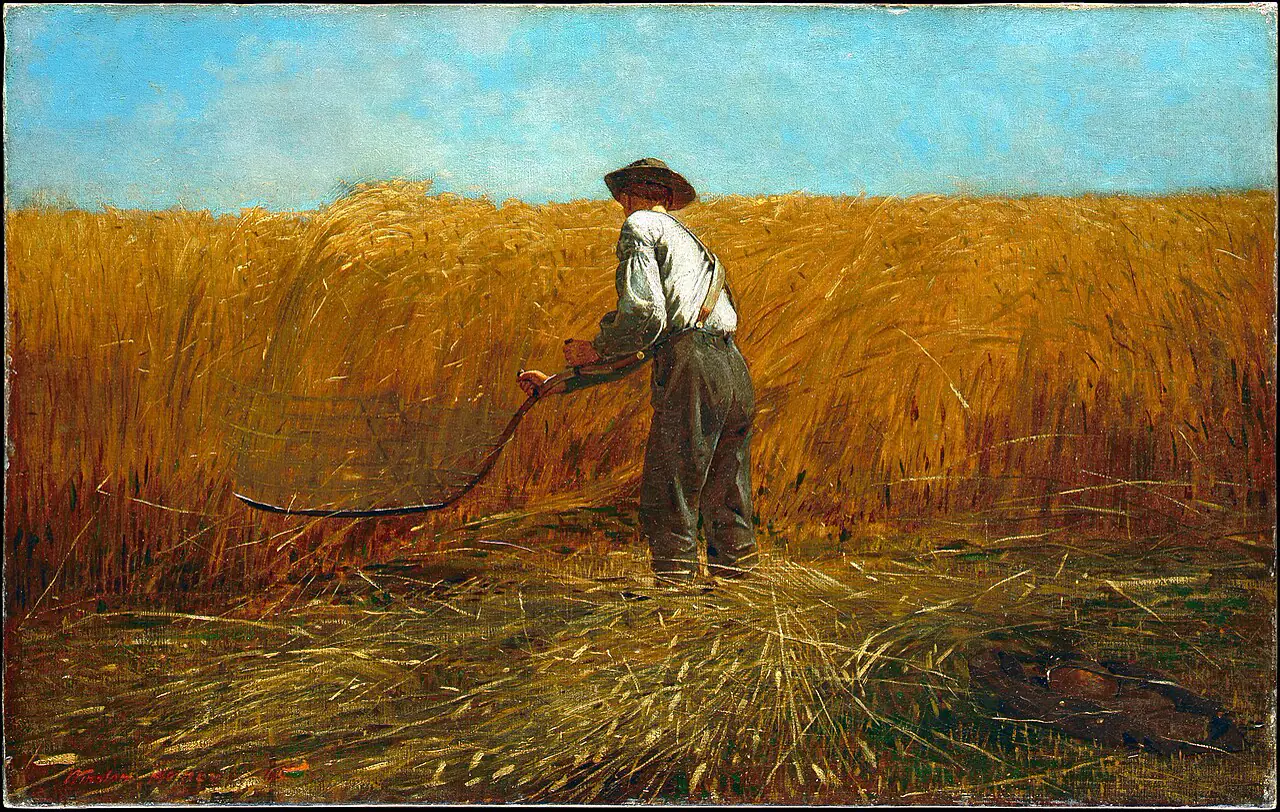
Winslow HomerThe Veteran in a New Field, 1865Oil on canvas · Metropolitan Museum of Art, New York
A Union Army jacket and canteen lie discarded in the lower right corner, showing that Homer’s reaper has come home from the Civil War. He now cuts wheat with a scythe that also recalls the Grim Reaper. The picture was painted in 1865, the year of Whitman’s Drum-Taps, and belongs beside The Wound-Dresser, since both concern the work left to the living after battle.
Walt Whitman
The Wound-Dresser — excerpt
1865; later revised
EnglishBearing the bandages, water and sponge,
Straight and swift to my wounded I go,
Where they lie on the ground after the battle brought in,
Where their priceless blood reddens the grass, the ground,
Or to the rows of the hospital tent, or under the roof’d hospital,
To the long rows of cots up and down each side I return,
To each and all one after another I draw near, not one do I miss,
An attendant follows holding a tray, he carries a refuse pail,
Soon to be fill’d with clotted rags and blood, emptied, and fill’d again.
Adams begins well inside Whitman’s poem. He cut the old man’s invitation to remember the war, and the setting opens with a sponge in his hand. Whitman had visited the soldiers’ hospitals, written letters for the wounded and comforted them. In the poem the refuse pail fills, is emptied and fills again.
John Donne
Batter my heart, three-person’d God
Published 1633
EnglishBatter my heart, three-person’d God, for you
As yet but knock, breathe, shine, and seek to mend;
That I may rise and stand, o’erthrow me, and bend
Your force to break, blow, burn, and make me new.
I, like an usurp’d town to another due,
Labor to admit you, but oh, to no end;
Reason, your viceroy in me, me should defend,
But is captiv’d, and proves weak or untrue.
Yet dearly I love you, and would be lov’d fain,
But am betroth’d unto your enemy;
Divorce me, untie or break that knot again,
Take me to you, imprison me, for I,
Except you enthrall me, never shall be free,
Nor ever chaste, except you ravish me.
At the end of Act I of Doctor Atomic, Oppenheimer is alone at the test site and sings Donne’s Holy Sonnet XIV, a seventeenth-century prayer in which the speaker asks to be broken and made new. The text was chosen by Sellars. Elsewhere in the opera Adams set words taken from military documents.
Recommended recordings
The Wound-Dresser · Fearful SymmetriesSanford Sylvan; Orchestra of St. Luke’s, John AdamsNonesuch · 1988–89Sylvan’s baritone is light and forward, and the Whitman setting is sung at close quarters; Naoko Tanaka’s violin and Chris Gekker’s trumpet alternate with the voice. Fearful Symmetries is on the same disc.
Shaker Loops · Short Ride in a Fast Machine · The Wound-DresserNathan Gunn; Bournemouth Symphony Orchestra, Marin AlsopNaxos · 2004A good first disc of Adams. Alsop has the strings play with a sharp, energetic attack. Gunn sings Whitman with a fuller, warmer voice than Sylvan. Adams’s arrangement of Busoni’s Berceuse élégiaque is a well-chosen companion to the hospital scenes.
Passed toPostminimalist orchestral writingAmerican historical operaContemporary English-language music theatre
Kirchner brought a direct connection to Schoenberg into Adams’s lessons at Harvard. From Reich, Riley and Glass Adams learned what repeated notes could do, and he also absorbed the sound of Ellington’s brass. He named Mahler, Sibelius, Debussy and the young Schoenberg as presences in Harmonielehre, and he made the second climax of its slow movement an explicit salute to Mahler’s Tenth.