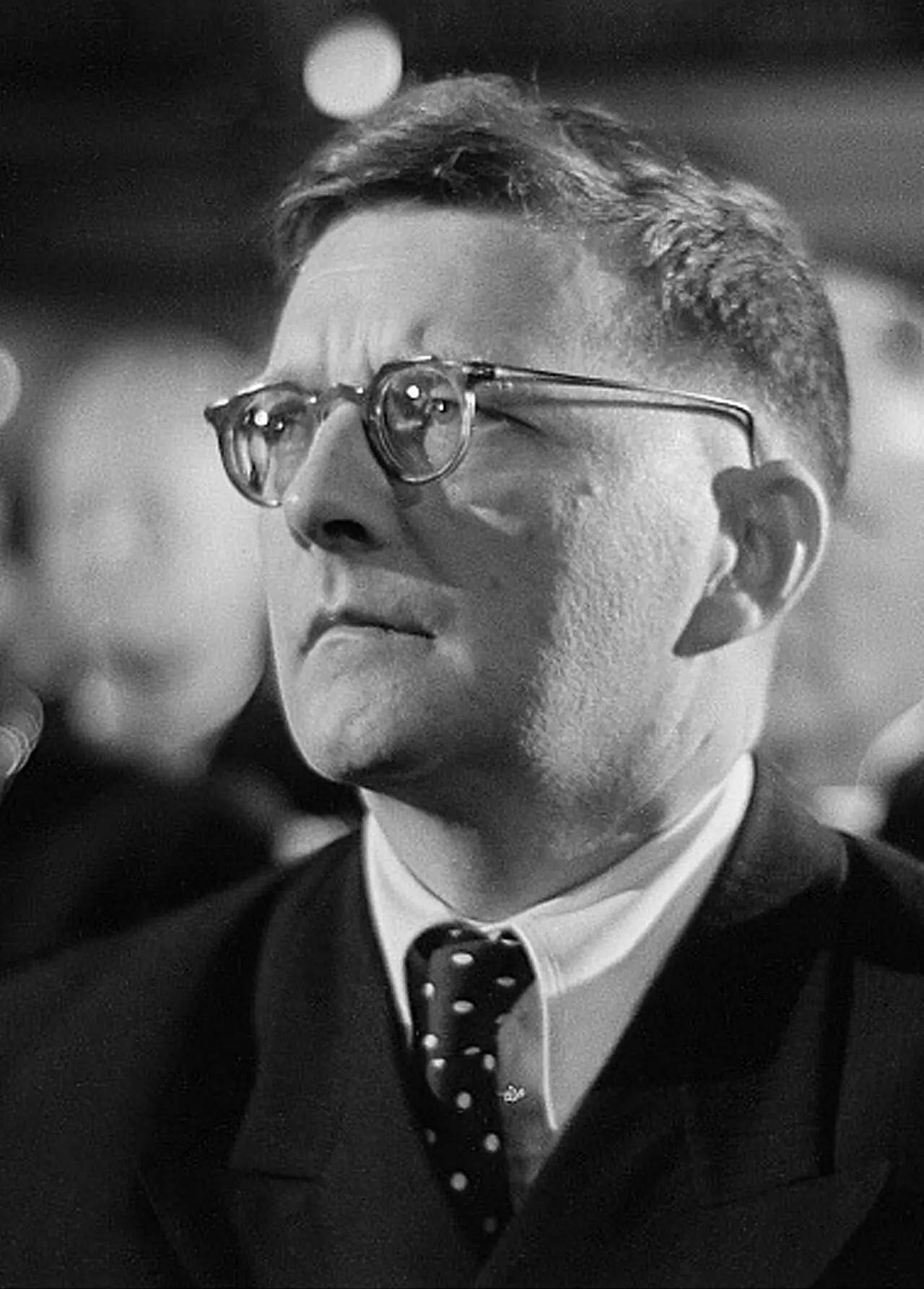
Shostakovich among the audience at Leipzig’s Bach celebrations, 28 July 1950. Roger and Renate Rössing, Deutsche Fotothek; image adjusted by Improvist, CC BY-SA 3.0 de.
Petrograd Conservatory, 1919–25; Nikolayev for piano, Steinberg for composition
Teaching
Leningrad from 1937; Moscow from 1943; both posts lost in 1948
Signature
D–E♭–C–B♮: DSCH in German note names
Output
Fifteen symphonies and fifteen quartets; operas, concertos and cinema scores
Life
For five weeks the cinema had been showing the same film, and Shostakovich had been playing the same accompaniment. “I’ve even started dreaming about this music,” he wrote from Leningrad to Boleslav Yavorsky on 18 October 1925. He was nineteen. His First Symphony was finished, but it was a graduation score and did not pay the household bills. His father had died three years earlier, and accompanying silent films helped to support the family.
He was born in St Petersburg in 1906 and learnt the piano from his mother, Sofiya. At the Petrograd Conservatory, which he entered in 1919, Leonid Nikolayev taught him piano and Maximilian Steinberg composition. Alexander Glazunov, the director, recognised his gifts and helped him through his student years. He graduated as a pianist in 1923 and as a composer in 1925.
Shostakovich told Yavorsky that he had let the conductor Nikolai Malko walk past him before he recovered his nerve and asked to show him the score of the symphony. Malko conducted its première on 12 May 1926, and the audience demanded that the scherzo be played again. International performances followed. In 1927 Shostakovich also entered the Warsaw Chopin Competition, where he received an honourable mention.
The twentiesTheatre, film and early operas
He worked for Vsevolod Meyerhold’s theatre and wrote music for the film-makers Grigori Kozintsev and Leonid Trauberg. In his score for their The New Babylon (1929), set during the Paris Commune, he set La Marseillaise against the can-can. In The Nose, completed in 1928 and staged in 1930, the nose that leaves its owner in Gogol’s story is sung by a tenor and holds a higher rank than its owner, a baritone. One interlude is scored without pitched instruments. His Second and Third symphonies brought revolutionary choruses into the concert hall.
The heroine of Lady Macbeth of the Mtsensk District is given longer phrases. Katerina, the merchant’s wife in Leskov’s story, has warmer vocal writing than most of the men around her. Shostakovich finished the opera in 1932 and dedicated it to Nina Varzar, the physicist he had married that May. Its Leningrad première in January 1934 led to productions abroad. Their daughter Galina was born in 1936, their son Maxim in 1938.
1936–37“Muddle Instead of Music” and the Fifth Symphony
Stalin attended Lady Macbeth at the Bolshoi on 26 January 1936. Two days later Pravda published its unsigned attack, “Muddle Instead of Music”. Another editorial condemned the ballet The Limpid Stream. The opera was withdrawn from Soviet stages. Shostakovich withdrew his large-scale Fourth Symphony during rehearsals that December, under pressure from the Philharmonic’s management. In 1937 his friend and patron Marshal Tukhachevsky was executed. The Fourth was not performed until 1961, when Kirill Kondrashin conducted it without a wholesale revision.
The Fifth Symphony reached the public first. At its Leningrad première on 21 November 1937, Yevgeny Mravinsky held up the score to the applauding hall. Steinberg recorded the ovation in his diary. In the Largo the brass are silent and the strings are divided into eight parts. The finale moves towards D major, with the strings repeating the note A many times beneath the brass.
1938–45Leningrad and the Seventh Symphony
He was now teaching at the Leningrad Conservatory. The First Quartet followed in 1938; in 1940 the Beethoven Quartet asked for a quintet they could play with him. He took the piano part at its November première. The work won a Stalin Prize the following year, and the Beethoven players became his closest quartet collaborators.
In 1941 he undertook civil-defence duties in Leningrad, including fire-watching on the conservatory roof, while composing the Seventh Symphony. He finished three movements before he was evacuated with Nina and the children on 1 October. He completed the finale in Kuibyshev that December, and Samuil Samosud conducted the première there in March 1942. On 9 August Karl Eliasberg conducted it inside besieged Leningrad, with military musicians reinforcing the depleted radio orchestra. Loudspeakers relayed the performance through the city. Shostakovich was hundreds of miles away at the time.
The Eighth Symphony followed in 1943. The smaller Ninth appeared in 1945, with a piccolo playing above a two-note trombone fanfare. He also wrote works in memory of particular friends who had died. The Second Piano Trio of 1944 commemorated Ivan Sollertinsky. It opens with the cello alone, playing harmonics so high that the violin enters below it. That year he finished orchestrating Rothschild’s Violin, the opera left by his pupil Veniamin Fleischmann, who had been killed defending Leningrad.
1948–53The 1948 anti-formalist campaign
The Party’s anti-formalist campaign of 1948 caught Shostakovich alongside Prokofiev and Khachaturian. He delivered a public self-criticism and lost both conservatory posts, in Leningrad and in Moscow, where he had taught since 1943. Film commissions brought in money. The First Violin Concerto and From Jewish Folk Poetry, completed that year, were not performed in public until 1955. Isaak Glikman remembered Shostakovich coming home from the “shameful, vile discussions at the Congress” to work on the concerto’s third movement, a passacaglia in F minor. “I finished it, and I think it came out pretty well,” the composer said. David Oistrakh, the dedicatee, played the première under Mravinsky in Leningrad on 29 October 1955. The early songs of the cycle are about bereaved parents and hungry households; the final three celebrate Soviet prosperity.
He and Mieczysław Weinberg played their symphonies together at the piano, four hands. Another pianist prompted a new work. At the Leipzig Bach Competition in 1950, Shostakovich sat on the jury and heard Tatiana Nikolayeva, who could play the whole of the Well-Tempered Clavier. His Twenty-four Preludes and Fugues followed in 1950–51. Each major key is paired with its relative minor, and the keys move round the circle of fifths. The fugues range from two voices (No. 9) to five (No. 13), and No. 4 and the last, in D minor, are double fugues.
The Tenth Symphony was first performed in December 1953, nine months after Stalin’s death. A long opening movement is followed by a short, fast scherzo. In the later movements a four-note motif spelling the composer’s initials recurs several times.
1960–62The Eighth Quartet and DSCH
At Gohrisch near Dresden in July 1960 he wrote the Eighth Quartet, which combines DSCH with quotations from his earlier music. The published dedication is to the victims of fascism and war. In a letter to Isaak Glikman, written at Zhukovka on 19 July, he gave another dedication: “I was thinking that if I ever die, hardly anyone will write a work in my memory. So I decided to write one myself.” He listed the borrowed passages, including the Second Piano Trio and Lady Macbeth, and wrote that he had cried while trying to play the quartet.
He joined the Communist Party that year, a step that Glikman recalled had caused him deep distress. In 1962 he set Yevgeny Yevtushenko’s Babi Yar in the Thirteenth Symphony, in which a bass soloist and a choir of basses sing of murdered Jews and of Russian antisemitism.
The last yearsThe last symphonies and quartets
His hands were failing, and illness kept him at home more and more. Irina, whom he married in 1962, recorded rehearsals so that he could listen to them at home. He began the Fourteenth Symphony in hospital in 1969. Dedicated to Britten, it sets eleven poems about death by Lorca, Apollinaire, Küchelbecker and Rilke for two singers, strings and percussion. The Fifteenth, completed in 1971, quotes Rossini’s William Tell in its first movement and Wagner in its finale. At the end, small percussion instruments play over a sustained chord.
The Fifteenth Quartet of 1974 is in six linked Adagios. His last completed work, the Viola Sonata, was written for Fyodor Druzhinin in 1975; its finale recalls Beethoven’s “Moonlight” Sonata. Shostakovich died on 9 August, before the première. Druzhinin first played the sonata privately on 25 September, the composer’s birthday, and in public on 1 October. At the public performance he answered the ovation by holding the score above his head.
Places
Every recorded place, joined in date order. Shostakovich on the MapAll 18 places, with sources
DSCH rises a semitone from D to E♭, falls a minor third to C, then falls a semitone to B♮. The Tenth Symphony and Eighth Quartet keep those pitches recognisable while changing their rhythm and surroundings. The quartet also quotes music from the Second Piano Trio and Lady Macbeth.
♭Use of the major key
At the end of the Fifth Symphony the key has moved from D minor to D major, and the strings repeat the note A beneath the brass for page after page.
𝅘𝅥Continuous melody
In the first movement of the Seventh Symphony a military drum pattern runs under the march. A short tune returns again and again while the orchestration around it grows. With each repetition the outline of the melody stays the same, but it gains weight and volume until it fills the texture.
𝄞Single solo instrument
In the Ninth’s Largo, trombones and tuba play a loud, heavy phrase, and a solo bassoon answers. After that mass of brass, the bassoonist plays a single, exposed line. Shostakovich makes similarly sharp changes of scale inside his larger scores. At the end of the Fifteenth, small percussion instruments go on playing around the orchestra’s held chord.
𝄢Fugue and passacaglia
The Twenty-four Preludes and Fugues range from two voices to five, ending with two fugue subjects brought together in D minor. Each fugue builds its texture one entry at a time around a single line. The passacaglia of the First Violin Concerto is built on a returning bass theme. Towards its end the accompaniment stops, and the violin plays a long cadenza alone before the finale.
𝄾Speech and song
Gogol’s officials in The Nose inspect rank and clothing even when confronted with an escaped body part. Their sung exchanges keep the fussiness of conversation. Katerina in Lady Macbeth is given longer, warmer phrases. In the Thirteenth Symphony, a bass soloist sings beside a choir of basses, and individual words are sung by many men together.
Works
A selection from the composer’s works.
1924–25
Symphony No. 1 in F minorOp. 10Orchestra with piano
The graduation symphony opens with muted trumpet and bassoon; the strings enter later. In the scherzo the piano breaks in with sharp interjections.
1927–28
The NoseOp. 15Opera in three acts; soloists, chorus and chamber orchestra
A civil servant loses his nose and finds that it now holds a higher rank than he does. Gogol’s officials sing their parts straight through the absurd events, and one interlude is scored for percussion alone.
1930–32
Lady Macbeth of the Mtsensk DistrictOp. 29Opera in four acts; soloists, chorus and orchestra
Katerina is given warm vocal writing, set against the brutality around her. After its suppression in 1936 the opera survived in a revised form, Katerina Izmailova, first staged in 1963.
1935–36
Symphony No. 4 in C minorOp. 43Large orchestra
A large orchestra plays a string fugato and changes character at speed. The finale ends on a sustained C minor chord with isolated notes on the celesta in place of a grand ending.
Symphony No. 7 in C major “Leningrad”Op. 60Large orchestra with expanded brass and percussion
The march in the first movement starts from a simple tune and builds to the full orchestra playing at full force. The Adagio has chorales for the wind and long lines for the strings.
1943–44
Piano Trio No. 2 in E minorOp. 67Violin, cello and piano
The trio was written in memory of Sollertinsky. The cello opens in harmonics, and the violin enters below it. A slow sequence of repeated piano chords leads into a dance with Jewish inflections, which grows more violent as it goes on.
1948
From Jewish Folk PoetryOp. 79Soprano, contralto, tenor and piano; orchestral version Op. 79a
The cycle sets eleven songs whose subjects include a dead child, a lullaby, poverty and promised prosperity. It is written for three singers. The version with piano was first performed in public in January 1955.
1950–51
Twenty-four Preludes and FuguesOp. 87Solo piano
Nikolayeva’s Bach playing in Leipzig helped set this cycle in motion. The final fugue, in D minor, combines two subjects.
1953
Symphony No. 10 in E minorOp. 93Orchestra
The opening Moderato is long, and the short scherzo follows it. DSCH becomes prominent in the later movements and returns near the end.
1960
String Quartet No. 8 in C minorOp. 110Two violins, viola and cello
The DSCH motif holds together five connected movements that quote music from his own past. In a letter to Glikman he called the work a memorial to himself.
1969
Symphony No. 14Op. 135Soprano, bass, string orchestra and percussion
Two singers perform eleven poems about death, accompanied without wind or brass. The small ensemble leaves the percussion unusually exposed.
In the score
Short examples, engraved and playable.
DSCH · schematicDSCH in short and long notes: schematic
A schematic using the DSCH pitches, D–E♭–C–B♮. The first and last bars give each note a crotchet; the middle two bars set the same sequence in minims. Two semitone steps, D–E♭ and C–B, sit either side of a falling minor third.
Ostinato · schematicSame bass, altered upper line (schematic)
In this schematic, the bassoon repeats the same notes and rhythm while both instruments get louder. In bar 3 the clarinet plays B♭ and E♭ above the repeated low C.
Passacaglia · schematicBass phrase, two turns — schematic
A schematic passacaglia. The cello’s two-bar phrase, D–F–A–B♭–A–D, repeats exactly. Above its second appearance, the violin moves into shorter notes and reaches C♯ at the end.
Sister arts
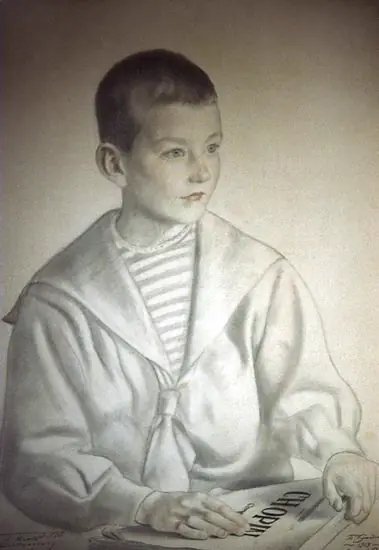
Boris KustodievPortrait of Mitya Shostakovich, 1919Sanguine and charcoal pencil · Shostakovich Memorial Apartment, Moscow
Kustodiev addressed this 1919 drawing “To my little friend Mitya Shostakovich, from the artist”. Mitya entered the Petrograd Conservatory that year, several years before the First Symphony. Kustodiev drew him again at Gaspra in 1923. Both drawings are now in the Moscow memorial apartment.
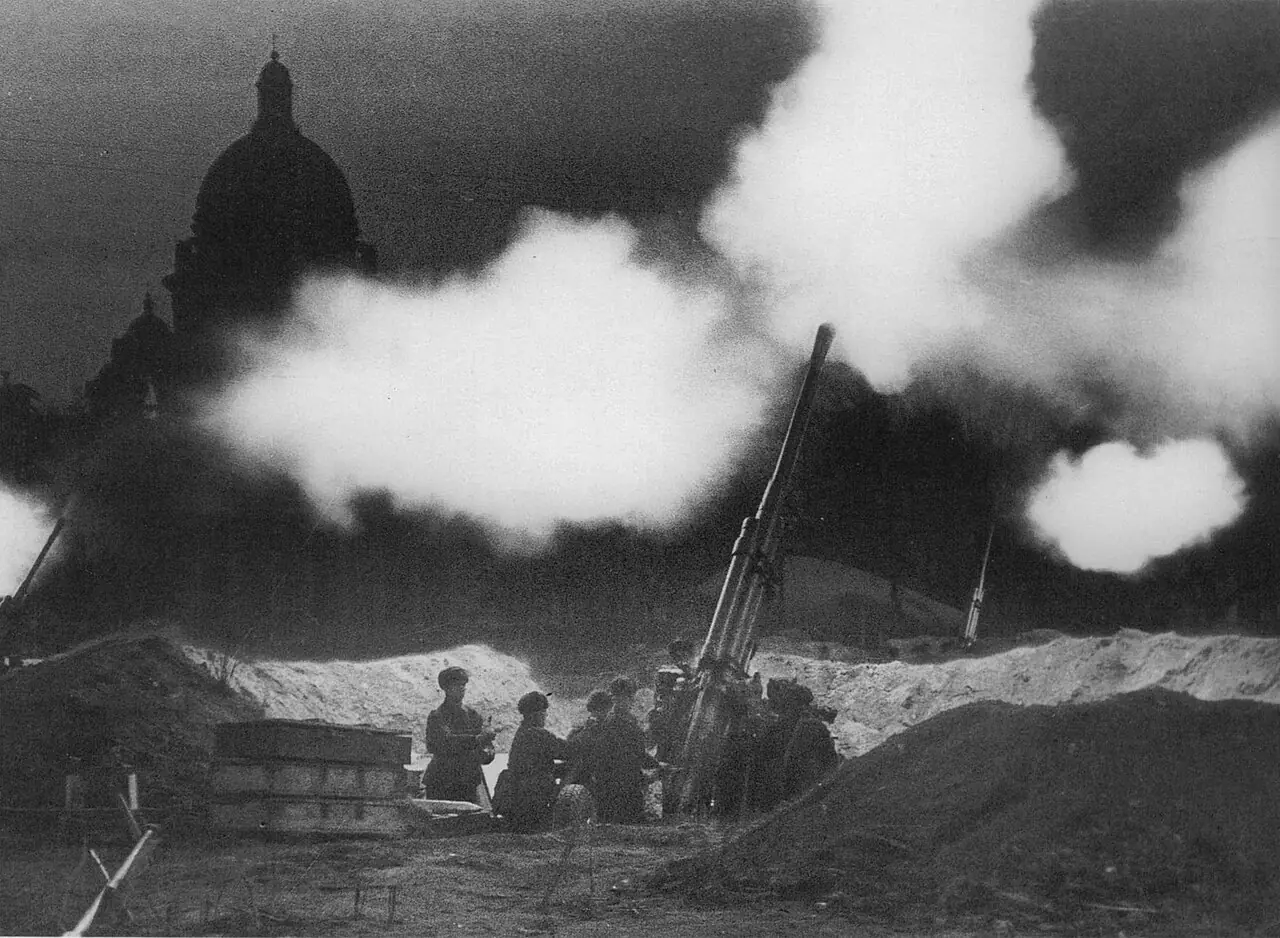
Boris KudoyarovAnti-aircraft guns near St Isaac’s Cathedral, Leningrad, 24 November 1941Black-and-white photograph · Wikimedia Commons; public-domain archival photograph
Kudoyarov photographed the guns firing during a night raid beside St Isaac’s Cathedral on 24 November 1941. Shostakovich had left Leningrad the previous month; he was finishing the Seventh Symphony in Kuibyshev. Earlier that summer he had watched for fires on the conservatory roof. He dedicated the finished score to Leningrad, where Eliasberg and his assembled players performed it the following August, still under siege.
Nikolai Gogol
The Nose — Kovalyov meets his nose
1836
RussianВы ошибаетесь, милостивый государь. Я сам по себе.
Притом между нами не может быть никаких тесных отношений.
Судя по пуговицам вашего виц-мундира, вы должны служить в сенате или, по крайней мере, по юстиции.
Я же по ученой части.
Our translationYou are mistaken, my dear sir. I am independent.
Besides, there can be no close connection between us.
To judge by the buttons on your undress uniform, you must serve in the Senate, or at least in the justice department.
I, however, serve in education.
Kovalyov finds his nose praying in the Kazan Cathedral, dressed as an official of higher rank. The nose looks at his buttons and tells him that there can be no connection between them, since they work in different departments. Shostakovich gave the owner a baritone voice and the escaped nose a tenor.
Recommended recordings
Symphony No. 4Moscow Philharmonic Orchestra, Kirill KondrashinMelodiya; reissued by Le Chant du Monde · 1962A first choice for this very large score, played by the orchestra and conductor who had given its first public performance the previous year. Kondrashin plays the large climaxes at full force.
Symphony No. 5New York Philharmonic, Leonard BernsteinColumbia; reissued by Sony Classical · 1959Bernstein takes the finale at a fast tempo. Shostakovich himself admired his unusually fast ending. Other recordings take the last pages slowly.
Symphony No. 7 “Leningrad”Chicago Symphony Orchestra, Leonard BernsteinDeutsche Grammophon · 1988The Chicago brass give the march great weight. The string recitatives are played vehemently, and the wind solos have strong character. The recording serves both the symphony’s long lament and its loudest passages.
String Quartet No. 8Fitzwilliam QuartetL’Oiseau-Lyre / Decca · 1975The Fitzwilliam play with intensity and a singing line, and keep warmth in the tone. They were friends of Shostakovich and gave the British premières of his last three quartets; theirs was an early complete cycle.
Twenty-four Preludes and FuguesAlexander Melnikov, pianoHarmonia Mundi · 2008–09Melnikov plays the quick A minor Prelude with a harpsichord-like bite, and his Fugue No. 15 is wild. The cycle also contains solemn pages.
From Bach he took the paired prelude and fugue, and Mahler’s example showed him how much a symphony could hold. He heard Berg’s Wozzeck in Leningrad in 1927. He later linked his Fourteenth Symphony with Mussorgsky’s Songs and Dances of Death, which he had orchestrated. Weinberg influenced him as well as learning from him, and the two played their symphonies together at the piano. Tishchenko studied with him, and Britten was the dedicatee of the Fourteenth. His last sonata quotes music from Beethoven’s “Moonlight” Sonata.