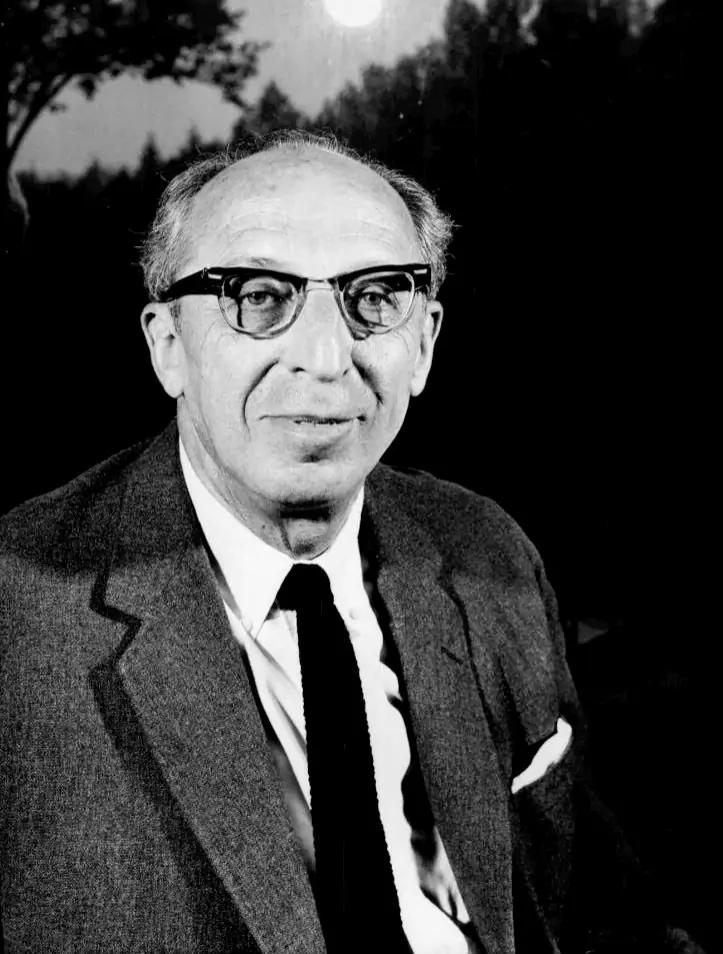
Rubin Goldmark in New York; Nadia Boulanger in Fontainebleau and Paris, 1921–24
At work
Composer, pianist, conductor and writer; taught at Tanglewood, 1940–65
Collaborators
Carlos Chávez · Martha Graham · Agnes de Mille · Leonard Bernstein
Output
Ballets, symphonies, concertos, piano music, songs, opera and film scores
Life
The Copland family lived above and beside their department store on Washington Avenue in Brooklyn. Aaron, born on 14 November 1900, was the youngest of Sarah and Harris Copland’s five children. His parents were Russian-born Jewish immigrants, and everyone in the family helped in the shop. His sister Laurine gave him his first piano lessons. When he wanted professional lessons, his parents let him find a teacher and agreed to pay. By 1917 he was crossing the Brooklyn Bridge to study harmony and counterpoint with Rubin Goldmark.
1921–25Nadia Boulanger and Koussevitzky
At Fontainebleau in 1921 a friend persuaded him to sit in on Nadia Boulanger’s harmony class. She became his composition teacher, and the year he had planned to spend abroad stretched to three. In Paris he encountered Stravinsky’s music and heard the latest concert works. Boulanger took him to meet Serge Koussevitzky, who was about to take over the Boston Symphony Orchestra. After the visit Koussevitzky commissioned a symphony with Boulanger herself as organ soloist.
Copland returned to New York in 1924 with that commission and no salaried post. Walter Damrosch and the New York Symphony gave the Symphony for Organ and Orchestra its first performance in 1925; Koussevitzky conducted it in Boston. Later that year came Music for the Theatre, five movements for piano, percussion and a small orchestra, commissioned by the League of Composers. Its Dance and Burlesque use jazz rhythms. The work was not written for a play.
1928–36Piano Variations and El Salón México
With Roger Sessions, Copland organised concerts of new music in New York from 1928 to 1932. He was also writing difficult piano music. The Piano Variations of 1930 open with a short theme spread across two octaves, with hard chords between its notes. Twenty variations and a coda are built from the same four-note cell. The young Leonard Bernstein learnt the piece before he met Copland in 1937.
In 1932 Carlos Chávez invited Copland to Mexico and took him to the dance hall El Salón México. Its name became the title of an orchestral piece, completed in 1936, built around Mexican melodies. Chávez also conducted the first performance of the fifteen-minute Short Symphony in Mexico City in 1934. Copland dedicated El Salón México to the photographer Victor Kraft.
At the New School he lectured about music, and those classes led to What to Listen for in Music in 1939. In the same year he scored the documentary The City and the feature film Of Mice and Men. In 1940 Koussevitzky brought him to the new Berkshire Music Center at Tanglewood, where he taught young composers each summer until 1965. During those years his own music was heard in cinemas and ballet theatres.
1938–44Billy the Kid, Rodeo and Appalachian Spring
In 1938 Lincoln Kirstein and the choreographer Eugene Loring invited Copland to write Billy the Kid. He used cowboy songs in the score, among them Git Along Little Dogies and Goodbye Old Paint, and opened and closed the ballet with slow music representing the open prairie. The first Chicago performance used two pianos. Four years later Agnes de Mille asked him to write Rodeo, which the Ballet Russe de Monte Carlo presented in New York on 16 October 1942.
De Mille’s Rodeo ends with Hoe-Down, its fiddle tune enlarged for the orchestra. That year Copland also assembled Lincoln’s words for a narrator in Lincoln Portrait and wrote Fanfare for the Common Man for Eugene Goossens in Cincinnati. When Goossens proposed a première at income-tax time, Copland replied that he was “all for honoring the common man at income tax time.” Bass drum, tam-tam and timpani open the fanfare, and the trumpets enter after them.
Martha Graham’s commission was on a more intimate scale. Her scripts for Appalachian Spring described a pioneer wedding, a house and a community facing the future. Copland worked to her timings. By June 1944 he had a piano score; before leaving for Mexico, he and Leo Smit recorded it for Graham to rehearse with in Vermont. The finished ensemble numbered thirteen: flute, clarinet, bassoon, piano and nine strings.
Graham danced the Bride at the Library of Congress on 30 October 1944, with Merce Cunningham as the Revivalist. In the ballet the Shaker song Simple Gifts is the subject of a set of variations. Copland had found it in Edward Deming Andrews’s collection The Gift to Be Simple. The ballet won the Pulitzer Prize in 1945, and the New York Philharmonic played his shortened suite for full orchestra that October.
1946–54Third Symphony, Dickinson songs, The Tender Land
The Third Symphony, first played in Boston under Koussevitzky in 1946, uses the Fanfare in its finale. Copland then wrote a concerto for Benny Goodman, made up of a slow clarinet song, an unaccompanied cadenza and a quick second movement that ends in a jazz smear. Twelve Poems of Emily Dickinson (1949–50) is scored for voice and piano. The first song opens with trills and the fluttering of birds, and the second sets a wind like a bugle.
In Washington in 1953, Copland’s support for left-wing causes brought him before a Senate investigation associated with Joseph McCarthy, and engagements were cancelled. He was then still working on The Tender Land, which New York City Opera staged in 1954. The first act ends with The Promise of Living, an ensemble in which the voices join in a song about harvest and shared labour. The song quotes the revivalist tune Zion’s Walls.
1960–90At Rock Hill
In 1960 he bought Rock Hill in the town of Cortlandt, north of New York. Two years later Bernstein conducted Connotations at the opening of Philharmonic Hall in Lincoln Center. The score uses Copland’s own approach to twelve-note composition, with a large percussion section and a piano solo. Inscape followed in 1967; its material is drawn from two twelve-note series.
Copland conducted his own scores more and more often. He recorded his orchestral music and conducted works by other American composers. At home, Vivian Perlis began interviewing him in 1975–76, and their conversations became two volumes of memoirs, published in 1984 and 1989. He lived at Rock Hill for thirty years. Copland died at Phelps Memorial Hospital in North Tarrytown on 2 December 1990, shortly after his ninetieth birthday. His ashes were scattered at Tanglewood.
Places
Every recorded place, joined in date order. Copland on the MapAll 14 places, with sources
Brooklyn, New York · 14 November 1900 · born
Born to Sarah and Harris Copland; the family lived above and beside its Washington Avenue department store. The coordinates mark Brooklyn; the house itself has not been independently geolocated.
Crossed from Brooklyn for lessons in harmony and counterpoint with Rubin Goldmark. The point marks New York in general and does not show where Goldmark taught.
Returned from France in 1924. Kept his New York apartment and loft studio until moving to Sneden’s Landing in 1947; travel and summer residencies interrupted this base.
Library of Congress, Washington, DC · 30 October 1944 · premiere
Martha Graham danced the première of Appalachian Spring in the Coolidge Auditorium; Louis Horst conducted thirteen instrumentalists. Appalachian Spring.
Octaves and open fifths leave space between the notes. In the rural dances of The Tender Land, this spacing lets a piano or orchestra imitate the open strings of a fiddle. A chord built this way has a firm root but leaves out the third, which would make it major or minor.
𝄾Rhythm
In Music for the Theatre the syncopation, with accents placed between the expected beats, comes from jazz. In the Piano Variations, notes from the short theme are displaced and reversed, so that the same pitches unsettle the pulse in a new way.
𝄞Borrowed tunes
Hoe-Down uses the version of a tune played by a Kentucky fiddler, William Hamilton Stepp; Appalachian Spring uses a Shaker song from a printed collection. Copland kept the melodies and changed their setting, including the instrumentation, register, dynamics and accompaniment.
𝄢Orchestration
The Fanfare is scored for brass and three kinds of percussion, without strings. The original Appalachian Spring has thirteen players: nine strings with one flute, one clarinet, one bassoon and a piano, so each wind instrument can be heard on its own.
♩Voice
The Dickinson songs ask the singer for leaps of the kind usually written for an instrument. Why do they shut me out of Heaven? covers a wide range; in Nature, the gentlest mother, piano trills imitate birds before the voice enters. These songs use no borrowed folk tunes.
♯Twelve notes
Inscape draws on two twelve-note series; Connotations applies serial technique to a large orchestra that includes metal sheet, conga drum and piano. Copland’s late concert music keeps the sharply separated sounds of his earlier piano writing.
Works
A selection from the composer’s works.
1925
Music for the TheatreChamber orchestra
Five movements, from Prologue to Epilogue, with a Dance and Burlesque in between. The work uses jazz rhythms and a small orchestra. The title names a theatre; there is no play.
1930
Piano VariationsPiano
A four-note cell generates twenty variations and a coda. Hard chords spread across two octaves interrupt the opening theme.
1932–33
Short Symphony (Symphony No. 2)Orchestra
A fifteen-minute symphony, dedicated to Carlos Chávez, who conducted its first performance in Mexico City in 1934.
1932–36
El Salón MéxicoOrchestra
Named after the Mexico City dance hall that Chávez showed him. The piece uses Mexican melodies and is dedicated to Victor Kraft.
1938
Billy the KidBallet; orchestra
Eugene Loring’s outlaw story for Ballet Caravan, framed by prairie music and using cowboy tunes. First performed in Chicago with two pianos.
1942
RodeoBallet; orchestra
Agnes de Mille’s ballet includes Corral Nocturne, Saturday Night Waltz and Hoe-Down. Four Dance Episodes make up the concert suite.
Appalachian SpringBallet for thirteen instruments; orchestral suite, 1945
Martha Graham’s pioneer wedding, with variations on Simple Gifts. The complete ballet and the shorter concert suite differ in sequence and proportions.
1944–46
Symphony No. 3Orchestra
Four movements, written for Koussevitzky and the Boston Symphony. The finale brings back Fanfare for the Common Man, scored for full orchestra.
1947–48
Clarinet ConcertoClarinet, strings, harp and piano
Commissioned by Benny Goodman. A slow opening movement leads through a cadenza into a quick finale, which ends with a glissando.
1949–50
Twelve Poems of Emily DickinsonVoice and piano
The subjects of the songs include birdsong, a bugle-like wind and a funeral inside the head. Each song is dedicated to a composer friend. Alice Howland and Copland gave the première in 1950.
1952–54; revised 1955
The Tender LandOpera in three acts
A rural American opera to a libretto by Horace Everett, the pen name of Erik Johns. The Promise of Living closes its first act.
1962
ConnotationsOrchestra
Written for the opening of Philharmonic Hall at Lincoln Center. Twelve-note writing for a large orchestra, with a piano solo and an extensive percussion section.
In the score
Short examples, engraved and playable.
Open fifths — invented schematicChord with an open middle
An invented four-bar schematic. Each bass note supports a fifth and an octave, with no third. The gaps show the open spacing associated with Copland’s pastoral writing. These notes quote no Copland work.
Syncopation — invented schematicThree plus three plus two
Eight quavers are accented in groups of 3 + 3 + 2 while the bass keeps four crotchet beats. The second accent falls between the bass beats. This invented exercise isolates one way jazz-derived syncopation can work. It is not a passage from a Copland score.
Sister arts
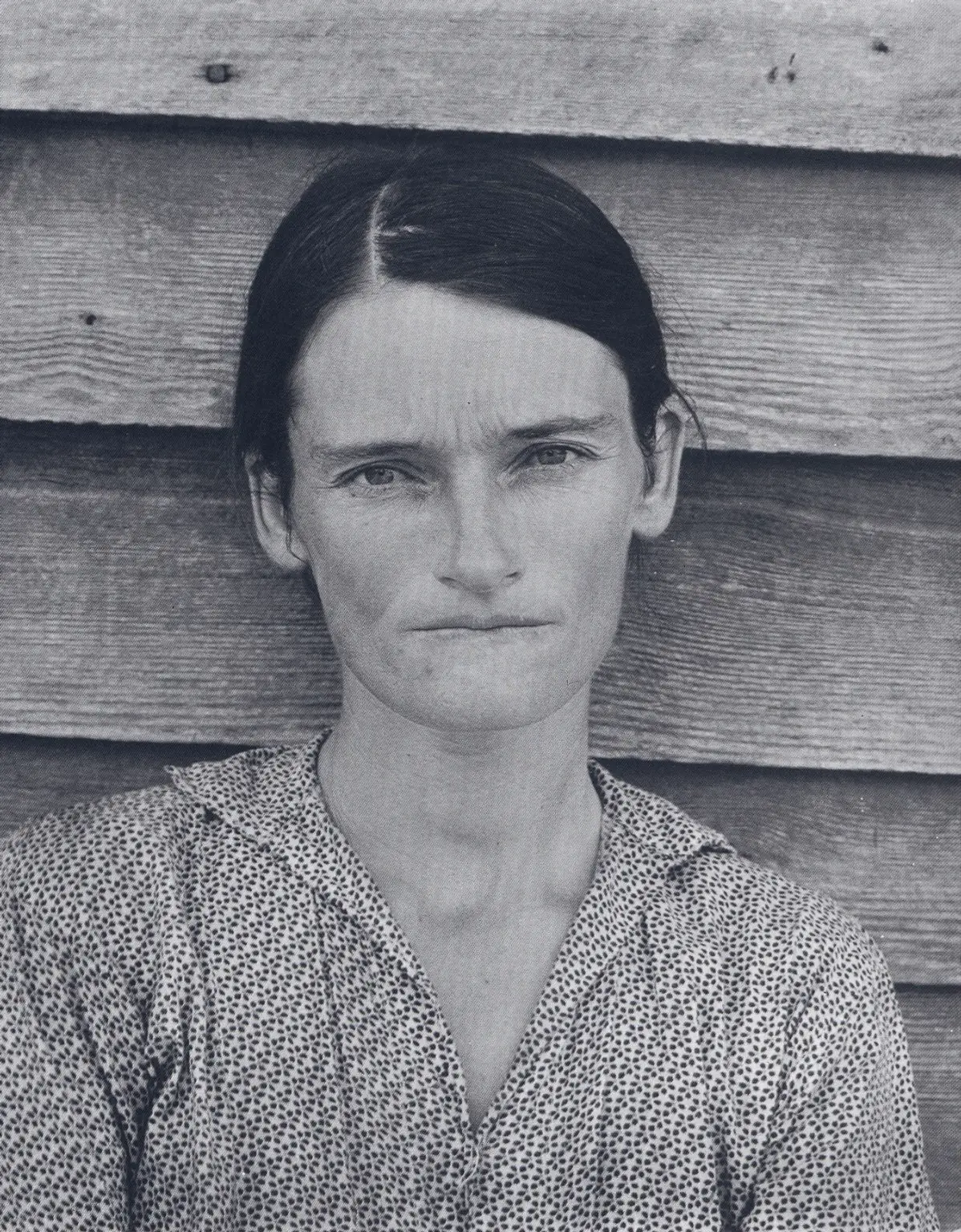
Walker EvansAllie Mae Burroughs, wife of a cotton sharecropper, 1936Photograph · Library of Congress, Washington, DC
Evans photographed Burroughs in Hale County, Alabama. The photographs in his and James Agee’s Let Us Now Praise Famous Men supplied the world from which Erik Johns developed The Tender Land. Copland’s opera moves the setting to a Midwestern farm, and it has a harvest celebration.
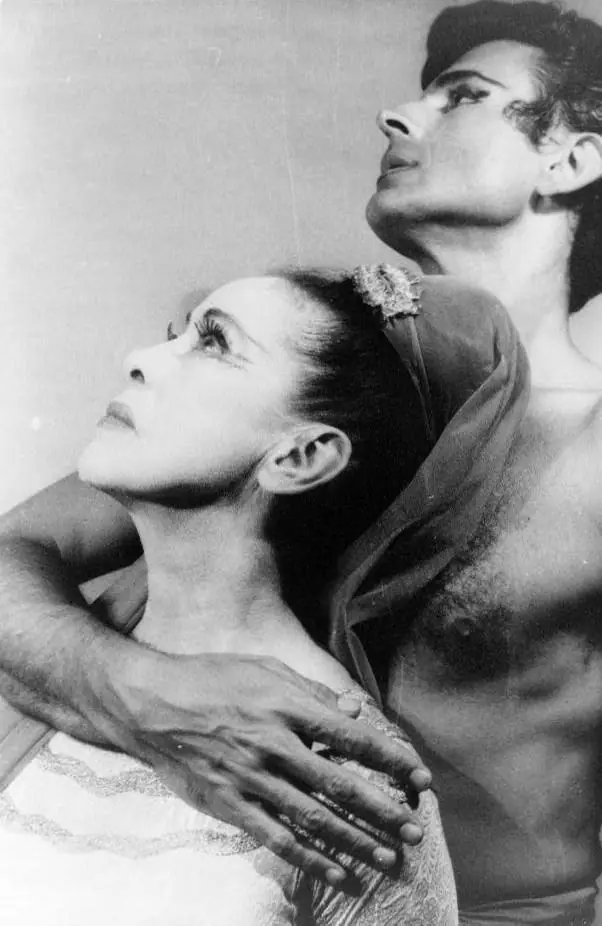
Carl Van VechtenMartha Graham and Bertram Ross, 27 June 1961Photograph · Library of Congress, Washington, DC
Ross’s arm crosses Graham’s shoulders, and both faces are turned upwards. For Appalachian Spring, Graham sent Copland scripts and timings, then changed her choreography in response to his score. This portrait is later.
Emily Dickinson
Mother Nature — opening
Published 1891
EnglishNature, the gentlest mother,
Impatient of no child,
The feeblest or the waywardest,—
Her admonition mild
In forest and the hill
By traveller is heard,
Restraining rampant squirrel
Or too impetuous bird.
The first two stanzas in the public-domain text of Poems: Second Series (1891). Copland opened his Dickinson cycle with this poem, under its first line, Nature, the gentlest mother. The piano plays trills and fluttering figures for the birds in the poem.
Recommended recordings
Appalachian Spring — extended suite for thirteen instrumentsColumbia Chamber Orchestra, Aaron CoplandColumbia / Sony Classical · 1973The composer’s chamber recording is the one to start with for the thirteen-player sound. It includes restored dramatic passages and can be heard alongside the familiar orchestral suite. The original LP’s claim to present the original ballet is misleading.
Appalachian Spring — orchestral suiteLos Angeles Philharmonic, Leonard BernsteinDeutsche Grammophon · 1982Bernstein was a long-standing champion of Copland’s music. It makes a useful second recording after the chamber version, since the suite has cuts and uses a larger ensemble, and both change the scale of Graham’s story.
Piano VariationsStephen HoughHyperion, CDA67005 · 1997For the hard-edged Copland who is overshadowed by the ballets. Hough’s recording of this short, concentrated work is included in his American piano anthology.
Twelve Poems of Emily DickinsonBarbara Bonney, soprano; André Previn, pianoDecca, American SongsA complete Dickinson cycle, within a recital of American songs, alongside the orchestral favourites. Voice and piano are balanced equally.
Where to hear more
Appalachian Spring · Rodeo · Billy the Kid — orchestral suites1939–45
New York Philharmonic; Leonard Bernstein · Sony Classical
Bernstein’s New York Philharmonic collection brings together the orchestral suites from all three ballets, including the four dance episodes from Rodeo. The programme includes music for a frontier-town street and a corral at night, and the Shaker tune ‘Simple Gifts’.
Variations on a Shaker Melody — symphonic-band version1956
United States Army Field Band; Finley R. Hamilton · Altissimo!
The Shaker tune ‘Simple Gifts’ appears here in Copland’s scoring for symphonic band, with saxophones and euphonium among the winds. Hamilton’s Army Field Band recording presents the variations from Appalachian Spring as a self-contained piece.
Boulanger taught him; Chávez brought him to Mexico and conducted the Short Symphony; Stepp’s fiddle playing reached Hoe-Down through transcription. Bernstein was a younger friend and an informal pupil, then a conductor who gave the première of Connotations and recorded the music. His piano arrangements of El Salón México were among his first published works.
Further reading
Aaron Copland and Vivian Perlis, The Complete Copland (Pendragon Press, 2013). memoir and oral history
Copland’s account of his decisions, teachers and collaborators. The two memoir volumes are brought together with Perlis’s commentary and a postlude on his last years.
A detailed study of the life and works, covering the private life, political commitments and individual compositions, with the context of the familiar ballets.
Crist connects the musical choices of El Salón México, the ballets and the wartime works with the left-wing cultural politics of the 1930s and 1940s, and asks whose America they represent.
Traces how a wartime commission for Graham, Copland and Noguchi became an emblem of American life: the ballet’s making, choreography, performances and later meanings.