Piano with Ricardo Viñes; counterpoint and composition with Charles Koechlin
Friends
Georges Auric · Jean Cocteau · Guillaume Apollinaire · Paul Éluard
Partners
Pierre Bernac, baritone; Denise Duval, soprano; Poulenc at the piano
Output
Three operas, songs, choral music, ballets, concertos and wind sonatas
Life
Ricardo Viñes used his feet as well as his hands when he taught the piano. When his pupil Francis Poulenc mishandled the pedal, a buttoned boot prodded his shin. Poulenc remembered the lessons with affection: “I owe him everything,” he told Claude Rostand in their radio conversations of 1953–54. Viñes taught him to make a staccato note sing through the pedal and to distinguish sharply between kinds of touch. Poulenc later adopted his own remedy, in the language of the kitchen, for a meagre piano sound: “Put butter in the sauce!”
1899–1919The piano at home
He was born in Paris on 7 January 1899. His father Émile ran a chemical business; his mother Jenny came from a family of Parisian artisans and began teaching him piano when he was five. She played Mozart and Schubert, Chopin and salon pieces. Poulenc’s tastes included what he later called “adorable bad music”. His uncle Marcel Royer, known as Papoum, took him to concerts and the theatre. Through the Ballets Russes he came to know Stravinsky, and Debussy’s scores were always in the house. “It is my oxygen,” he told Rostand of Debussy’s music.
His father insisted on general education before a musical career. Poulenc never entered the Conservatoire. From 1914 to 1917 he studied privately with Viñes, who introduced him to Satie and Georges Auric. Jenny died in 1915, Émile in 1917. That year the eighteen-year-old composer’s Rapsodie nègre was performed at the Théâtre du Vieux-Colombier. The following year, during military service, he wrote the three Mouvements perpétuels, short piano pieces built on repeated figures.
Through his childhood friend Raymonde Linossier he came to Adrienne Monnier’s bookshop at 7 rue de l’Odéon. There he heard Apollinaire read his own poems. In 1919 he set six of the animals in Le Bestiaire, beginning with a traveller and his four camels.
1920–32Les Six and Les Biches
In 1921 Poulenc went to Charles Koechlin for lessons in counterpoint and composition, and he continued with him until 1925. He wanted the craft to support the tunes that came easily to him. Les Biches, staged by Diaghilev’s Ballets Russes in Monte Carlo in January 1924, made his name in the theatre. Nijinska choreographed a fashionable gathering of young men and women, with décor by Marie Laurencin. An offstage chorus sings old French verses. The orchestral suite omits the vocal numbers.
Wanda Landowska commissioned the Concert champêtre and first played it in 1929, with Monteux conducting. Her powerful modern harpsichord could be heard against a full orchestra. The Princesse de Polignac commissioned both the Organ Concerto and the Concerto for Two Pianos. Poulenc and Jacques Février gave the first performance of the latter in Venice in September 1932. Near the end of its first movement, repeated piano figures recall the Balinese gamelan Poulenc had heard at the Paris Colonial Exhibition the previous year. The slow movement opens with a phrase in the manner of Mozart, played by one pianist alone.
In 1927 he bought Le Grand Coteau at Noizay, among the vineyards of Touraine. It gave him a place to work away from Paris. He kept both addresses, finishing scores at the country house and returning to the city for its singers, friends and new poems.
1934–43Bernac, Rocamadour and Figure humaine
In Salzburg in August 1934, a note arrived at Poulenc’s hotel asking him to accompany Bernac in some Debussy songs. They had first worked together in 1926; from 1934 the partnership became established. Bernac tried out the new songs with his voice, advising on breathing and range. Tel jour telle nuit sets nine Éluard poems and ends with a piano postlude that continues after the singer’s last line. Apollinaire remained the other indispensable poet. His street talk, sudden jokes and wounded affections suited Poulenc’s quick changes of key.
In August 1936 the composer Pierre-Octave Ferroud was killed in a road accident. Poulenc, who was working with Bernac and Yvonne Gouverné at Uzerche, went to the shrine of the Black Virgin at Rocamadour. “Rocamadour completed my return to the faith of my childhood,” he told Rostand in 1953. That evening he began the Litanies à la Vierge noire for women’s voices and organ, and Nadia Boulanger conducted the first performance in London that November. The unaccompanied Mass in G followed in 1937.
He loved men and practised his Catholic faith. Both entered his music, and he used the same musical vocabulary for each; an ordinary major chord could set a lover’s words or the Mass. During the German occupation he composed Figure humaine, an unaccompanied cantata for two choirs on eight Éluard poems. The word Liberté does not appear until the end of the final movement, where a soprano sings a high E. The work was written in 1943 and first broadcast by the BBC in March 1945, sung in English.
1947–59Denise Duval and the later operas
Apollinaire’s Les Mamelles de Tirésias has a woman whose breasts become balloons and a husband who sets out to bear children himself. Denise Duval sang Thérèse at the 1947 première, and she went on to sing in Poulenc’s later stage works. In 1957 she sang Blanche in the French première of Dialogues des Carmélites, and in 1959 she sang the single role, a woman on the telephone, in La Voix humaine.
Dialogues occupied him from 1953 to 1956. Bernanos’s text follows a frightened young aristocrat into a Carmelite convent during the French Revolution. The old prioress dies terrified, the convent is condemned, and the sisters sing the Salve Regina as they go to the guillotine; at each fall of the blade one voice drops out. Poulenc’s lover Lucien Roubert was dying while he worked on the opera; Roubert died in October 1955 as Poulenc completed the fair copy of the vocal score. The first performance was in Italian at La Scala in January 1957; Paris heard it in French that June.
Duval’s woman in La Voix humaine lies about how she has spent her evening, copes with crossed lines and tries to keep her former lover on the telephone. Poulenc breaks her phrases at the points where speech catches or the connection fails. There is an orchestra, and she is the only character on stage.
1959–63Gloria, wind sonatas and death
The Gloria was written in 1959–60 and first performed in Boston in January 1961. In Laudamus te the chorus sings quick syllables, and Domine Deus is given to the soprano. Poulenc also wrote three sonatas for wind instruments in his last years. He played the Flute Sonata with Jean-Pierre Rampal in 1957. The Clarinet Sonata, dedicated to Honegger, and the Oboe Sonata were both still unperformed when Poulenc died of a heart attack in Paris on 30 January 1963; the Clarinet Sonata was later played by Benny Goodman and Leonard Bernstein. The music at his funeral was by Bach.
Places
Every recorded place, joined in date order. Poulenc on the MapAll 15 places, with sources
In the songs, a repeated note can carry several syllables in the rhythm of speech. Then a leap or a new chord stresses a single word. Poulenc tried these decisions with Pierre Bernac at the piano. Tel jour telle nuit ends with the piano playing alone after the voice has stopped.
♮Key changes
An ordinary major chord can be followed by another from a distant key. Each chord is easy to recognise, and the surprise lies in the move from one to the next. In the opening movement of the piano set Mouvements perpétuels, a quiet repeating accompaniment continues under a melody that moves freely. Elsewhere, especially in Les Biches, a new block of music can begin abruptly, with no transition from the one before.
𝅘𝅥Dance character
Les Biches includes a Rag-Mazurka. Poulenc keeps the attacks crisp and changes the tempo without much warning. In the Two-Piano Concerto, the two pianos play a loud passage together, then move to quiet repeated figures that recall the gamelan he heard in Paris.
𝄢The choir
Figure humaine is written for two unaccompanied choirs, with no orchestra to hold the pitch. The singers carry the changes of key themselves through eight settings of Éluard, and the final cry of Liberté reaches a high E in the sopranos. In Dialogues des Carmélites, the guillotine cuts the singers out of the Salve Regina one by one until none remain.
𝄡Blending role in the texture
Poulenc asked pianists for clear attacks and generous pedal; thin, dry playing irritated him. His wind sonatas need both. In the Clarinet Sonata, the middle Romanza gives the clarinet a long line over chords in the piano. The finale, marked Allegro con fuoco, returns to short notes and sudden changes of direction.
Six very short settings of Apollinaire, beginning with four camels and ending with a carp. The poems came from the book illustrated by Raoul Dufy in 1911.
Commissioned by the Princesse de Polignac and first performed in Venice by Poulenc and Jacques Février. The first movement draws on the Balinese gamelan; the slow movement opens with a reference to Mozart.
Organ Concerto in G minorFP 93Organ, strings and timpani
The work runs without a break between movements, through sharply contrasting sections. Maurice Duruflé was the soloist at both the private première in 1938 and the first public performance in 1939.
1943
Figure humaineFP 120Double mixed choir, unaccompanied; poems by Paul Éluard
Written during the occupation, with Liberté saved for the eighth and final movement. Its first performance was a BBC broadcast in English in March 1945.
1953–56
Dialogues des CarmélitesFP 159Opera in three acts; text after Georges Bernanos
Blanche enters a convent to escape fear and follows its sisters to the scaffold. In the final Salve Regina, each stroke of the guillotine removes a voice from the chorus.
1959–60
GloriaFP 177Soprano, mixed chorus and orchestra
Six movements commissioned by the Koussevitzky Music Foundation. Charles Munch conducted the Boston première in January 1961, with Adele Addison as soprano soloist.
1962
Clarinet SonataFP 184Clarinet and piano
Dedicated to Honegger’s memory, with a Romanza between two quick movements. Benny Goodman and Leonard Bernstein gave the première in April 1963, after Poulenc’s death.
A schematic of sudden changes between major chords. C major and E♭ major share G; the move to A major replaces every note. Each chord is a common major triad, and the sequence does not use the dominant–tonic progression back to the home key.
Sister arts
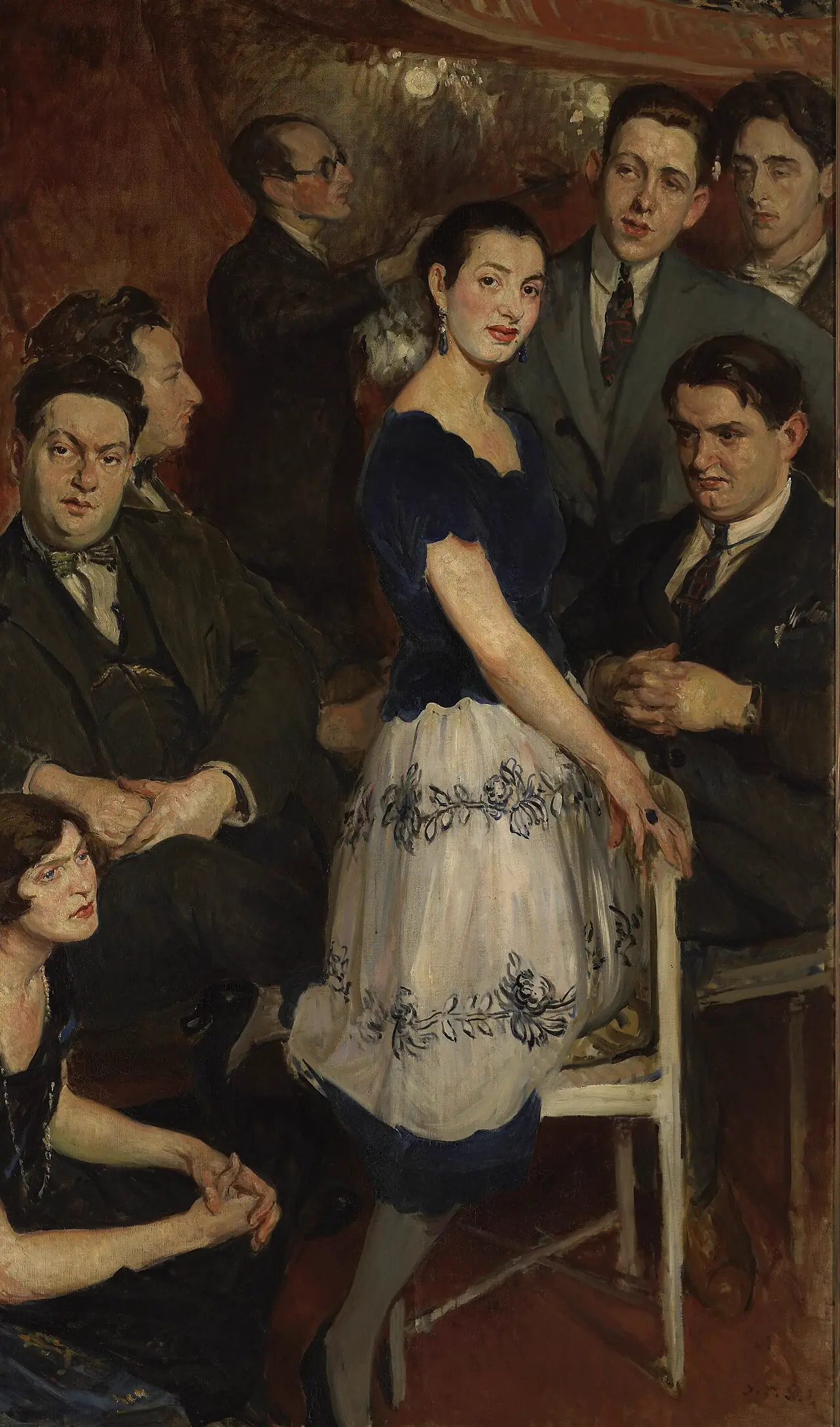
Jacques-Émile BlancheLe Groupe des Six, 1922Oil on canvas · Musée des Beaux-Arts, Rouen
The pianist Marcelle Meyer sits at the centre of Blanche’s gathering, with Cocteau among the composers. She played their music, and he helped to make them famous. Poulenc was twenty-three in the year of this portrait and was taking private lessons with Koechlin while the group was becoming known under its public name.
Raoul DufyLe Dromadaire, from Le Bestiaire, 1911Woodcut illustration · From the original illustrated edition of Apollinaire’s Le Bestiaire
Dufy’s woodcuts accompanied the thirty short poems of Apollinaire’s Bestiaire when it appeared in 1911. Poulenc, who had heard the poet read, chose six of its animals for his 1919 songs. The camel is the first of his songs and the animal on this printed page.
Guillaume Apollinaire
Le Dromadaire
1911; set by Poulenc in 1919
FrenchAvec ses quatre dromadaires
Don Pedro d’Alfaroubeira
Courut le monde et l’admira.
Il fit ce que je voudrais faire
Si j’avais quatre dromadaires.
Our translationWith his four dromedaries
Don Pedro d’Alfaroubeira
Travelled the world and admired it.
He did what I would like to do
If I had four dromedaries.
In the poem Don Pedro has four camels and the whole world, and the poet, in five lines, envies him. Poulenc set it as the opening song of Le Bestiaire. The traveller’s name extends across the verse, and the last line states how little equipment the speaker has.
Recommended recordings
SongsPierre Bernac, Francis PoulencEMI / WarnerPierre Bernac, the singer for whom so many of the songs were written, with their composer at the piano. Bernac’s words are clear and Poulenc’s accompaniments are alert, even in the shortest songs.
Dialogues des CarmélitesDenise Duval, Régine Crespin, Rita Gorr, Denise Scharley, Liliane Berton; Paris Opéra forces, Pierre DervauxEMI / Warner · 1958The first choice for the French text and its original cast, with Duval as Blanche and Scharley as the dying prioress.
GloriaRosanna Carteri, French Radio-Television Choir and Orchestra, Georges PrêtreEMI / Warner · 1961A lively, direct account recorded in Poulenc’s lifetime. Carteri’s broad soprano line contrasts with the choir’s quick Laudamus te.
Where to hear more
Gloria, FP 1771959–60
Susan Gritton, soprano; Polyphony; The Choir of Trinity College, Cambridge; Britten Sinfonia; Stephen Layton, conductor · Hyperion · April 2007, All Hallows, Gospel Oak, London
Poulenc had Benedictine monks playing football in mind when he wrote the second movement of the Gloria. Layton’s choirs sing its rhythms precisely, and Susan Gritton sings the soprano solo.
Catherine Dubosc (Blanche), Rita Gorr (the old Prioress), Rachel Yakar (the new Prioress), Martine Dupuy (Mère Marie), Brigitte Fournier (Constance), José van Dam (the Marquis de la Force), Jean-Luc Viala (the Chevalier de la Force), Michel Sénéchal (the Chaplain); Chorus and Orchestra of the Opéra National de Lyon; Kent Nagano, conductor · Virgin Classics (now Erato / Warner Classics) · 21–30 June 1990, Auditorium Maurice Ravel, Lyon
Blanche, a frightened young aristocrat, joins a Carmelite convent during the French Revolution; in the last scene the sisters sing the Salve Regina and are guillotined one by one. Nagano’s Lyon recording won the 1993 Gramophone opera award. Rita Gorr, who sang Mère Marie in Dervaux’s Paris recording, sings the dying old Prioress here.
Sextet for piano, flute, oboe, clarinet, bassoon and horn, FP 1001932–39
Philippa Davies, flute; Gareth Hulse, oboe; Richard Hosford, clarinet; Ursula Leveaux, bassoon; Richard Watkins, horn; Ian Brown, piano (The Nash Ensemble) · Hyperion · January 1999, Henry Wood Hall, London
A theme first heard on the winds returns in all three movements of this sextet for piano and five wind instruments. Ian Brown and the Nash players perform it.
Passed toJean FrançaixLater French song and wind repertory
He admired Chabrier’s bold chords, and Mozart gave him a model for a melody that could stand with very little accompaniment. Viñes introduced him to Satie, and Koechlin made him work at counterpoint. From Stravinsky’s ballets he learned the uses of a sharp instrumental attack.