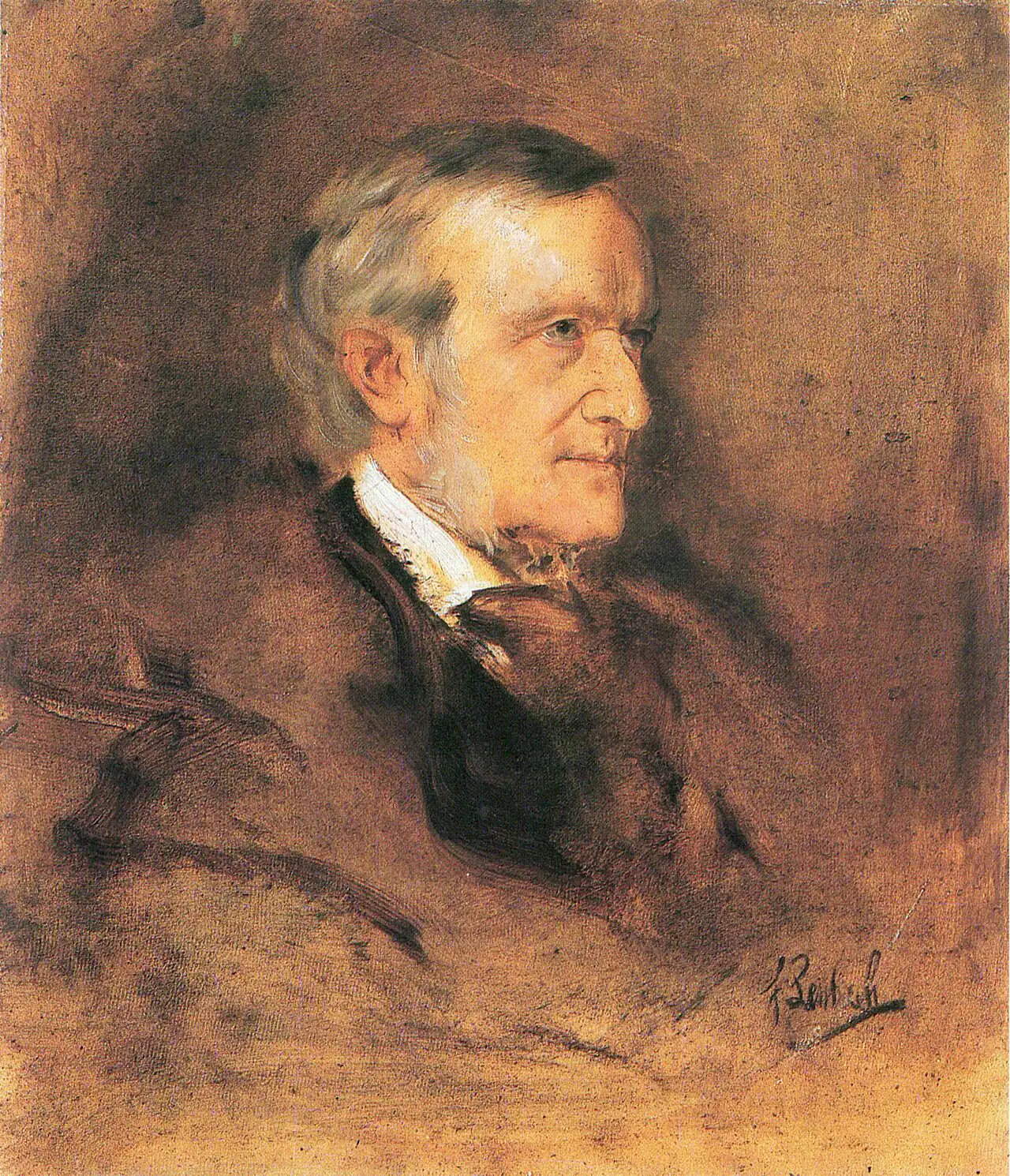
Theodor Weinlig, Leipzig, 1831; then the daily work of provincial opera houses
Posts
Dresden court conductor, 1843–49 · Bayreuth Festival founder, 1876
Words
Wrote his own librettos; published essays on theatre, music and politics
Output
Thirteen completed operas, including the four evenings of the Ring
Life
In 1839 Richard Wagner and his wife Minna fled Riga ahead of their creditors and took a storm-battered ship to London. He was twenty-six, an opera conductor with two completed operas and no real success. The sea passage stayed with him. A story by Heinrich Heine about a captain condemned to sail for ever became Der fliegende Holländer; its overture begins over a bare fifth, with horns and bassoons playing against the storm music in the strings. The Wagners went on to Paris, where he made arrangements for publishers and tried to get his music staged.
He grew up in the theatre. Born in Leipzig in 1813, he lost his father as an infant and moved with his mother into the household of Ludwig Geyer, an actor and painter in Dresden. Wagner wanted to write plays before he knew how to write music. He heard Weber’s Der Freischütz and Beethoven’s symphonies, and in 1831 he took counterpoint lessons from Theodor Weinlig. Posts followed in Würzburg, Magdeburg, Königsberg and Riga. Die Feen was not performed, and Das Liebesverbot, his operatic version of Measure for Measure, failed after one performance in 1836. That year he married Minna, an actress.
1842–49Dresden and the 1849 uprising
Meyerbeer helped get Rienzi accepted in Dresden. Its success in October 1842 won Wagner a court appointment the following year, and Dresden heard both Holländer and Tannhäuser. Senta’s ballad tells the Dutchman’s story before he walks into her house; the pilgrims’ chorus in Tannhäuser returns several times against the music of Venus. Both operas have arias, choruses and clear points of rest, and both already bring back phrases from earlier scenes. In Lohengrin, completed in 1848, the bride destroys her marriage by asking her husband his name, the one question he has forbidden.
Wagner’s Dresden friends included the anarchist Mikhail Bakunin. Wagner helped the insurgents during the May uprising of 1849, then fled when the revolt failed and a warrant was issued for his arrest. Liszt helped him escape and conducted Lohengrin in Weimar in 1850, while Wagner was in Switzerland. In Zurich he wrote The Artwork of the Future and Opera and Drama, proposing a theatre in which poetry, acting and music worked together, and began planning performances for which no theatre yet existed.
He also published Das Judenthum in der Musik in 1850, attacking Jewish musicians, including Mendelssohn and Meyerbeer, who had helped him. He claimed that Jews could only imitate the art of the nations among whom they lived. The essay first appeared under the pseudonym K. Freigedank. In 1869, by which time he had secured fame and royal patronage, he enlarged it and published it under his own name.
1848–74The Ring
The Ring began as a drama about Siegfried’s death. Wagner repeatedly found that he needed another opera to explain what had happened before it. By 1852 he had the texts for four evenings: Das Rheingold, Die Walküre, Siegfried and Götterdämmerung. He composed the music in sequence, starting Rheingold in 1853. It opens on a low E♭ in the double basses; the horns enter one after another, the strings follow with running figures, and the harmony stays on E♭ for 136 bars.
Alberich steals the gold, and Wotan steals the ring made from it. Each bargain leaves somebody unpaid. In Act II of Die Walküre, Wotan tells Brünnhilde how he reached this impasse, and music from the earlier drama returns in the orchestra beneath his account. A leitmotif can be attached to a sword, a promise or a person, and its meaning can change when another character hears it. In Siegfried’s funeral march, the orchestra recalls the motifs of his ancestry and his life with no voice singing.
1857–65Tristan und Isolde and Mathilde Wesendonck
Wagner put Siegfried aside in 1857, after Act II. He had discovered Schopenhauer in 1854 and fallen in love with Mathilde Wesendonck, whose husband Otto helped support him. Schopenhauer’s account of desire and Wagner’s closeness to Mathilde both fed into Tristan und Isolde. Wagner set five of Mathilde’s poems in 1857–58, and called Im Treibhaus and Träume studies for the opera. Minna intercepted a letter to Mathilde in 1858. Wagner left Zurich and finished Tristan the following year.
The Prelude begins with cellos, a wind chord and an oboe climbing by semitones. A silence follows. The next phrase is repeated higher. In the drama, daylight separates the lovers and night promises a union it cannot sustain; in Act III Tristan waits for Isolde through a delirium in which earlier music returns. In April 1859 Wagner wrote to Mathilde: “Only mediocre performances can save me! Completely good ones must drive people mad.” The opera ends in B major after Tristan has died.
In 1864 the eighteen-year-old Ludwig II summoned Wagner to Munich and paid his debts. Hans von Bülow conducted the first Tristan there on 10 June 1865. Two months earlier Bülow’s wife Cosima, Liszt’s daughter, had borne Wagner a daughter named Isolde. The affair scandalised Munich, and Ludwig was forced to send his composer away. Wagner settled at Tribschen beside Lake Lucerne.
1867–70Die Meistersinger and the Siegfried Idyll
At Tribschen he completed Die Meistersinger von Nürnberg, first performed in Munich in 1868. The cobbler Hans Sachs helps a young singer win a bride and a hearing from the town’s rule-bound guild. The opera includes a street riot set as counterpoint and a five-voice ensemble. In Sachs’s last speech, after generosity towards the young, he warns against foreign influence on German art.
Wagner resumed Siegfried in 1869. He and Cosima married in August 1870, after the births of Isolde, Eva and Siegfried. On Christmas morning a small group of players assembled on the staircase of their house and woke Cosima with the Siegfried Idyll, a birthday surprise; the piece shares music with the opera. Four years later Wagner finished Götterdämmerung.
1876–83The Bayreuth Festival
The complete Ring opened at Bayreuth in August 1876, conducted by Hans Richter. Subscriptions had not covered the cost of the theatre, and another loan from Ludwig had saved it. The three cycles drew an international audience and left an enormous deficit. Wagner’s staging made heavy demands on the theatre’s machinery as well as on the musicians. For the Rhinemaidens, the singers had to climb onto tall contraptions that made them appear to swim.
Parsifal brought the festival back in 1882, under Hermann Levi. Its wounded king, Amfortas, suffers through the ceremony he must perform; bells and brass accompany the passage into the Grail hall. Wagner died in Venice on 13 February 1883 and was buried in the garden of Wahnfried, his Bayreuth house. Cosima took charge of the festival after him. Under later family leadership Bayreuth became a platform for Nazi culture. Hitler first visited the Wagner family in 1923 and was a regular festival guest from 1933 to 1940.
Places
Every recorded place, joined in date order. Wagner on the MapAll 25 places, with sources
Brühl 3, Leipzig · 22 May 1813 – 1814 · born
Born ninth and youngest child in the Brühl house in Leipzig’s Jewish quarter; baptised at St Thomas.
Villa Tribschen, Lucerne · April 1866 – April 1872 · lived
Ludwig II funded the lakeside house; Wagner finished Meistersinger here and first performed the Siegfried Idyll here on 25 December 1870. Siegfried Idyll.
Wagner used instrumental phrases to recall material the singer leaves out. During Wotan’s account of his troubles in Act II of Die Walküre, motifs from Rheingold return in the orchestra beneath him. At Siegfried’s funeral, the orchestra plays the motifs associated with his family and his sword. The same tune can be scored for brass or for strings, or set over a changed bass.
♯Semitones
A single moving note can keep a chord unsettled. In the Tristan Prelude, the oboe climbs G♯–A–A♯–B while the parts beneath it move to new dissonances. The opening reaches E7, a chord that points towards A minor, and stops before reaching A minor. Successive phrases begin again after the silence.
𝅘𝅥Words
The Ring’s alliterative German gives singers hard consonants to bite on and short phrases that can cut across an orchestral line. Meistersinger puts the rules of verse on stage. In it, Walther’s song is examined and rejected, and is eventually taught into shape.
𝄢Brass and anvils
For the Ring, Wagner added a bass trumpet, a contrabass tuba and the Wagner tubas, which are played by horn players, to the brass section. Their chords accompany the first appearance of Valhalla. In the Nibelheim music eighteen anvils are struck. Six harps play in the music for the gold. Each of these instruments is tied to particular places and actions in the drama.
𝄋Sustained chords
Rheingold begins with 136 bars on E♭. The double basses hold the root while the horns enter one after another on the notes of the chord, and quicker figures spread through the strings. The texture and rhythm change over these bars, but the harmony stays on E♭. In Tristan small harmonic changes carry large consequences, while the lovers stay together in one place and try to prolong the night.
𝄆Comic counterpoint
In the Meistersinger Prelude, tunes introduced separately are later combined. At the end of Act II, the town’s street fight grows through overlapping entries and imitations, each new group of voices adding to the number of parts. Then the crowd disperses and the Nightwatchman resumes his rounds.
Works
A selection from the composer’s works.
1841
Der fliegende HolländerWWV 63Opera in three acts; soloists, chorus and orchestra
First staged in Dresden in 1843; Wagner later revised the ending. Senta sings the Dutchman’s legend as a ballad before she meets him.
The Paris revision of 1861 greatly expanded the Venusberg music. Its ballet was placed in Act I, which offended the members of the Jockey Club, who expected to arrive later.
Liszt conducted the première at Weimar in 1850, while Wagner was in exile. The Prelude opens with high, divided violins. The opera concerns a knight whose bride must never ask his name.
1854
Das RheingoldWWV 86AMusic drama in one continuous evening; large orchestra
The Ring’s preliminary evening begins on a low E♭ and stays in that harmony for 136 bars. Ludwig II ordered its separate Munich première in 1869 against Wagner’s wishes.
First staged in Munich in 1870. A stranger takes shelter from a storm; by the end of Act I, Siegmund and Sieglinde have recognised each other as twins and become lovers.
Five poems by Mathilde Wesendonck, including two studies for Tristan: Im Treibhaus and Träume. Wagner arranged Träume for violin and small orchestra; the other songs were orchestrated by Felix Mottl.
Completed six years before its Munich première. In Act III a shepherd’s tune is played on the cor anglais while Tristan, on his sickbed, waits for the ship bringing Isolde.
A birthday gift for Cosima, first played on the staircase at Tribschen on Christmas morning. Wagner later published it with provision for a larger string section.
Twelve years separate the composition of Acts II and III. The boy who cannot learn fear forges a sword, kills a dragon and wakes Brünnhilde. The complete opera was first performed at Bayreuth in 1876.
1874
GötterdämmerungWWV 86DPrologue and three acts; soloists, chorus and large orchestra
First performed in 1876, completing the Ring. Siegfried’s funeral march brings back in the orchestra the motifs associated with his life before Brünnhilde orders the pyre.
1882
ParsifalWWV 111Stage consecration festival play in three acts
Hermann Levi conducted the Bayreuth première. The transformation music accompanies the passage from the forest to the Grail hall, with bells and ceremonial brass.
In the score
Short examples, engraved and playable.
Tristan und Isolde, Prelude — harmonic reductionF–B–D♯–G♯, then E7
A schematic of the Tristan chord and its E7 destination, in even note values. F falls to E and D♯ to D♮; B and G♯ stay in place in this simplified voicing. The moving notes between the two chords are omitted. E7 is the dominant of A minor and is left unresolved.
Das Rheingold, Prelude — schematicMotion within a single E♭ chord
A schematic: notes of the E♭ major chord rise one after another above a held low E♭. In Rheingold, Wagner sustains this harmony for 136 bars, adding instruments and quicker movement until the river fills the stage.
Tristan und Isolde, Prelude — pitch-cell schematicFour-note chromatic ascent
A schematic of the opening oboe ascent, G♯–A–A♯–B, with even durations and no accompaniment. Each note rises by one semitone. The University of Texas score commentary shows the phrase in its original rhythm and harmony.
Sister arts
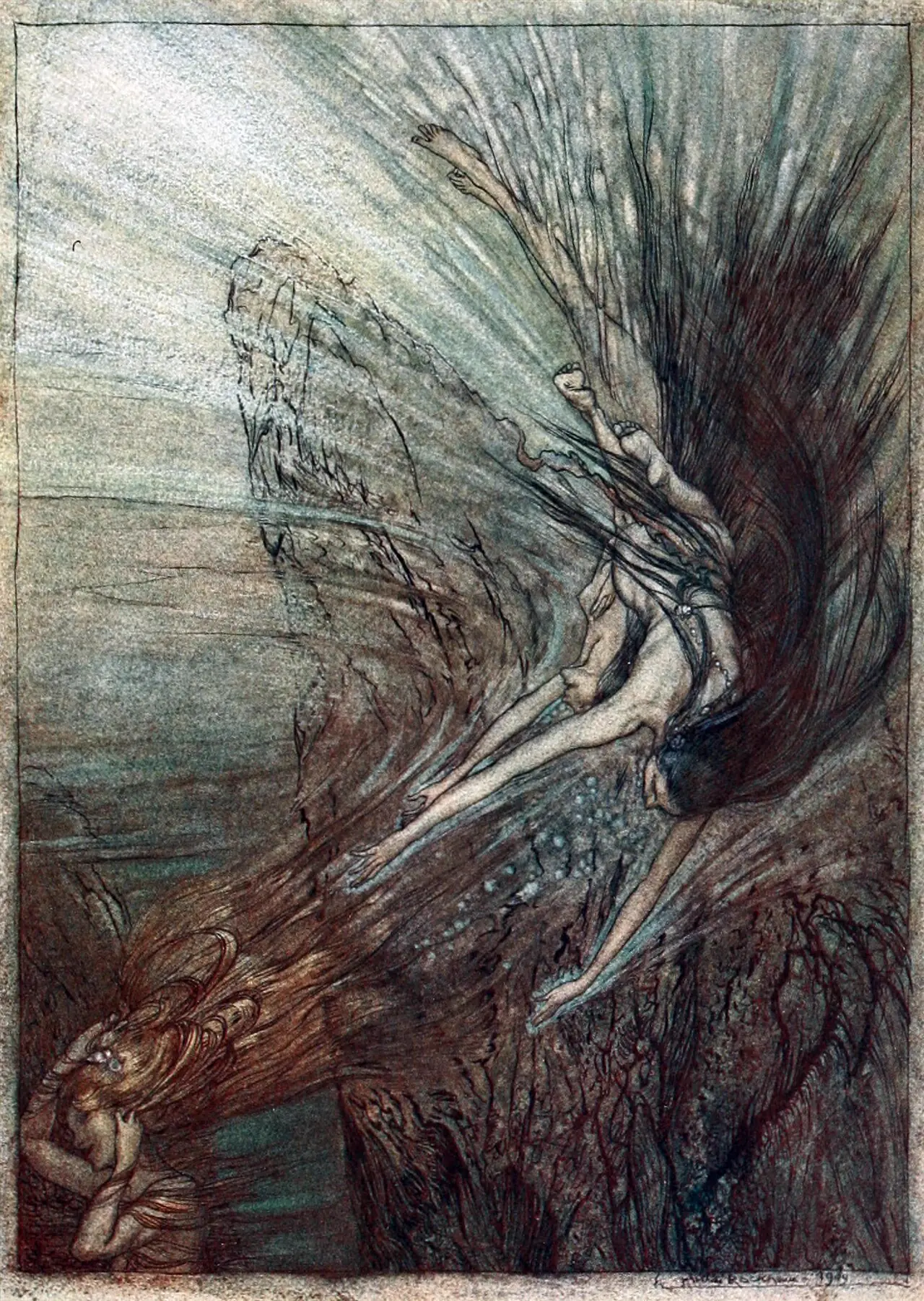
Arthur RackhamThe Frolic of the Rhine-Maidens, 1910Colour book illustration · Published in The Rhinegold & The Valkyrie, translated by Margaret Armour
Rackham drew these swimmers for Margaret Armour’s English translation of Wagner’s dramas, published in 1910. Their hair and limbs curl with the water that fills the opening scene of Rheingold. In the illustrations they float freely; at Bayreuth the first singers of these roles were placed on tall swimming machines.
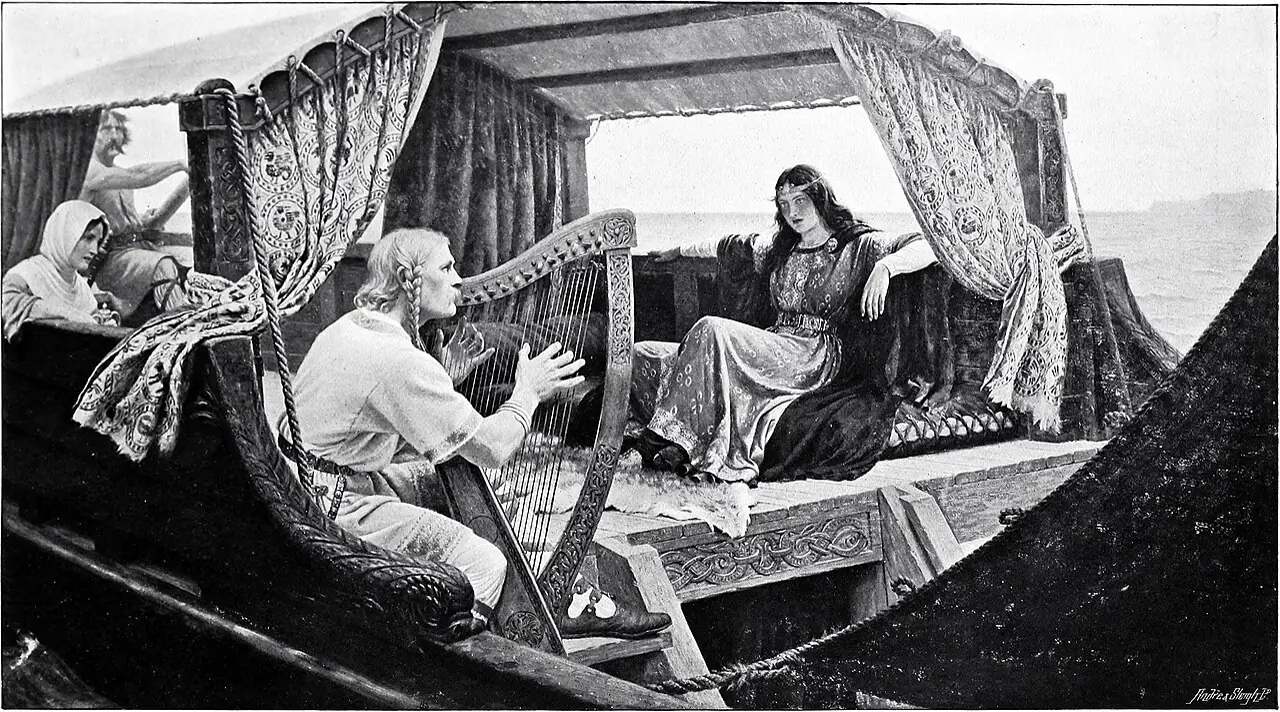
Edmund Blair LeightonTristram and Isolde, Exhibited 1907Photomechanical reproduction of an oil painting · Reproduced in Royal Academy Pictures and Sculpture, 1907
Leighton exhibited his picture of the lovers at the Royal Academy in 1907, and this reproduction appeared in that year’s exhibition book. Their medieval clothes place them in the chivalric world that Wagner’s lovers want to escape. In the opera’s second act, Isolde puts out the torch that separates her from Tristan, and they meet in darkness.
Mathilde Wesendonck
Im Treibhaus — opening stanzas
1858
GermanHochgewölbte Blätterkronen,
Baldachine von Smaragd:
Kinder ihr aus fernen Zonen,
Saget mir, warum ihr klagt?
Schweigend neiget ihr die Zweige,
Malet Zeichen in die Luft;
Und der Leiden stummer Zeuge
Steiget aufwärts, süßer Duft.
Our translationHigh-vaulted crowns of leaves,
canopies of emerald:
children from distant regions,
tell me why you lament.
Silently you bend your branches,
trace signs into the air;
and the mute witness of suffering
rises upward, sweet fragrance.
Mathilde’s poem describes plants growing far from the countries they came from. Wagner was living in a cottage on her husband’s Zurich estate when he wrote the song. He marked it as a study for Tristan, and the Prelude to the third act takes up its music. These are the first two of six stanzas. In the complete German poem the greenhouse becomes a place of human exile.
Richard Wagner
Hans Sachs’s Wahn monologue — opening
Libretto completed 1862; opera completed 1867
GermanWahn! Wahn!
Überall Wahn!
Wohin ich forschend blick’
in Stadt- und Weltchronik,
den Grund mir aufzufinden,
warum gar bis aufs Blut
die Leut’ sich quälen und schinden
in unnütz toller Wut?
Our translationDelusion! Delusion!
Delusion everywhere!
Wherever I look in inquiry
in the chronicles of town and world,
to find the reason
why, even to the shedding of blood,
people torment and flay one another
in useless, frantic rage.
On the morning after the street fight, Sachs sits with his book and tries to account for the neighbours’ behaviour. His word Wahn covers delusion, folly and madness. He resolves to put that unruly energy to work in the song contest, then helps Walther turn a dream into a song the judges can hear.
Recommended recordings
Tristan und IsoldeKirsten Flagstad, Ludwig Suthaus, Philharmonia Orchestra, Wilhelm FurtwänglerEMI · 1952The recording to begin with for the orchestral playing. Flagstad sings Isolde with steady dignity; Furtwängler’s tempos change often.
Der Ring des NibelungenVienna Philharmonic, Georg SoltiDecca · 1958–65In John Culshaw’s studio production the brass has an edge, the anvils have a fixed position, and the Vienna players drive the orchestral climaxes hard.
Die Meistersinger von NürnbergFerdinand Frantz, Elisabeth Grümmer, Rudolf Schock, Berlin Philharmonic, Rudolf KempeEMI · 1956Kempe allows time for the conversational scenes and keeps the large ensembles moving. Grümmer’s Eva is the high point of the set; her line rises through the Act III quintet.
ParsifalJess Thomas, Hans Hotter, Irene Dalis, Bayreuth Festival forces, Hans KnappertsbuschPhilips · 1962The tempos are broad, and the long first act holds together. Hans Hotter sings Gurnemanz. The live Bayreuth recording keeps the acoustic space around the ceremonial brass and the chorus.
Mahler learnt Wagner from the conductor’s desk, balancing these orchestras against singers night after night. Bruckner brought Wagner tubas into the symphony. Debussy went to Bayreuth, and later quoted Tristan in Golliwogg’s Cake-walk to make fun of it. Schoenberg took Wagner’s chromaticism further, into music that eventually gave up a home key.
Substantial biography placing Wagner’s artistic activity within his political and social environment.
Barry Millington, John Deathridge, Carl Dahlhaus and Robert Bailey, ‘Wagner, (Wilhelm) Richard’, Grove Music Online (Oxford University Press, 2001). reference
Biographical reference, work-list and bibliography; subscription required.
Catalogue of musical works and their surviving sources, prepared for the complete edition.
Richard Wagner and Franz Liszt, Correspondence of Wagner and Liszt, vol. 1, translated by Francis Hueffer (Project Gutenberg, 2003 electronic edition). letters
Freely readable letters on composition, performances and practical support.
Cite this page
Contrapunctus. “Richard Wagner.” Accessed 20 October 2026. https://mottopanikeiku.github.io/contrapunctus/composers/wagner.html.