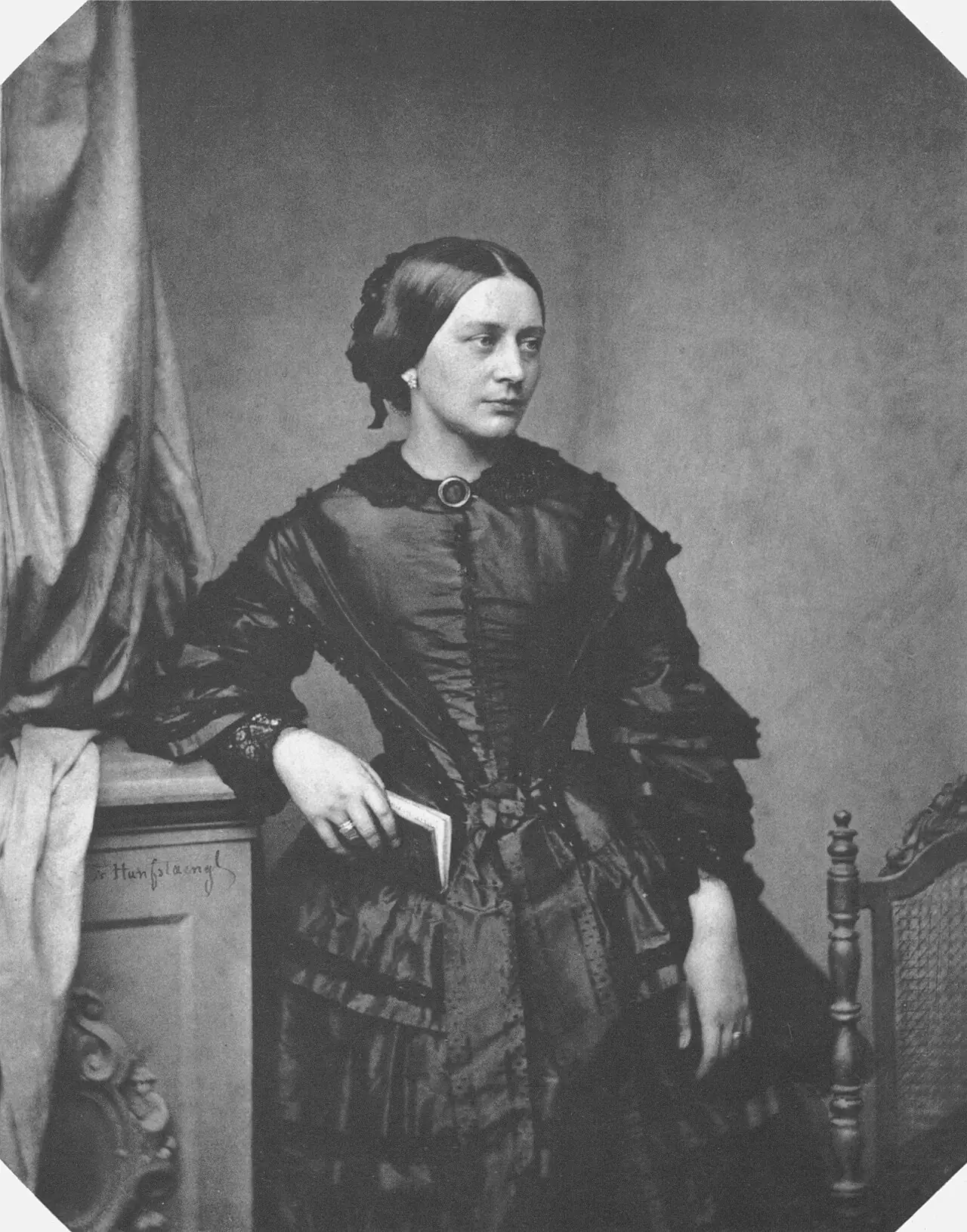
On 9 November 1835 the sixteen-year-old Clara Wieck played her A minor Piano Concerto at the Leipzig Gewandhaus, with Mendelssohn conducting. In the middle movement the orchestra stops. The piano begins a Romance in A♭ major, and a solo cello joins it, so that for a few minutes the concerto is a duet. That evening Clara also played Mendelssohn’s Capriccio brillant, and with him and Louis Rakemann she played Bach’s Concerto for Three Keyboards.
1819–38Friedrich Wieck’s daughter
She was born in Leipzig on 13 September 1819. Her mother, Mariane, was a pianist and singer; her father, Friedrich Wieck, taught piano and sold instruments. After their divorce in 1825, Clara remained with him. He arranged lessons in harmony, counterpoint and languages, supervised her practising and required daily walks. Private teachers supplied most of her education. He also managed her concert tours.
Her public début came in Leipzig in 1828. By 1832 she had played for Goethe in Weimar and met Chopin in Paris. Like other young virtuosos, she filled her programmes with variations and brilliant display pieces, some of them her own. The Romance variée, Op. 3, appeared in 1833 with a dedication to Robert Schumann, her father’s pupil. Robert used its theme in his own Op. 5 Impromptus. He also helped orchestrate the movement that became the finale of her concerto. Clara then added the first two movements and joined all three without a break.
Vienna received her with enthusiasm in 1838. The emperor appointed her imperial and royal chamber virtuosa, an unusual honour for a young Protestant woman from abroad. At home, her growing attachment to Robert brought her into conflict with the man who had trained her. Friedrich opposed the marriage and tried to prevent their correspondence. In 1839 Clara travelled to Paris without him. He withheld her property, including her grand piano, and the dispute went to court.
1840–46Marriage, Leipzig and Dresden
Clara and Robert married at Schönefeld, near Leipzig, on 12 September 1840, the day before her twenty-first birthday. Their married life included visits to the theatre, walks, friends and music-making. It also required negotiations over the piano, since Robert needed quiet to compose and Clara needed to practise. He encouraged her compositions and helped to get them published, while the hours in which she could write or play grew fewer. Between 1841 and 1854 she bore eight children, seven of whom survived infancy.
Their Rückert songs of 1841 were a joint collection on married love. In Clara’s Liebst du um Schönheit, the speaker sends a lover elsewhere if he wants beauty, youth or wealth. Only the fourth stanza says yes. Her songs often carry a sentence past the point where a regular musical period would stop; the voice continues into the next line of text while the piano accompaniment keeps moving.
In 1844 Robert accompanied her on a tour of Russia, where they spent time in St Petersburg and Moscow. Her reputation was greater than his at the time, and it secured engagements that his name alone could not have. Later that year they moved to Dresden, hoping that his health would improve. Clara taught and performed, and in 1846 she wrote her G minor Piano Trio. The Andante is built on a long melody, and the finale includes a fugue for the three instruments. Joseph Joachim and Mendelssohn both admired the trio.
1853Düsseldorf and the summer’s compositions
The family moved to Düsseldorf in 1850, when Robert became the city’s music director. In their last apartment there Clara had, for the first time, a room in which she could practise without disturbing him. In the summer of 1853 she composed a good deal. On 10 June, after finishing two settings of Hermann Rollett, she wrote in her diary: “Composing gives me great pleasure.” By 22 June she had written six songs. Writing had given her “hours of self-forgetfulness, when one lives in a world of sound”.
For Robert’s birthday that June she copied her Op. 20 Variations onto decorated paper. The seven variations turn his short piano piece into a chorale, a canon and passages of rapid filigree. In the published coda, the theme of her own Op. 3 appears in the middle voices. She also wrote the Three Romances for violin and piano, Op. 22, dedicated to Joachim. The piano romances that became Op. 21 were also begun that summer; in 1855 she replaced their first piece with a new Andante in A minor.
Brahms arrived at the Schumanns’ home on 30 September 1853. Robert announced his gifts in print; Clara played his music, argued with him over it and corresponded with him for the rest of her life. Joachim, whom she had also met that year, became a regular concert partner.
1854–56Endenich and Robert’s death
In February 1854 Robert attempted suicide. He entered the sanatorium at Endenich in March, and his doctors kept Clara from visiting. Their youngest child, Felix, was born that June. She continued to give concerts; Brahms helped the household. She made her first English tour in 1856 and saw Robert again shortly before his death on 29 July. She was thirty-six, had seven children and had to earn her living.
For decades afterwards she organised tours, negotiated fees and prepared programmes. England became a regular destination. Her daughter Marie often travelled with her, and summers were spent with family and friends and on preparing the next season’s music. Her composing dwindled to occasional pieces, arrangements and cadenzas, while she went on performing. In 1868 she told Brahms that practising her art was a great part of herself: “It is the air I breathe.”
1878–96Teaching in Frankfurt and last years
Her programmes helped make Bach, Beethoven, Chopin, Robert Schumann and Brahms regular items in the concert repertoire. She played major works from memory, and through her partnership with Joachim she brought chamber music to the same audiences. From 1878 she taught advanced pianists at the Hoch Conservatoire in Frankfurt, assisted by her daughters. Fanny Davies and Adelina de Lara were among her pupils. Davies later recorded Robert’s Piano Concerto and solo works; de Lara also left recordings. There is no recording of Clara herself.
She edited Robert’s collected works and an instructive edition of his piano music, recording what she knew of his phrasing and performance. She and Brahms left the Violin Concerto out of the collected edition; Joachim shared their reservations. It was not performed in public until 1937. She outlived three of her adult children, and supported her son Ferdinand’s six children when his illness left him unable to provide for them.
She gave her last public concert in Frankfurt on 12 March 1891 and retired from the conservatoire in 1892. Her hands troubled her and her hearing deteriorated, though she went on playing privately. She died on 20 May 1896 and was buried beside Robert in Bonn.
The Concerto’s central Romance begins with piano alone in A♭ major. When a solo cello takes up the tune, the pianist accompanies it and answers it. The rest of the orchestra is silent. A drum roll and trumpet fanfare then lead into the finale. The Concerto’s three movements run together.
𝄢Melodies within melodies
Near the end of the Op. 20 Variations, the pianist has to bring out a second melody inside the moving parts, the theme of Clara’s own Romance variée, written twenty years earlier. Elsewhere the variations use a chorale and a canon. Much of their difficulty lies in making several distinct voices audible under two hands.
𝅘𝅥Romance: quickening tempo
The G minor Romance, Op. 11 No. 2, begins quietly and moves to a faster B♭ major middle section. Clara marked the approach Nach und nach schneller (gradually faster), then asked for the opening tempo again. The opening melody returns and the piece ends on pianissimo chords.
𝄋Three equal players
In the G minor Trio, the violin and cello hold notes while the piano moves beneath them, or take over ideas the keyboard has started. In the finale’s fugue, the subject enters in one instrument after another. In the Andante, the instruments share a broad melody.
𝄾With fire
The C minor Scherzo, Op. 14, is marked Con fuoco. Its opening arpeggio rises from the bass into the right hand and fills the three-beat bar with running quavers. Accents fall on the line where it changes direction. The writing requires a pianist who can play a large gesture quickly and land cleanly before the next one.
Works
A selection from the composer’s works.
1831–33
Romance variée in C majorOp. 3Piano
Published in 1833 and dedicated to Robert, who used the theme in his Op. 5 Impromptus. Clara returned to it in the coda of her Op. 20 Variations.
1833–35
Piano Concerto in A minorOp. 7Piano and orchestra
The finale came first, with Robert helping to orchestrate it. Clara played the complete three-movement concerto under Mendelssohn in Leipzig on 9 November 1835.
1838–39
Three RomancesOp. 11Piano
The keys are E♭ minor, G minor and A♭ major. The second Romance appeared in Robert’s Neue Zeitschrift für Musik in 1839, before the complete set was published.
1841
Three songs from Rückert’s LiebesfrühlingOp. 12Voice and piano
Clara contributed three songs to the joint twelve-song collection with Robert’s Op. 37. Liebst du um Schönheit is her second contribution and the fourth song in the combined volume.
Published 1845
Scherzo No. 2 in C minorOp. 14Piano
Marked Con fuoco, it opens with a C minor arpeggio rising from the bass. A substantial concert scherzo, published by Breitkopf & Härtel.
Variations on a Theme by Robert SchumannOp. 20Piano
Seven variations on Bunte Blätter, Op. 99 No. 4, presented to Robert for his birthday. Published in November 1854 alongside Brahms’s Op. 9 on the same theme.
1853–55
Three RomancesOp. 21Piano
The published set begins with an A minor Andante written in 1855 to replace an earlier piece. The F major and G minor Romances date from 1853.
1853
Three RomancesOp. 22Violin and piano
Dedicated to Joseph Joachim, Clara’s concert partner for decades. The violin carries the melody over a demanding piano part.
In the score
Short examples, engraved and playable.
Variation workshopVaried surface over a retained bass
A schematic in F♯ minor. Bars 3–4 repeat the bass and chords of bars 1–2 and break the upper melody into smaller note values. It shows the basic procedure of varying a tune over familiar harmony. Clara’s Op. 20 adds canons, changes of pace and a second, remembered melody.
Sister arts
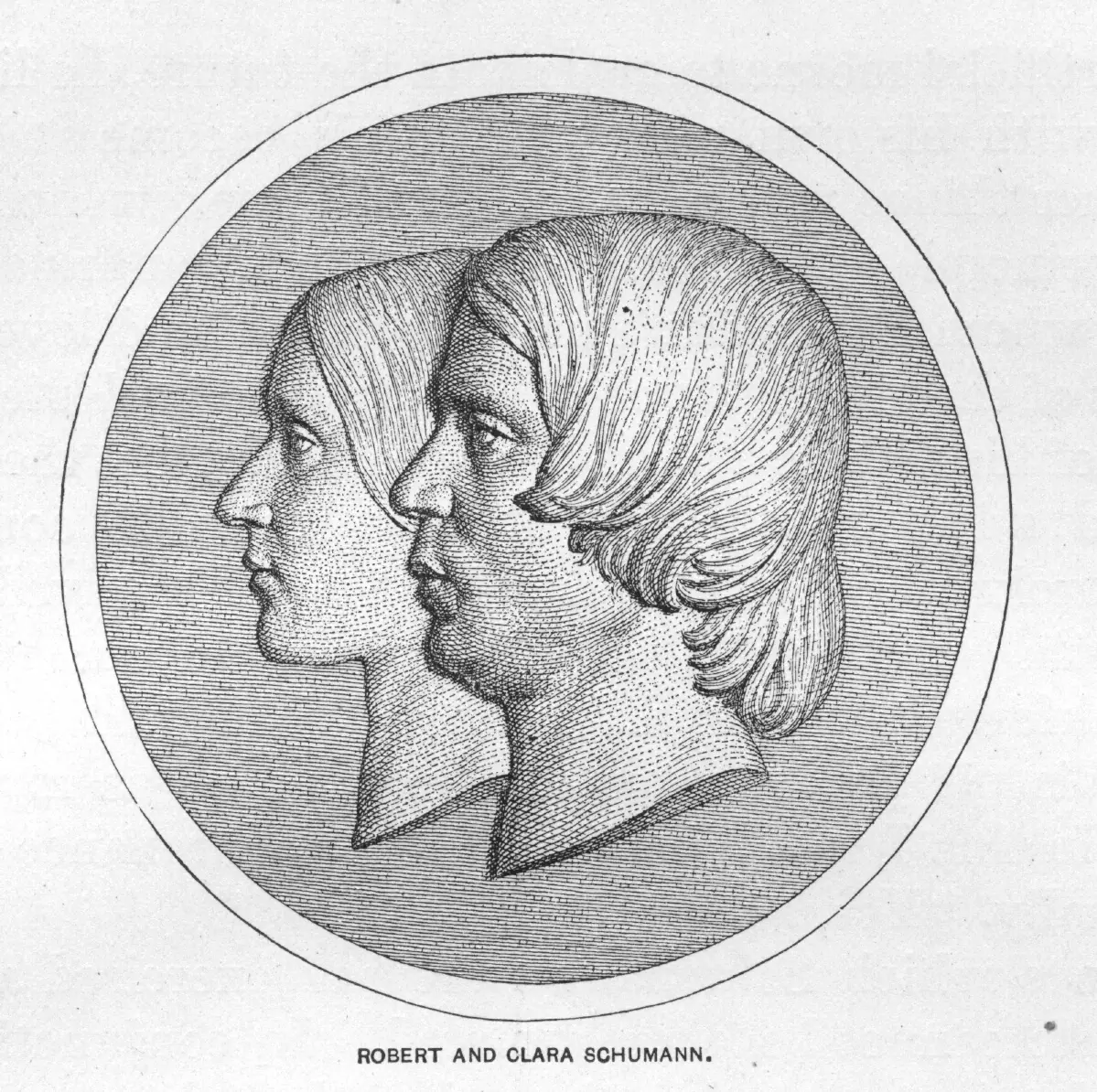
After Ernst Rietschel; reproductive artist unidentifiedRobert and Clara Schumann, Reproduced in 1918Book illustration after a portrait relief · Published in Modern Music & Musicians, University Society, New York
Rietschel belonged to the Schumanns’ circle in Dresden and made a double portrait of the couple. This later book illustration reproduces their paired profiles. The joint Rückert songs also bear both names. Robert died in 1856; Clara was still giving concerts in 1891.
Friedrich Rückert
Liebst du um Schönheit
From Liebesfrühling; Clara’s setting 1841
GermanLiebst du um Schönheit,
O nicht mich liebe!
Liebe die Sonne,
Sie trägt ein gold’nes Haar!
Liebst du um Jugend,
O nicht mich liebe!
Liebe den Frühling,
Der jung ist jedes Jahr!
Liebst du um Schätze,
O nicht mich liebe!
Liebe die Meerfrau,
Sie hat viel Perlen klar!
Liebst du um Liebe,
O ja, mich liebe!
Liebe mich immer,
Dich lieb’ ich immerdar!
Our translationIf beauty is why you love,
do not choose me!
Give your love to the sun:
she wears golden hair.
If youth is why you love,
do not choose me!
Give your love to spring:
it is young again each year.
If riches are why you love,
do not choose me!
Give your love to the mermaid:
she owns many bright pearls.
If love is why you love,
then yes, choose me!
Keep loving me always;
my love for you will not end.
Clara included this setting in the Rückert volume she and Robert published in 1841, their first full year of marriage. Three times the speaker says ‘O nicht mich liebe’; in the fourth stanza ‘nicht’ becomes ‘ja’. Mahler set the poem in 1902 as a gift for Alma. German text and work identification.
Recommended recordings
Piano Trio in G minorBeaux Arts TrioPhilipsThe opening is taken briskly, and Menahem Pressler’s rounded piano sound leaves the strings clearly audible. The ensemble playing is poised, and the articulation stays clear through the finale’s exchanges.
Where to hear more
Piano Concerto in A minor, Op. 71833–35
Isata Kanneh-Mason, piano; Jonathan Aasgaard, cello; Royal Liverpool Philharmonic Orchestra; Holly Mathieson, conductor · Decca · April 2019, The Friary, Liverpool
The teenage Clara Wieck placed a duet for piano and cello at the centre of her concerto, and Jonathan Aasgaard joins Isata Kanneh-Mason as cellist in the Romance. Kanneh-Mason plays with strength and keeps the quick passages decisive. The album adds solo pieces and the violin Romances, played by Elena Urioste, and serves as a first survey of Clara’s music.
The Nash Ensemble: Stephanie Gonley, violin; Adrian Brendel, cello; Simon Crawford-Phillips, piano · Hyperion · May 2019, St Silas the Martyr, Kentish Town, London
Written in Dresden in 1846, this trio is in four movements, and its finale includes a substantial fugue. The Nash Ensemble play it with fire and a fine balance between violin, cello and piano, a more impetuous alternative to the Beaux Arts Trio’s, especially in the first-movement crescendos and the finale. The coupling, Fanny Hensel’s Trio and Quartet, is well chosen, and all three works are sharply characterised.
Brahms sent her music to play and judge, and her performances helped it reach the public. Fanny Davies and Adelina de Lara carried her teaching into their own concert careers and recordings. She performed Robert’s piano music in concert and also edited it.