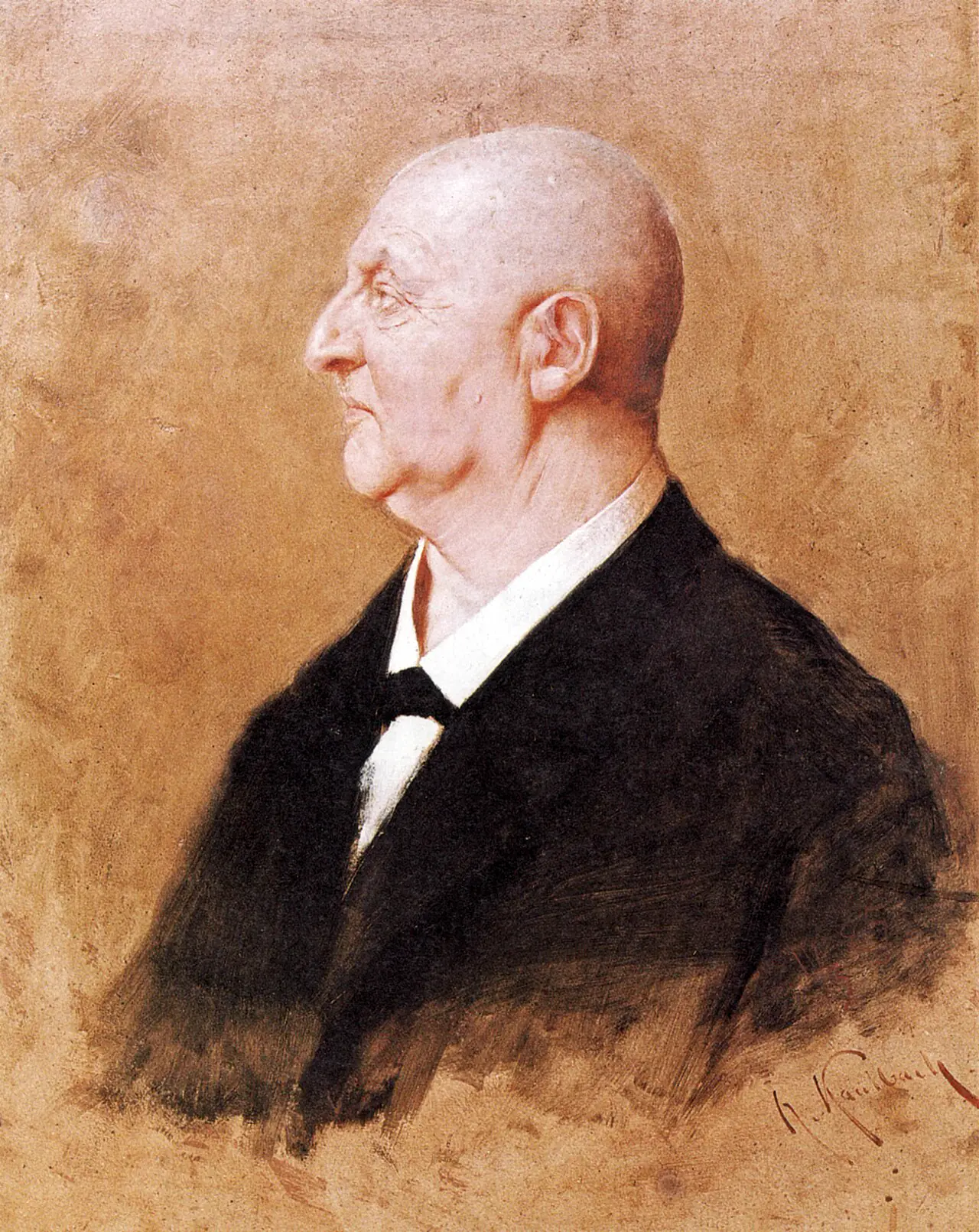
St Florian; counterpoint with Simon Sechter, 1855–61; composition with Otto Kitzler, 1861–63
Posts
Organist at St Florian and Linz; Vienna Conservatory from 1868; university lecturer from 1875
Output
Nine numbered symphonies, two outside the sequence; masses, motets and secular choral music
Breakthrough
The Seventh Symphony, Leipzig, 30 December 1884; Arthur Nikisch conducting
Life
On 16 December 1877 Bruckner conducted his Third Symphony with the Vienna Philharmonic. Johann Herbeck, who had intended to conduct it, had died in October. The audience began to leave during the performance. Among the supporters who stayed was the seventeen-year-old Mahler, who helped arrange the large score for piano duet. Bruckner was then fifty-three, a professor at the conservatory and an organist admired internationally. As a symphonist he was still little known in the concert hall.
1824–61Ansfelden, St Florian and Linz
He was born in Ansfelden, near Linz, where his father taught school and played church music. After his father died in 1837, his mother took him to the Augustinian abbey of St Florian as a choirboy. He learned the organ, trained as a teacher and worked in the villages of Windhaag and Kronstorf. In Windhaag he also played the fiddle for dancing.
He returned to St Florian in 1845, taught at the school and later became the abbey organist. In 1855 he began lessons with Simon Sechter in Vienna, and the following January he obtained the post of cathedral and parish organist in Linz. He was then thirty-one. For six years he sent exercises to Sechter and travelled to Vienna for lessons. During this time he wrote no free compositions and worked through harmony, fugue and counterpoint. In November 1861 he took another examination, in which he improvised an introduction and fugue on a theme given by his teacher.
1861–68Studies with Kitzler and the Masses
Then he started again with Otto Kitzler, the conductor at the Linz theatre, studying orchestration and musical form. One exercise was to orchestrate the first movement of Beethoven’s “Pathétique” Sonata; a larger one was the F minor Study Symphony of 1863. When Kitzler conducted Tannhäuser in Linz that year, Bruckner studied the score and prepared the Pilgrims’ Chorus with his choral society, Frohsinn. Two years later he went to Munich for Tristan und Isolde and met Wagner.
The D minor Mass followed in 1864, the First Symphony and the E minor Mass in 1866, and the F minor Mass in 1867–68. His choral singers could divide into eight parts. In 1867 he suffered a serious nervous crisis and spent three months at Bad Kreuzen for treatment. His pupil Karl Waldeck remembered him stopping on a walk to count the leaves of a tree. At night he begged Waldeck to stay, afraid of being left alone with his fixations. He began the F minor Mass after returning home. In 1868 he conducted the First Symphony in Linz and accepted Sechter’s former teaching post at the Vienna Conservatory.
ViennaTeaching, Wagner and the Fifth Symphony
In Vienna he had students, an organ post at the court chapel and, from 1875, a university lectureship. His diary for 1877 records thirty-one hours of teaching each week, and the symphonies had to fit around them. In 1873 he took the Third to Wagner in Bayreuth and obtained permission to dedicate it to him. The first version includes quotations from Wagner’s operas. This made Bruckner easy to enlist in Vienna’s quarrels over Wagner and Brahms; the critic Eduard Hanslick became a persistent opponent.
The Third’s première had been a disaster. In April 1878 Liszt played through the Fifth Symphony and spoke favourably of it. Bruckner reported this to Wagner on 20 May as “certainly my last comfort in Vienna”. Meanwhile the Fifth was finished, and he was rebuilding the Fourth, eventually replacing its scherzo with the familiar hunt, in which horns and trumpets call across the orchestra and the strings rush beneath them.
The Fifth draws most fully on those years of exercises. It opens with plucked bass notes and widely separated outbursts; at the beginning of the finale, a clarinet interrupts the returning introduction. A fugue follows. Later the brass play a chorale, and Bruckner combines the two themes. He never heard an orchestra play it. Illness kept him away from the 1894 première in Graz, where Franz Schalk conducted a version with extensive cuts and altered scoring.
1884–92The Seventh and Eighth Symphonies
Arthur Nikisch conducted the première of the Seventh in Leipzig on 30 December 1884, and it brought Bruckner his first real success. He was sixty. The symphony opens with cellos and horn playing a long E major melody over tremolo violins. In the Adagio, four Wagner tubas join the brass. Bruckner wrote its closing funeral music after Wagner’s death in February 1883.
Hermann Levi took up the Seventh in Munich in March 1885. After a performance of Die Walküre the following evening, he had the orchestra play the Seventh’s funeral music for Bruckner in the emptied theatre. Two years later the same conductor could make nothing of the Eighth. Bruckner revised it. On 27 February 1888 he told Levi that “it is already beginning to look quite different”. He worked on it until 1890.
Hans Richter conducted the revised Eighth in Vienna in December 1892. In the Adagio, harps join the strings and Wagner tubas. The finale opens with timpani and a fanfare in the brass. At the end, themes from all four movements are combined in C major. Hanslick left before the finale.
1893–96The Ninth Symphony and death
By 1894 Bruckner had completed three movements of the Ninth. The Adagio climbs to a dissonance and then ends quietly in E major. He went on composing the finale. When the stairs to his apartment became too much for him, the emperor provided ground-floor rooms at the Belvedere in 1895. There he continued to write.
He died on 11 October 1896. Four days later he was buried at St Florian, in the crypt beneath the organ he had played as a young man. After his death the symphonies continued to be performed with cuts and retouchings, and in rival editions. The orchestral score of the Fifth was not heard without Schalk’s alterations until 1935.
Places
Every recorded place, joined in date order. Bruckner on the MapAll 15 places, with sources
Ansfelden · 4 September 1824 – 1840 · born
Born in a village near Linz, where his father inherited the schoolmaster’s post in 1823.
Premiered under Hans Richter to great acclaim. It was the first premiere of a Bruckner symphony that Bruckner did not conduct himself. Symphony No. 4 “Romantic”.
A held bass note lets Bruckner build upwards without the bass moving. At the opening of the Seventh the melody for cellos and horn is held over quiet string tremolo. The harmony moves only after some time, before the brass enter.
𝄞Instrumental choirs
Bruckner often keeps strings, woodwind and brass recognisably separate. The Fifth begins with plucked low strings and then sets sustained chords and sudden loud passages against them. In the Seventh’s Adagio the Wagner tubas form a separate, closely voiced group. A brass chord can enter directly after a passage for a single clarinet.
𝅘𝅥Two and three
Two equal notes followed by three make the characteristic Bruckner rhythm, with five attacks fitted into a four-beat bar. The first movement of the Eighth uses it in its second group of themes. A broad tune can run above the uneven rhythm while the bar stays steady. The triplet pushes each phrase forward.
𝄋Three theme groups
The first movement of the Eighth has three substantial groups of themes. The opening is followed by a more flowing, song-like group, then by a third idea with a firmer tread. Each group is long. When they return, the same rhythm or tune comes back in a changed key, sometimes played by a different instrument.
𝄢Fugue and chorale
The finale of the Fifth combines its fugue subject and brass chorale in a double fugue, so that lines first heard separately now sound together. Near the end the theme of the first movement returns as well. Bruckner’s years of study with Sechter show in the part-writing: even at full strength the brass have distinct notes to play against the moving strings.
𝄾Church style on a small scale
Locus iste is written for four unaccompanied vocal parts and lasts a few minutes. The C major opening sets the words in clear chords. Chromatic notes enter in the middle section, and the opening material then returns. A pause follows, during which the choir’s sound continues in the building’s resonance. Bruckner’s symphonies also leave rests around cadences, on a much larger scale.
Works
A selection from the composer’s works.
1866
Mass No. 2 in E minorWAB 27Eight-part mixed chorus and fifteen wind instruments
Written for Linz’s new cathedral and first sung at the dedication of its votive chapel in 1869. It is scored for eight vocal parts and wind band, without strings.
1868
Mass No. 3 in F minorWAB 28Four soloists, chorus, orchestra and organ
Bruckner began it after his treatment at Bad Kreuzen and conducted the première in Vienna in 1872. Its choral fugues are as demanding as his symphonic finales.
1873
Symphony No. 3 in D minorWAB 103Orchestra
The symphony whose dedication Wagner accepted; a solo trumpet call enters over the opening strings. The versions of 1873, 1877 and 1889 differ substantially, and most of the Wagner quotations were removed in revision.
1874
Symphony No. 4 in E♭ major “Romantic”WAB 104Orchestra
A horn calls over string tremolo. The familiar hunting scherzo was written in 1878 and replaced the quite different movement of the first version; the finale was also rebuilt.
1876
Symphony No. 5 in B♭ majorWAB 105Orchestra
Revised until 1878; not performed by an orchestra until 1894. In the finale a fugue subject and a brass chorale are developed separately and then combined.
1881
Symphony No. 6 in A majorWAB 106Orchestra
The first movement sets a broad tune in the low strings against a repeated rhythm in the violins. In the Adagio an oboe lament and a funeral march share the same slow tempo.
The Leipzig première in 1884 made his name internationally. The closing funeral music of the Adagio is a lament for Wagner, who died while Bruckner was composing the symphony.
Te Deum in C majorWAB 45Four soloists, chorus, orchestra and organ
The voices sing the opening over bare fifths and octaves. The final fugue sets the words In te, Domine, speravi (“In you, Lord, I have hoped”).
1887; revised 1890
Symphony No. 8 in C minorWAB 108Large orchestra including Wagner tubas and harps
His only symphony with harps, heard in the slow movement and, in the revision, the scherzo’s trio. The finale combines themes from all four movements in its closing C major.
1887–96
Symphony No. 9 in D minor (unfinished)WAB 109Orchestra including Wagner tubas
Three completed movements and an unfinished finale. The Adagio ends quietly in E major after one of the most dissonant chords Bruckner ever wrote.
In the score
Short examples, engraved and playable.
Brass chorale and pause — schematicHarmonic block with a defined edge
A schematic brass chorale over C–F–G–C. All the parts stop together and a whole bar is left empty, marked as clearly as the chords. Bruckner’s symphonies use this kind of separation on a much larger scale.
The Bruckner rhythm — schematicTwo notes followed by three
A schematic of the Bruckner rhythm on one pitch: two crotchets, then three crotchet triplets. Each group takes two beats, so the bar stays in 4/4 and the number of attacks changes from two to three.
Sister arts
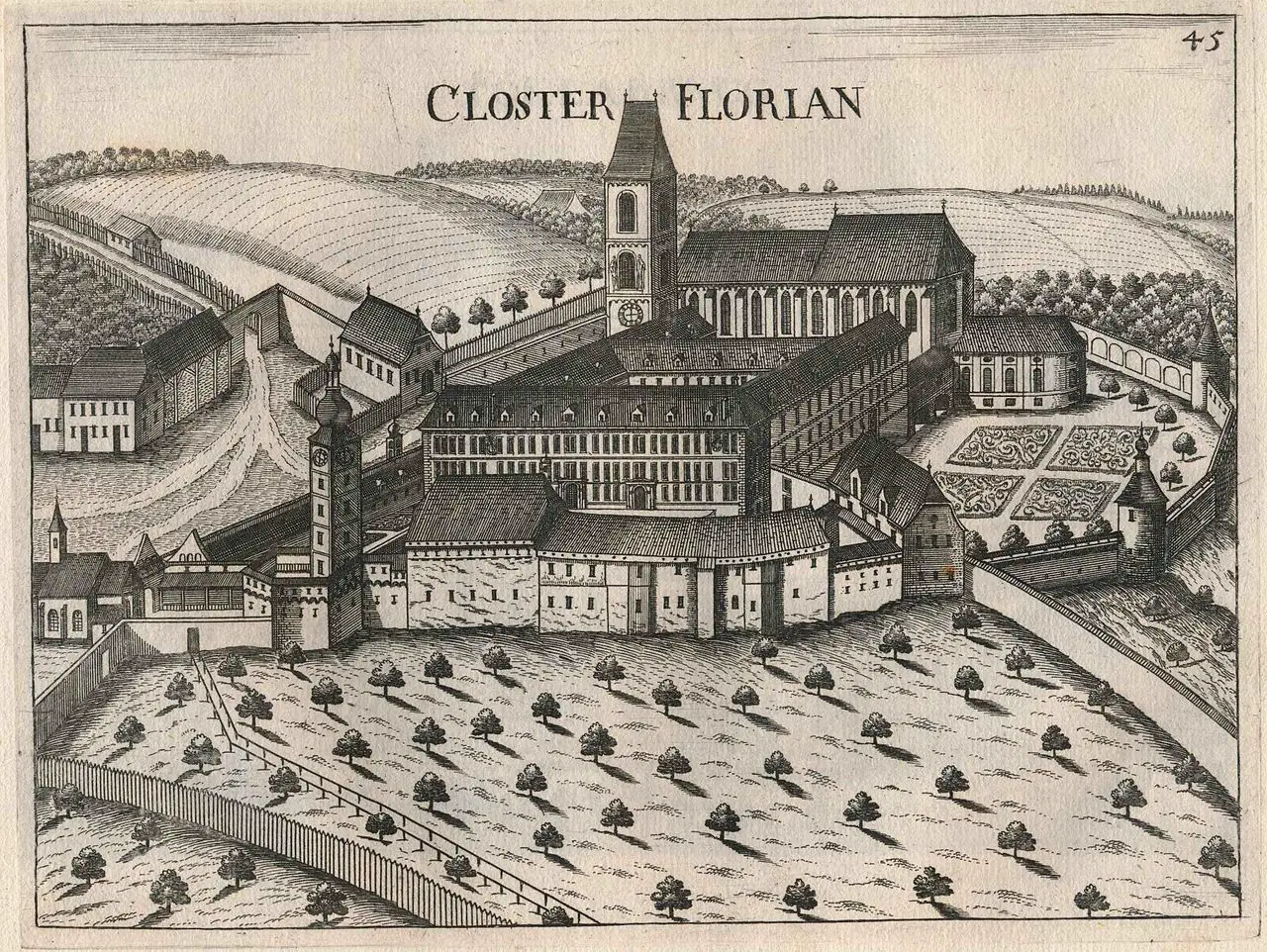
Georg Matthäus VischerSt Florian Abbey, 1677 edition; first published 1674Copper engraving · Topographia Austriae superioris modernae
St Florian before its Baroque rebuilding. Bruckner arrived as a choirboy in 1837, returned as a teacher in 1845 and later became its organist. At the end of his life he asked to be buried here, directly beneath the great organ.
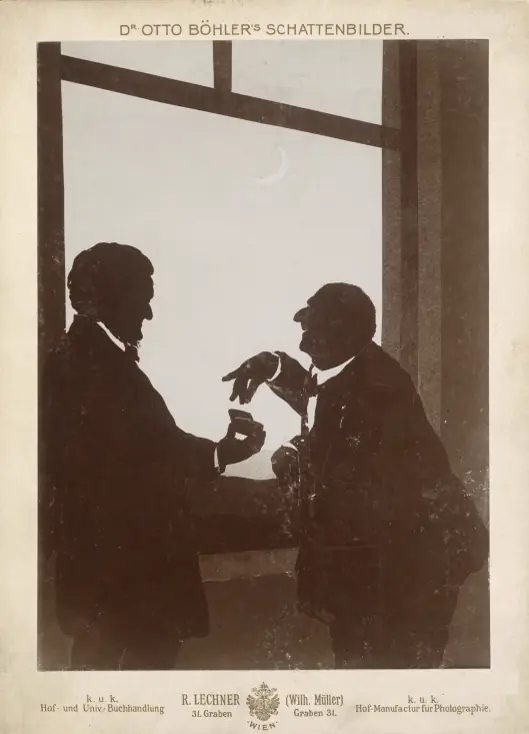
Otto BöhlerAnton Bruckner and Richard Wagner, c. 1885Published silhouette · Issued by R. Lechner, Vienna
Wagner offers snuff, and Bruckner bends towards him. Böhler shows Bruckner’s devotion to Wagner as an exchange between two figures. In 1873 Bruckner had gone to Bayreuth to ask Wagner to accept the dedication of his Third Symphony, whose first version quotes from Wagner’s operas.
Roman Catholic liturgy
Locus iste
Traditional Latin gradual; Bruckner’s setting, 1869
LatinLocus iste a Deo factus est,
inaestimabile sacramentum,
irreprehensibilis est.
Our translationThis place was made by God,
a mystery beyond price;
it is without fault.
A setting of the text for the dedication of a church, for four unaccompanied voices. Bruckner wrote Locus iste for Linz’s new cathedral in 1869, and it was first sung in the votive chapel that October. The choir’s C major chords give way to chromatic harmony in the middle section, and the music then returns to the opening words.
Recommended recordings
Symphony No. 5Staatskapelle Dresden, Eugen JochumEMI · 1980A fast Fifth, with bright Dresden brass and flexible tempos. Jochum keeps the fugue in the finale moving up to the full-strength entry of the chorale.
Symphony No. 8Berlin Philharmonic, Günter WandRCA · 2001The Haas edition, recorded live. Wand keeps the bass line firm through the long Adagio, and the harps are clearly audible. The performance lasts nearly ninety minutes and ends with the full brass.
Symphony No. 9Vienna Philharmonic, Carlo Maria GiuliniDeutsche GrammophonFor spaciousness and the Vienna strings. Giulini takes the Adagio at an exceptionally broad pace. The quiet final pages are the reason to choose this three-movement account.
Mahler helped arrange the Third for piano duet and later conducted the masses and the Te Deum. His own symphonies kept Bruckner’s long spans and added songs and street music. In the Fifth, themes from earlier movements return, as in Beethoven’s Ninth. The Seventh uses Wagner tubas, an instrument taken over directly from Wagner. Franz Schmidt and Hans Rott belong to the Austrian symphonic tradition that grew up around these scores.
Further reading
Derek Watson, Bruckner, revised edition (New York: Oxford University Press, 1996). biography
Compact life-and-works study in the Master Musicians series.
Paul Hawkshaw and Timothy L. Jackson, ‘Bruckner, (Joseph) Anton’, Grove Music Online (Oxford University Press, 2001). reference
Biographical reference, work-list and bibliography; subscription required.
Robert Klugseder, with Clemens Gubsch and Desiree Mayer, Werkverzeichnis Anton Bruckner, 2 vols. (Vienna: Hollitzer, 2024). catalogue
Open-access revised WAB catalogue; includes sketches, studies, arrangements and copied works.
Österreichische Akademie der Wissenschaften, Bruckner Online (online research portal, n.d.; accessed 16 October 2026). reference
Free work catalogue, manuscript images, early editions, chronology and biographical reference.
Cite this page
Contrapunctus. “Anton Bruckner.” Accessed 20 October 2026. https://mottopanikeiku.github.io/contrapunctus/composers/bruckner.html.