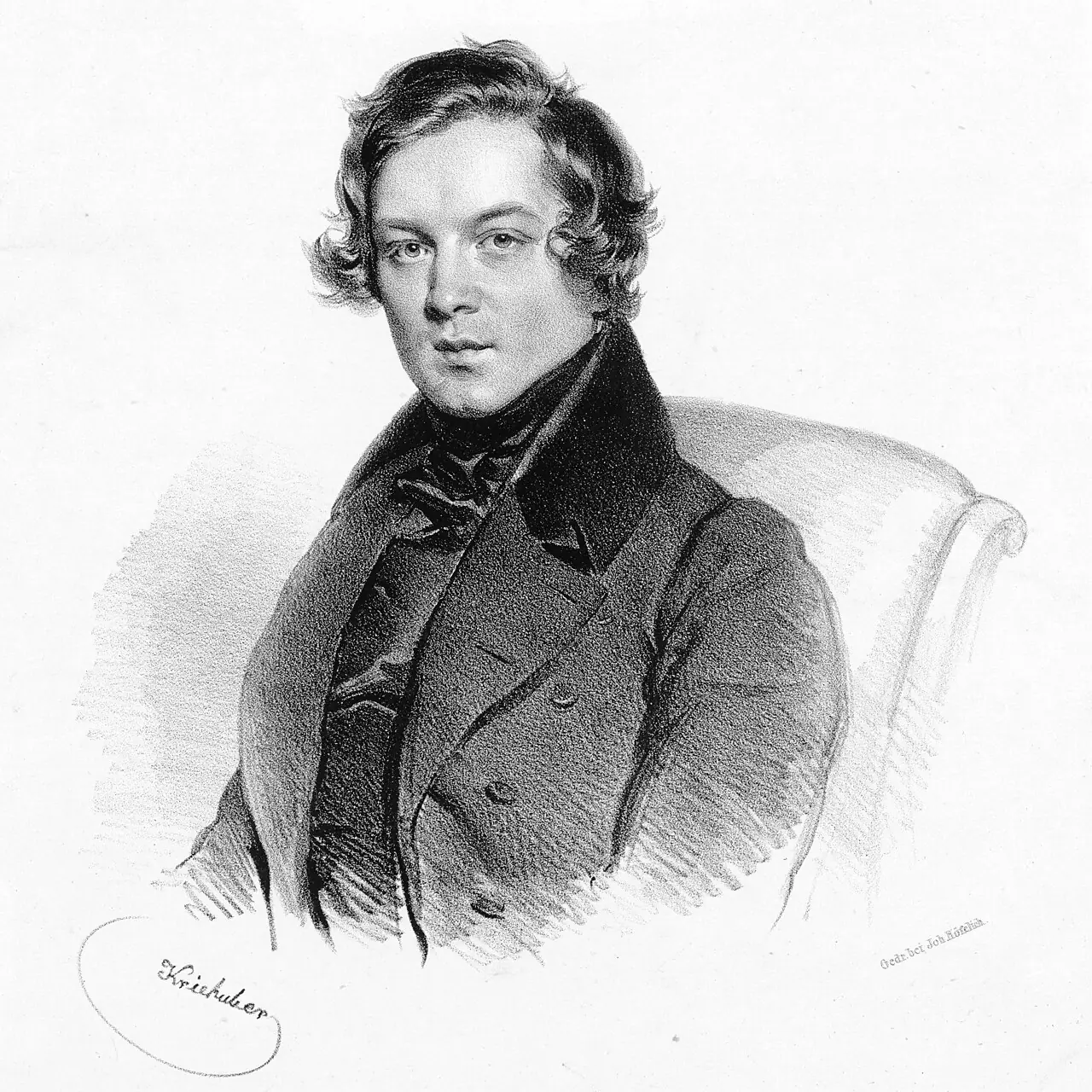
Friedrich Wieck, piano; Heinrich Dorn, composition
Journal
Co-founded the Neue Zeitschrift für Musik in 1834; edited it until 1844
Family
Married Clara Wieck in 1840; eight children, seven surviving infancy
Posts
Leipzig Conservatoire · Düsseldorf music director, 1850–54
Life
Robert Schumann grew up among books in Zwickau. His father August sold and published them, and encouraged his son’s music; Robert read Jean Paul’s novels while learning the piano. The novels contain twins, disguises, and conversations that wander from their subject and return to it unexpectedly. In Papillons, his early set of piano dances, Schumann took up the masked ball at the end of Jean Paul’s Flegeljahre.
He went to Leipzig to study law in 1828 and moved to Heidelberg the following year. In the end he persuaded his mother to let him pursue music. Friedrich Wieck undertook to train him as a pianist. Wieck’s young daughter Clara was already performing in public; Robert was the older pupil and had more ground to make up. By 1832 paralysis in his right hand had ended his hopes of becoming a virtuoso. He studied composition with Heinrich Dorn and turned to composing and writing.
1834–44The Neue Zeitschrift für Musik and Davidsbund
Schumann helped found the Neue Zeitschrift für Musik in 1834 and edited it for ten years. He filled its pages with a partly imaginary society, the Davidsbund, sworn to fight musical Philistines. Two of its members also stood for parts of himself: the impulsive Florestan and the inward-looking Eusebius. A review could take the form of a conversation between them. He had already championed Chopin in 1831, and he gave Berlioz’s Symphonie fantastique sustained attention.
His admiration for Chopin did not stop him being surprised. Reviewing Chopin’s Preludes in 1839, he admitted that he had expected pieces in the grand manner of the études. What he found were “sketches, beginnings of études”, even “ruins, isolated eagle’s wings, all in a colourful, wild jumble”. He went on to describe some things in the collection as sickly and repellent. “Let each seek what suits him,” he told his readers.
Carnaval builds a series of character pieces on those notes. Chopin and Paganini appear among the masks; “Chiarina” is Clara, and the Florestan piece breaks off more than once to quote Papillons. The final march brings the Davidsbündler out against the Philistines. Schumann wrote it in three beats to the bar, with an old-fashioned dance tune among the combatants.
ClaraClara, Wieck and the piano works
His engagement to Ernestine ended in 1835. He and Clara fell in love, and Wieck did everything he could to keep them apart. He distrusted Robert’s finances and his ability to provide a stable life. The couple communicated through letters and through music. The C major Fantasie grew partly from a plan to raise money for the Beethoven monument in Bonn; at the end of its first movement, a phrase from Beethoven’s An die ferne Geliebte is quoted. Writing to Clara on 18 March 1838, Schumann called the movement “a deep lament for you”.
Schumann wrote several piano works during the separation. Davidsbündlertänze begins with a short motto from Clara’s own piano music; Kreisleriana takes its name from E. T. A. Hoffmann’s fictional musician. On 11 March 1839, finishing the Humoreske in Vienna, Robert told Clara that he had spent the week at the piano, “composing and writing, laughing and weeping all at once”.
1840–42Marriage, songs and larger forms
A court finally allowed them to marry without Wieck’s consent. The wedding took place on 12 September 1840, the day before Clara’s twenty-first birthday. Schumann wrote more than a hundred songs that year, setting Heine, Eichendorff, Chamisso and Rückert. He offered Clara Myrthen as a wedding present. The following year, the two composers contributed songs to a joint Rückert collection.
In Dichterliebe, Heine’s disappointed lover insists that he bears no grudge, while the piano hammers beneath him. The first song ends on an unresolved dominant chord. At the end of the cycle, after the singer has ordered his love and sorrow buried in an enormous coffin, the pianist continues alone and returns to music from an earlier song.
In the next two years Schumann turned to larger forms. In 1841 he wrote the “Spring” Symphony, first conducted by Mendelssohn, and the original D minor Symphony. In 1842 came three string quartets, the E♭ major Piano Quintet and the Piano Quartet in the same key. At the end of the Quintet, the opening theme of the first movement returns and is combined in counterpoint with the theme of the finale.
Clara earned money through concerts and carried Robert’s music onto the platform. Practice and composition competed for quiet in a growing household; pregnancies and children interrupted her touring. They studied Bach together. His Piano Concerto began as a one-movement Fantasy in 1841; he added the Intermezzo and finale in 1845. At its opening, the piano’s downward flourish stops for the oboe to introduce the principal tune, and the soloist then answers.
Dresden and DüsseldorfSymphonies, Genoveva and conducting
Schumann joined the staff of the new Leipzig Conservatoire in 1843. After accompanying Clara on her Russian tour the following year, he suffered another period of serious ill health. He sold the journal and the family moved to Dresden. His study of Bach led to the six organ fugues on B–A–C–H. The C major Second Symphony places a long Adagio between its quick movements. His opera Genoveva was staged in 1850 but did not reach the public he had wanted. In the same period he wrote the Album for the Young, a collection of short pieces for children learning to play.
In 1850 he became music director in Düsseldorf. He was warmly received there, and he wrote the Cello Concerto and the five-movement “Rhenish” Symphony. The solemn fourth movement brings in the trombones, and the finale returns to a faster, busier manner. He had difficulty working with the orchestra. Rehearsals deteriorated, the players lost confidence, and by late 1853 he had been displaced from regular conducting.
1853–56Brahms, Endenich and Schumann’s death
That autumn the twenty-year-old Brahms came to the Schumanns with an introduction from Joseph Joachim and played his music. Schumann returned to the journal for Neue Bahnen, published on 28 October 1853. At the piano, he wrote, Brahms had revealed “an orchestra of lamenting and loudly rejoicing voices”; his sonatas were “veiled symphonies”. For Joachim himself, Schumann composed the Violin Concerto, whose finale is in the rhythm of a polonaise.
In February 1854, suffering from auditory disturbances, Schumann attempted suicide in the Rhine. He was rescued and asked to enter the private asylum at Endenich, near Bonn. Brahms and Joachim were allowed to visit; the doctors kept Clara away until two days before his death on 29 July 1856. She continued to perform and edit his music for decades. The Violin Concerto was withheld after his death and received its first public performance in 1937.
Schumann often wrote phrases that are heard as two beats against a notated three, or that begin where the bar appears to end. The closing march of Carnaval is in triple metre, and its accents fall against the metre. In the quicker piano pieces, tied notes and offbeat chords cut across the pulse, while the player continues to count the written metre.
𝄡Inner voices
Schumann did not always put the melody in the top note. He could place it between busy parts in both hands, or, as in the Humoreske, print an “inner voice” on a separate stave for the pianist to imagine. Clara said that this extra line should remain unplayed. Its notes leave traces in the parts that are played.
𝄋Fragments and returns
Carnaval changes character within a few bars, from a hesitant mask to a rush of dancing to a portrait of someone remembered. In the middle of his own portrait Florestan starts to quote Papillons. A returning tune can be recognised before it has finished a phrase.
𝅘𝅥Piano and voice
Dichterliebe begins with a piano phrase that does not settle, and its first song ends on an unresolved dominant chord. At the other end of the cycle, after the voice has sung the last words of Heine’s story, the piano continues alone and recalls an earlier song.
𝄢Counterpoint
The finale of the Piano Quintet brings back the opening movement’s principal theme and combines it with its own theme. Both remain audible as they pass between the instruments of the ensemble. Schumann’s study of Bach also produced six organ fugues on the notes B♭–A–C–B♮, which spell Bach’s name in German notation.
𝄞Orchestra
Schumann’s orchestral writing includes the oboe that answers the piano’s opening flourish in the Concerto, the brass call that begins the “Spring” Symphony and the trombones in the fourth movement of the “Rhenish”. His middle parts are active and need clear articulation. In the Fourth Symphony, phrases recur across the work and the movements are connected.
Works
A selection from the composer’s works.
1829–31
PapillonsOp. 2Piano
Dances linked to the masked ball in Jean Paul’s Flegeljahre. Near the close, the opening waltz returns as the ball ends.
1834–35
CarnavalOp. 9Piano
Chopin, Paganini and Clara appear alongside carnival masks. The pieces are built on the notes spelling ASCH.
Begun 1834; editions 1837, 1852
Symphonic ÉtudesOp. 13Piano
Variations on a theme supplied by Ernestine von Fricken’s father. The piano writing changes in weight and spacing in ways that can suggest different sections of an orchestra.
1836–38
Fantasie in C majorOp. 17Piano
The first movement ends with a phrase from Beethoven’s An die ferne Geliebte. Schumann called it a lament for Clara; the published work is dedicated to Liszt.
1837
DavidsbündlertänzeOp. 6Piano
Eighteen pieces begin with a motto from Clara’s music. In the first edition the pieces were signed by Florestan and Eusebius.
1838
KreislerianaOp. 16Piano
Eight pieces named after Hoffmann’s fictional musician. Quick movements repeatedly break in on the slower music.
1840
LiederkreisOp. 39Voice and piano; poems by Eichendorff
Twelve songs, including Mondnacht and Zwielicht. In Waldesgespräch, a meeting in the forest turns out to be an encounter with the Lorelei.
1840
DichterliebeOp. 48Voice and piano; poems by Heine
Sixteen songs in the published cycle. After the singer buries his love and grief, music heard earlier returns in the piano.
1841
Symphony No. 1 in B♭ major “Spring”Op. 38Orchestra
The opening brass call supplies the first movement with its chief idea. Mendelssohn conducted the première in Leipzig in March 1841.
1841; revised 1851
Symphony No. 4 in D minorOp. 120Orchestra
Its movements connect, and themes return across their boundaries. The 1841 version is more lightly scored than Schumann’s familiar revision.
1842
Piano Quintet in E♭ majorOp. 44Piano and string quartet
The slow movement is in the manner of a funeral march. The finale combines its own principal theme with the first movement’s opening.
The piano’s opening flourish stops for an oboe melody, which the soloist takes up. The work grew from a one-movement Fantasy written four years earlier.
A brass motto opens the work. The Adagio combines its long melodic line with answering voices, a result of Schumann’s renewed study of Bach.
1850
Cello Concerto in A minorOp. 129Cello and orchestra
The three movements are played without a break. The cello plays continuously across the joins, which leaves few places for applause.
1850
Symphony No. 3 in E♭ major “Rhenish”Op. 97Orchestra
Five movements. The trombones enter in the fourth, which is solemn and contrapuntal; the finale follows.
1853
Violin Concerto in D minorViolin and orchestra
Written for Joachim and kept from public performance until 1937. Its finale is in the rhythm of a polonaise.
In the score
Short examples, engraved and playable.
Carnaval · the ASCH cipherA town name as four pitch classes
A schematic using the pitch classes of the third Sphinx in Carnaval: A–E♭–C–B♮. Here they are written as regular minims; Schumann’s original has no measured rhythm. In German note names Es gives S, and H is B♮. The three Sphinxes.
A schematic of a cadence and its interruption. First C♯7 resolves to F♯ minor; then the same dominant chord is followed by silence. The first song of Dichterliebe ends on an unresolved dominant in the same way.
Sister arts
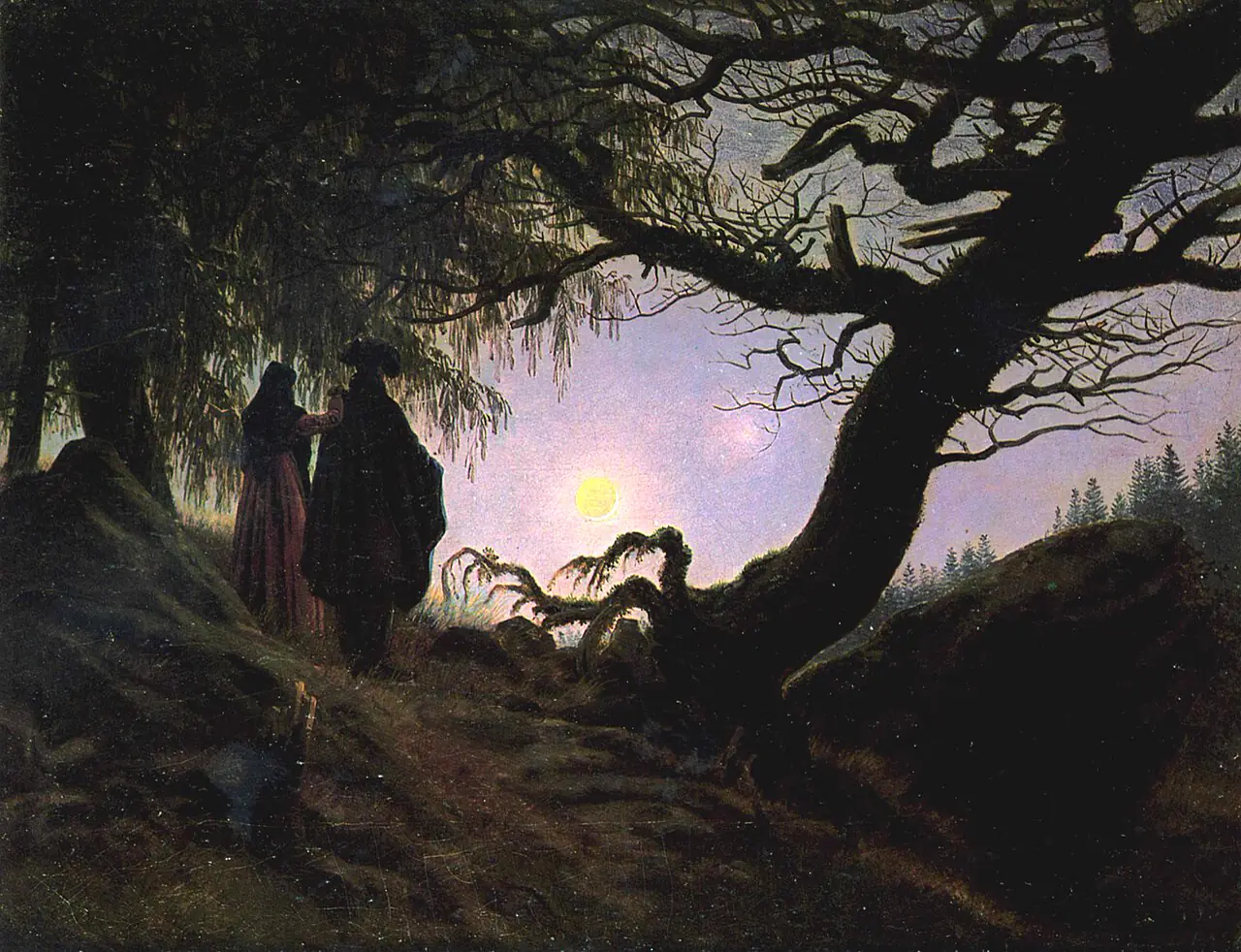
Caspar David FriedrichMan and Woman Contemplating the Moon, c. 1824Oil on canvas · Alte Nationalgalerie, Berlin
The painting shows two people who have stopped together to look at the moon. It makes a good companion piece for Schumann’s Mondnacht, where the voice sings long phrases over small, persistent movements in the piano. In Friedrich’s picture the two figures stand on rough ground among exposed roots.
Heinrich Heine
Im wunderschönen Monat Mai
1822–23; collected in Buch der Lieder, 1827
GermanIm wunderschönen Monat Mai,
Als alle Knospen sprangen,
Da ist in meinem Herzen
Die Liebe aufgegangen.
Im wunderschönen Monat Mai,
Als alle Vögel sangen,
Da hab ich ihr gestanden
Mein Sehnen und Verlangen.
Our translationIn the wonderfully lovely month of May,
when all the buds burst open,
then in my heart
love opened too.
In the wonderfully lovely month of May,
when all the birds were singing,
I confessed to her
my longing and desire.
Heine’s poem is a confession, and the beloved’s reply is not written. Schumann set it as the opening song of Dichterliebe in 1840. The piano begins before the singer and ends after him, and the song closes without the chord that would resolve it. 1827 text and scan.
E. T. A. Hoffmann
Beethovens Instrumentalmusik · from Kreisleriana
Collected in 1814
German proseDie Musik schließt dem Menschen ein unbekanntes Reich auf, eine Welt, die nichts gemein hat mit der äußern Sinnenwelt, die ihn umgibt und in der er alle bestimmten Gefühle zurückläßt, um sich einer unaussprechlichen Sehnsucht hinzugeben.
Our translationMusic opens to a person an unknown domain, a world with nothing in common with the outward world of the senses surrounding them, in which they leave behind all definite feelings to surrender to an inexpressible longing.
Later in this essay, Hoffmann’s Kapellmeister Kreisler sits beside the piano after hearing Beethoven’s first Op. 70 Trio and writes down its effect on him. Hoffmann presented criticism as a scene in a story. Schumann took Kreisler’s name for his Op. 16, and in Hoffmann he had a model for writing in the voice of an invented musician. The Beethoven essay.
Recommended recordings
KreislerianaRadu LupuDeccaLupu gives the middle voices of the quiet passages warmth and weight, and he plays the sudden violent turns as interruptions of the line of thought.
Fantasie in C majorSviatoslav RichterEMIA first choice. The upheavals of the first movement are held within one long line, and the intensity of the slow finale is sustained without forcing the volume.
DichterliebeFritz Wunderlich, Hubert GiesenDeutsche GrammophonWunderlich sings the young lover with a direct tone. Giesen’s accompaniment is plain, and he plays the piano postludes without added interpretative emphasis.
Piano ConcertoDinu Lipatti, Philharmonia Orchestra, Herbert von KarajanColumbia · 1948Lipatti shapes his phrases without holding up the orchestra. The 1948 mono recording preserves the give-and-take between soloist and orchestra clearly.
SymphoniesStaatskapelle Dresden, Wolfgang SawallischEMIThe Dresden sound has body, and Sawallisch keeps it moving. The horns in the “Rhenish” are a particular pleasure, and the busy inner parts are seldom indistinct.
Schumann’s music draws on Bach’s fugues, Beethoven’s returning themes and Jean Paul’s masked balls. He was a friend and advocate of the young Brahms, and heard the promise of an orchestra in Brahms’s sonatas. Tchaikovsky took Schumann’s short pieces for children as a model for his own Children’s Album.