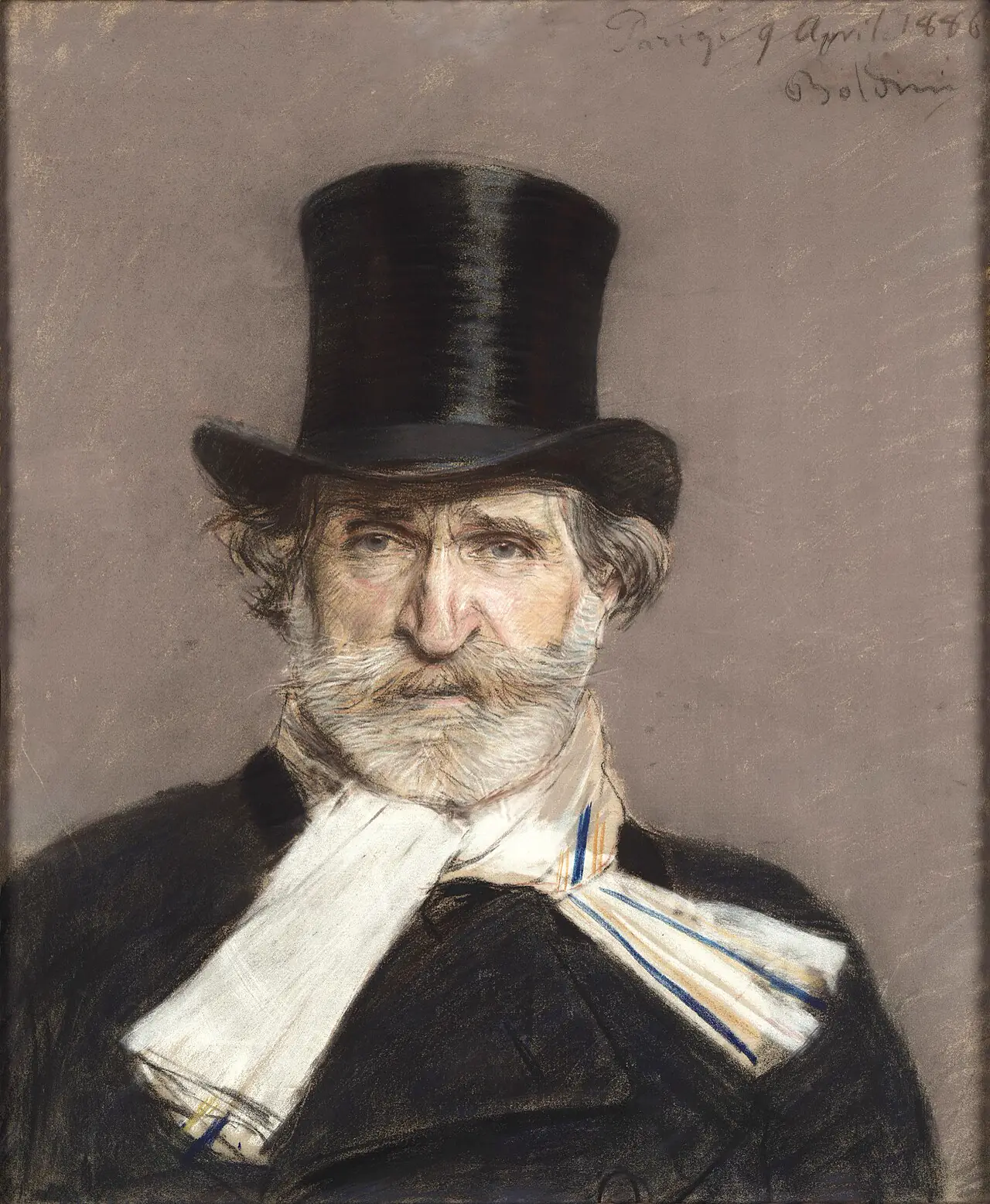
Provesi in Busseto; private lessons with Lavigna after Milan’s Conservatoire rejected him
Theatres
Milan · Venice · Florence · Rome · Naples · Paris · St Petersburg · Cairo
Librettists
Piave, Cammarano and Boito, his principal collaborators
Output
Operas from Oberto (1839) to Falstaff (1893); the Requiem, sacred music, songs and a string quartet
Life
Milan’s Conservatoire turned Giuseppe Verdi down in 1832. Antonio Barezzi, a merchant from Busseto who had helped pay for his move to Milan, kept supporting him, and Verdi studied privately with Vincenzo Lavigna, formerly a musician at La Scala. He learnt counterpoint and went to the theatre. Four years later he married Barezzi’s daughter Margherita and took a municipal musical post in Busseto. His patrons had known him since he was a boy and had heard him play, and they supported him with their own money.
His parents kept an inn and shop at Le Roncole, where he was born in 1813. He learnt the organ locally, then studied with Ferdinando Provesi in nearby Busseto. Oberto, his first opera, reached La Scala in 1839 and earned him further commissions. His daughter Virginia had died in 1838; his son Icilio died in 1839, and his wife Margherita in June 1840, when Verdi was twenty-six. That September the theatre presented his comedy Un giorno di regno, which failed.
1842–50Nabucco and later commissions
Nabucco changed his prospects in March 1842. Giuseppina Strepponi sang Abigaille, the king’s ferocious supposed daughter, and a chorus of exiles sang Va, pensiero. Temistocle Solera’s libretto supplied a captive people, a mad king and a conflict between religions. Verdi wrote for large groups of voices acting together. In the exiles’ chorus the whole chorus sings one shared melody.
Commissions followed for I Lombardi, Ernani, I due Foscari and Attila, among others. Verdi chose subjects, argued over casts, dealt with censors and supervised rehearsals, then moved to the next theatre. Writing to Clara Maffei on 12 May 1858, he looked back to Nabucco: “Sixteen years in the galleys!” The work required music that a particular singer could deliver on a particular evening. He learnt how to move from dialogue into a slow melody, let an interruption change the situation, then release the singer into a fast cabaletta.
His letters to librettists could be mercilessly practical. On 4 September 1846, working on Macbeth, he told Francesco Maria Piave: “Remember that there must be no useless word in the verse: everything must say something.” Shakespeare’s witches and Lady Macbeth are at the centre of the opera. In the sleepwalking scene the soprano goes back over the murder in broken, subdued phrases while scrubbing at blood she can still see. The opera was heard in Florence in 1847; for Paris in 1865 Verdi rewrote substantial stretches, including the ending.
By the beginning of the 1850s he could afford to fight hard for a subject. Victor Hugo’s Le roi s’amuse, with its predatory king and court jester, met fierce resistance from the Venetian censors. King Francis I became the Duke of Mantua; the jester kept his deformity, his malice and his daughter. Rigoletto opened at La Fenice in March 1851. In the final act Rigoletto believes he has paid for the Duke’s murder. He then hears the Duke singing La donna è mobile inside the inn, and on opening the sack he finds Gilda.
1853Il trovatore and La traviata
Il trovatore opened in Rome in January, La traviata in Venice in March. Azucena, the Romani woman in Trovatore, has raised the son of the man who burnt her mother; her memories repeatedly take the opera back to the fire. Its lovers sing grand melodies while she tells the story they do not understand. Traviata was adapted from Dumas fils. In it, Alfredo’s father asks Violetta to give up his son so that his daughter can make a respectable marriage.
In the long scene with Germont, Violetta first assumes he wants a temporary separation. As his meaning becomes clear, her quick objections give way to the quiet line of Dite alla giovine. She agrees to leave Alfredo and asks Germont to tell his daughter what the sacrifice has cost. The duet changes pace several times, following each stage of what she learns. In the party music elsewhere in the opera she sings in a different manner, brilliant and ornamented, as a woman paid to be amusing.
Sant’AgataSant’Agata, Don Carlos and Aida
Strepponi became Verdi’s partner and, in 1859, his wife. They made their home at Sant’Agata near Busseto, where he bought land, supervised farming and took a close interest in irrigation. Strepponi told the publisher Léon Escudier that he got up at about dawn to examine the wheat, the maize and the vines, while she preferred to see the sunrise from her bed. During these years he also visited Paris and St Petersburg.
He supported Italian unification and entered the new national parliament in 1861. In Don Carlos, written for Paris in 1867, Philip II can order executions but cannot command his wife’s love or withstand the Grand Inquisitor. Verdi set their confrontation as a duet for two basses. The original five-act French version includes the meeting at Fontainebleau where Carlos and Elisabeth fall in love; the later Italian revisions changed how much of this scene the audience sees.
Aida has trumpets for the army and a large procession for the victory. It also has a night scene beside the Nile for a captive woman, with high strings above her voice, and a scene in which a princess hears the priests condemn the man she loves and cannot stop them. In the last scene the stage is divided in two. Radamès and Aida sing together in the tomb below, and Amneris prays in the temple above.
1874–1901Requiem, Otello and Falstaff
When Alessandro Manzoni died in 1873, Verdi proposed a Requiem for the first anniversary of his death. He conducted it at San Marco in Milan on 22 May 1874. The Libera me reworked music he had written for an abandoned collective memorial to Rossini. The Dies irae returns several times, breaking into the prayers for mercy. At the end the soprano returns to a plea that is close to speech.
Arrigo Boito worked with Verdi on Simon Boccanegra, whose revised version of 1881 gained the Council Chamber scene. Otello followed in 1887. Boito cut Shakespeare’s Venetian first act, and Verdi began the opera with a storm off Cyprus and the crowd waiting for Otello’s ship. Their second new opera, Falstaff, reached La Scala in 1893, fifty-three years after Verdi’s first comedy had failed. In it the old knight is tipped into the Thames in a laundry basket, and he later joins in the final fugue.
The Quattro pezzi sacri, published in 1898, included the Stabat Mater and Te Deum. Strepponi had died the previous year. Verdi founded the Casa di Riposo per Musicisti in Milan for retired singers and players without sufficient means, and asked to be buried in its chapel. He died in Milan on 27 January 1901. A month later, crowds accompanied his body and Giuseppina’s to the Casa di Riposo.
Places
Every recorded place, joined in date order. Verdi on the MapAll 23 places, with sources
Le Roncole, near Busseto · 10 October 1813 – 1823 · born
Born to an innkeeper and a spinner, he sang in the church choir and took organ lessons.
In Cortigiani, Rigoletto begins by abusing the men who have abducted his daughter. When his rage achieves nothing, the vocal line turns to pleading, and he asks the courtiers for help. The baritone has to make both voices belong to the same man within a single aria.
𝄋Slow song and quick song
At the end of Traviata’s first act, Violetta asks herself whether she has found love in the slow Ah, fors’è lui, then tries to laugh it off with Sempre libera. The faster cabaletta sets her declaration of freedom with rapid runs. Alfredo’s voice is heard from outside, singing the love melody again.
𝄢Four people at once
In the Rigoletto quartet, the Duke makes love to Maddalena inside the inn while Gilda and her father listen outside. His smooth tune, Maddalena’s laughing replies and Gilda’s broken phrases remain distinct when the voices overlap. Rigoletto has brought his daughter there to hear the Duke with Maddalena.
𝄞Before the curtain
The Prelude to La traviata begins very softly, with the violins high in their register. A warmer string melody follows, and light decoration is then added above it. When the curtain rises, dance music takes over.
𝄾A melody repeated
The Duke’s La donna è mobile is set in short 3/8 phrases built from repeated notes, a quick turn and a brief answering phrase. Near the end of Rigoletto the Duke sings it offstage, and when the jester hears it he learns that his enemy is not dead.
♮The Dies irae
The Dies irae of the Requiem opens with full-orchestra blows and fast string figures, and the chorus shouts the text of judgement. The music returns in later sections and breaks into quieter passages of prayer. At the end, after the final fugue, the soprano sings the plea for deliverance very quietly.
Works
A selection from the composer’s works.
1842
NabuccoOpera in four parts; soloists, chorus and orchestra
Strepponi sang Abigaille at the La Scala première. In Va, pensiero, the chorus of the captive Hebrews sings a single melody.
Verdi rewrote substantial parts for Paris in 1865, eighteen years after the Florence première. In the sleepwalking scene Lady Macbeth tries to rub the blood from her hands.
1851
RigolettoOpera in three acts
The Venetian censors required Hugo’s French king to be changed to a Mantuan duke. When the Duke repeats La donna è mobile offstage, Rigoletto learns that the assassin has killed the wrong person.
1853
Il trovatoreOpera in four parts
Azucena knows the central secret of the plot, that Manrico and the Count, who are enemies, are brothers. She tells of her mother’s execution by fire long before the final catastrophe.
Dumas fils’s La Dame aux camélias supplied the subject. In the opera, Violetta’s long negotiation with Alfredo’s father comes between the party scenes.
Don CarlosFrench opera in five acts; later revised in Italian
The five-act French original opens with Carlos and Elisabeth falling in love at Fontainebleau. The four-act Italian version cuts that act, and their happiness there is known only from what they later recall of it.
1871
AidaOpera in four acts, including stage bands
The final scene requires two levels, with the lovers in their tomb and Amneris praying above them. Verdi ended the opera with three voices, two inside the tomb and one above its stone.
1874
Messa da RequiemSoprano, mezzo-soprano, tenor, bass, chorus and orchestra
First performed in San Marco, Milan, on the anniversary of Manzoni’s death. The Libera me grew from Verdi’s contribution to an earlier, unrealised memorial for Rossini.
OtelloOpera in four acts; libretto by Arrigo Boito
Boito removed Shakespeare’s first act, set in Venice. The opera opens during a storm off Cyprus, and the lovers recall their courtship in the duet that closes Act I.
1893
FalstaffOpera in three acts; libretto by Arrigo Boito
Boito combined The Merry Wives of Windsor with material from the Henry IV plays. Verdi’s last opera ends with a fugue sung by the tricksters and their victim together.
Quoted from the first four bars of the Duke’s vocal entry, one octave above sounding tenor pitch; accompaniment omitted. In B major and 3/8, three repeated notes lead to a clipped turn. The next two bars repeat the pattern a step lower. Rigoletto recognises this tune from inside the inn.
La traviata, Act IAlfredo’s drinking song
Quoted from the opening bars of Alfredo’s drinking song, including the pickup and preceding rests, one octave above sounding tenor pitch. The pickup F leaps a sixth to D, which he holds before moving lightly between the same two notes again. The accompaniment is omitted; the key of B♭ major and the 3/8 time signature are retained.
Sister arts
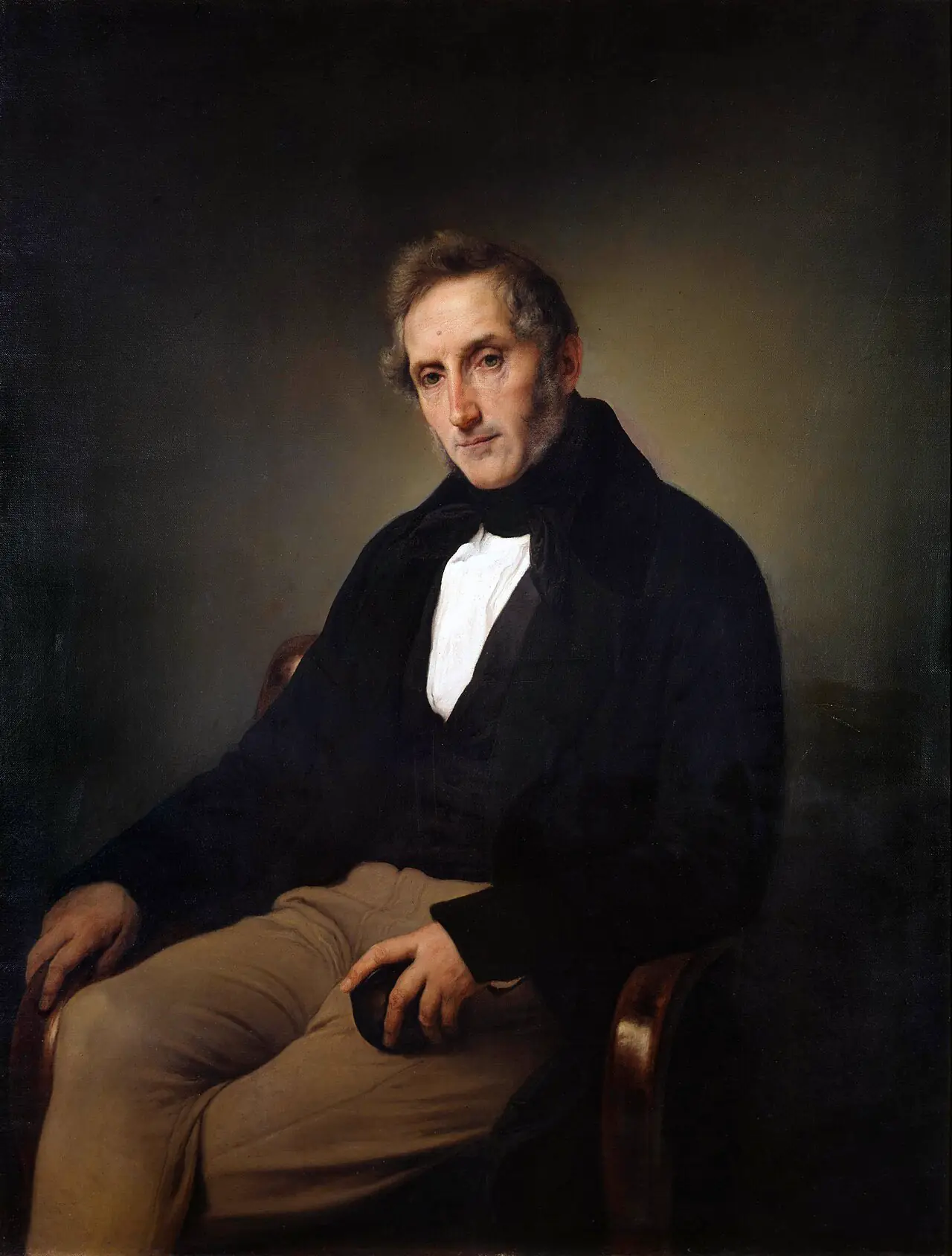
Francesco HayezPortrait of Alessandro Manzoni, 1841Oil on canvas · Pinacoteca di Brera, Milan
Manzoni disliked sitting for portraits, but he gave Hayez fifteen sittings for this one, which his wife Teresa commissioned. The round tobacco tin in his hand was also copied from life. Verdi admired the author of I promessi sposi and wrote the Requiem after his death, conducting it on the first anniversary in 1874. Brera’s account of the sittings.
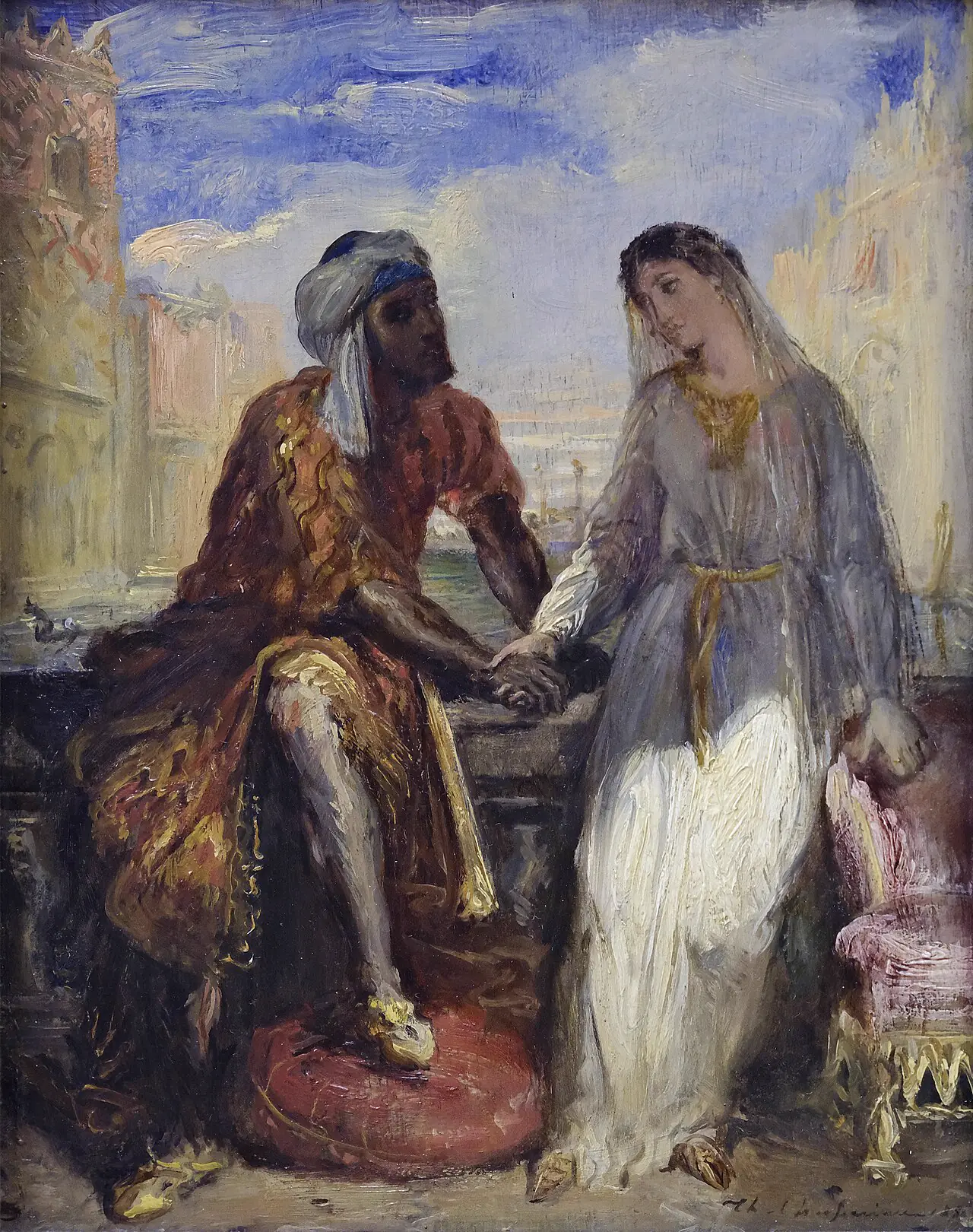
Théodore ChassériauOthello and Desdemona in Venice, 1850Oil on wood · Musée du Louvre, Paris
Othello tells Desdemona about his life, the story of their courtship recalled in Shakespeare’s first act. Boito cut that Venetian act but kept its substance for the duet that closes Verdi’s Act I: she loved him for the dangers he had endured, and he loved her for pitying them. Chassériau painted the couple before the marriage that Iago destroys. Louvre collection record.
William Shakespeare
Macbeth, Act V, scene 5 — “Tomorrow”
c. 1606; first published 1623
EnglishTomorrow, and tomorrow, and tomorrow,
Creeps in this petty pace from day to day,
To the last syllable of recorded time;
And all our yesterdays have lighted fools
The way to dusty death. Out, out, brief candle!
Life’s but a walking shadow, a poor player,
That struts and frets his hour upon the stage,
And then is heard no more. It is a tale
Told by an idiot, full of sound and fury,
Signifying nothing.
In Shakespeare, Macbeth hears of his wife’s death and answers with this speech. Verdi and Piave gave him a much shorter reply, in which life is an idiot’s story, wind and noise. His lament, Pietà, rispetto, amore, comes earlier, when he counts the pity, respect and love his old age will never receive.
Recommended recordings
Messa da RequiemElisabeth Schwarzkopf, Christa Ludwig, Nicolai Gedda, Nicolai Ghiaurov, Philharmonia Orchestra and Chorus, Carlo Maria GiuliniEMI · 1963–64Giulini takes the prayers at unhurried tempi, and Ghiaurov sings the bass part in the solo quartet.
OtelloJon Vickers, Leonie Rysanek, Tito Gobbi, Rome Opera Orchestra and Chorus, Tullio SerafinRCA · 1960Vickers sings with a ringing young voice; Gobbi’s Iago is persuasive. The contrast between military command and private collapse is unusually sharp. Gobbi directs each insinuation at a particular listener.
FalstaffTito Gobbi, Elisabeth Schwarzkopf, Rolando Panerai, Philharmonia Orchestra and Chorus, Herbert von KarajanEMI · 1956Gobbi sings the honour monologue with frequent changes of colour. Karajan and the Philharmonia keep the quick exchanges precise, and Panerai plays Ford with a temper that is dangerous as well as comic.
Puccini inherited theatres and audiences that knew Verdi’s operas by heart. Britten’s War Requiem draws on Verdi’s handling of the Mass for the Dead. Boito, himself a composer, supplied the words, cuts and theatrical inventions for Verdi’s last two operas.
Further reading
Julian Budden, Verdi, third edition (New York: Oxford University Press, 2008). biography
Life-and-works survey centred on the operas.
Roger Parker, ‘Verdi, Giuseppe’, Grove Music Online (Oxford University Press, 2001). reference
Biographical reference, work-list and bibliography; subscription required.
Giuseppe Verdi and Arrigo Boito, The Verdi-Boito Correspondence, edited by Marcello Conati and Mario Medici, English-language edition prepared by William Weaver (University of Chicago Press, 1994). letters
Composer and librettist debate the creation of the revised Simon Boccanegra, Otello and Falstaff.