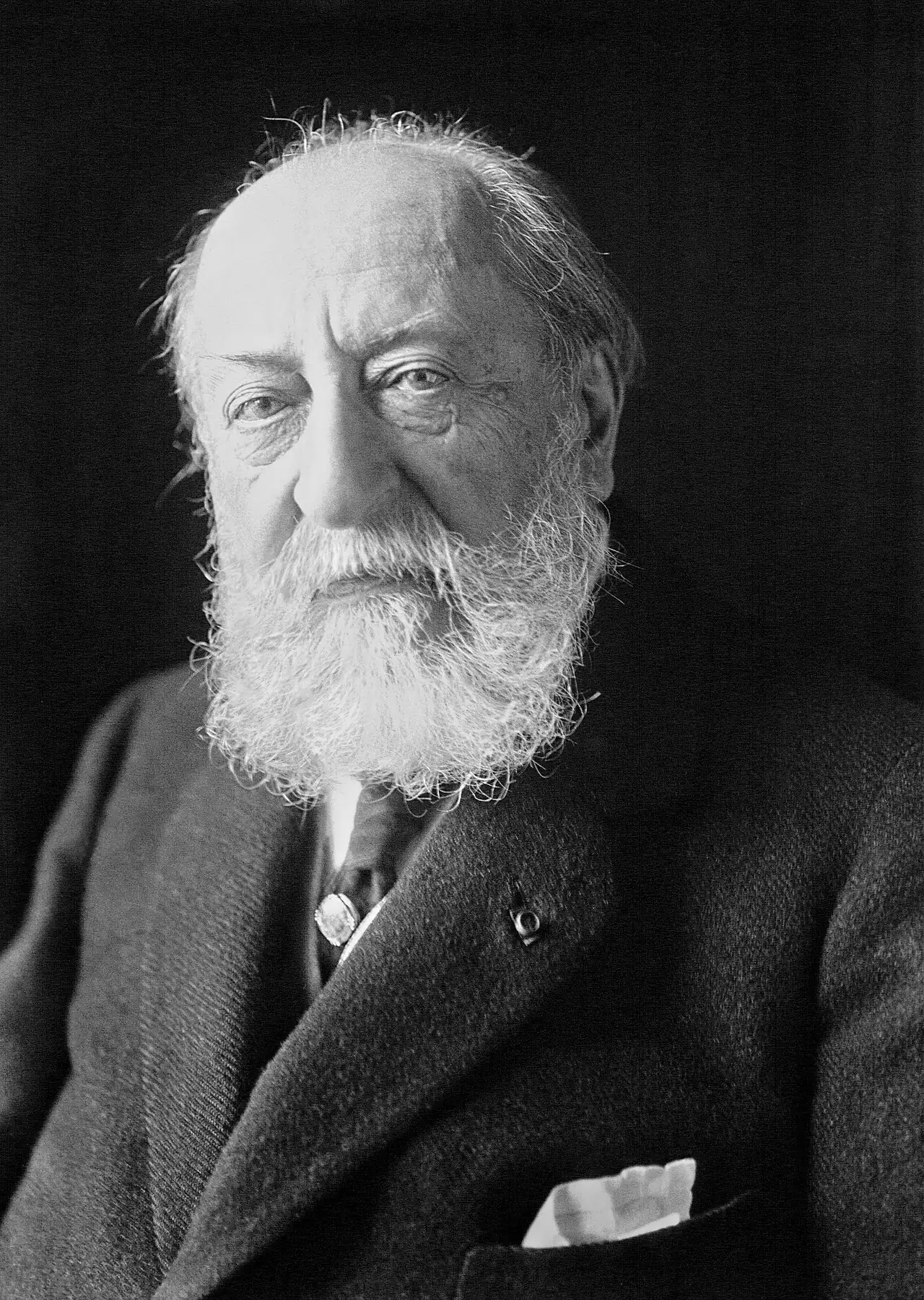
Born 9 October 1835, Paris, FranceDied 16 December 1921, Algiers, French Algeria
Pianist from the age of ten and organist for twenty years, known for the Organ Symphony, a dance of skeletons featuring xylophone, and a zoo suite he forbade anyone to publish.
Piano with Stamaty; organ with François Benoist and composition under Halévy at the Paris Conservatoire, from 1848
Posts
Organist of La Madeleine, 1857–77; piano professor at the École Niedermeyer, 1861–65; co-founder of the Société nationale de musique, 1871
Output
Symphonies, ten concertos, four symphonic poems, operas, organ music, songs and chamber music; also plays, poems and articles
Travels
Spent most winters from 1873 in Algeria, Egypt or the Canary Islands, and kept no fixed address from 1889 to 1905
“I have given it all that I had to give. What I have done I shall never do again.”
Life
Camille Saint-Saëns was born at 3 rue du Jardinet in Paris on 9 October 1835. His father, a clerk in the Ministry of the Interior, died of consumption on 30 December, when the boy was not yet three months old. He was a sickly child and was raised by two widows, his mother Clémence and her aunt Charlotte Masson, who taught him piano. At two and a half he pressed the keys one at a time and waited for each note to die away before playing the next. By his own account he already listened at that age to the kettle on the drawing-room fire, which he called a “microscopic oboe”, and to its sound swelling until the water boiled.
Children’s pieces gave the left hand nothing to do. “The bass doesn’t sing,” he told his teachers in disgust, and was given Haydn and Mozart. On 6 May 1846, aged ten, he played Beethoven’s Third Piano Concerto and a Mozart concerto in B♭ at the Salle Pleyel, and played the whole programme from memory. Someone asked his mother what he would play when he was twenty. “He will play his own,” she said.
1848–1861The organ loft and the library
At the Conservatoire he attended François Benoist’s organ class as an auditor until the day Benoist, with no other student prepared, put him at the instrument. Halévy, his composition teacher, often sent word that he would not come. On those days Saint-Saëns went to the library: “what I devoured there of old and modern music is unimaginable.” In December 1853 François Seghers’s Société Sainte-Cécile played a symphony in E♭ that Seghers had presented as the work of an unknown German. Berlioz and Gounod discussed it at the rehearsal. When the composer’s name became known, Gounod wrote that he had taken on “the obligation of becoming a great master”.
At Seghers’s house in 1854 he first heard Liszt. The dreams of his youth, he wrote, were “only prose beside the Dionysian poem” played by Liszt’s supernatural fingers. In December 1857 he took over the organ of La Madeleine, where Paris came to hear him improvise. He held the post for twenty years.
1861–1875Société nationale and Danse macabre
In March 1861 he took over the piano class at the École Niedermeyer, where he thought himself “more pupil than teacher” and played the boys new scores by Chopin, Liszt, Schumann and Wagner. Gabriel Fauré, one of the boys, remembered it. During the siege of Paris his friend the painter Henri Regnault was killed at Buzenval on 19 January 1871. On 25 February Saint-Saëns and Romain Bussine founded the Société nationale de musique, with the motto Ars Gallica, to have new French music performed. When the Commune was proclaimed in March, Saint-Saëns, a former national guardsman and the organist of the Madeleine, left for London and stayed until the end of May. On 24 May the Commune shot the curé of the Madeleine, the abbé Deguerry.
On 24 January 1875 Édouard Colonne conducted Danse macabre at the Châtelet. In the piece a harp plays the twelve strokes of midnight, a solo violin with its E string tuned down to E♭ plays a tritone, and a xylophone represents the rattling of the skeletons’ bones. The reviews were mixed. By March 1876 he was telling his publisher, Auguste Durand, that violinists no longer wanted their top strings tuned any other way. Ten days after the première he married Marie-Laure Truffot at Le Cateau-Cambrésis. She was nineteen, twenty years his junior.
1877–1881Samson et Dalila at Weimar; two sons
In 1877 a legacy of 100,000 francs from his friend Albert Libon, left to free him from “the servitude of the Madeleine organ”, let him resign the loft. Paris opera directors had turned down Samson et Dalila, a biblical subject. Liszt, he wrote, “did not know a note of it” but had promised in 1870 to stage it at Weimar. On 2 December 1877 the court theatre gave it in German under Eduard Lassen. The Paris Opéra did not stage it until 23 November 1892.
In 1878 both his sons died. André, two and a half, fell from the fourth-floor window of their flat on 28 May. Jean-François, seven months old, died on 7 July. In July 1881, at La Bourboule, the couple separated for good. They never divorced; he paid her a pension all his life, and she attended his funeral.
1886Le Carnaval des animaux and the Third Symphony
His book Harmonie et mélodie (1885) said of Wagner: “I have never been, I am not, I shall never be of the Wagnerian religion.” In January 1886 a Berlin concert was disrupted, and German theatres dropped his works. He withdrew to Chrudim in Bohemia and in a few days wrote a zoological fantasy for the Mardi Gras concert of his friend, the cellist Charles Lebouc. Le Carnaval des animaux was played on 9 March 1886. He allowed a few performances and forbade publication, except for Le Cygne; the rest appeared in 1922.
On 19 May 1886, at St James’s Hall in London, he played a Beethoven concerto, then conducted his Third Symphony for the Royal Philharmonic Society. He had meant to dedicate it to Liszt, who died that July; the dedication reads “to the memory of Franz Liszt”. Paris heard it that winter. Gounod called it “the French Beethoven”. “I have given it all that I had to give,” Saint-Saëns said. “What I have done I shall never do again.”
1888–1914Travels and the Fifth Piano Concerto
His mother died on 18 December 1888. He gave much of his collection to the town of Dieppe and, for some fifteen years, kept no fixed address. In December 1889 he disappeared, and newspapers reported him dead or mad. He had written to Louis Gallet that he wanted to look far away, under other skies, for “the means of making myself another self”. In April 1890 he was recognised from a newspaper portrait in the Canary Islands, where he was travelling as Charles Sannois. In the following years he spent the winters in the south, in Algiers, Las Palmas, Ceylon and Cairo.
In February 1896 he was in Egypt, at Luxor and Karnak with the painter Georges Clairin. On Sunday 22 March he reached Cairo, and the next day began to fill manuscript paper; by 26 March he had 35 pages of the Fifth Piano Concerto. He finished it on 15 April. At the Salle Pleyel on 2 June, fifty years after his debut, he played it himself. Its slow movement uses what he said was a Nubian love song, heard from boatmen on the Nile. In 1908 he wrote the music for a short film, L’Assassinat du duc de Guise, which the Société Camille Saint-Saëns calls the first film score.
1914–1921The last recital
In 1915 he sailed for California as a representative of French artists at the Panama–Pacific Exposition, taking Hail California, a large new piece for organ, orchestra and military band. At San Francisco he gave recitals and conducted three concerts. In 1916, at eighty, he toured France and then South America. “They will say that I cannot sit still,” he wrote; “I should love to stay at home and work in peace. Fate does not want it.”
On 6 August 1921 he gave his farewell recital at the Dieppe casino, after seventy-five years before the public. That November the Opéra revived Ascanio with the role of Scozzone again sung by a contralto. On 4 December he reached Algiers and took rooms at the Hôtel Oasis. He died there on the evening of 16 December. In his last year he had written sonatas for oboe, clarinet and bassoon. A national funeral followed at La Madeleine, and he was buried at Montparnasse, in the chapel he had built for his children.
Places
Every recorded place, joined in date order. Saint-Saëns on the MapAll 20 places, with sources
Paris · 9 October 1835 · born
Born at 3 rue du Jardinet; his father died on 30 December, three months later. Coordinates mark the town or site centre, not a building.
Paris (Conservatoire) · November 1848 – 1852 · studied
Organ with François Benoist from 1848, first prize in 1851; composition under Halévy from 1851. Coordinates mark the town or site centre, not a building.
Paris (La Madeleine) · 7 December 1857 – 1877 · worked
Organist of La Madeleine for twenty years; he resigned the loft in 1877 after Albert Libon’s legacy. Coordinates mark the town or site centre, not a building.
Paris (École Niedermeyer) · March 1861 – March 1865 · worked
Piano professor at the École Niedermeyer; Fauré was among his pupils. Coordinates mark the centre of the town or site and do not identify a particular building.
Paris (Société nationale de musique) · 25 February 1871 · worked
Founded the Société nationale de musique with Romain Bussine; motto Ars Gallica. Coordinates mark the centre of the town or site and do not identify a particular building.
Left Paris when the Commune was proclaimed, in danger as a former national guardsman and the Madeleine’s organist, and stayed away until the end of May; gave concerts and wrote songs. Coordinates mark the centre of the town or site and do not identify a particular building.
Samson et Dalila was first performed at the Grand-Ducal Theatre, in German, under Eduard Lassen, as Liszt had promised. Coordinates mark the centre of the town or site, not a building.
Withdrew here after the Berlin concert was disrupted and wrote Le Carnaval des animaux. Coordinates mark the centre of the town or site and do not identify a particular building.
Reported in the Canary Islands in April 1890, recognised from a newspaper portrait while travelling as Charles Sannois; he wintered in the Canary Islands many times. Coordinates mark Las Palmas, not the place of the sighting.
Visited Luxor and Karnak with the painter Georges Clairin; finished his Second Violin Sonata here in mid-March. Coordinates mark the centre of the town or site, not a particular building.
San Francisco · 23 May 1915 – 9 July 1915 · travelled
Represented French artists at the Panama–Pacific Exposition; gave recitals and conducted three concerts of his works. Coordinates mark the town or site centre; they do not mark a specific building.
Dieppe · 3 August 1921 – 11 August 1921 · travelled
Gave his farewell recital at the casino on 6 August, after seventy-five years as a concert artist; the town holds his museum. Coordinates mark the town or site centre, not a building.
Buried in the chapel he had built for his children, after a national funeral at La Madeleine. Coordinates mark the centre of the town or site and do not identify a particular building.
The Third Symphony is in two large movements, each of which contains a slow movement or a scherzo. In Part I the Adagio introduction, with phrases for oboe, cor anglais and bassoon, leads into a fast Allegro in the strings; the organ first enters with soft chords in D♭ major under the slow melody. In Part II a scherzo in C minor has a Presto in C major as its middle section, with scales for the piano, and a loud C major chord on the organ opens the finale. The organ does not play for much of the work.
𝄢Borrowed colour
Danse macabre adds a xylophone for the bones and retunes the solo violin’s E string to E♭, so that the open A and E♭ strings form a tritone. The Third Symphony adds a piano duet in the upper register, a sonority he took from Berlioz’s Lélio.
♭Orientalism
The slow movement of the Fifth Piano Concerto passes from an Arabic-sounding theme to a Nubian love song in G, then to quiet chirruping in F♯ major with a Chinese-sounding tune over tam-tam strokes. A cadenza in the manner of a Spanish guitar follows. Saint-Saëns called the movement a voyage to the Orient.
𝄞The piano as an equal partner
His concertos treat piano and orchestra as partners and are full of cadenza-like passages. The Second opens with a long solo that began in his organ improvisations, a homage to Bach, and its main theme came from Fauré.
♩Long melody over small-note accompaniment
In Le Cygne a cello plays a slow melody in G major over an accompaniment of continuous broken chords in six crotchet beats to the bar.
Works
A selection from the composer’s works.
1858
Piano Concerto No. 1Op. 17Piano and orchestra
Begins with antiphonal horn calls; the accompaniment of its slow movement is reduced to strings, clarinet and bassoon.
1868
Piano Concerto No. 2Op. 22Piano and orchestra
First played at the Salle Pleyel on 13 May 1868 with Anton Rubinstein conducting. Opens with a solo in the manner of an organ improvisation; the theme of the first movement came from Fauré.
1872
Le Rouet d’OmphaleOp. 31Orchestra
The first of his four symphonic poems, first played in orchestral form on 14 April 1872 and dedicated to Augusta Holmès.
1872
Cello Concerto No. 1Op. 33Cello and orchestra
Played first by Auguste Tolbecque at the Société des Concerts du Conservatoire on 19 January 1873.
Written at Chrudim for the Mardi Gras concert of 9 March 1886. Published only after his death, in 1922; the thirteenth piece, Le Cygne, appeared in his lifetime.
Symphony No. 3 “Organ”Op. 78Orchestra, organ and piano four hands
Commissioned by the Royal Philharmonic Society; first conducted by the composer in London on 19 May 1886. Dedicated to the memory of Liszt.
1887
HavanaiseOp. 83Violin and piano; violin and orchestra
Composed in 1887; the Société Camille Saint-Saëns lists it in its violin-and-piano version.
1896
Piano Concerto No. 5 “Egyptian”Op. 103Piano and orchestra
Written in Cairo in about three weeks and first played by the composer on 2 June 1896. The slow movement is the Nile movement.
1908
L’Assassinat du duc de GuiseFilm score
Music for André Calmettes’s film, shown in the Visions d’art series; the Société Camille Saint-Saëns calls it the first film score.
1921
Sonatas for oboe, clarinet and bassoonOpp. 166–168Wind instrument and piano
Begun in Algeria in the spring of 1921 and finished in Paris.
In the score
Short examples, engraved and playable.
The chant — quotedDies irae, before Saint-Saëns
The opening eight notes of the plainchant sequence, as printed in the Vatican Graduale Romanum of 1908, p. 83*. Equal note lengths are an editorial aid, because the chant has a free rhythm. In Danse macabre the woodwinds play the melody in a major key.
The solo violin — schematicOpen strings and the tritone
The example is schematic and is not quoted from the score. The solo violin of Danse macabre has its E string lowered to E♭, so the open strings are G, D, A and E♭. Sounded together, the open A and E♭ form a tritone.
Sister arts
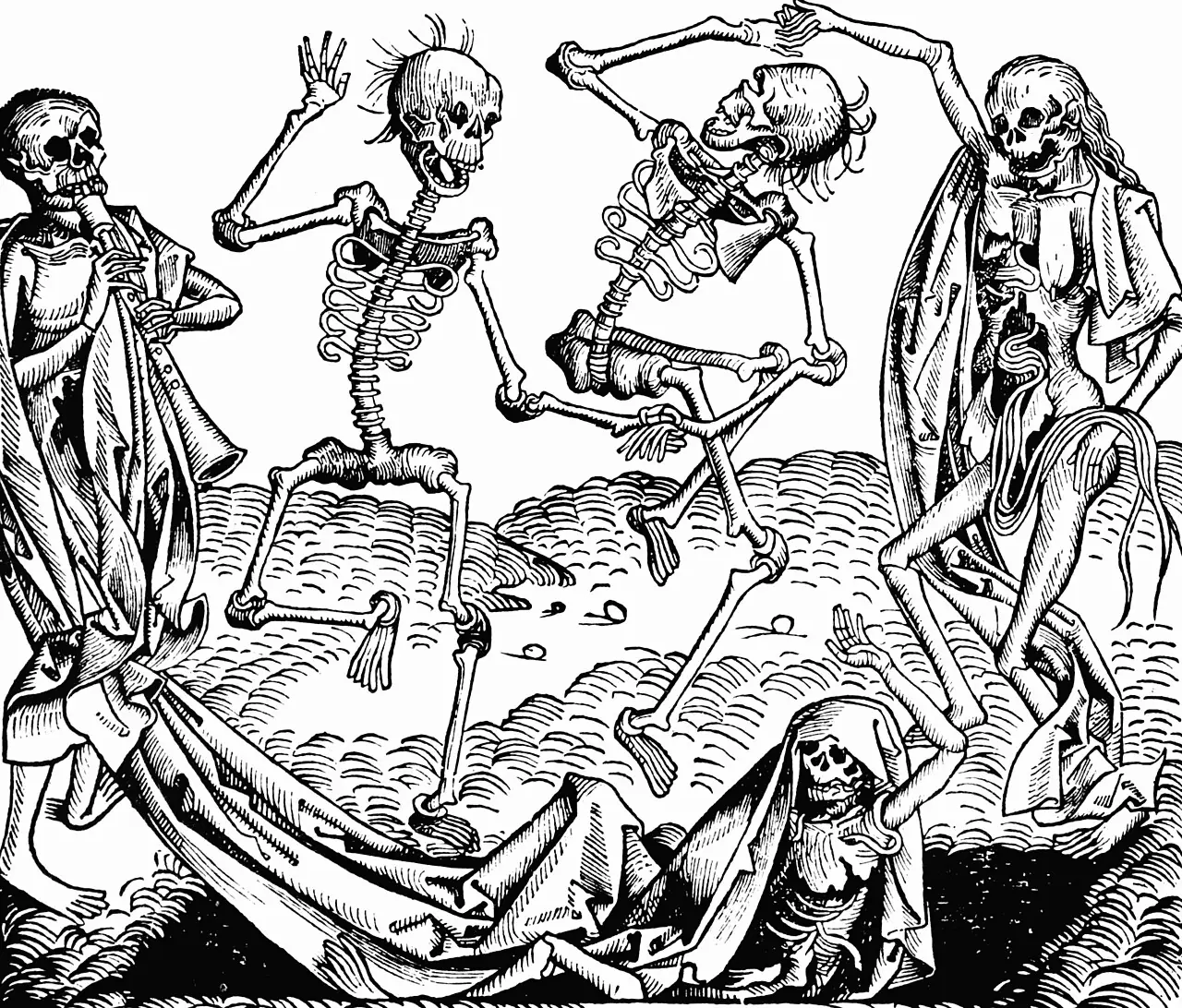
Michael WolgemutDance of Death (Imago mortis), 1493Woodcut · Hartmann Schedel, Nuremberg Chronicle
Skeletons dance in the woodcut from the Nuremberg Chronicle, which belongs to the same tradition that Saint-Saëns inherited. Before it reached the orchestra and the xylophone, the danse macabre was a medieval allegory in which death danced with the Pope, the emperor and the pauper alike.
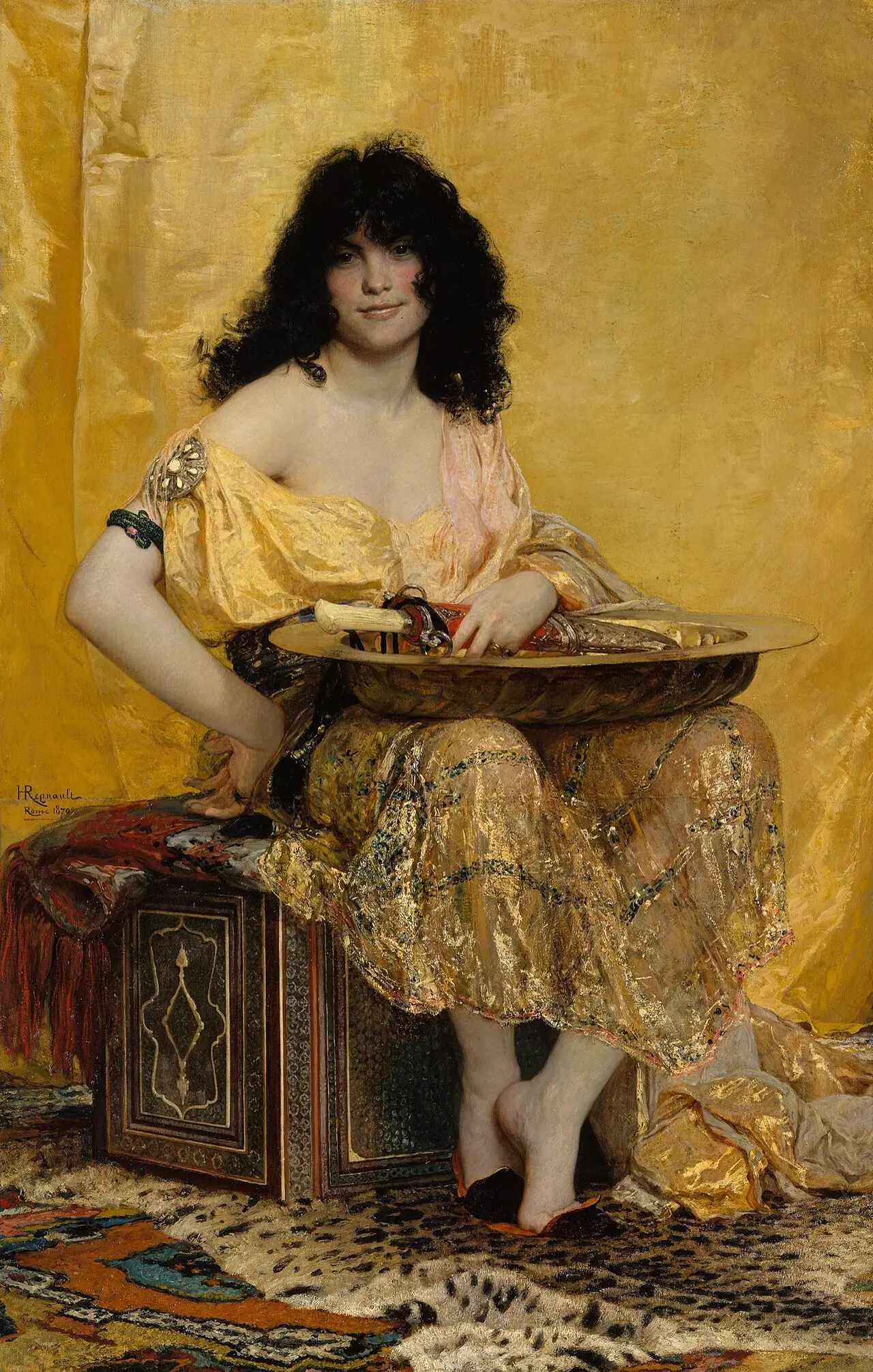
Henri RegnaultSalomé, 1870Oil on canvas · The Metropolitan Museum of Art, New York
Regnault was Saint-Saëns’s friend, and the two travelled in Brittany with other painters. He was killed at Buzenval on 19 January 1871. Saint-Saëns dedicated the fourth of his Mélodies persanes, Sabre en main, and the Marche héroïque to him.
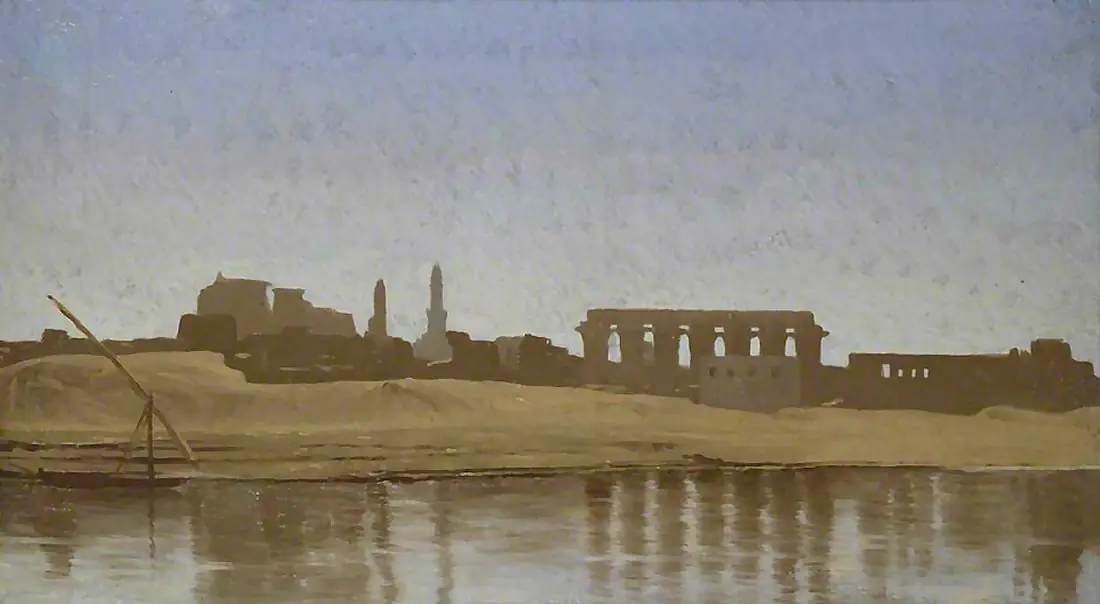
Jean-Léon GérômeView of the Nile at Luxor, 1857Painting · Ashmolean Museum, Oxford
Saint-Saëns reached Luxor and Karnak in February 1896 with the painter Georges Clairin and finished a violin sonata there. The Fifth Piano Concerto followed in Cairo. Its slow movement is built around a love song he said he heard sung by boatmen on the Nile.
Henri Cazalis (as Jean Lahor)
Égalité, Fraternité…
Mélancholia, 1868
FrenchZig et zig et zig, la mort en cadence
Frappant une tombe avec son talon,
La mort à minuit joue un air de danse,
Zig et zig et zag, sur son violon.
Mais psit ! tout à coup on quitte la ronde,
On se pousse, on fuit, le coq a chanté.
Oh ! la belle nuit pour le pauvre monde !
Et vive la mort et l’égalité !
Our translationZig and zig and zig, Death keeping time,
Striking a tomb with his heel,
Death plays a dance tune at midnight,
Zig and zig and zag, on his violin.
But hush! All at once the round breaks up,
They jostle, they flee, the cock has crowed.
Oh, what a fine night for the poor world!
And long live death and equality!
The first and last stanzas of the poem Saint-Saëns set as a song in 1872 and then turned into Danse macabre. The solo violin plays Death’s fiddle, and an oboe plays the cock that ends the night.
Where to hear more
Piano pieces and accompaniments, recorded by the composer1904 and 1919
Camille Saint-Saëns, piano; with Meyriane Héglon and Gabriel Willaume · Marston Records · 26 June 1904; 1919
This set of Saint-Saëns’s recordings at the keyboard (Marston 52054-2) includes the 1904 Gramophone and Typewriter sides, with extracts from the Second Piano Concerto, the Rhapsodie d’Auvergne and an improvised cadenza on Africa, together with his own piano pieces; the Valse mignonne is played in both 1904 and 1919. It also holds the sides on which he accompanied Héglon in arias from Ascanio and Samson et Dalila.
Stephen Hough, piano; City of Birmingham Symphony Orchestra; Sakari Oramo · Hyperion · September 2000
All five concertos in one set (Hyperion CDA67331/2), including the Egyptian with its Nubian love song, and the best single place to start with the piano music. Phillip Borg-Wheeler’s booklet note can be read free on the label’s page.
His great-aunt gave him his first piano lessons, Stamaty taught him the Kalkbrenner method and Benoist the organ. Liszt championed him from the 1850s and had Samson et Dalila staged. Fauré, Gigout and, later, Messager were his pupils at the École Niedermeyer.
Saint-Saëns’s own account of his childhood, the old Conservatoire, Liszt and the road to Samson et Dalila, with the story of the kettle’s oboe.
Société Camille Saint-Saëns, Chronologie, 1835–1921 (website of the Société). chronology
A dated chronology in eleven periods, based on letters, recording where he was on given days and who wrote to whom, with quotations from his letters and from reviews.
For the writing and publication of the concertos and symphonies, the catalogue supplies the letters to Durand that Henle’s preface (linked) cites for the Fifth Piano Concerto.
Macdonald’s study of the operas, incidental music and film score; his Boston Symphony note (linked) is a short introduction to his view of the symphony.