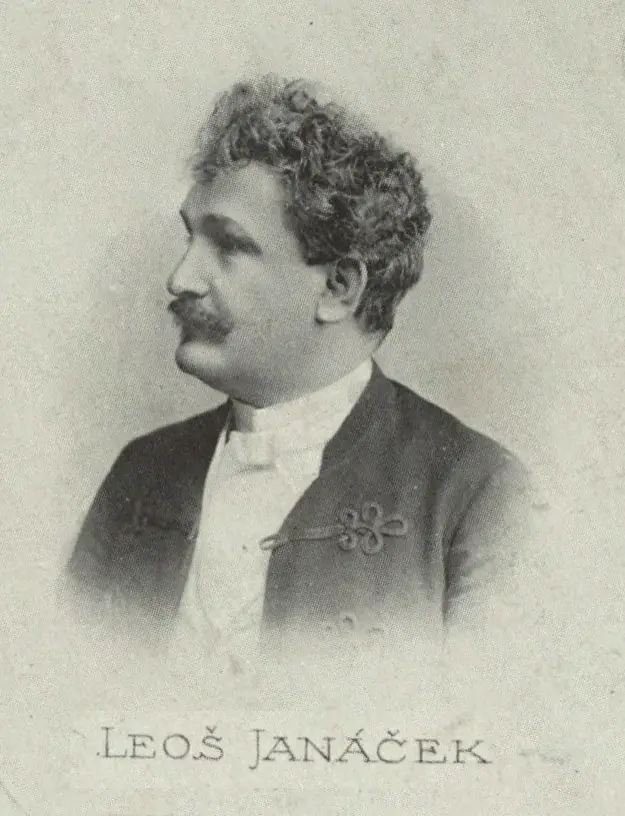
LeošJanáček
Composer who wrote down the voices of strangers in Brno and wrote operas known for their recognisable characters.
- Trained
- Chorister in Old Brno; organ studies in Prague; conservatories in Leipzig and Vienna
- Brno
- Founded the Organ School in 1881; directed it until 1919
- Breakthrough
- Jenůfa: Brno 1904, Prague 1916, Vienna 1918
- Output
- Nine operas, two string quartets, Sinfonietta, Glagolitic Mass, piano music and folk-song collections
Life
In August 1865, Janáček’s mother took her eleven-year-old son to Brno and left him at the Augustinian monastery. His father, a schoolmaster in Hukvaldy, was ill, and the family needed the scholarship. Nearly sixty years later, in his autobiographical sketch of 1924, Janáček recalled “a hard bed, harder bread. No caresses.” The monastery’s choirmaster, Pavel Křížkovský, taught him music. The boy sang at services, went to concerts and the theatre, and learned the profession that kept him in Brno for the rest of his life.
He trained as a teacher, studied at the Prague Organ School, and attended the conservatories in Leipzig and Vienna. In Prague he also formed a lasting friendship with Dvořák. Back in Brno he taught, conducted the Beseda choir and organised concerts; in 1881 he founded the Organ School, which he directed until 1919. His programmes included Beethoven’s Missa solemnis and Dvořák’s Stabat mater.
1881–1903Olga, Vladimír and Jenůfa
He married his former piano pupil Zdeňka Schulzová in 1881. They had a daughter, Olga, and a son, Vladimír, who died aged two in 1890. Olga died in February 1903, at twenty, while her father was finishing Jenůfa. The marriage continued. In his 1924 recollection Janáček imagined binding the opera “with the black ribbon of the long illness, pain and lamentation of my daughter Olga and my little boy Vladimír”. He dedicated it to Olga.
He had begun Jenůfa in 1894, adapting Gabriela Preissová’s play Její pastorkyňa (Her Stepdaughter), and he kept her prose. In the play a young woman bears a child outside marriage, and her stepmother, the Kostelnička, drowns the baby to save her from disgrace. The child is found beneath the melting ice on Jenůfa’s wedding day. In the first act a xylophone plays a repeated figure beneath the singing, representing the mill wheel. In the last act Jenůfa forgives the woman who killed her son, and the opera ends with Jenůfa and Laca together.
The notebooksJanáček’s speech melodies
From 1897 he filled notebooks with the rise and fall of ordinary voices, heard in the market, on trains and in the street. His collection grew to more than four thousand entries and included barking dogs, mosquitoes and creaking floorboards. He held that the words alone were insufficient, and that a repeated syllable or a sudden high note could disclose anxiety that the sentence concealed. On 25 January 1925, on Brno’s Špilberk hill, he stopped to record a passing woman’s pleased remark about the view.
He had already spent years collecting Moravian songs with František Bartoš, and in time he brought a phonograph into the work. Their major joint collection appeared in 1901. In his own music the short phrases and uneven accents remained long after he stopped relying on folk-song arrangements. His male choruses on poems by Petr Bezruč deal with poverty, dispossession and national oppression, and were sung by the Moravian Teachers’ Choir. Writing to Bezruč on 1 October 1924, he recalled making from the poems “a storm of rage, despair and pain in sound”.
1904–16Jenůfa in Brno and Prague
Brno staged Jenůfa on 21 January 1904. Prague had refused it, and twelve more years passed before it reached the capital. Meanwhile Janáček continued teaching and composing in Moravia. His piano sonata 1. X. 1905 commemorated František Pavlík, who was killed during demonstrations for a Czech university in Brno. Janáček destroyed its final movement and later threw away the rest. The first two movements survive because the pianist Ludmila Tučková had kept a copy of them.
On 26 May 1916 the National Theatre performed the opera, with Kovařovic conducting his revised score. Janáček was sixty-one. Max Brod heard it, translated the libretto into German and brought it to Universal Edition. Vienna followed in 1918, New York in 1924.
1917–28Kamila and the theatre
At Luhačovice in 1917 he met Kamila Stösslová, a married woman thirty-seven years younger than he was. He wrote to her for the rest of his life, associated her with the women in his operas and imagined, in his letters, a life they shared. On 1 February 1928 he announced a new quartet: “Our life will be in it.” He first called it Love Letters and planned to use a viola d’amore. It became Intimate Letters, with an ordinary viola, which has many exposed passages.
Janáček had long read Russian literature. Ostrovsky’s The Storm became Káťa Kabanová, first performed in 1921; its heroine looks for love outside her marriage and is driven to her death. Tolstoy’s The Kreutzer Sonata became the First String Quartet in 1923. Its bowing can change within seconds from a sung line to a scraping, rapid repetition. In the opera The Makropulos Affair (1926), after Karel Čapek, a legal dispute leads to the story of a woman who has lived for three centuries.
The Cunning Little Vixen came from the newspaper. The Janáčeks’ servant Marie Stejskalová remembered laughing over Stanislav Lolek’s drawings and Rudolf Těsnohlídek’s story in Lidové noviny, then handing the paper to her employer. The opera reached the Brno stage in 1924. Among the animals, the foxes marry and the hens squabble. The humans drink, and Harašta shoots the vixen. In the final scene the Forester meets a little frog, which has to explain to him that it is the grandson of the one he remembers.
The last summersSinfonietta, Glagolitic Mass, last opera
The Sinfonietta of 1926 began as a fanfare for the Sokol gymnastics festival. Janáček had in mind a military band he had heard in Písek. The opening is scored for nine trumpets, two bass trumpets, two tenor tubas and timpani, and the full orchestra joins these instruments when the fanfare returns at the end. That summer at Luhačovice he also wrote most of the Glagolitic Mass, a setting of Old Church Slavonic words for soloists, chorus, orchestra and organ. The tenor part has high, exposed phrases, and near the end the organ has a movement to itself.
In July 1928 Janáček took From the House of the Dead to Hukvaldy to continue revising it. He had made the libretto himself from Dostoevsky’s Russian. In the opera prisoners tell their stories, chains rattle in the orchestra, and an injured eagle recovers and is released. Most of the men remain behind. Kamila and her son joined him in Hukvaldy. He caught pneumonia and died in Ostrava on 12 August, leaving the final revisions unfinished.
Places

All 18 places, with sources
- Hukvaldy · 3 July 1854 – 1865 · born
Born into a schoolmaster’s family with six surviving siblings and baptised Leo Eugen; a gifted child whose family had limited means.
- St Thomas’s Abbey, Brno · 1865–1872 · studied
Enrolled as a foundation ward; he sang under Pavel Křížkovský and occasionally played the organ.
- Prague Organ School · 1874 – 24 July 1875 · studied
He was expelled for criticising Skuherský’s Gregorian mass, then readmitted, and graduated best in his class on 24 July 1875.
- Leipzig Conservatory · October 1879 – February 1880 · studied
Dissatisfied with his teachers, and denied a place with Saint-Saëns in Paris, he moved on to Vienna.
- Vienna Conservatory · April 1880 – June 1880 · studied
Studied composition with Franz Krenn; he left in June, disappointed, although Krenn’s report on him was complimentary.
- Brno · 13 July 1881 – August 1928 · lived
Married his pupil Zdenka Schulzová; he founded and directed the organ school from 1881, later the Brno Conservatory.
- Saint Petersburg · 1902 · travelled
One of two visits to Russia that year; he took his daughter Olga to study Russian.
- Luhačovice spa · 1904 · travelled (inferred)
After Prague rejected Jenůfa, he went away to recover. He met Kamila Urválková, whose love story was the basis of Osud.
- National Theatre, Brno · 21 January 1904 · premiere
Premiere of Jenůfa, dedicated to his late daughter Olga; Prague refused it for twelve years. Jenůfa.
Jenůfa — Wikipedia (English) · Leoš Janáček — Wikipedia (English)
- National Theatre, Prague · 1916 · premiere
The revised Jenůfa was a great success in Prague. It brought him his first acclaim and access to the world’s opera stages. Jenůfa (Prague).
- National Theatre, Brno · 23 November 1921 · premiere
First performance of Káťa Kabanová, dedicated to Kamila Stösslová, when he was sixty-seven. Káťa Kabanová.
- National Theatre, Brno · 6 November 1924 · premiere
Premiere of The Cunning Little Vixen under František Neumann. The Cunning Little Vixen.
- Prague · 26 June 1926 · premiere
First performance of the Sinfonietta, conducted by Václav Talich; the work was soon widely praised by critics. Sinfonietta.
Sinfonietta (Janáček) — Wikipedia (English) · Leoš Janáček — Wikipedia (English)
- Brno · 5 December 1927 · premiere
Premiere of the Glagolitic Mass by the Brno Arts Society under Jaroslav Kvapil; he revised it the next year. Glagolitic Mass.
- Štramberk · August 1928 · travelled
Excursion with Kamila Stösslová and her son Otto, on which he caught the chill that became pneumonia.
- Brno Central Cemetery · August 1928 · buried
Large public funeral with music from the last scene of The Cunning Little Vixen; buried in the Circle of Honour.
- Sanatorium of Dr L. Klein, Ostrava · 12 August 1928 · died
Died of pneumonia at seventy-four, shortly after composing his second string quartet, Intimate Letters.
- National Theatre, Brno · 12 April 1930 · premiere
Posthumous premiere of From the House of the Dead, his last opera, two years after his death. From the House of the Dead.
Influences
Teachers, encounters and borrowed music, each with its account and sources in the Web of Influence.
Influences received
Influences passed on
- None listed.
The sound
Speech and melody
Janáček’s singers repeat a note, leap upwards, break off and start again. In Jenůfa the Kostelnička has to plead, lie and confess, and the length and pitch of each phrase follow what she is doing at that moment. He had trained his ear for character in his speech notebooks. A change of mind can take a few syllables, sung before the orchestra has finished its repeating figure.
Repetition
The xylophone at the start of Jenůfa repeats its figure while the voices sing around it. Short repeated figures of this kind run through Janáček’s music, and they can suggest a machine, a dance step or a recurring thought. He moves them between instruments or changes the chords beneath them, while the repeated notes themselves stay the same.
Harmony
A Janáček phrase can be tuneful and then end on an unexpected chord. In the Sinfonietta, short dance phrases meet with little preparation, and the brass can interrupt the strings before a cadence arrives. Held notes and repeated figures make these collisions audible, and familiar material is heard within a new chord.
Orchestration
The Sinfonietta opens with brass and timpani alone; the strings enter later. Low trombones play agile passages, and high woodwind cut through the orchestra. Janáček wrote for the awkward edge of an instrument. In the Glagolitic Mass, the organ plays solo, without the singers.
Dramatic shape
In The Cunning Little Vixen, a scene in the forest can be followed by men drinking at the inn; the animals continue their lives while the humans grow older. From the House of the Dead passes from one prisoner’s story to another. In both operas Janáček built the evening from these encounters, and short musical figures return so that characters and situations can be recognised.
Works
A selection from the composer’s works.
- 1894–1903; revised laterJenůfaOpera in three actsGabriela Preissová’s village tragedy, set in prose and dedicated to Janáček’s daughter Olga. In the first act a xylophone plays the figure of the mill wheel.
- 1900–11On an Overgrown PathPianoTwo series of short pieces. The first ends with The Barn Owl Has Not Flown Away! The pieces draw on childhood recollections and the fear of death.
- 1915–18Taras BulbaOrchestra with organThree episodes from Gogol, each ending in a death: Andrei, Ostap and finally their father Taras. The last movement follows the execution with an orchestral proclamation on a large scale.Recordings in the Hall
- 1919–21Káťa KabanováOpera in three actsBased on Ostrovsky’s The Storm, compressed into three acts. Káťa wants freedom and comes into conflict with her mother-in-law, the Kabanicha, who rules the household.
- 1922–23The Cunning Little VixenOpera in three actsA newspaper serial became an opera after the Janáčeks’ servant drew his attention to it. The opera ends with a conversation between the Forester and a small frog.
- 1923String Quartet No. 1 “The Kreutzer Sonata”String quartetTolstoy’s story of jealousy and murder was the starting point. Singing phrases are cut short by repeated notes, tremolo and sudden changes of speed.
- 1926SinfoniettaOrchestra and additional brass ensembleThe opening fanfare needs nine trumpets, two bass trumpets, two tenor tubas and timpani. It returns at the end with the full orchestra behind it.
- 1926; revised 1927Glagolitic MassFour vocal soloists, mixed chorus, orchestra and organThe Mass in Old Church Slavonic, with a solo for organ near the end. First performed in Brno in December 1927 and revised around the time of that première.
- 1927–28From the House of the DeadOpera in three actsDostoevsky’s prison memoir supplied the inmates and their stories. Janáček died before completing his revisions; the 1930 première altered the ending.
- 1928String Quartet No. 2 “Intimate Letters”String quartetWritten for Kamila Stösslová and originally conceived with a viola d’amore. The ordinary viola retained a leading role in the finished quartet.
In the score
Short examples, engraved and playable.
Nápěvky mluvyOne contour in two utterances (schematic)
Ostinato and harmonic changeRepeated cell in changing surroundings — schematic
Sister arts
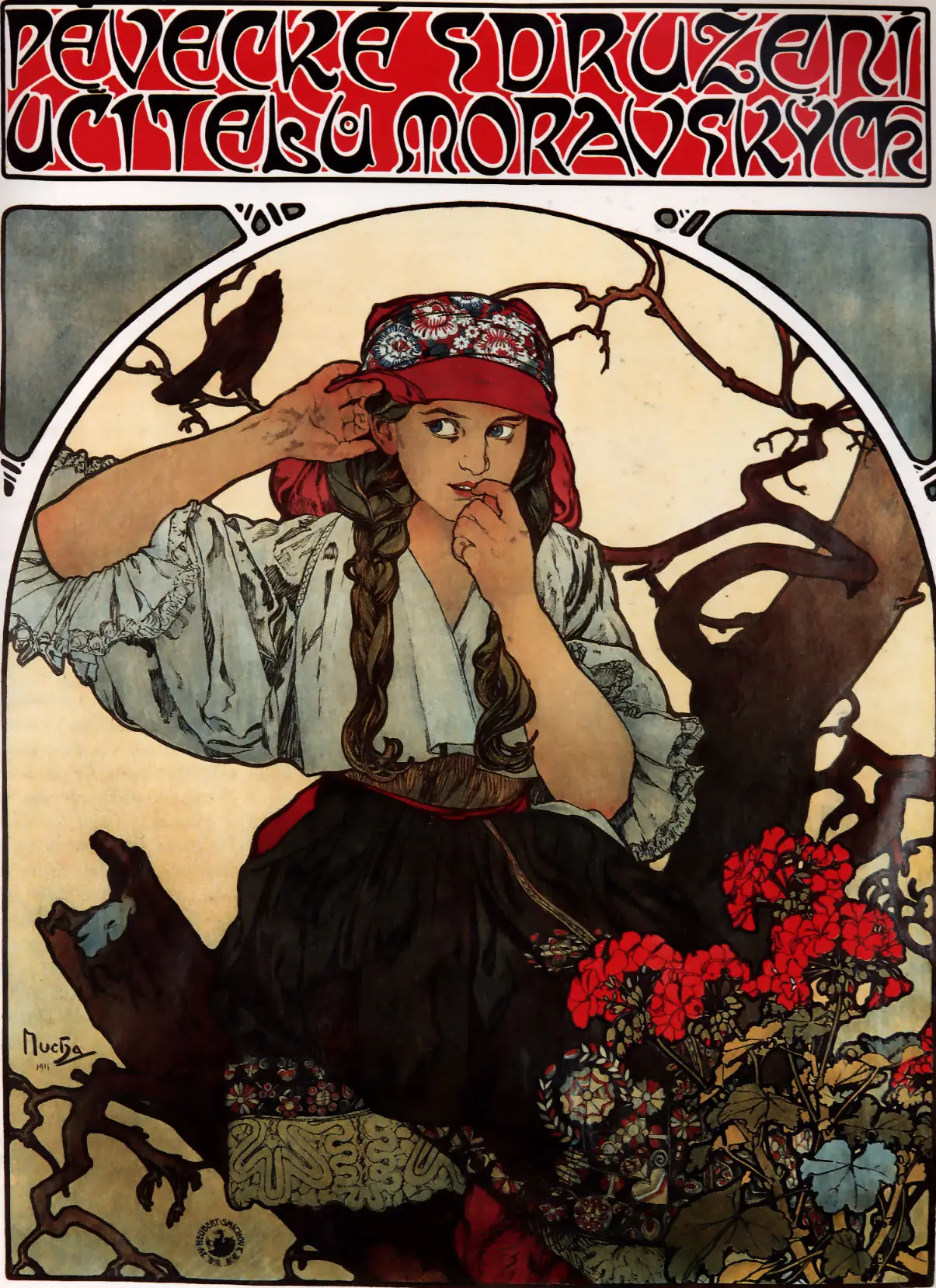
The girl in Kyjov costume cups a hand to her ear to catch a bird’s song. Mucha made this poster for the choir that performed Janáček’s demanding male choruses abroad. Its singers were Moravian teachers. Janáček had himself spent years teaching in Brno.
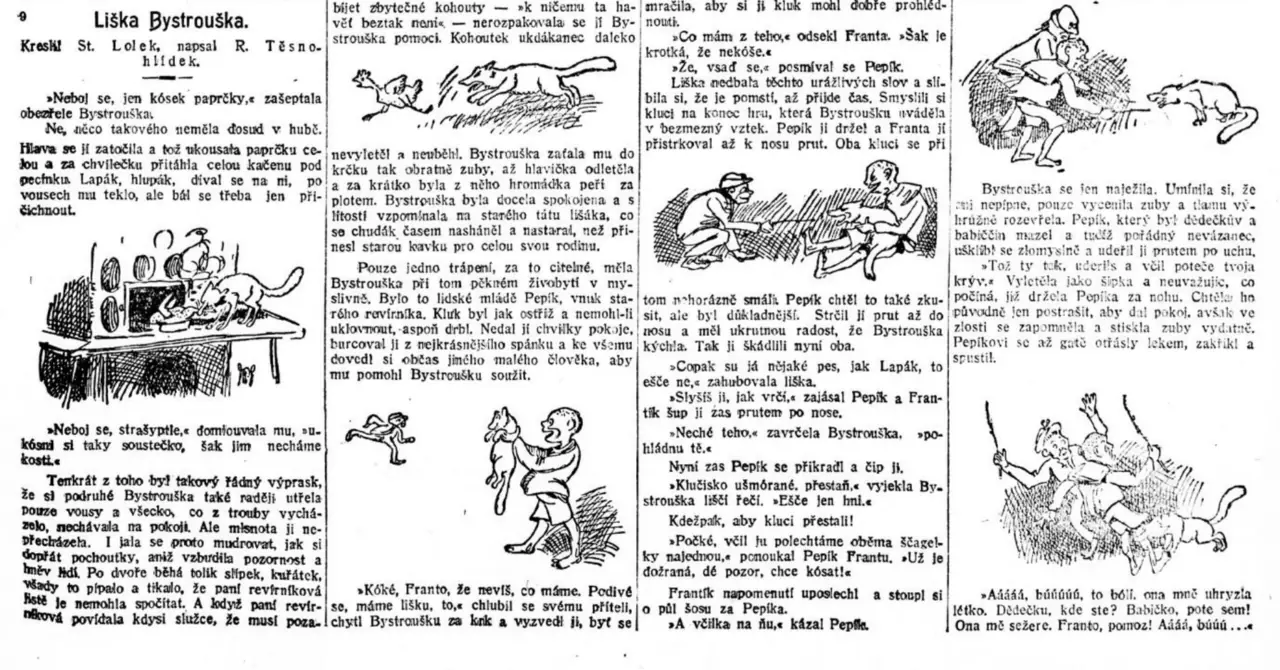
Lolek drew the foxes before Těsnohlídek wrote their story. The illustrated serial appeared in Lidové noviny in 1920. Marie Stejskalová, the Janáčeks’ servant, remembered laughing over it in the kitchen and suggesting that her employer make an opera. The comic animal scenes of the drawings were carried into the opera in the hens and the foxes’ wedding.
Recommended recordings
- JenůfaElisabeth Söderström, Eva Randová, Wiesław Ochman, Peter Dvorský, Vienna Philharmonic, Charles MackerrasDeccaSöderström’s wiry voice and Randová’s fuller, stern Kostelnička make the two women sharply different. Mackerras keeps the dialogue urgent. The appendix includes Kovařovic’s richer final orchestration.
- Glagolitic MassLibuše Domanínská, Věra Soukupová, Beno Blachut, Eduard Haken, Czech Philharmonic and Prague Philharmonic Choir, Karel AnčerlSupraphon · 1963Tense, sometimes rough singing and tangy Czech winds. Blachut sings the tenor part with great force; Ančerl conducts the orchestral interruptions.
Lineage
Křížkovský trained the chorister; Dvořák became the young conductor’s friend. Janáček drew material from Moravian singers and Russian books, and his voice was unlike either man’s. Bartók was a fellow collector; Britten’s stage characters and Kurtág’s compressed pieces are later neighbours. Mackerras and Tyrrell restored Janáček’s scores for opera houses.
Further reading
- John Tyrrell, Janáček: Years of a Life, 2 vols., The Lonely Blackbird (1854–1914) and Tsar of the Forests (1914–28) (London: Faber and Faber, 2006–2007). biography
Documentary biography covering the full career across two volumes.
- John Tyrrell, ‘Janáček, Leoš’, Grove Music Online (Oxford University Press, 2001). reference
Biographical reference, work-list and bibliography; subscription required.
- Nigel Simeone, John Tyrrell and Alena Němcová, Janáček’s Works: A Catalogue of the Music and Writings of Leoš Janáček, catalogue of writings by Theodora Straková (Oxford: Clarendon Press, 1997). catalogue
JW work numbers, sources, dating evidence, performances, publications and an annotated list of writings.
- Leoš Janáček, Intimate Letters: Leoš Janáček to Kamila Stösslová, edited and translated by John Tyrrell (Princeton University Press, 1994). letters
Letters to Kamila Stösslová complement the late-career biography.
- Moravské zemské muzeum, Oddělení dějin hudby (online archive guide, n.d.; accessed 16 October 2026). reference
Free guide to the Janáček Archive; linked correspondence edition requires registration.
Cite this page
Contrapunctus. “Leoš Janáček.” Accessed 20 October 2026. https://mottopanikeiku.github.io/contrapunctus/composers/janacek.html.
@misc{contrapunctus-composers-janacek,
  author = {{Contrapunctus}},
  title = {Leoš Janáček},
  howpublished = {\url{https://mottopanikeiku.github.io/contrapunctus/composers/janacek.html}},
  note = {Accessed 2026-10-20}
}