Violist at Prague’s Provisional Theatre, 1862–71; organist and piano teacher
Teaching
Prague Conservatory; director of New York’s National Conservatory, 1892–95
Output
Nine symphonies; operas, concertos, chamber music, choral works and songs
Life
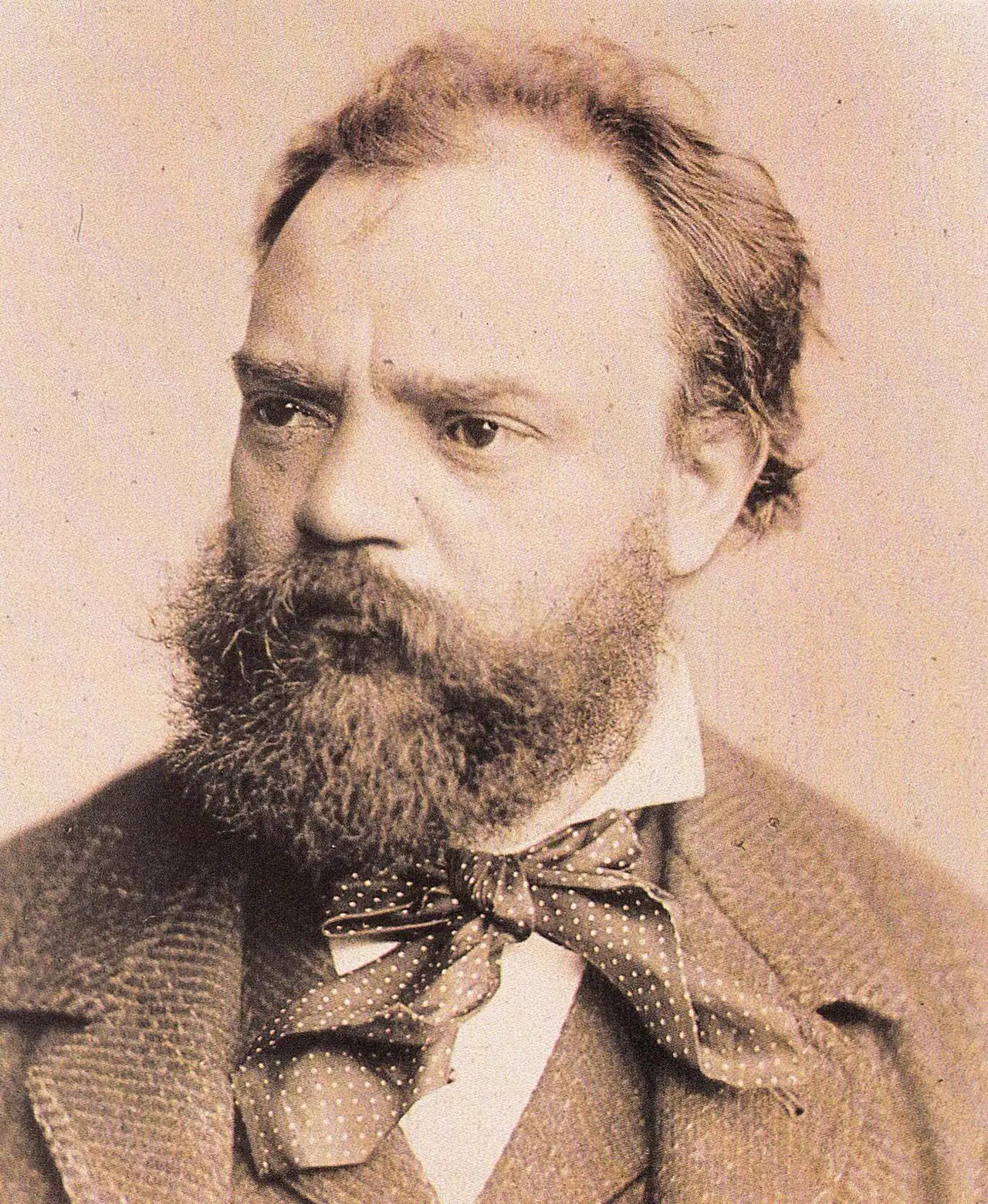
In the village band at Nelahozeves, north of Prague, the musicians collected their money by stopping a couple halfway through a dance and asking them to pay. Young Antonín Dvořák handed his share straight to his father, the village butcher and innkeeper. “I belonged to ours as soon as I could fiddle a little,” he told the London Sunday Times on 10 May 1885. He was born in Nelahozeves on 8 September 1841.
At Zlonice, the schoolteacher Antonín Liehmann taught him harmony and several instruments. Dvořák remembered bringing home a polka for the band to try. The opening chord came out all right except for the cornet, whose part he had written in the wrong key. In 1857 he went to the Prague Organ School, graduating two years later. He played viola in a dance band which became the nucleus of the Provisional Theatre orchestra in 1862. For nine years he sat in the pit, often under Smetana, playing operas while writing his own music at home.
Scores were expensive. His friend Karel Bendl lent him what he needed, including Beethoven’s Septet, and chamber music and symphonies accumulated in his rented rooms. Wagner came to Prague in 1863, and Dvořák remembered following him through the streets to see his face again. “I was perfectly crazy about him,” he told the same Sunday Times interviewer. The theatre’s singers could not manage his opera King and Collier at rehearsal. Dvořák later set the whole libretto again from the beginning.
1873–78Simrock and the Slavonic Dances
He left the orchestra in 1871 to make more time for composition. In 1873 he married Anna Čermáková, a former piano pupil and a good singer; teaching, her church engagements and his organist’s post at St Adalbert’s kept the household going. An Austrian state grant of 400 gulden arrived in January 1875. Brahms, who later joined the award’s jury, took an interest in his scores and recommended the Moravian Duets to Fritz Simrock in Berlin.
Simrock published them in 1878 and asked for a set of dances for piano duet. He had already done well with Brahms’s Hungarian Dances. Dvořák supplied eight Slavonic Dances, writing his own melodies and beginning the orchestration while the piano set was still in progress. The first is a furiant in C major, with accents that divide the beat into competing groups. By the end of the year the dances had reached orchestras in London, New York and cities across Europe. Simrock wanted more of these small pieces because they were profitable, although Dvořák wanted to write symphonies.
1876–85Stabat Mater and the Seventh Symphony
By September 1877 Anna and Antonín had lost all three of their children. Josefa had died two days after birth in 1875; Růžena died of poisoning, and Otakar of smallpox, within a month of each other. Dvořák had begun Stabat Mater in 1876. He now expanded it to ten movements and scored it for orchestra. It is a long setting of the Virgin Mary’s grief at the Cross, and it opens with a bare F♯ played across the orchestra. Its success in London brought him to the Royal Albert Hall in March 1884 to conduct it himself. In a letter home he gave the number of sopranos as 250.
English invitations followed, including a commission from the Philharmonic Society for the Seventh Symphony. Dvořák conducted its première at St James’s Hall on 22 April 1885. The first theme begins quietly above a held D and rises to a diminished-seventh chord; the finale reaches D major only after a long struggle. After the première he cut forty bars from the slow movement. Simrock offered him 3,000 marks for the symphony and tried to persuade him to return to dances. They quarrelled over the fee, and then over the publisher’s German spelling of his name.
1887–91At home in Vysoká
The family spent summers at Vysoká, where Dvořák had bought a house and garden from his brother-in-law. Six more children were born between 1878 and 1888, and all survived to adulthood. Much of the A major Piano Quintet was written there in 1887. The cello begins with a broad tune over the piano, and the viola has the second subject. Two years later came the Eighth Symphony, whose G minor opening is answered by a flute in G major. In the Dumky Trio of 1890–91, the six movements alternate between slow lament and quick dance. Dvořák played the piano in its first performance.
1892–95America
Jeannette Thurber brought him to New York in 1892 to direct the National Conservatory. Her school admitted women and Black students. One of them, the baritone Harry T. Burleigh, sang him the spirituals he had learnt from his mother and grandfather. Dvořák urged American composers to take this music seriously. “These are the folk songs of America and your composers must turn to them,” he told the New York Herald on 21 May 1893. In January 1894 he conducted a benefit concert with Burleigh, the soprano Sissieretta Jones and an all-Black choir at Madison Square Garden’s concert hall.
The Ninth Symphony was written in New York between January and May 1893. In the Largo the cor anglais plays the main tune over muted strings; the scherzo draws on Longfellow’s The Song of Hiawatha; the finale brings back themes from all three earlier movements. Anton Seidl conducted the première at Carnegie Hall on 16 December. Dvořák spent the summer in Iowa after the symphony was finished. At Spillville, among Czech-speaking settlers and reunited with his children, he wrote the F major String Quartet and the E♭ major String Quintet. He also played the organ at morning Mass.
Dvořák wrote the Cello Concerto during his last American winter, in 1894–95. News that his sister-in-law Josefina was ill reached him while he was composing it. In the slow movement he quoted Leave Me Alone, a song she loved. After he returned to Bohemia and she died, he enlarged the quiet closing passage of the finale, bringing the song back on a solo violin. The cellist Hanuš Wihan proposed a virtuoso cadenza. Dvořák refused. He required the cello to fall quiet and the orchestra to close the work.
1896–1904Erben ballads and Rusalka
Back in Prague, he taught pupils including Josef Suk and Vítězslav Novák. In 1896 he turned to four of Karel Jaromír Erben’s ballads: The Water Goblin, The Noon Witch, The Golden Spinning Wheel and The Wild Dove. Their murders and revenants unsettled admirers of the symphonies. Dvořák followed the poems closely and fitted musical phrases to the rhythm of their words. The goblin’s sewing song returns when he threatens the mother of his child.
In his last years Dvořák wrote three operas: The Devil and Kate, Rusalka and Armida. In Jaroslav Kvapil’s libretto for Rusalka, which Dvořák set in 1900, a water nymph gives up her voice in exchange for human form. For part of the opera the heroine is silent on stage while other characters talk about her. When the servants mock her, the orchestra plays a distorted version of her own melody. He became director of the Prague Conservatory in 1901. A few weeks before his death, ill and disappointed by the way the production had been prepared, he left the première of Armida before it ended. He died in Prague on 1 May 1904.
Places
Every recorded place, joined in date order. Dvořák on the MapAll 21 places, with sources
Nelahozeves · 8 September 1841 – 1853 · born
Born the eldest son of František and Anna Dvořák; his violin teacher Joseph Spitz taught him from 1847.
Carnegie Hall, New York · 16 December 1893 · premiere
The New York Philharmonic gave the premiere of From the New World under Anton Seidl; the audience applauded after each movement. Symphony No. 9 “From the New World”.
The first and last dances of Op. 46 are furiants, in which the accents pull a beat in three towards a beat in two. Across six crotchets, three pairs can compete with two groups of three. The tune stays easy to sing while the dance steps change; the bass often has a melody of its own.
𝅘𝅥Melody and modes
The cor anglais’s first phrase in the Ninth Symphony’s Largo uses only D♭, E♭, F and A♭. The leading note C is absent, and the phrase comes to rest on D♭ over muted strings. William Arms Fisher later added words to the tune, and Dvořák’s instrumental melody became the song Goin’ Home, nearly thirty years after he wrote it.
𝄋Themes from memory
The Ninth Symphony’s first-movement theme comes back in each of the later movements. In the finale, the Largo melody and the scherzo’s dance music also return, and Dvořák sets earlier tunes alongside the new ones. Near the end, the orchestra plays the Largo’s opening chords again.
𝄡Middle voices
Dvořák wrote prominent parts for the viola. It introduces the first tune of the “American” Quartet over an F major tremolo, and in the A major Piano Quintet it takes the second subject after the cello has played the first. Dvořák had earlier been a theatre violist.
𝄐Narrative in the music
In The Water Goblin, the orchestra takes its phrases from the rhythms of Erben’s verse. A short refrain first accompanies the creature sewing his wedding clothes, and it returns through the abduction and his revenge. In Rusalka, the heroine’s theme is heard in the orchestra while she is silent. When the Gamekeeper and Turnspit make fun of her, Dvořák has the orchestra distort it.
Works
A selection from the composer’s works.
1876–77
Stabat MaterOp. 58 · B 71Four vocal soloists, chorus and orchestra
Dvořák had lost all three of his children by the time he completed the orchestral score. The last of its ten movements brings back the opening music and builds to an Amenfugue.
1878; 1886
Slavonic Dances, two setsOpp. 46 and 72Piano four hands; orchestral versions by the composer
Sixteen dances on melodies of Dvořák’s own invention, first written for piano duet. The second set ends with a slow sousedská.
1884–85
Symphony No. 7 in D minorOp. 70 · B 141Orchestra
Commissioned by London’s Philharmonic Society and first conducted there by Dvořák in April 1885. Afterwards he cut forty bars from the Adagio.
1887
Piano Quintet No. 2 in A majorOp. 81 · B 155Piano, two violins, viola and cello
The cello and viola introduce the two main themes of the first movement. A long dumka in F♯ minor follows; the finale includes a fugato before the close.
1889
Symphony No. 8 in G majorOp. 88 · B 163Orchestra
Written largely at Vysoká; the symphony is in G major but opens in G minor. A trumpet fanfare introduces the finale’s variations, which include fast flute writing and high horn trills.
Anton Seidl conducted the première in New York on 16 December 1893. The last movement brings back themes from all three earlier movements, including the cor anglais melody of the Largo.
String Quartet No. 12 in F major “American”Op. 96 · B 179Two violins, viola and cello
Sketched in three days at Spillville in June 1893. The Boston-based Kneisel Quartet gave the première on New Year’s Day 1894.
1894–95
Cello Concerto in B minorOp. 104 · B 191Cello and orchestra
The orchestra has eighty-six bars to itself before the cello enters. Near the end, a solo violin quotes Leave Me Alone, the song associated with Dvořák’s sister-in-law Josefina.
1896
The Water GoblinOp. 107 · B 195Orchestra
Erben’s goblin sews his wedding clothes, abducts a girl and finally kills their child. Dvořák built the goblin’s recurring phrase on the rhythm of his sewing song.
1900
RusalkaOp. 114 · B 203Opera in three acts
A water nymph gives up her voice to live among humans. Růžena Maturová sang the title role at Prague’s National Theatre in 1901, with Karel Kovařovic conducting.
Quoted from bars 7–10 of the Largo, transposed down a perfect fifth from the cor anglais part to sounding pitch; accompaniment and slurs omitted. The melody uses four notes: D♭, E♭, F and A♭. A dotted rhythm precedes the close on D♭. Source: the original part reproduced by Dartmouth Symphony Orchestra.
Dance workshop · schematicThree pairs against two bars of three
A schematic of hemiola. The upper part accents three pairs of crotchets while the bass keeps two bars of three. Both parts cover the same six beats with their accents in different places. This shifting accent is characteristic of the furiant.
Sister arts
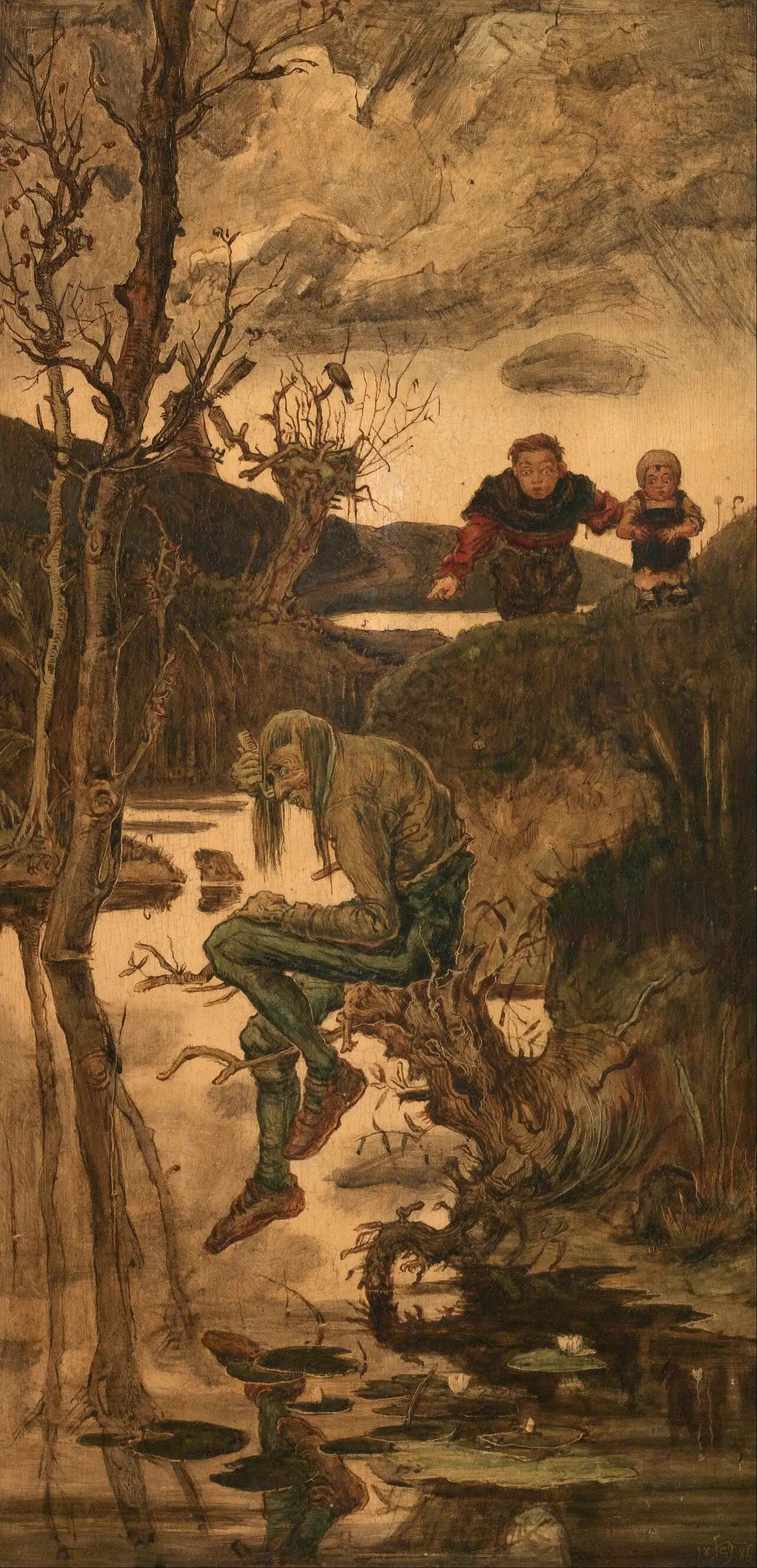
Hanuš SchwaigerWater Gnome (Vodník), 1886Painting · National Gallery Prague
Schwaiger’s creature comes from the same Czech folklore as Erben’s ballad and Dvořák’s symphonic poem, which was composed ten years after this painting. The goblin appeared repeatedly in Schwaiger’s work. In 1903 he illustrated a book of water-goblin tales written by his wife, Josefína.
Karel Jaromír Erben
Vodník (The Water Goblin) — opening
1853
CzechNa topole nad jezerem
seděl Vodník podvečerem:
„Sviť, měsíčku, sviť,
ať mi šije niť.
Šiju, šiju si botičky
do sucha i do vodičky:
Sviť, měsíčku, sviť,
ať mi šije niť.“
Our translationOn a poplar above the lake
the Water Goblin sat at evening:
“Shine, little moon, shine,
so my thread can sew.
I sew, I sew myself little boots
for dry ground and for water:
shine, little moon, shine,
so my thread can sew.”
The goblin is sewing boots for his wedding tomorrow. By the end of Erben’s ballad he has torn the head from his own child and thrown it onto the mother’s doorstep. Dvořák made the rhythm of this sewing refrain into the goblin’s recurring orchestral phrase, which returns when he comes for revenge. Erben’s text.
Henry Wadsworth Longfellow
The Song of Hiawatha — the wedding dance
1855
EnglishTo the sound of flutes and singing,
To the sound of drums and voices,
Rose the handsome Pau-Puk-Keewis,
And began his mystic dances.
First he danced a solemn measure,
Very slow in step and gesture,
In and out among the pine-trees,
Through the shadows and the sunshine,
Pau-Puk-Keewis begins slowly, then spins until the dust rises in a whirlwind. Dvořák told the New York Herald on 15 December 1893 that this wedding feast suggested his Ninth Symphony’s scherzo. He had known Hiawatha in a Czech translation long before he crossed the Atlantic.
Recommended recordings
Symphonies Nos. 1–9London Symphony Orchestra, István KertészDeccaThe cycle is strongest in the Sixth. Kertész takes the Eighth’s finale very fast, and the LSO keeps up with him.
Cello ConcertoMstislav Rostropovich; Berlin Philharmonic, Herbert von KarajanDeutsche Grammophon · 1968Karajan takes the long opening orchestral tutti broadly and on a large scale, and Rostropovich’s tone is strong enough to enter on equal terms with the orchestra.
RusalkaRenée Fleming, Ben Heppner; Czech Philharmonic and Kühn Mixed Choir, Charles MackerrasDecca · 1998Mackerras brings out the orchestral detail beneath the voices, and the Act II dances are richly played. Fleming sings in long phrases; at times the drama slows for the sake of the sound.
Passed toJosef SukVítězslav NovákHarry T. BurleighWilliam Grant Still
Brahms found him a publisher and later corrected the proofs of Dumky while he was in America. Suk and Novák studied with him in Prague; Suk married his daughter Otilie. Burleigh sang spirituals to Dvořák, who encouraged him to preserve them in his own work. William Grant Still belongs to the later American history, in which Black musical traditions became the material of a symphony.