Zverev and Siloti at the piano; Taneyev and Arensky in composition
Conducted
Mamontov’s private opera, 1897–98; the Bolshoi, 1904–06
Homes
Ivanovka, Dresden, New York, Villa Senar and Beverly Hills
Output
Four piano concertos, three symphonies, three completed operas, choral music, songs and piano works
“I feel like a ghost wandering in a world grown alien. I cannot cast out the old way of writing, and I cannot acquire the new.”
Life
“My hearty thanks to the old man for not having forgotten about me!” Rachmaninoff wrote to the singer Mikhail Slonov on 26 December 1892. The old man was Tchaikovsky, who had praised his opera Aleko in a newspaper interview. Rachmaninoff was nineteen and had recently graduated from the Moscow Conservatory with its Great Gold Medal. Tchaikovsky helped get the opera into the Bolshoi, and in May 1893 he sat in the audience and applauded.
His childhood had been less settled. He was born into a landowning family and grew up at Oneg, near Novgorod, until his father’s financial failures forced a move to St Petersburg. He entered the Conservatory there in 1883. His parents separated, his sister Sofia died of diphtheria, and his schoolwork went badly. His grandmother took him to Orthodox services, where he heard the choirs and bells he remembered all his life. In 1885 his cousin Alexander Siloti recommended that he move to Moscow to study with the piano teacher Nikolai Zverev, who was known for his strictness.
1885–93The boys at Zverev’s
Zverev housed Rachmaninoff and taught him without charge. Practice was regulated to the minute: “God forbid that I leave the piano five minutes before my time of three hours was up!” Zverev’s temper was famous, and Rachmaninoff was the object of it three or four times; he nevertheless remembered him as “a man of rare intellect, generosity and kindness”. The pupils were fed, dressed and taken to every concert and theatre première, and on Sundays Moscow’s musicians crowded the house, Tchaikovsky, Arensky, Anton Rubinstein, Safonov and Siloti among them. Scriabin was another pupil. Rachmaninoff went on to study piano with Siloti, a pupil of Liszt, counterpoint with Sergei Taneyev and composition with Anton Arensky. In 1889 he asked for more privacy to compose. Zverev objected, and the boy moved in with his relatives, the Satins. Their estate at Ivanovka became his summer home from 1890.
He passed the piano examination in 1891 and completed his composition course the following year. Aleko was the examination piece, its libretto by Vladimir Nemirovich-Danchenko taken from Pushkin’s The Gypsies. The C♯ minor Prelude, which also dates from 1892, has three descending notes, A–G♯–C♯, followed by quiet chords. Tchaikovsky liked it. When he died in November 1893, Rachmaninoff wrote the D minor Trio élégiaque, with a large variation movement and a funeral ending that recall Tchaikovsky’s own memorial trio.
1897–1901First Symphony and Second Piano Concerto
The First Symphony’s première in St Petersburg on 27 March 1897 undid that early confidence. Alexander Glazunov conducted; rehearsals went badly and the reviews were savage, César Cui’s above all. Rachmaninoff put the score aside, and the symphony, with its sharp motto and violent accents, was not heard again until 1945. For about three years he composed little, though he taught and conducted. At Savva Mamontov’s private opera in 1897–98 he worked with the bass Feodor Chaliapin, who was known for his attention to words and dramatic timing.
In 1900 Dr Nikolai Dahl treated him with hypnosis and encouragement. The Second Piano Concerto is dedicated to Dahl. Its last two movements were played in December 1900; the complete work followed in Moscow on 9 November 1901, with Rachmaninoff at the piano and Siloti conducting. The piano opens alone with eight bars of chords like bells, and the orchestra then enters with the main theme. The pianist Nikolai Medtner said that from “the first bell stroke” “you feel the figure of Russia rising up to her full height.” The soloist then accompanies, playing arpeggios beneath the strings. The Cello Sonata and the Second Suite for two pianos date from the same return to work.
1902–08Ivanovka, the Bolshoi and Dresden
He married Natalia Satina, his cousin and a trained pianist, in 1902. At Ivanovka he had uninterrupted summers; he helped run the estate and invested in livestock and machinery. Winters were given to rehearsals and concerts. At the Bolshoi from 1904 to 1906 he conducted carefully prepared performances, including the premières of his The Miserly Knight and Francesca da Rimini. In the first, based on Pushkin, the miser has a long bass monologue over his gold; in the second, based on Dante, the lovers are depicted in an orchestral whirlwind.
In 1906 the family moved to Dresden, returning to Ivanovka for summers. There he wrote the Second Symphony, which he premiered successfully in St Petersburg in 1908. The slow movement has a long clarinet solo. Around it, the strings develop another melody, and the two lines build towards a climax. Ideas from the opening return across the four movements, which last about an hour.
1907–10Isle of the Dead and Third Concerto
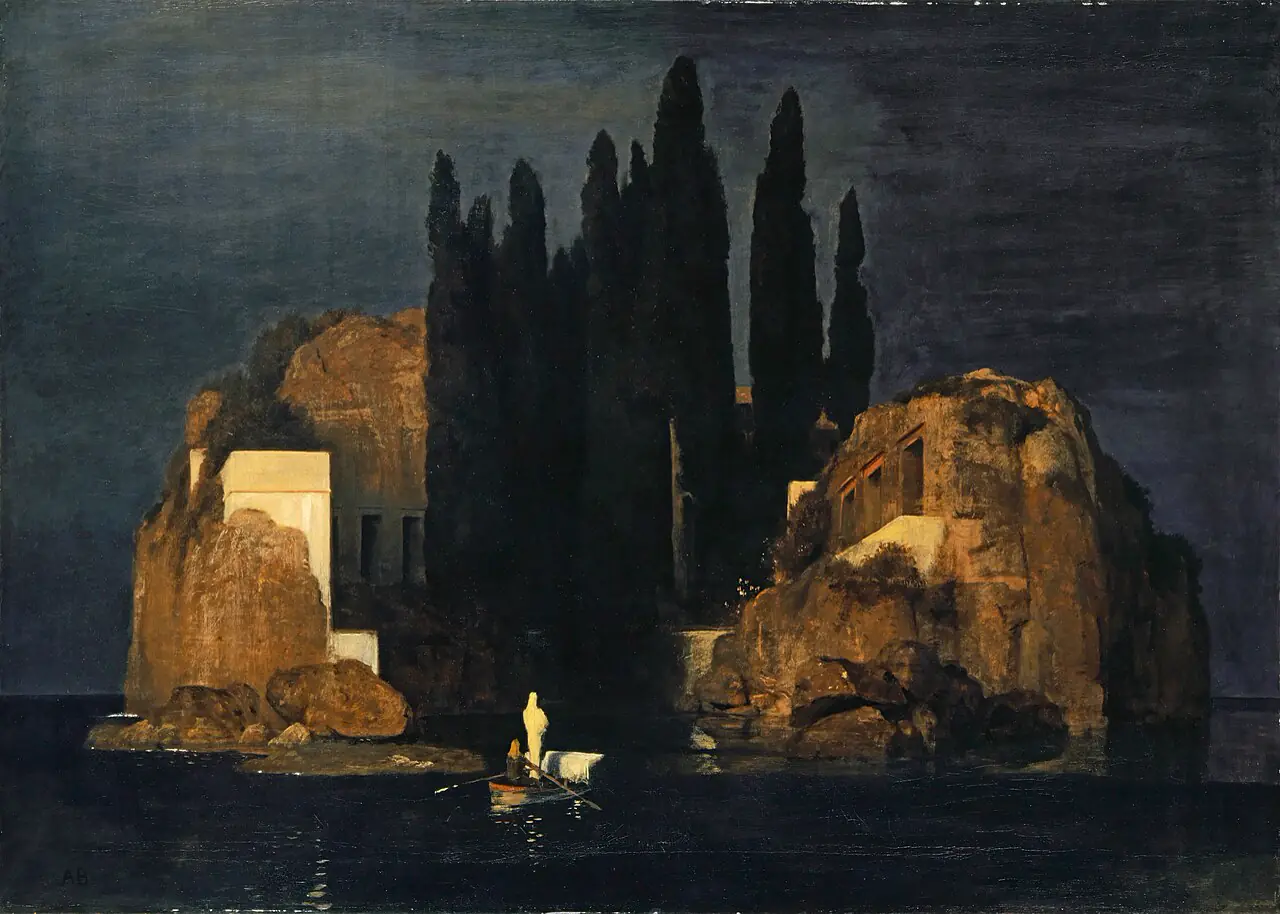
In Paris in 1907 he saw a black-and-white reproduction of Böcklin’s Isle of the Dead. He composed the symphonic poem in Dresden in 1909 and conducted its première in Moscow on 18 April. He later saw a painted version in Leipzig and liked it less than the reproduction. The music is in 5/8, and its uneven bars of five quavers represent the rowing of the boat towards the island. A broader central section comes before the rowing figure returns. The brass play the medieval Dies irae chant, and the low strings close the work. The chant appears again in the Paganini Rhapsody and the Symphonic Dances.
Rachmaninoff wrote the Third Concerto for his first American tour in 1909. It begins with a plain D minor theme in octaves, which the piano part then develops at length. For the first movement he wrote two cadenzas, a longer chordal one and a shorter, lighter one, which he played himself. Rachmaninoff gave the première in New York under Walter Damrosch on 28 November and played it with Mahler and the New York Philharmonic in January 1910. Mahler’s meticulous rehearsing impressed him. Afterwards he returned home. At the time few pianists took the concerto on.
1913–15The Bells and the All-Night Vigil
An anonymous letter from a young admirer, later revealed to be a cello student in Moscow, brought him Konstantin Balmont’s Russian version of Poe’s The Bells. “In the drowsy quiet of a Roman afternoon, with Poe’s verses before me,” he remembered in 1913, “I heard the bell voices.” He began setting it for three soloists, chorus and orchestra in Rome, finished it at Ivanovka on 27 July 1913 and conducted the first performance in St Petersburg that November. Each of the four movements has its own bells, in turn sleigh bells, wedding bells, alarm bells and funeral bells. The third has no vocal soloist. In the fourth a cor anglais plays a lament before the baritone enters. In the final pages, after the last words about death, the strings move from C♯ minor to D♭ major.
The All-Night Vigil followed in 1915, dedicated to the chant scholar Stepan Smolensky. Nikolai Danilin conducted the Moscow Synodal Choir at its première. The work is for unaccompanied voices; in places a chant is passed through the middle parts while the other voices sing around it. At the end of the fifth movement, the Song of Simeon, the basses descend quietly to B♭1.
1917–31Emigration, touring and recording
In December 1917 Rachmaninoff left Russia with Natalia and their daughters Irina and Tatiana, using a Scandinavian concert invitation to get out. They reached the United States in November 1918. He never returned to Russia. Touring now supported the household and left little time to compose. After his departure he wrote only six new opus-numbered works, besides revisions and transcriptions. The Fourth Concerto and Three Russian Songs, both completed in 1926, were the first new works after the long break.
The records show a pianist with very large hands and, when he wanted it, a light touch. A melody stays clear inside dense figuration, and a passage can drive forward without every note becoming heavy. He played Chopin, Schumann and Liszt beside his own music, and made transcriptions of familiar works. Audiences demanded the C♯ minor Prelude, and he went on playing it in his recitals.
1933–43The last years
From 1933 Villa Senar, on Lake Lucerne, gave him a summer workplace again. Its name combined Sergei, Natalia and the initial of their surname. He wrote the Paganini Rhapsody there in 1934 and the Third Symphony in 1935–36. The Rhapsody’s famous eighteenth variation inverts Paganini’s theme and sets it in D♭ major. In the variations around it, the exchanges between piano and orchestra are much sharper. The Dies irae enters in the seventh variation and returns in the tenth and the last.
War ended the Swiss summers. On Long Island in 1940 he wrote Symphonic Dances for Eugene Ormandy and the Philadelphia Orchestra, who premiered it the following January to a lukewarm reception. The first dance grew from sketches he had made in 1915 for a ballet, The Scythians, which Fokine rejected as “unballetic”. Fritz Kreisler checked the violin bowings, and the arranger Robert Russell Bennett tested the alto saxophone part. The alto saxophone has a solo in the first dance; near its end the theme of the abandoned First Symphony returns in the major. The finale sets the Dies irae against resurrection music from the ninth movement of the Vigil, with “Alliluya” written over its return.
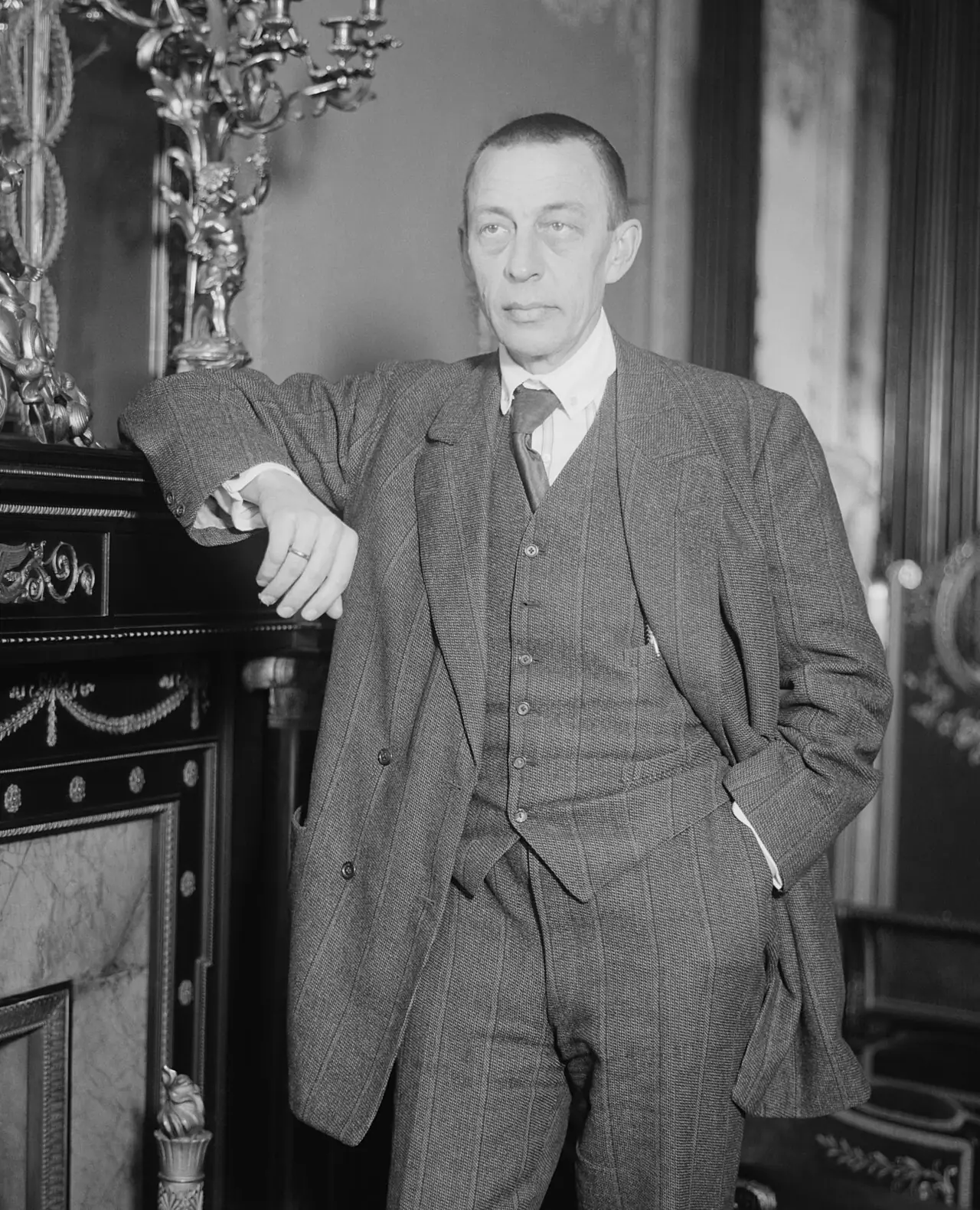
“I write down on paper the music I hear within me, as naturally as possible,” he told David Ewen in The Etude, December 1941. He moved to Beverly Hills in 1942 and became an American citizen in February 1943. His last recital, at Knoxville on 17 February, included Chopin’s B♭ minor Sonata. Cancer ended the tour. He died on 28 March, four days before his seventieth birthday, and was buried at Kensico Cemetery in New York state.
Places
Every recorded place, joined in date order. Rachmaninoff on the MapAll 60 places, with sources
Semyonovo estate vicinity (Starye Degtyari) · 1 April 1873 · born (inferred)
Born at Semyonovo; marker uses nearby Starye Degtyari, where his baptism was registered.
The Third Concerto begins with a narrow-ranging tune in octaves. The piano writing built on its small steps is among the most elaborate in the repertory. In the Adagio of the Second Symphony, a solo clarinet plays the long melody across the bar lines. Vocalise gives a singer a wordless melody that rises to a high point and then falls away.
𝄢Bell sonorities in the piano writing
The Second Concerto begins with repeated chords that grow steadily louder, each still sounding when the next arrives. In the C♯ minor Prelude, the low A–G♯–C♯ figure returns after the fast middle section, now spread across four staves. Rachmaninoff separated the registers of the piano widely, so that a deep bass note keeps sounding beneath a large number of quicker notes.
♮Chord
A Rachmaninoff pianist has to make melodies audible inside handfuls of notes. Common notes hold one chord to the next while another voice slides by a semitone. The Second Concerto’s slow movement reaches E major through a short orchestral bridge from C minor. His harmonies can move to distant keys, with the modulation carried by a moving inner voice.
𝄋Recurring chant themes
The Orthodox chants in the Vigil and the Latin Dies irae have different histories. Rachmaninoff brought both into his last Symphonic Dance, where fragments of the Western chant are combined with music from his own setting of the resurrection. In the Paganini Rhapsody, the pianist introduces the Dies irae in Variation 7 while Paganini’s tune continues around it.
𝄾Rhythm and wit
The boat in Isle of the Dead rows in unequal five-quaver bars. The late concertos and dances favour sharp attacks, quick exchanges and offbeat accents, and their long tunes are set against brisk material. The Paganini Rhapsody ends, after its virtuoso writing, with the piano playing a short, quiet fragment.
𝄞Orchestral aspects
He often gave an important melody to one wind player: the clarinet in the Second Symphony, the cor anglais in the funeral movement of The Bells, the alto saxophone in the first Symphonic Dance. The strings then enlarge what began as a solo. In the concertos the piano often moves from the melody to the accompaniment beneath an orchestral line.
Works
A selection from the composer’s works.
1891; revised 1917
Piano Concerto No. 1 in F♯ minorOp. 1Piano and orchestra
Dedicated to his cousin and teacher Alexander Siloti. Rachmaninoff revised the student concerto in 1917, tightening the piano part and the orchestration; the revised version is the one usually played.
1892
AlekoOne-act opera; soloists, chorus and orchestra
Written for his composition examination, after Pushkin’s The Gypsies. Tchaikovsky applauded at the 1893 Bolshoi première; the jealous hero’s baritone cavatina is its best-known number.
Trio élégiaque No. 2 in D minorOp. 9Piano, violin and cello
Rachmaninoff’s memorial to Tchaikovsky followed the older composer’s example with an extended variation movement. The finale eventually returns to funeral music.
1895
Symphony No. 1 in D minorOp. 13Orchestra
Its terse motto links all four movements. After the disastrous 1897 première, it was not performed again until 1945, when it was revived from surviving orchestral parts.
1896
Six Moments musicauxOp. 16Piano
No. 4 sets a melody above continuous left-hand semiquavers. The six pieces range from nocturne-like writing to a finale that covers the whole keyboard.
Dedicated to Dr Nikolai Dahl, who helped Rachmaninoff through his depression. The piano opens alone with bell-like chords, then accompanies the orchestra’s first melody.
The piano and the cello have equal parts across the four movements. In the E♭ major Andante, each plays the melody in turn while the other accompanies.
1901–03; 1910
Ten Preludes · Thirteen PreludesOpp. 23 and 32Piano
Together with the C♯ minor Prelude, they complete all twenty-four major and minor keys. The set includes the G minor march and the B minor Prelude.
1906–07
Symphony No. 2 in E minorOp. 27Orchestra
The famous clarinet solo is part of a much larger Adagio, with its own long string melody. Earlier themes return in the E major finale.
1909
Isle of the DeadOp. 29Orchestra
Rachmaninoff first knew Böcklin’s painting from a black-and-white reproduction. Rowing figures in five quavers come before and after the broader middle section, and the Dies irae is heard at the return.
1909
Piano Concerto No. 3 in D minorOp. 30Piano and orchestra
Dedicated to Josef Hofmann and premiered by Rachmaninoff under Walter Damrosch. The first movement has two alternative cadenzas, one in heavy chords and the other lighter and faster.
1911; 1916–17
Études-tableauxOpp. 33 and 39Piano
Rachmaninoff did not name the subjects of most of these “study-pictures”. In a 1930 letter to Respighi, who was orchestrating five of them, he said that Op. 39 No. 2 depicted the sea and seagulls.
1913
The BellsOp. 35Soprano, tenor, baritone, chorus and orchestra
Poe’s four kinds of bells, in Balmont’s Russian adaptation, become four movements. A cor anglais introduces the funeral lament; the last pages move to D♭ major.
1915
All-Night Vigil (“Vespers”)Op. 37Unaccompanied mixed choir, alto and tenor solos
Fifteen settings of Church Slavonic texts, ten of them based on existing chants. The Song of Simeon ends with the basses descending to B♭1 in a slow, quiet scale.
1926; revised 1927 and 1941
Piano Concerto No. 4 in G minorOp. 40Piano and orchestra
Dedicated to Nikolai Medtner, who dedicated his Second Concerto to Rachmaninoff in return. Rachmaninoff shortened the work repeatedly and reached its final version in 1941.
1934
Rhapsody on a Theme of PaganiniOp. 43Piano and orchestra
Variation 1 comes before the theme; No. 7 introduces the Dies irae; No. 18 inverts Paganini’s theme in D♭ major. The composer and Stokowski gave the première in Baltimore.
1940
Symphonic DancesOp. 45Orchestra, including alto saxophone and piano; also a version for two pianos
His last original orchestral score, dedicated to Ormandy and Philadelphia. The First Symphony returns in the first dance, the Vigil in the last.
In the score
Short examples, engraved and playable.
The recurring chantDies irae: the identifying pitches
The opening of Dies irae in a schematic, equal-note rhythm, F–E–F–D–E–C–D–D. Its first four notes fall a semitone, return, then drop a minor third. These pitches recur throughout Rachmaninoff’s music, separately from the Orthodox chants of the Vigil.
Prelude in C♯ minor, Op. 3 No. 2Register set by three pitches
A schematic of the Prelude’s opening pitches, A–G♯–C♯, with the last note prolonged. A semitone fall is followed by a perfect fifth. In the score the figure is doubled in octaves and answered by much quieter chords.
A pitch schematic of inversion. A–C–B–A rises a third and falls by steps; D♭–B♭–C–D♭ falls a third and rises by steps. Rachmaninoff changed the key and lengthened the notes to make the Andante cantabile of Variation 18.
Isle of the Dead, metreUneven division of five quavers
A schematic with invented pitches: two bars group five quavers as 3 + 2, then two reverse the order to 2 + 3. Isle of the Dead has recurring bars of five quavers, which give its rocking figure an uneven pulse.
Sister arts
Arnold BöcklinDie Toteninsel (Isle of the Dead), first version, 1880Oil on canvas · Kunstmuseum Basel
A white figure and a coffin approach an island cut with tombs. Böcklin painted five versions between 1880 and 1886; this is the first, now in Basel. Rachmaninoff’s music was prompted by a monochrome reproduction he saw in Paris in 1907. When he later saw a painted version in Leipzig, he said he preferred the black-and-white reproduction.
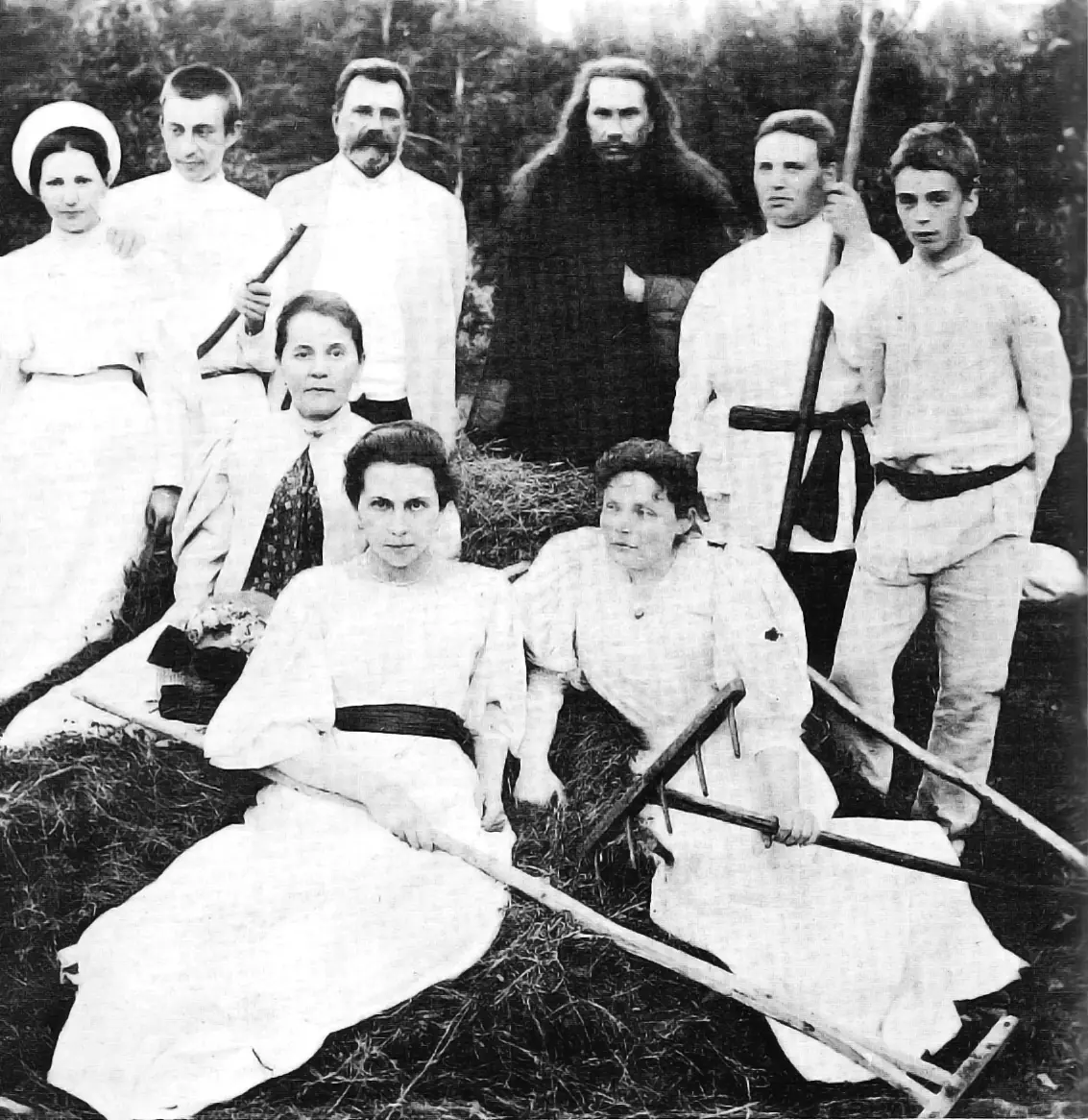
Unidentified photographerRachmaninoff with family and friends at Ivanovka, Mid-1890sPhotograph
Rachmaninoff stands second from the left in the back row; Natalia Satina, whom he later married, sits in the middle of the front row. He first came to her family’s estate, Ivanovka, in 1890. There he wrote the First Concerto and much of the Third. The estate later became a farm, and he put his earnings from concert performances into it.
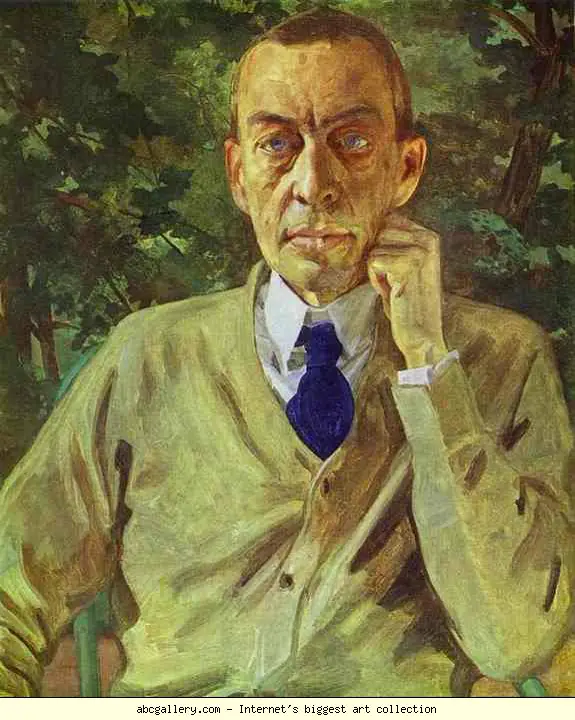
Konstantin SomovPortrait of Sergei Rachmaninoff, 1925Oil on canvas · State Russian Museum, St Petersburg
Steinway commissioned a large portrait for Carnegie Hall in 1925. Somov painted this study in two weeks at the Rachmaninoffs’ home at Corbeville, near Orsay. He was still dissatisfied with it and finished it only a year later, when he added the landscape behind the composer. Somov, a founder of Mir iskusstva, had also left Russia.
Edgar Allan Poe
The Bells — opening section
1849
EnglishHear the sledges with the bells —
Silver bells!
What a world of merriment their melody foretells!
How they tinkle, tinkle, tinkle,
In the icy air of night!
While the stars that oversprinkle
All the Heavens, seem to twinkle
With a crystalline delight;
Keeping time, time, time,
In a sort of Runic rhyme,
To the tintinnabulation that so musically wells
From the bells, bells, bells, bells,
Bells, bells, bells —
From the jingling and the tinkling of the bells.
In Poe’s poem the words “tinkle” and “bells” are repeated many times. Rachmaninoff used Balmont’s Russian adaptation, keeping the four stages from sleigh bells to funeral bells. The tenor begins the sleigh scene and the chorus answers him. Poe’s complete poem appeared in November 1849, after his death.
Alexander Pushkin
Не пой, красавица, при мне… (Do not sing, beautiful one, before me)
1828; set by Rachmaninoff 1892
RussianНе пой, красавица, при мне
Ты песен Грузии печальной:
Напоминают мне оне
Другую жизнь и берег дальный.
Увы! напоминают мне
Твои жестокие напевы
И степь, и ночь — и при луне
Черты далекой, бедной девы.
Our translationDo not sing, beautiful one, before me
those songs of sorrowful Georgia:
they remind me
of another life and a distant shore.
Alas, your cruel melodies
remind me
of the steppe, the night — and, in the moonlight,
the features of a distant, unhappy girl.
The first two of four stanzas. Rachmaninoff dedicated his A minor setting, Op. 4 No. 4, to Natalia Satina, his future wife. The piano introduces the melody before the singer asks for silence. It was published in 1893.
Recommended recordings
Piano Concerto No. 2Sergei Rachmaninoff, Philadelphia Orchestra, Leopold StokowskiVictor / RCA · 1929The electrical remake is direct. Rachmaninoff kept the opening movement taut; the old recording caught the piano better than the strings.
Piano Concerto No. 3Sergei Rachmaninoff, Philadelphia Orchestra, Eugene OrmandyRCA Victor · 1939–40Lean and quick, with clear phrasing. He plays the lighter first-movement cadenza and makes cuts. This is the composer’s performing version.
Rhapsody on a Theme of PaganiniSergei Rachmaninoff, Philadelphia Orchestra, Leopold StokowskiRCA Victor · 1934Recorded on Christmas Eve, weeks after the première. The eighteenth variation is played at a tempo in keeping with the rest of the work.
Symphony No. 2London Symphony Orchestra, André PrevinEMI / Warner Classics · 1973Previn restores the passages that were commonly cut, but omits the exposition repeat in the first movement. Jack Brymer plays the clarinet solos.
The Bells · Symphonic DancesElizaveta Shumskaya, Mikhail Dovenman, Alexei Bolshakov, Yurlov Russian State Academic Choir, Moscow Philharmonic Orchestra, Kirill KondrashinMelodiya, MEL CD 1000840Raw-edged sound and fierce choral singing, and the conductor keeps everything moving. The dances are played with a hard attack.
All-Night VigilKlara Korkan, Konstantin Ognevoi, USSR State Academic Russian Choir, Alexander SveshnikovMelodiya · 1965The first complete recording has very heavy bass sound and a theatrical fervour. The tenors are sometimes unsteady and some tempos are slow.
24 PreludesSteven OsborneHyperion, CDA67700Osborne keeps melody and ornament distinct even in the thickest writing. He plays the D major Prelude, Op. 23 No. 4, and takes the G minor march at a firm, unhurried tread.
Tchaikovsky encouraged the student and gave him a model for a memorial trio. Taneyev taught him how to keep voices independent inside a crowded score. The friendship with Medtner produced reciprocal concerto dedications; Horowitz championed the Third Concerto. Recordings survive of Rachmaninoff’s own quick, finely weighted playing and of the larger gestures of his successors.