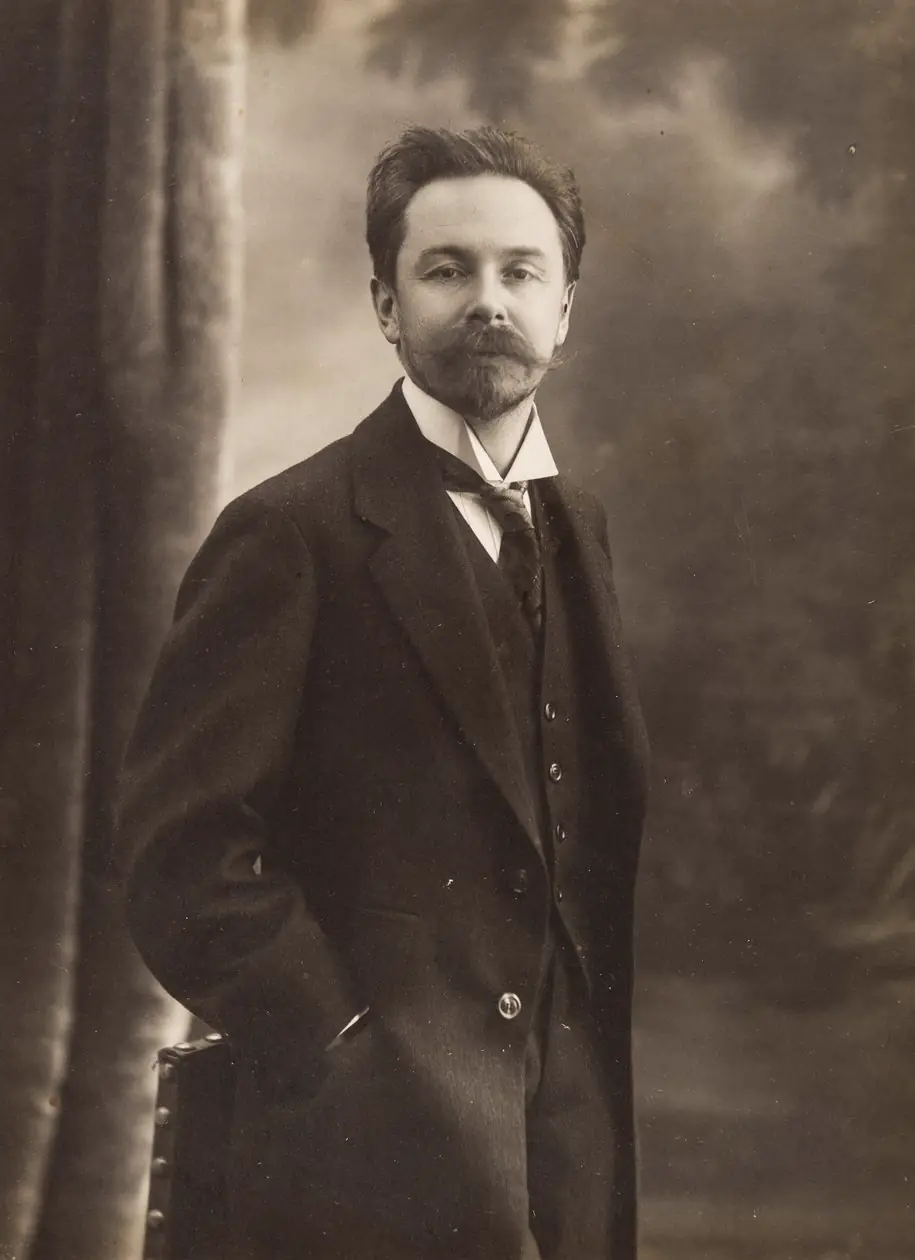
AlexanderScriabin
Composer who wrote a part for coloured light that had to be omitted at the work’s first performance.
- Trained
- Moscow Conservatory, 1888–92: Safonov, Taneyev and Arensky
- Teaching
- Piano professor at the Moscow Conservatory from 1898
- Patrons
- Publisher Mitrofan Belyayev; conductor Serge Koussevitzky
- Output
- Ten piano sonatas; three symphonies; a concerto; The Poem of Ecstasy and Prometheus
Life
At the Moscow première of Prometheus in 1911, Scriabin sat at the piano and Serge Koussevitzky conducted. The audience heard the large orchestra, the solo piano and the sustained harmonies that precede the first horn melody. One part of the score was not performed: the keyboard intended to project coloured light. Alexander Mozer had built a small apparatus for Scriabin, but because of technical difficulties Scriabin withdrew it from the concert, and the première went ahead without the lights.
1872–92Moscow Conservatory and the Op. 11 Preludes
He was born in Moscow in 1872. His mother, Lyubov, was a trained pianist; she died when he was a baby. His father was pursuing a diplomatic career abroad, and his aunt, also Lyubov, helped bring him up. He entered the cadet corps in 1882, took lessons from Nikolai Zverev, and joined Vasily Safonov’s piano class at the Moscow Conservatory in 1888. Rachmaninoff studied there too. Scriabin graduated as a pianist in 1892, a year after Rachmaninoff, but left without completing the composition course with Sergei Taneyev and Anton Arensky.
He had small hands and practised hard. While he was still a student, an injury to his right hand threatened his career. The First Sonata ends with a funeral march, which he later connected with the despair of that time. The Prelude and Nocturne for the left hand, Op. 9, were a practical response to the injury. In them the left hand plays the bass, the accompaniment and the melody.
The young man’s music drew heavily on Chopin, in the titles of his mazurkas and nocturnes, in melodies set above busy accompaniments and in harmonies that delay the last chord. The Twenty-four Preludes, Op. 11, carry dates and place-names from his travels. One was written in Amsterdam, another in Dresden, several beside Lake Lucerne. The left hand is often as active as the right; in No. 19 it starts each new accompanying figure just before the beat.
1894–1903Belyayev and the Moscow Conservatory
The wealthy publisher Mitrofan Belyayev took him up in the 1890s, paying for new compositions and helping arrange concerts. Scriabin married the pianist Vera Isakovich in 1897. The following year he began teaching at the Moscow Conservatory. He needed the income, though lessons and touring took hours he wanted for composing. His Piano Concerto, written in 1896–97, has as its central movement a set of variations on a quiet theme for muted strings, which the piano decorates.
His ambitions were growing. The First Symphony ends with soloists and chorus praising art. The Third, The Divine Poem, has three connected movements that pass through struggle, pleasure and release. Among the piano works, the Fourth Sonata of 1903 sets a slow Andante beside a movement marked Prestissimo volando (flying, as fast as possible). Scriabin imagined a star drawing closer until it could be possessed. Near the end the opening music returns at full strength across the whole keyboard.
1904–08The Fifth Sonata and The Poem of Ecstasy
In 1904 he moved to Switzerland. His relationship with Tatiana Schloezer broke up his household with Vera, who refused a divorce. He and Tatiana lived together abroad, and for a time settled in Brussels. Philosophy and Theosophy entered his conversation and notebooks. “I am, and there is nothing outside me,” he wrote in 1904, and a few lines later, “I am god”.
The Fifth Sonata of 1907 is in a single movement. A sudden rush out of the bass breaks off into quiet, widely spaced notes, and slow, suspended phrases and fast dance passages interrupt one another. Its epigraph comes from the poem Scriabin wrote alongside The Poem of Ecstasy. That orchestral work was first heard in New York in 1908, conducted by Modest Altschuler. A solo trumpet plays repeatedly above the orchestra. Eight horns, five trumpets, bells and organ play in the final C major chord.
1909–13Prometheus and the light part
In Prometheus, completed in 1910, the six-note chord and its transpositions supply much of the music’s harmony. A melody can draw on the same notes as its accompaniment. The score begins quietly, with tremolo strings and the six-note chord; it ends on a loud chord of F♯ major. In between, the piano is one solo voice among the horns, trumpet, flute and violin. A wordless chorus can join in the closing section.
The light part has two lines. One follows the changing harmony; the other moves slowly through the larger spans of the piece. C is red, D yellow, F♯ blue-violet. In 1913 Scriabin added instructions for flames, lightning and sparks to a copy of the score. Explaining his plan to the British psychologist Charles Myers in 1914, he said: “The colour underlines the tonality”; it “makes the tonality more evident”.
The Belgian painter Jean Delville designed the cover of the published score. Both Delville and Scriabin took occult ideas seriously. Scriabin’s projected Mysterium was to be a collective rite in India, combining music, poetry, dance, light and perfume, in which everyone present would participate and which was intended to transform the world. He worked on an introduction, the Prefatory Action, and left words and musical sketches for it.
1911–15Late sonatas and Vers la flamme
Back in Russia, he continued giving concerts and wrote his last five sonatas. These have no key signatures, but their ideas still return, develop and collide within recognisable sonata forms. The Ninth acquired the nickname Black Mass, which he accepted. A quiet phrase becomes a march with increasingly violent accents. According to Leonid Sabaneev’s memoir, published in 1925, Scriabin called the Tenth “a whole sonata of insects”. Its trills spread across the keyboard.
Vers la flamme, written in 1914, opens with widely spaced chords. Repeated notes and tremolos gradually fill the texture, and the piece builds in intensity over a few minutes. Scriabin was still making plans when an infection on his lip developed into septicaemia. He died in Moscow on 27 April 1915, aged forty-three. Mysterium had never been rehearsed.
Places

All 17 places, with sources
- Moscow · 6 January 1872 · born
Born into a family of musicians and military officers.
- Moscow · 1882–1889 · studied
Attended the Second Moscow Cadet Corps while studying music privately.
- Moscow Conservatory · 1888–1892 · studied
Studied piano with Safonov and theory with Taneyev and Arensky.
- Saint Petersburg · 1894 · travelled
Made his professional piano debut.
- Odesa Ukraine · 1897 · premiere
Played his Piano Concerto with Safonov conducting. Piano Concerto.
- Moscow Conservatory · 1898–1903 · worked
Taught piano while composing and performing.
- Geneva · 1904 · lived
Moved abroad with his family and worked on the Third Symphony. Symphony No. 3, The Divine Poem.
- Bogliasco · 1905–1906 · lived
Lived on the Ligurian coast with Tatiana Schloezer.
- Paris · 29 May 1905 · premiere
Arthur Nikisch conducted The Divine Poem. Symphony No. 3.
- New York City · 1906–1907 · travelled
Toured the United States as a pianist.
- Lausanne · 1907–1908 · lived
Worked on the Fifth Piano Sonata and The Poem of Ecstasy. Piano Sonata No. 5; The Poem of Ecstasy.
- Brussels · 1908–1909 · lived
Lived in Belgium before returning to Russia.
- New York City · 10 December 1908 · premiere
Modest Altschuler conducted The Poem of Ecstasy. The Poem of Ecstasy.
- Moscow · 1909–1915 · lived
Returned to Russia; his final apartment is now a museum.
- Moscow · 15 March 1911 · premiere
Played the piano part under Koussevitzky; the planned light apparatus was omitted. Prometheus: The Poem of Fire.
- Novodevichy Cemetery Moscow · 1915 · buried
Buried in Novodevichy Cemetery.
- Moscow · 27 April 1915 · died
Died of septicaemia following an infected lip lesion.
Influences
Teachers, encounters and borrowed music, each with its account and sources in the Web of Influence.
Influences received
Influences passed on
- None listed.
The sound
Six-note harmony
In Prometheus, C–F♯–B♭–E–A–D and transpositions of that collection can supply both a chord and a melody. The collection returns repeatedly, over changing bass notes. Elsewhere Scriabin draws on octatonic scales. In a late sonata the harmony can stay unresolved for pages, and the strongest arrivals are made by a trill, an accent or a sudden leap.
Unequal divisions
Three notes in one hand can run against five in the other, or a melody can pause while its accompaniment continues. Scriabin notated these cross-rhythms precisely. The early Op. 11 Preludes already vary the bar: No. 16 alternates 5/8 and 4/8, and in No. 19 the accompanying figures start before the beat.
Trills and tremolos
In the Tenth Sonata the trills accumulate and spread into different registers of the keyboard. In Vers la flamme, widely separated chords grow increasingly busy until the texture is filled with tremolos.
Sonata shapes
The Fourth joins a slow movement to a fast one; the Fifth through Tenth each occupy one movement. Within them, contrasting ideas are introduced, developed and brought back. Scriabin’s eruptions are carefully placed. The Fifth’s opening rush interrupts the music again later, while the Ninth takes its gentle material into a brutal march.
Orchestra and light
The trumpet in The Poem of Ecstasy plays over a very large orchestra. Prometheus has a solo piano part and adds two lines for light on a single stave. One line changes colour quickly with the chords, and a slower sequence follows the larger course of the work. At the end, chorus, organ and orchestra arrive together on F♯ major, and the light was meant to be dazzling.
Works
A selection from the composer’s works.
- 1888–96Twenty-four PreludesOp. 11PianoChopin’s scheme of twenty-four keys, set with Scriabin’s own rhythms. Dates and place-names on the pieces record his travels through Europe.
- 1892–97Piano Sonata No. 2 in G♯ minor “Sonata-Fantasy”Op. 19PianoAn Andante and a fast Presto, which the composer associated with the sea. In the first movement a melody emerges from the middle of the surrounding figuration.
- 1896–97Piano Concerto in F♯ minorOp. 20Piano and orchestraScriabin played the première in Odessa in 1897, with his teacher Safonov conducting. The central variations begin with a chorale-like theme on muted strings.
- 1903Piano Sonata No. 4 in F♯ majorOp. 30PianoThe second movement is marked Prestissimo volando (as fast as possible, flying). Near the end, the quiet opening music returns at full strength.
- 1905–08The Poem of EcstasyOp. 54Large orchestra with organA solo trumpet plays repeatedly above the orchestra. The final C major chord is scored for an ensemble including eight horns, five trumpets and organ.
- 1907Piano Sonata No. 5Op. 53PianoA single movement whose violent opening rush returns throughout. Its epigraph comes from the poem Scriabin wrote for The Poem of Ecstasy.Recordings in the Hall
- 1909–10Prometheus: The Poem of FireOp. 60Piano, large orchestra, organ, optional chorus and colour keyboardThe 1911 Moscow première was given without the intended lights. The printed score gives the lights two lines, which move at very different speeds.
- 1912–13Piano Sonata No. 9Op. 68PianoScriabin accepted the nickname Black Mass, suggested by others. A soft idea grows into a violent march.
- 1912–13Piano Sonata No. 10Op. 70PianoTrills spread across the keyboard in the sonata Scriabin associated with insects. The quiet opening material returns after the trills have run their course.
- 1914Vers la flamme (Towards the Flame)Op. 72PianoWithin a few minutes the piano writing moves from widely separated chords to repeated notes and tremolos. Much of the intensity comes from a short semitone figure.
In the score
Short examples, engraved and playable.
Prometheus harmony · schematic voicingsC–F♯–B♭–E–A–D
Piano workshop · schematicThree against five within one beat
Sister arts
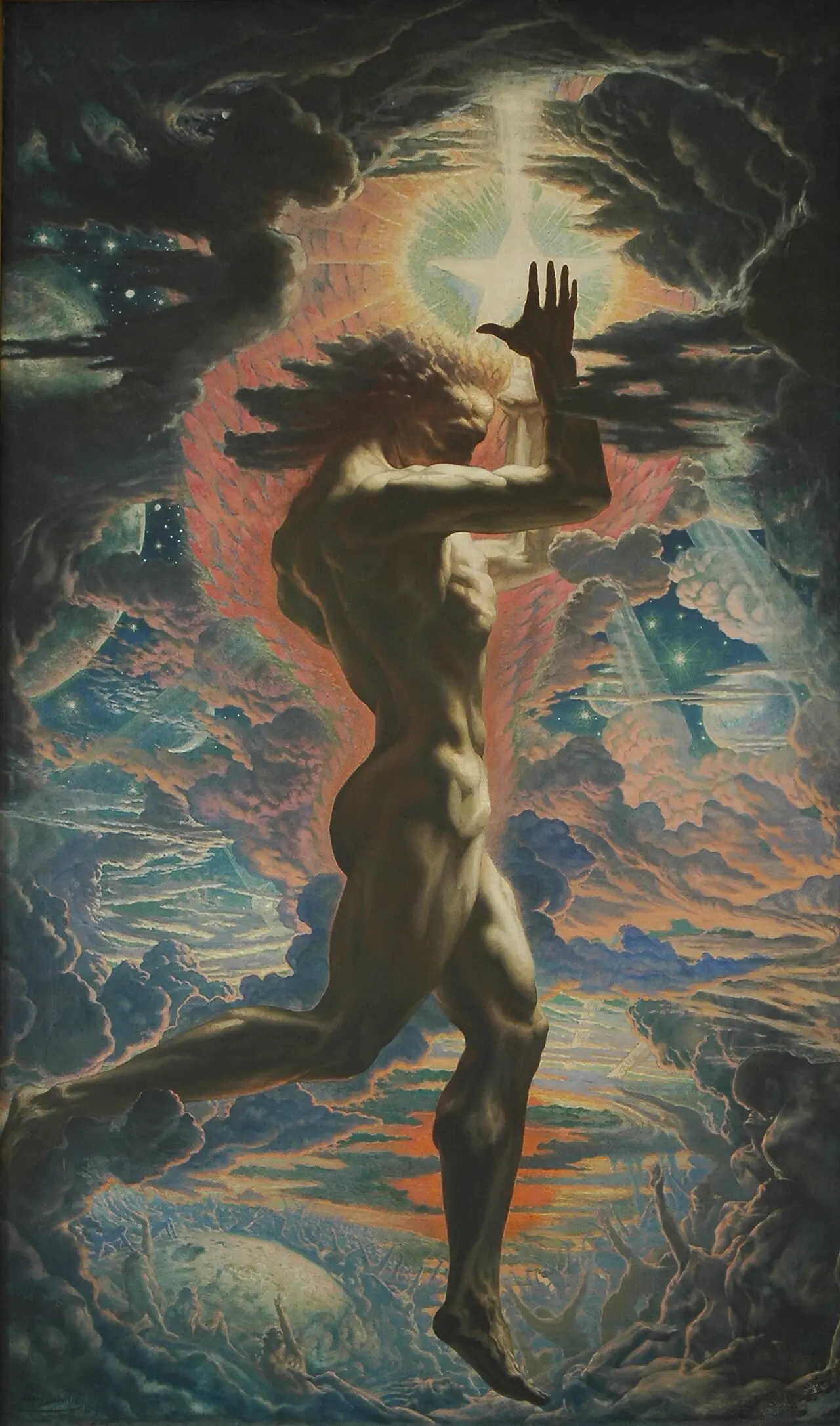
Delville’s fire-bearer offers light to humanity, the gift Scriabin made the subject of his orchestral Prometheus. The painter and composer knew each other in their Theosophical circle, and Delville later designed the cover of the score. Both treated Prometheus as the awakener of human consciousness.
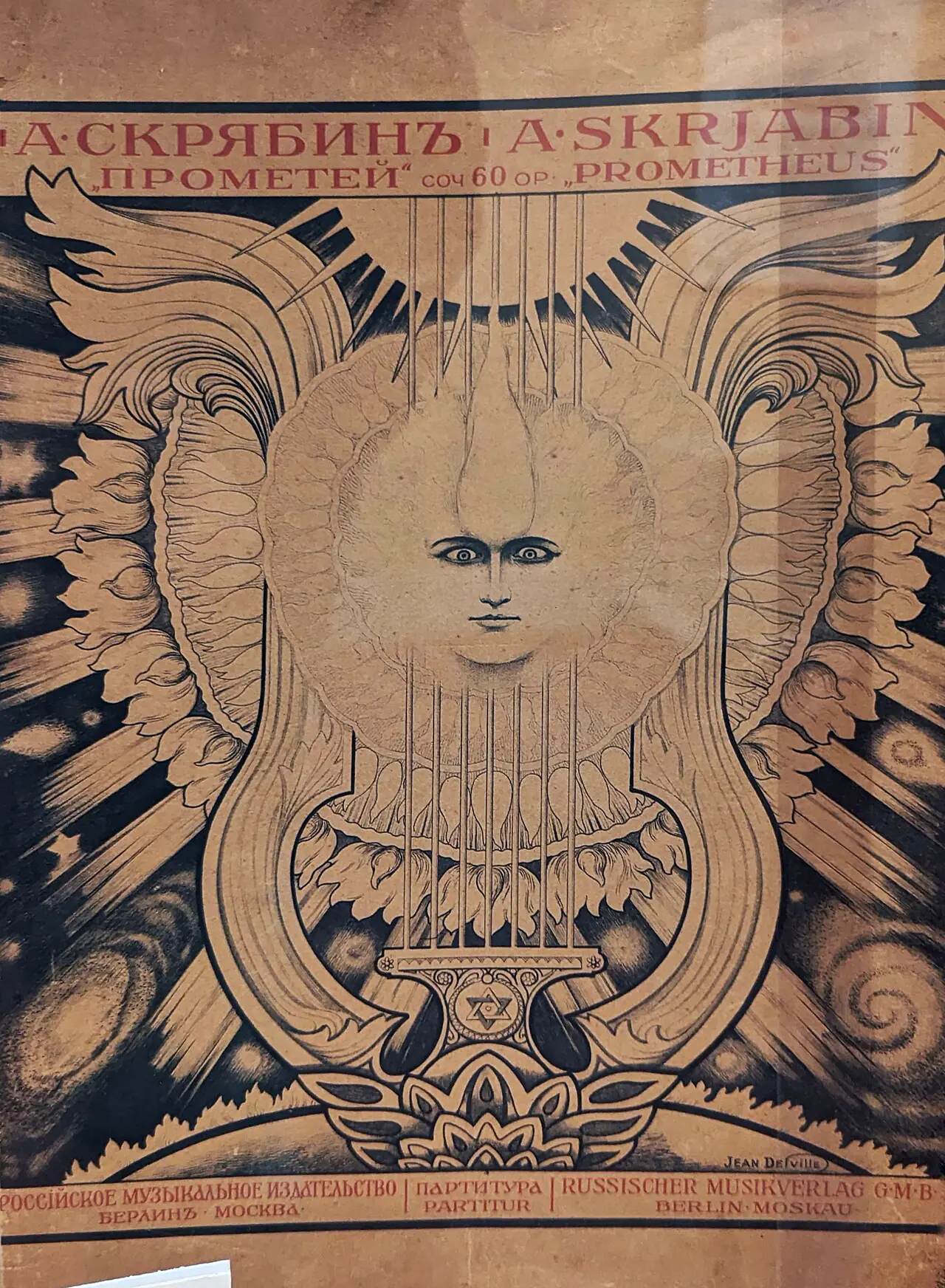
Delville drew this cover for the published score in 1911. It shows an elaborate face, rays and geometric shapes. Inside the score, Scriabin wrote two lines for light, and in 1913 he added handwritten colour annotations.
Recommended recordings
- The Complete Piano SonatasRuth Laredo, pianoNonesuch · 1970Especially persuasive in the Fifth and Ninth, where Laredo keeps a continuous line. Originally recorded for Connoisseur Society, later reissued by Nonesuch.
- Piano ConcertoVladimir Ashkenazy; London Philharmonic Orchestra, Lorin MaazelDecca · 1971A lyrical performance with firm orchestral support. Decca’s Kingsway Hall recording gives the piano room without losing detail in the strings. The slow variations are the centre of the work.
- The Poem of Ecstasy · PrometheusAnatol Ugorski, piano in Prometheus; Chicago Symphony Orchestra and Chorus, Pierre BoulezDeutsche Grammophon · 1995–96Best for Prometheus: Boulez separates the wind voices and gives Ugorski’s solo passages a firm setting. The playing is clear, though Ecstasy could use more abandon.
Lineage
Scriabin took the singing style of piano writing and many of his favourite forms from Chopin. Later composers took up his harmonies: Roslavets built his own method around synthetic chords, and Feinberg extended the sonata. Prokofiev dedicated Dreams to him in 1910. Messiaen also used colour and selected scales, with a very different religious imagination.
Further reading
- Faubion Bowers, Scriabin: A Biography (Dover, 1996). biography
A biographical account to set beside technical studies of the compositions.
- James M. Baker, The Music of Alexander Scriabin (Yale University Press, 1986). study
An analytical study of Scriabin’s musical language.
- Anna M. Gawboy and Justin Townsend, ‘Scriabin and the Possible’, Music Theory Online 18, no. 2 (2012). study
Re-examines the surviving light notation for Prometheus and documents a performance that tests its relation to the music.
Cite this page
Contrapunctus. “Alexander Scriabin.” Accessed 20 October 2026. https://mottopanikeiku.github.io/contrapunctus/composers/scriabin.html.
@misc{contrapunctus-composers-scriabin,
  author = {{Contrapunctus}},
  title = {Alexander Scriabin},
  howpublished = {\url{https://mottopanikeiku.github.io/contrapunctus/composers/scriabin.html}},
  note = {Accessed 2026-10-20}
}