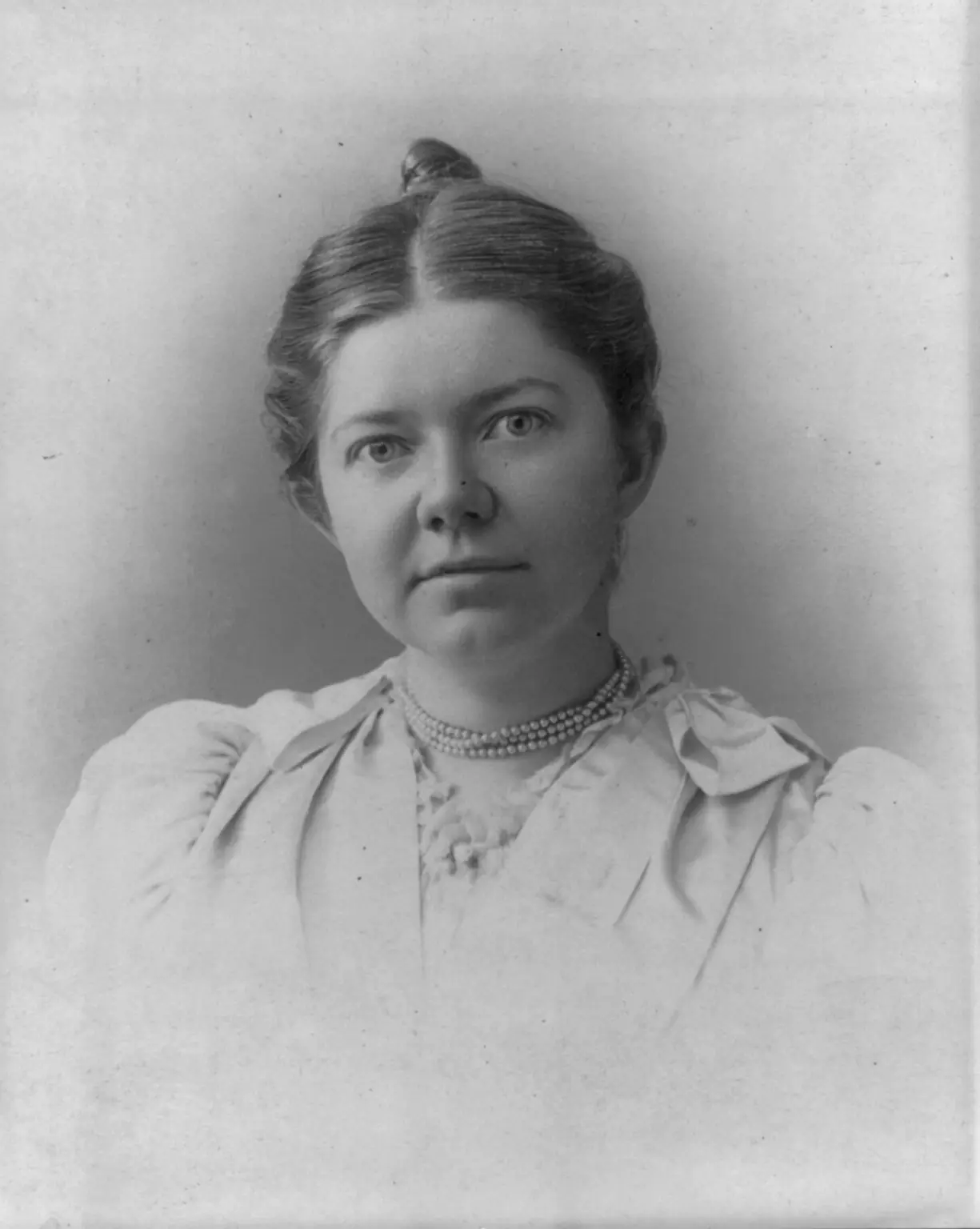
Born 5 September 1867, Henniker, New Hampshire, United StatesDied 27 December 1944, New York City, United States
American composer and former prodigy from New Hampshire who taught herself orchestration by attending Boston Symphony concerts; known for a symphony built on Irish tunes, first given in Boston.
Piano with Ernst Perabo and Carl Baermann; one year of harmony with Junius Hill; otherwise self-taught
Published as
Mrs H. H. A. Beach, from her marriage in December 1885
Landmarks
Mass in E♭ (1892) · “Gaelic” Symphony (1896) · Piano Concerto (1900) · Piano Quintet (1908)
Output
More than 300 published works: songs, piano music, chamber music, choral and sacred music, one opera
“I was not allowed to climb up on her lap, or on the music stool. I could only hear music, think music.”
Life
Amy Marcy Cheney was born on 5 September 1867 in Henniker, New Hampshire, the only child of a paper manufacturer and a singer-pianist. At four she spent a summer on her grandfather’s farm in West Henniker, where there was no piano, and composed three waltzes in her head; she played them when she got home. Her mother would not teach her the piano until she was six. “I was not allowed to climb up on her lap, or on the music stool,” Beach remembered. “I could only hear music, think music.”
1871–85Boston debut and marriage
The Cheneys moved to Chelsea, Massachusetts, in 1871 and to Boston in 1875. Ernst Perabo and then Carl Baermann, a pupil of Liszt, taught her the piano; Junius Hill gave her a year of harmony. Boston musicians told her parents to send her to Europe. They kept her at home. On 24 October 1883, aged sixteen, she played Moscheles’s G minor Concerto and Chopin’s E♭ Rondo at the Boston Music Hall. Her first song in print, The Rainy Day, a Longfellow setting, appeared the same year. On 28 March 1885 she played Chopin’s F minor Concerto with the Boston Symphony under Wilhelm Gericke.
On 2 December 1885 she married Dr Henry Harris Aubrey Beach, a Boston surgeon and a widower more than twenty years her senior. From then on every title page read “Mrs H. H. A. Beach”. He did not want her to give up music, but he wanted her fees to go to charity and her recitals limited to a few a year. “I was happy and Dr. Beach was content,” she said later. She spent the time studying. She told the compiler Otto Ebel that her orchestration, counterpoint and fugue had been “acquired alone, without teacher”, from treatises, from the scores of the masters, and from translating Berlioz and Gevaert on instrumentation. On Gericke’s advice, she studied every work the Boston Symphony played before, during and after the performance, and kept this up for years.
1892–96Mass in E♭ and “Gaelic” Symphony
On 7 February 1892 the Handel and Haydn Society gave her Mass in E♭ at the Boston Music Hall under Carl Zerrahn, the first mass composed by an American woman. In December the New York Symphony Society under Walter Damrosch played Eilende Wolken, her concert aria on Schiller’s Mary Stuart, with the contralto Katie Alves. Festival Jubilate opened the Woman’s Building at the Chicago exposition on 1 May 1893, with Theodore Thomas conducting.
Dvořák had told the New York Herald in May 1893 that “In the Negro melodies of America I discover all that is needed for a great and noble school of music.” That December Beach heard the “New World” Symphony in Boston and wrote in her journal that Dvořák might have given more of “the dark, tragic, side!” She told the Boston Herald that Northerners “should be far more likely to be influenced by the old English, Scotch, or Irish songs inherited with our literature from our ancestors.” She wrote the “Gaelic” Symphony in 1894–96.
Emil Paur conducted the first performance at the Friday-afternoon rehearsal on 30 October 1896; the Saturday-evening concert followed. The symphony opens pianissimo, with a tremulous chromatic passage in the strings that grows for sixteen bars before the first theme enters in the trumpets. Philip Hale reviewed it in the Boston Journal: “The only trace of woman that I find in this symphony is this same boisterousness.” George Whitefield Chadwick called her “one of the boys”.
1897–1910Sonata, concerto, quintet
The Violin Sonata in A minor was new to the Kneisel Quartet’s fourth concert at Association Hall on 4 January 1897, with Mrs Beach at the piano. On 6 April 1900, in the old Music Hall, she played her own Piano Concerto in C♯ minor with the Boston Symphony under Gericke, the conductor whose advice had sent her to study the orchestra’s concerts. Hale was less favourable this time and called it “a disappointment in nearly every way”. On 27 February 1908 she and the Hoffmann Quartet gave the first performance of her Piano Quintet in F♯ minor at Potter Hall, Boston.
1910–14Europe
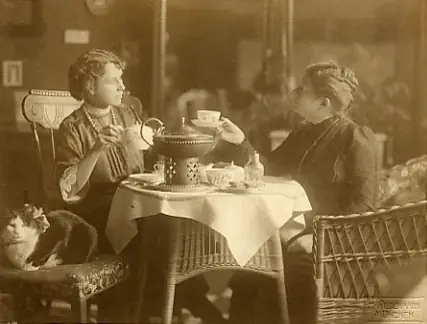
Dr Beach died on 28 June 1910, after a fall; her mother died on 18 February 1911. On 5 September 1911 Beach sailed for Europe. She was a bad sailor, and she told an interviewer she had half hoped to cross “by some other way—perhaps by a flying machine”. From the autumn of 1912 she played her concerto, sonata and quintet in German cities, and the “Gaelic” Symphony was performed in Leipzig and Hamburg. A photograph from Munich, dated 14 February 1913, shows her with the soprano Marcella Craft, who had sung her songs in European recitals for years. After the Hamburg concert in December 1913, Dr Ferdinand Pfohl wrote in the Hamburger Nachrichten that “one need only mention the names of Amelie Nikisch and Amy Beach in order to refute this foolish prejudice concerning women composers.” She was home in the autumn of 1914.
1921–44The MacDowell Colony and later years
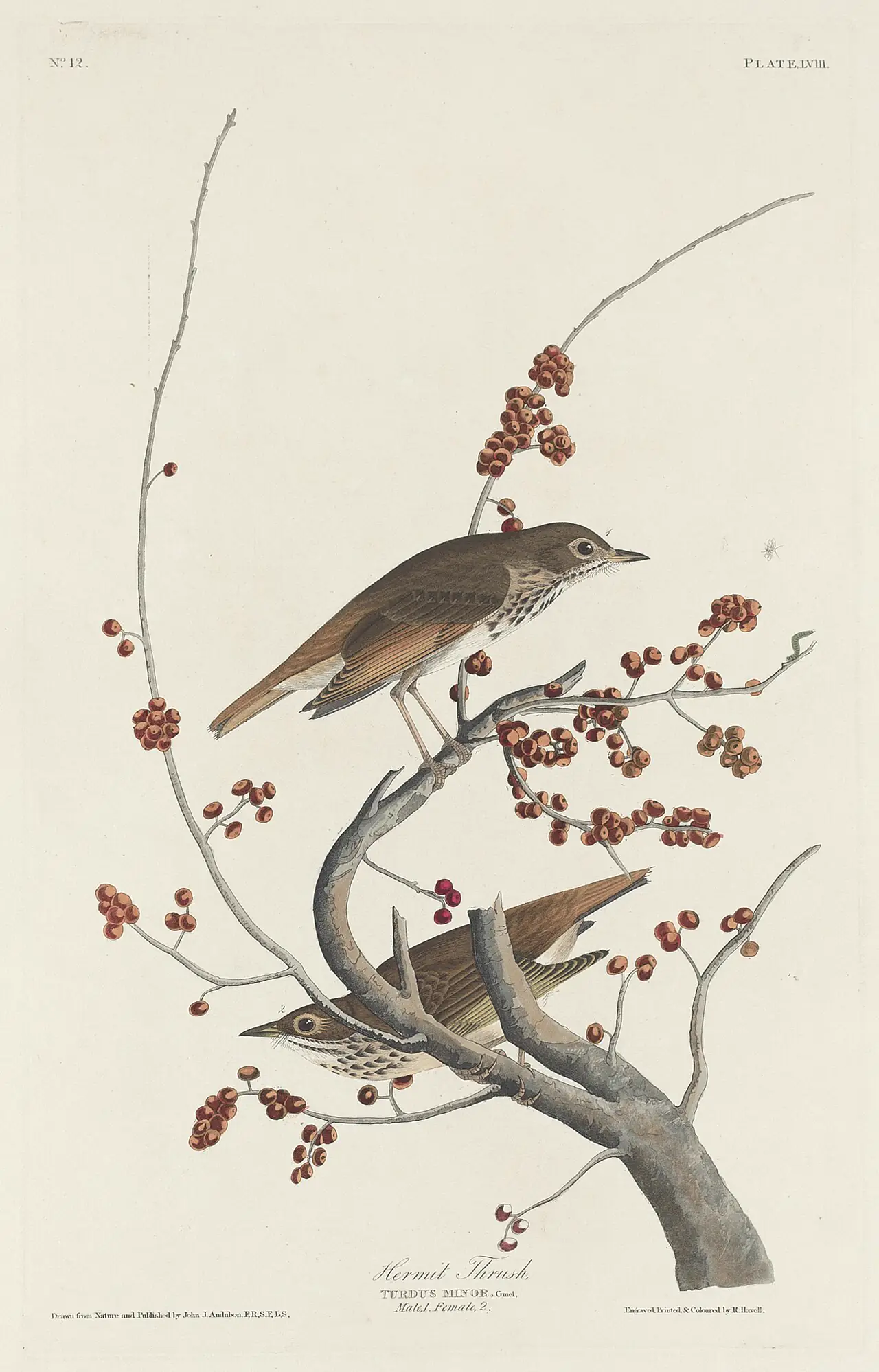
In the summer of 1921 she began the first of eighteen residencies at the MacDowell Colony in Peterborough, New Hampshire, working in the Watson studio. A hermit thrush sang near her. She wrote down its songs and based two piano pieces on them, A Hermit Thrush at Eve and A Hermit Thrush at Morn, Op. 92. A footnote to the second reads: “These bird-calls are exact notations of hermit thrush songs, in the original keys, but an octave lower, obtained at MacDowell Colony, Peterborough, N.H.” Younger composers there called her Aunt Amy.
She became the first president of the Society of American Women Composers, made New York her winter home from 1930, and wrote her only opera, Cabildo, in 1932; it reached the stage at Athens, Georgia, on 27 February 1945. Beach died of heart failure in her New York apartment on 27 December 1944. She left her copyright to the MacDowell Colony, and her royalties still support it. “My work has always been judged from the beginning by work as such, not according to sex,” she said near the end.
Places
Every recorded place, joined in date order. Beach on the MapAll 21 places, with sources
Henniker, New Hampshire · 5 September 1867 · born
Born Amy Marcy Cheney. At four she composed three waltzes in her head during a summer on her grandfather’s farm in West Henniker, where there was no piano. Coordinates mark the town.
The family moved to Boston in 1875. She studied piano with Ernst Perabo and Carl Baermann and harmony with Junius Hill, and was kept from European study. Coordinates mark the city.
Her public debut as a pianist was at A. P. Peck’s Anniversary Concert, in Moscheles’s G minor Concerto and Chopin’s E♭ Rondo. The hall on Winter Street still stands; its interior was rebuilt as the Orpheum Theatre.
28 Commonwealth Avenue, Boston · December 1885 – 1910 · lived
Dr Beach had owned this Back Bay house since 1879, and she moved in when they married in December 1885. After his death in 1910 she let it to physicians; she sold it in 1924.
On 2 and 3 December 1892 the New York Symphony Society under Walter Damrosch played her concert aria on Schiller’s Mary Stuart, with the contralto Katie Alves as soloist. Eilende Wolken, Op. 18.
She composed it for the dedication of the Woman’s Building at the World’s Columbian Exposition, where it was performed by a chorus of 300 conducted by Theodore Thomas. The coordinates mark the park. Festival Jubilate, Op. 17.
The Boston Symphony under Emil Paur played the symphony at the Friday-afternoon rehearsal on 30 October and at the concert on Saturday evening, 31 October. “Gaelic” Symphony, Op. 32.
Association Hall, Boston · 4 January 1897 · premiere
The sonata was first played at the Kneisel Quartet’s fourth concert, with Mrs Beach assisting. The hall stood at the corner of Boylston and Berkeley Streets, and the coordinates mark that corner. Violin Sonata, Op. 34.
After her husband’s funeral she and her mother went to her cottage here, which remained her main summer residence. It had been paid for with the royalties from her song Ecstasy.
At her European concert debut she played her Violin Sonata with a violinist named Dr Bülau. From the autumn of 1912 she played her concerto, sonata and quintet in German cities.
She played her Piano Concerto with a Hamburg orchestra, and the “Gaelic” Symphony was performed. Dr Ferdinand Pfohl reviewed the concert in the Hamburger Nachrichten of 3 December 1913.
She sailed on 11 December 1928 for a five-month trip. In Rome she finished her String Quartet, Op. 89, sketched at the MacDowell Colony in 1921, and appeared in concerts at the American Academy and the American embassy.
The first movement of the “Gaelic” Symphony draws on her own song Dark Is the Night (1890), a Henley setting. She reused tunes across her songs, piano pieces and orchestral works.
♮The falling third
The 1896 programme book identified a “Keltic” cadence in the slow movement, in which the third degree falls to the tonic. The slow movement also sets two folk-like themes against each other so that they sound together.
𝄢Orchestration
The symphony is scored for pairs of flutes, oboes, clarinets and bassoons, four horns, two trumpets, three trombones, tuba, three timpani and strings. In the concerto she added a bass clarinet, and a triangle in the scherzo.
𝄾Repeated chords
In The Year’s at the Spring (Op. 44 No. 1) the piano plays repeated chords under nearly every bar. The voice holds long notes over them, with a tied B♭ on “year’s” and a held note at the climax on “right”.
𝄞Birdsong
According to her own footnote, the thrush calls in Op. 92 are exact notations, written an octave lower than the bird sang them. She had been taking down birdsong since childhood.
♯Brahms
The Piano Quintet’s main theme, first heard on the first violin, derives from the second theme in the finale of Brahms’s Piano Quintet. Falling phrases from it recur in all three movements, and two F♯ major chords end the work.
Works
A selection from the composer’s works.
1888
Cadenza to Beethoven’s Piano Concerto No. 3Op. 3Piano
A cadenza for the first movement of the C minor Concerto.
1890
Mass in E♭Op. 5Soloists, chorus, orchestra and organ
First performed by the Handel and Haydn Society on 7 February 1892.
1892
Eilende Wolken, Segler der LüfteOp. 18Alto and orchestra
Mary Stuart’s speech from Schiller; first performed by the New York Symphony Society, December 1892.
1893
EcstasyOp. 19 No. 2Voice, piano and violin
The royalties from this song paid for her cottage at Centerville on Cape Cod.
1894–96
“Gaelic” Symphony in E minorOp. 32Orchestra
Four movements; first played by the Boston Symphony under Emil Paur, 30 and 31 October 1896.
1896
Violin Sonata in A minorOp. 34Violin and piano
Four movements. First heard at a Kneisel Quartet concert, 4 January 1897.
1897
Three Shakespeare SongsOp. 37Voice and piano
O mistress mine; Take, O take those lips away; Fairy Lullaby.
1899
Piano Concerto in C♯ minorOp. 45Piano and orchestra
Dedicated to Teresa Carreño; first played by Beach and the Boston Symphony, 6 April 1900.
1900
Three Browning SongsOp. 44Voice and piano
The Year’s at the Spring; Ah, Love, but a Day; I Send My Heart Up to Thee. Dedicated to the Browning Society of Boston.
1907
Piano Quintet in F♯ minorOp. 67Piano and string quartet
First performed by Beach and the Hoffmann Quartet at Potter Hall, Boston, 27 February 1908.
1921
Hermit Thrush at Eve; Hermit Thrush at MornOp. 92Piano
Two pieces built on thrush songs taken down at the MacDowell Colony.
1921–29
String QuartetOp. 89String quartet, one movement
Sketched at the MacDowell Colony in 1921 and finished in Rome in 1929; it is based on three Inuit melodies.
1932
CabildoOp. 149Opera in one act
Libretto by N. B. Stephens; first staged at Athens, Georgia, 27 February 1945.
1938
Piano Trio in A minorOp. 150Piano trio
Composed at the MacDowell Colony; first played in New York on 15 January 1939.
In the score
Short examples, engraved and playable.
Violin Sonata — quotedThe violin’s rising entry
Quoted from the violin part of the first edition (A. P. Schmidt, 1899, on IMSLP). These are the violin’s first four bars, marked Allegro moderato and tranquillo, which follow five bars for piano alone. The line climbs through B–C, E–G–B and C–E–G to a held A.
Browning song — quotedThe Year’s at the Spring: voice part
Quoted from the A. P. Schmidt print of 1900 (the B♭ edition), voice part only, marked Allegro di molto. In “The year’s at the spring, and day’s at the morn”, the second phrase repeats the first a step higher. The piano’s repeated chords are omitted here.
Celtic cadence — invented schematicPhrase cadence: third degree to tonic
An invented two-bar schematic that does not quote the symphony. The phrase ends with G, the third degree, falling to E, the tonic, the cadence the 1896 programme book calls “Keltic”.
Sister arts
Robert Havell after John James AudubonHermit Thrush, 1829Hand-coloured print, from The Birds of America · National Gallery of Art, Washington, DC
This is the bird Beach heard at the MacDowell Colony in 1921. Her Op. 92 pieces set its songs in notation, and her footnote states that they are exact. Audubon’s plate 58 shows the male and the female, lettered “Male, 1. Female, 2.” in its title.
H. WiedenmannAmy Beach and Marcella Craft, Munich, 14 February 1913Photograph · Wikimedia Commons
Craft sang with the Munich opera and had given Beach’s songs in European recitals for years. The picture dates from Beach’s German season of 1912–14, when her concerto, sonata and quintet were played in German cities.
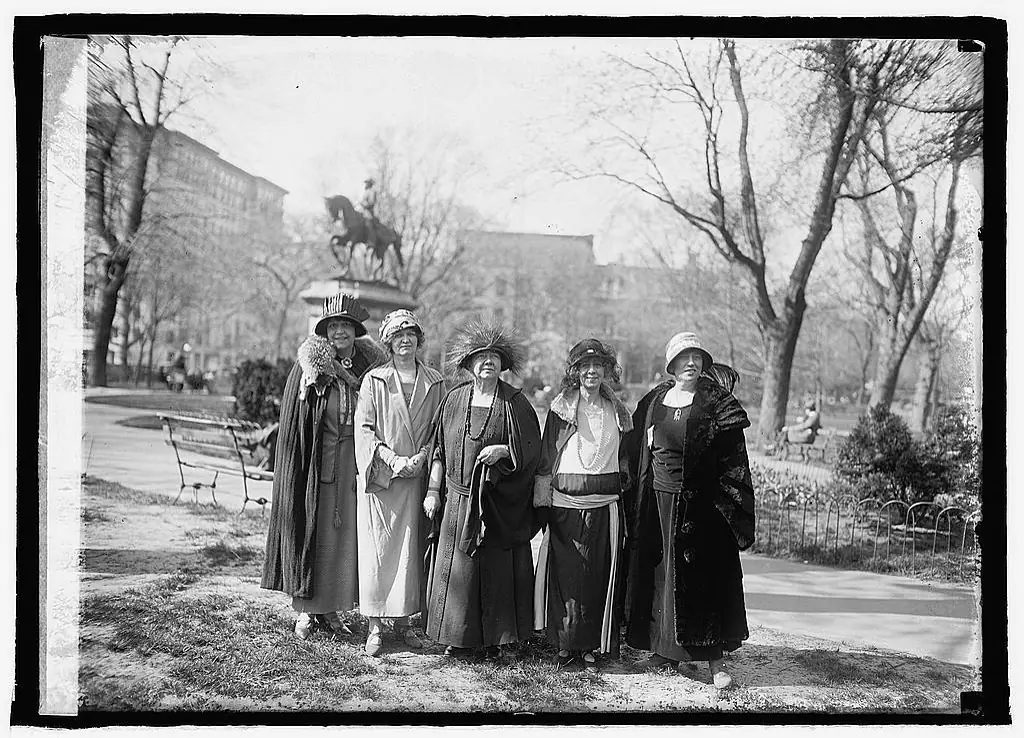
Unknown photographer for the National Photo CompanyFive American women composers, 23 April 1924Photograph · Wikimedia Commons
Left to right: Phyllis Fergus, Ethel Glenn Hier, Amy Beach, Harriet Ware and Gena Branscombe. Beach was first president of the Society of American Women Composers.
Robert Browning
The Year’s at the Spring
1841
EnglishThe year’s at the spring,
And day’s at the morn;
Morning’s at seven;
The hillside’s dew-pearled;
The lark’s on the wing;
The snail’s on the thorn:
God’s in his heaven—
All’s right with the world!
Pippa’s song from Pippa Passes. Beach set it as Op. 44 No. 1 and printed the text on the page opposite the music. She sets the first four lines, slows at “dew-pearled”, then starts again, drops “Morning’s at seven” and “The hillside’s dew-pearled”, and runs on to “All’s right with the world”.
Recommended recordings
Violin Sonata in A minor, Op. 34Joseph Silverstein, Gilbert KalishNew World Records, NW 268 · 1977Part of the Recorded Anthology of American Music, coupled with Arthur Foote’s Violin Sonata in G minor, Op. 20. The Beach sonata runs 28:41; New World later reissued it on CD as 80542.
Where to hear more
Piano Quintet in F♯ minor, Op. 671907
Garrick Ohlsson, piano; Takács Quartet · Hyperion · May 2019
Coupled with Elgar’s quintet on Hyperion CDA68295, recorded at Wyastone and released in 2020. Nigel Simeone’s notes trace the theme Beach took from the finale of Brahms’s quintet through all three movements, ending with the two F♯ major chords that close the work.
Detroit Symphony Orchestra; Neeme Järvi · Chandos · 19–20 January 1991
Chandos CHAN 8958, recorded in Orchestra Hall, Detroit, and released in 1992, with Barber’s First Symphony. The four movements run 11:06, 7:45, 12:41 and 9:20.
Dvořák’s call for an American music prompted the “Gaelic” Symphony. Brahms’s quintet supplied the theme of her own quintet, and she set texts by Browning and Schiller. The soprano Marcella Craft sang her songs in Munich.
The standard life, covering how a prodigy with one year of formal harmony came to compose a symphony. It is the source of the Amy Beach Project’s works list.
A life drawn from her scrapbooks and letters, now at the University of New Hampshire, covering the marriage, the Cape Cod cottage and the MacDowell summers.
The programme that listeners read at the first performance of the “Gaelic” Symphony gives Beach’s training, the movements, the scoring and the Celtic cadence.
The locations of the manuscripts and first editions are given here. The Schmidt archive, her letters to the Library and the published scores are listed.
Cite this page
Contrapunctus. “Amy Beach.” Accessed 20 October 2026. https://mottopanikeiku.github.io/contrapunctus/composers/beach.html.