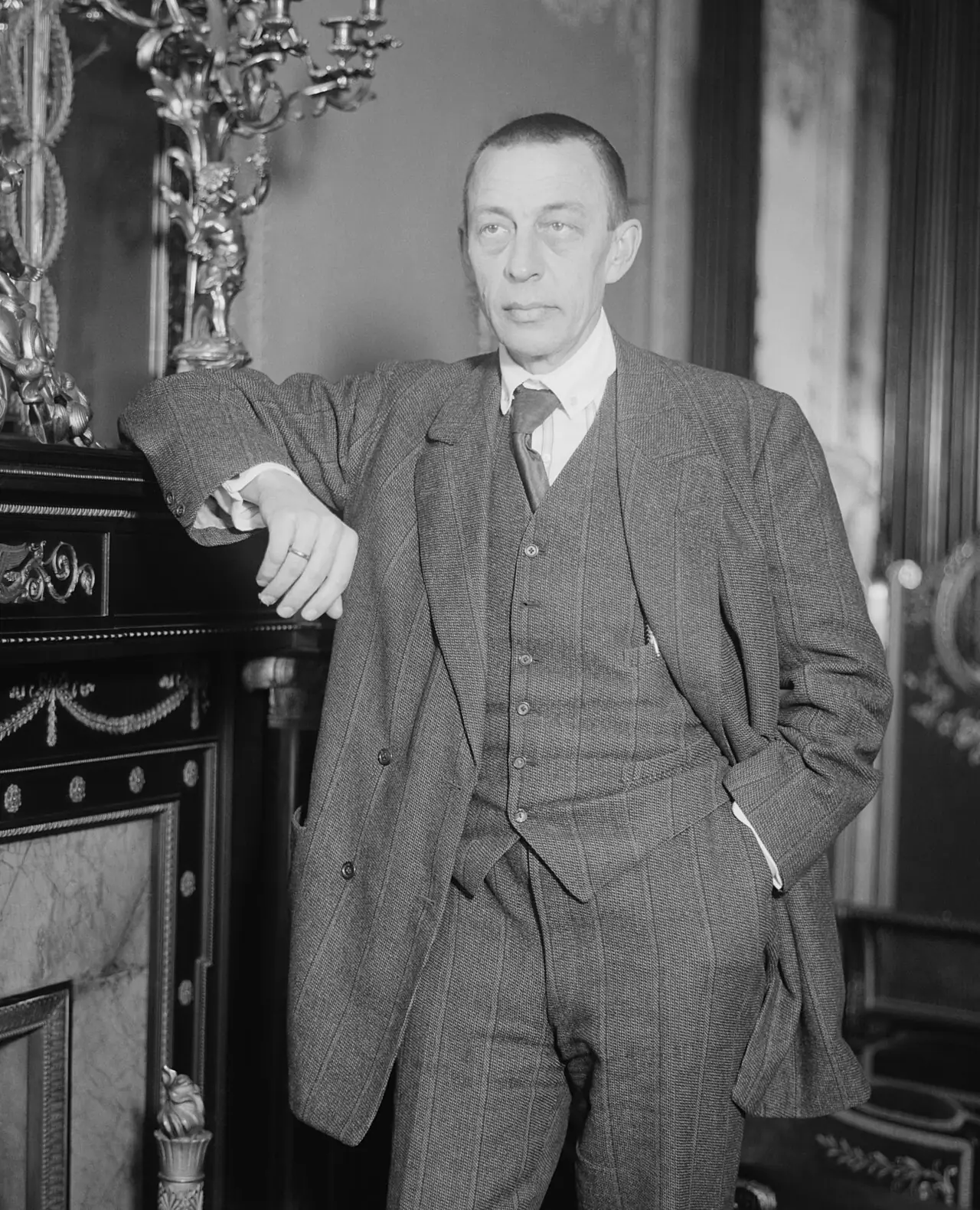
Recording
- Sostenuto — Tempo di ValseSergei Rachmaninoff, piano · 4 November 19223:10
Rachmaninoff plays his Sérénade, Op. 3 No. 5, which he wrote at nineteen. A few soft notes around F lead into a waltz, which fades to near silence before a final loud chord.
Listening notes · joins
- Opening, Sostenuto
The left hand begins on F, pp, in a slow 3/8. Small turning figures move around that note before the right hand enters with chords.
- Tchaikovsky interview, November 1892
In November 1892 Rachmaninoff read an interview in which Tchaikovsky named him among the outstanding young composers. Delighted, he sat down at the piano and added this Sérénade to his planned set of four pieces. Gutheil published all five the following February.
- Tempo di Valse
At Tempo di Valse, in 3/8, a bass note and offbeat chords set up the waltz accompaniment. The melody turns around neighbouring notes and extends the turning figures of the opening into a longer line.
- Victor recording sessions, New York, 1922
Victor’s ledgers record five takes of the Sérénade in New York, three on 1 November 1922 and two on 4 November. The first four were destroyed, and the fifth was issued on Victor 66129 and 816. For 1 November the ledger names the piano: “Steinway piano, style B-211833.”
- Final chords
The waltz thins to chords marked ppp, then pppp. A final fortissimo chord follows, held under a fermata.
Joins
- From Sostenuto to Tempo di Valse
The opening returns repeatedly to F, the dominant of B♭ minor. After chords marked ppp, a short rising run leads the piano into Tempo di Valse. The left hand starts its bass-and-chord pattern, and the small turning figures become the melody of the waltz.
- Waltz bass stops before final chord
The waltz bass stops and the piano moves into descending chords, marked ppp and then pppp. Small turning figures continue above the bass. The piece ends on a single ff chord under a fermata.