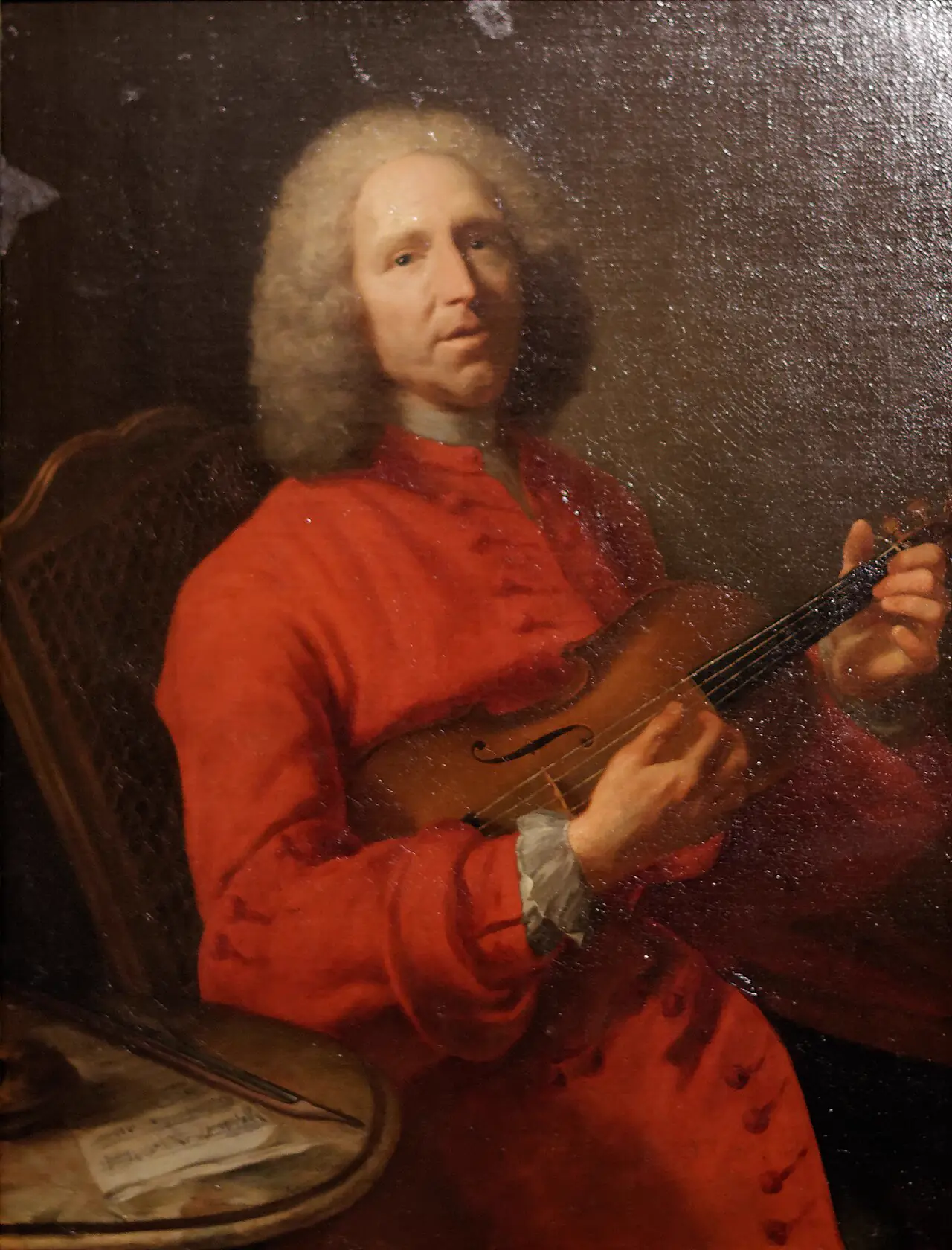
Organist in Dijon, Clermont-Ferrand and Lyon; first harpsichord book, 1706
Theory
Traité de l’harmonie, 1722; Nouveau système de musique théorique, 1726
Theatre
Hippolyte et Aricie, 1733; royal composer from 1745
Patron
Alexandre Le Riche de La Pouplinière, financier with a private orchestra
Life
When Hippolyte et Aricie opened at the Paris Opéra on 1 October 1733, Rameau had just turned fifty. One passage had already been cut. A trio for the Fates, with harmonies that proved too difficult for the singers and players in rehearsal, was removed before the première. The opera divided its audience. Admirers heard a new theatrical voice, while devotees of Lully heard an attack on their inheritance. It was the first opera by Rameau, an organist from Dijon.
1683–1722Organ posts and the Traité de l’harmonie
His father played the organ in Dijon. Jean-Philippe followed the same trade in a succession of French churches, with appointments in Clermont-Ferrand, Dijon and Lyon and an early attempt to establish himself in Paris. There he published his first harpsichord book in 1706. It begins with an unmeasured prelude, in which the player must work out the timing of the notes, followed by a faster section in regular metre. Allemandes, courante and sarabandes follow. He was twenty-three, and he was writing within the French keyboard tradition before Couperin had published his first book.
Back at Clermont-Ferrand, Rameau worked on the book that would make his name. The Traité de l’harmonie appeared in 1722, its preface declaring: “Music is a science which must have definite rules.” He wanted to explain the chords an organist knew from practice, and why one led naturally to another. When C, E and G are placed in a different order the bass changes, but the chord is still recognisably the same chord. From observations like this he built his account of the fundamental bass, a sequence of roots beneath the notes actually being played.
He settled permanently in Paris in the early 1720s, published the Nouveau système in 1726 and continued to revise his explanations as he studied the behaviour of vibrating strings. He also wanted a theatre. On 25 October 1727 he wrote to the librettist Houdar de La Motte asking for an opera text. His reputation for learning was an obstacle. “I try to conceal art through art itself,” he told La Motte, and he referred him to the harpsichord pieces and cantatas as evidence of what he could do. No libretto came.
The keyboardRameau’s harpsichord pieces
The harpsichord books of 1724 and about 1728 contain many descriptive pieces. In Le Rappel des oiseaux the keyboard imitates bird calls. In Les Cyclopes the hands alternate like drumsticks, and then the left hand crosses over the right to strike high and low notes; Rameau explained both techniques in his preface. La Poule opens with repeated notes imitating a hen clucking and builds to a passage of great activity. The tune of the A minor Gavotte is followed by six doubles, or variations, each more demanding for the fingers than the last.
In L’Enharmonique a note is reinterpreted enharmonically, and the next chord takes the music into an unexpected key. Rameau wrote a preface explaining the passage. In the Pièces de clavecin en concerts of 1741 he gave the harpsichord a fully written-out part, with a violin or flute and a viol or second violin alongside, so the keyboard player did not have to fill in chords from a figured bass as usual.
1733Hippolyte et Aricie
The financier Alexandre Le Riche de La Pouplinière supplied the orchestra and society Rameau needed. His household brought the composer into contact with Voltaire and the abbé Simon-Joseph Pellegrin, who finally provided a libretto. Hippolyte et Aricie takes its lovers and its dangerous stepmother from Racine’s Phèdre, and adds gods, sea monsters and a whole act in the underworld. In Pellegrin’s libretto the young lovers survive, while Phèdre’s catastrophe takes place around them.
In the underworld, the Fates tell Thésée that the hell he has escaped awaits him in his own house. The trio Rameau wrote for that prophecy was cut in 1733 and restored in 1757; its harmony leaves the destination of a chord uncertain at the moment his future is announced. Above ground, horns lead the hunt, and flutes play blasts of wind when the sea monster appears. Rameau also set a cheerful dance against the drama. Thésée, convinced that his son has betrayed him, must sit through a celebration of his safe return, and the sailors dance their rigaudons while he waits to call down punishment.
1735–44Les Indes galantes and later operas
Les Indes galantes brought separate love stories to the stage in 1735, with Turkish, Peruvian and Persian settings. The North American act was added in 1736. Its famous dance had begun as a harpsichord piece. Rameau wrote Les Sauvages after seeing two Indigenous visitors from Louisiana dance at the Comédie-Italienne in 1725. In the opera, Zima rejects both her French and Spanish suitors and chooses Adario. The rejected Europeans end by joining the celebration.
In Castor et Pollux (1737), two brothers love the same woman, and the immortal one must choose whether to take the mortal one’s place among the dead. Télaïre’s lament, Tristes apprêts, has a bassoon line. Pollux’s sacrifice leads eventually to the brothers becoming stars. Dardanus followed in 1739. Its libretto was so troublesome that Rameau returned to the work in 1744 and replaced much of the drama.
1745–64Platée, the Querelle, Les Boréades
Platée was performed at Versailles in 1745 during the Dauphin’s wedding celebrations. Jupiter pretends he will marry an ungainly marsh nymph to cure Juno of jealousy. Platée believes him, and everyone else knows the truth. Frogs croak around her, the dances are absurd, and La Folie sings a virtuoso display. That same year Rameau became a royal composer.
By the time of the Querelle des Bouffons of 1752, Rameau, who had once disturbed French opera, had become its chief defender. Performances of Pergolesi’s La serva padrona by a visiting Italian company started a new dispute in Paris. Rousseau championed Italian melody and attacked French musical speech. Rameau replied from his conviction that the force of melody rested on harmony. He continued to compose during the dispute, and the comic Les Paladins reached the stage in 1760.
Rehearsals for Les Boréades began in 1763 and were stopped before a public performance took place. In the opera the queen, Alphise, wants to marry the man she loves; the descendants of the north wind oppose the match, and a storm breaks up the festivities. Rameau died in Paris on 12 September 1764, shortly before his eighty-first birthday. The opera received its first full staging in 1982, at Aix-en-Provence under John Eliot Gardiner.
Places
Every recorded place, joined in date order. Rameau on the MapAll 16 places, with sources
Dijon · 25 September 1683 – 1701 · born
Born and baptised on the same day; his father was an organist in Dijon churches. He was taught music before he learned to read.
Organist of the Jesuits in rue Saint-Jacques; published his first harpsichord book, showing Marchand’s influence. Premier livre de pièces de clavecin.
In the Fates’ trio in Hippolyte et Aricie, a chord leads somewhere unexpected. L’Enharmonique uses a related device at the harpsichord. A familiar pitch takes on a new spelling and points towards another key, although the note played on the keyboard stays the same.
𝅘𝅥French speech
Phèdre’s confrontation with Hippolyte is set as fast-moving recitative. Short phrases, leaps and changes of harmony carry her words, and no aria forms. Rameau inherited French recitative from Lully and asked more of the singer’s range and ornaments. A change in the bass can alter the harmony under a single syllable.
𝄋Dance
In Act III of Hippolyte et Aricie, sailors celebrate Thésée’s return with rigaudons while he is burning with jealousy. The dancing delays his revenge. Rameau’s gavottes, menuets and chaconnes stand on their own as instrumental pieces; in the theatre, their meaning depends on the dramatic situation in which they are danced.
𝄞The orchestra
Horns announce the hunt in Hippolyte et Aricie; flutes represent the wind in its sea storm. In Tristes apprêts a bassoon plays beside Télaïre’s lament.
𝄢The hands
In Les Cyclopes, alternating hands imitate a drummer’s sticks, and the left hand crosses the right to reach the treble before returning to the bass. Rameau explained the technique in his 1724 preface. His A minor Gavotte keeps the same harmonic route through six doubles while quick notes and repeated attacks fill more and more of the keyboard.
Works
A selection from the composer’s works.
1706
Premier Livre de pièces de clavecinHarpsichord
An unmeasured prelude opens Rameau’s first published suite. Its freely timed opening is followed by a quick, regular dance, and then the allemandes begin.
1724
Pièces de clavecinHarpsichord
The two suites include Le Rappel des oiseaux, with its bird calls, and Les Cyclopes, with its hammering hand-work. Rameau explained his new keyboard techniques in the preface.
La Poule is built on a repeated note imitating a hen’s clucking. The collection also includes Les Sauvages, L’Enharmonique and the A minor Gavotte with six doubles.
Hippolyte et AricieTragédie en musique, soloists, chorus and orchestra
His first opera, after Racine through Pellegrin. The Fates’ most adventurous trio had to be cut because the performers could not master it.
1735–36
Les Indes galantesOpéra-ballet, soloists, chorus, dancers and orchestra
Separate love stories set in Turkey, Peru, Persia and North America. The American act, added in 1736, reuses the harpsichord dance Les Sauvages.
1737; revised 1754
Castor et PolluxTragédie en musique
Pollux offers his immortality to save his brother. The first version opens at Castor’s tomb; in the revision Castor appears on stage before his death.
1739; revised 1744
DardanusTragédie en musique
A score Rameau refused to abandon when its libretto drew criticism. The 1744 revision rebuilt much of the action around the lovers.
1741
Pièces de clavecin en concertsHarpsichord with violin or flute and bass viol or second violin
Five chamber concerts with the harpsichord part written out in full. The harpsichord is a principal player and does not only supply the chords.
1745
PlatéeComic stage work with high-tenor title role, chorus and orchestra
A marsh nymph is promised Jupiter’s hand as a practical joke. Written for royal wedding festivities. La Folie has a virtuoso scene.
1763
Les BoréadesTragédie en musique in five acts
The north wind interrupts a queen’s attempt to choose her own husband. Rehearsed in 1763, it received its first full staging at Aix-en-Provence in 1982.
In the score
Short examples, engraved and playable.
The fundamental bassThree bass notes and one chord root
A schematic of chord inversion. The bass moves C–E–G–C, and all four chords contain only C, E and G. The root remains C throughout. The figures count intervals above the sounding bass, so they change from chord to chord while the chord’s identity stays the same.
Enharmonic hearingShared pitches in different keys
A schematic of enharmonic reinterpretation. On an equal-tempered keyboard, C♯–E–G–B♭ sounds the same as D♭–E–G–B♭. The first chord resolves to D minor; the second is an inversion of E–G–B♭–D♭ and resolves to F minor. The chord that follows shows which spelling is meant.
Sister arts
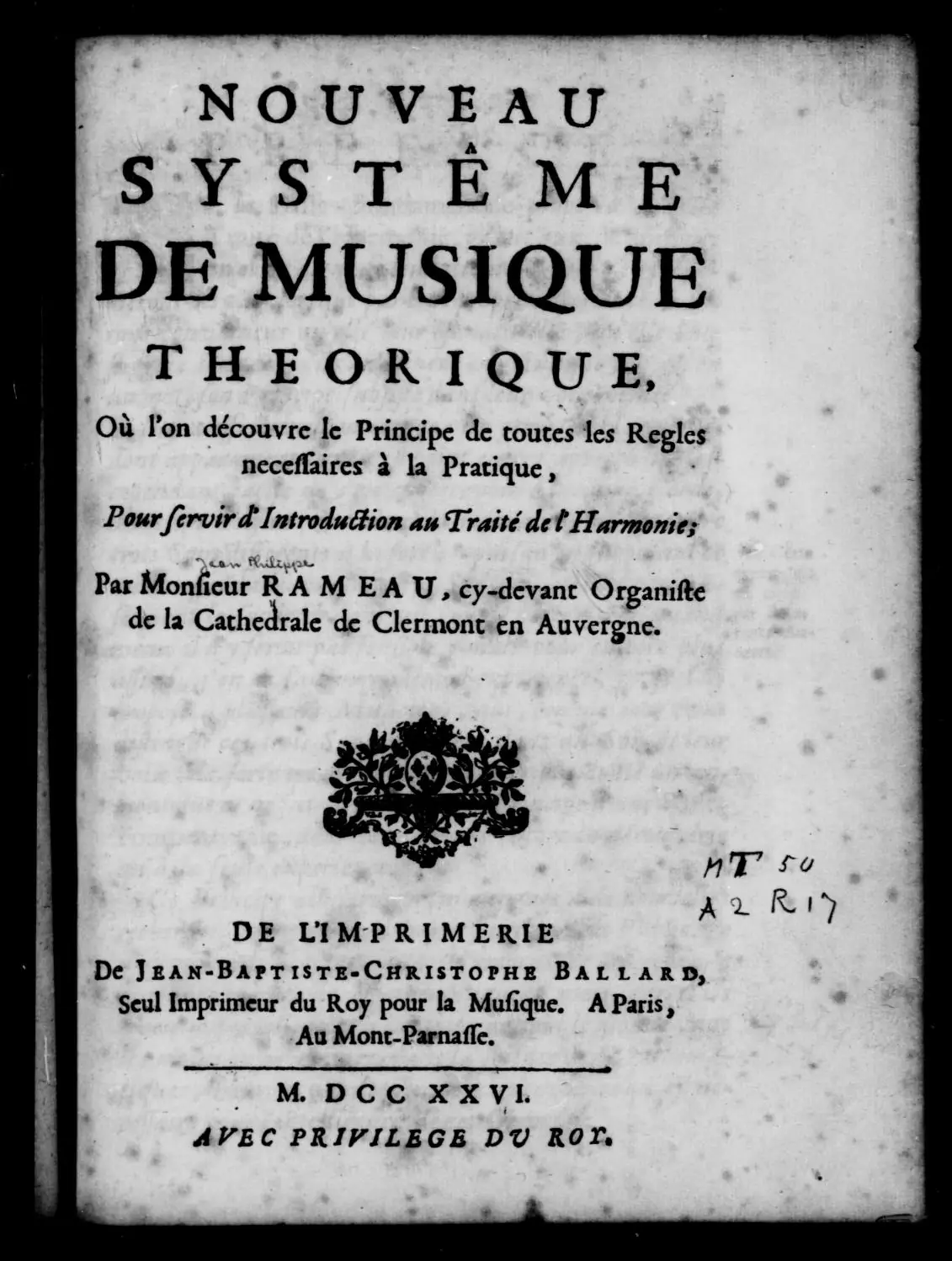
Jean-Philippe Rameau; printed by Jean-Baptiste-Christophe BallardTitle page of Nouveau système de musique théorique, 1726Printed book · Library of Congress, Washington, DC
Rameau published the Nouveau système in Paris in 1726, four years after his Traité. His printed books had made his name as a theorist. A year later he wrote to La Motte asking for an opera libretto, and he cited his harpsichord pieces and cantatas to persuade the poet that he could also write for the stage.
Jean Racine
Phèdre — Act I, scene 3
1677
FrenchJe le vis, je rougis, je pâlis à sa vue ;
Un trouble s’éleva dans mon âme éperdue ;
Mes yeux ne voyaient plus, je ne pouvais parler ;
Je sentis tout mon corps et transir et brûler.
Our translationI saw him; I blushed, I turned pale at the sight;
a disturbance rose in my bewildered soul;
my eyes no longer saw, I could not speak;
I felt my whole body both freeze and burn.
In Racine’s tragedy Phèdre recalls first seeing Hippolyte; she blushes, turns pale, loses her voice, freezes and burns. Pellegrin adapted the tragedy for Rameau as Hippolyte et Aricie and explained his changes in his 1733 preface. Gods could appear in an opera, and the lovers could be saved. Phèdre still had to face what she had done.
Recommended recordings
Complete harpsichord worksChristophe Rousset, harpsichordL’Oiseau-Lyre / DeccaA compact survey of the complete keyboard output, from the free prelude of 1706 to the six doubles of the A minor Gavotte.
Castor et PolluxLes Arts Florissants, William ChristieHarmonia MundiThe 1737 version, with Howard Crook, Agnès Mellon and Véronique Gens. The French is exceptionally clear. The opera opens with the funeral scene.
PlatéeGilles Ragon, Les Musiciens du Louvre, Marc MinkowskiEratoRagon’s nymph is touching as well as ridiculous, and Jennifer Smith’s La Folie steals the scenes she is in. Minkowski’s young orchestra plays the comedy with a rough edge.
Les BoréadesMonteverdi Choir, English Baroque Soloists, John Eliot GardinerEratoMade at Aix in 1982, during the opera’s first full staging. The orchestra’s articulation is sharp and the chorus is strong in the storm scenes.
Lineage
Drew fromJean-Baptiste LullyAndré CampraFrançois CouperinFrench dance and declamatory theatre
Lully supplied the five-act theatre, its French declamation and its dancers, and Rameau wrote more demanding harmonies and instrumental parts for it. Berlioz admired Télaïre’s Tristes apprêts. Debussy attended the 1903 revival of Castor et Pollux and later placed Hommage à Rameau at the centre of his first book of Images.