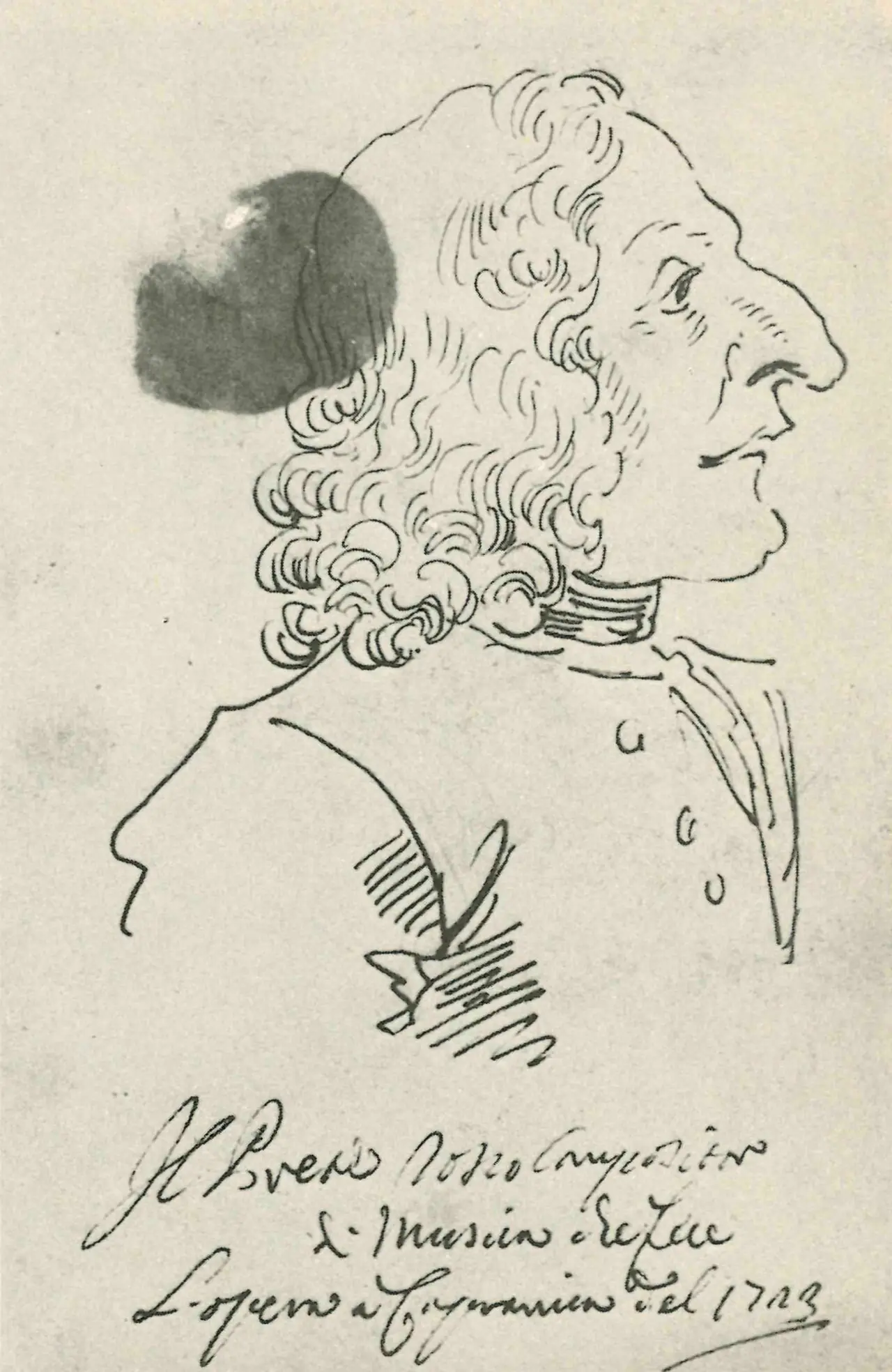
Violin with his father Giovanni Battista, a player at St Mark’s, Venice
Posts
Pietà violin teacher from 1703; maestro de’ concerti from 1716; court service in Mantua, 1718–20
Output
More than 500 concertos, operas, sacred music and sonatas
Life
In 1703 Antonio Vivaldi, a twenty-five-year-old Venetian, was ordained priest in March and became a violin teacher in September. He had red hair, a formidable bow arm and a chest complaint that made celebrating Mass difficult. His father Giovanni Battista had been a barber before joining the violinists at St Mark’s; he taught Antonio and went on helping with his career long after the son had become famous. In Venice Antonio was known as il prete rosso, the red priest. He worked in the chapel, the orchestra gallery and the opera house.
The PietàThe women of the Pietà
The Ospedale della Pietà cared for abandoned children. Its musical establishment was a selected group of girls and women, trained to sing and play to a standard that brought visitors from across Europe. Some remained there as adult musicians and teachers. Vivaldi taught the advanced string players, rehearsed the orchestra and supplied new pieces. The governors voted on his employment each year. In 1709 they dispensed with him, and in 1711 they took him back.
He had players for whom he could write a bassoon concerto, a cello concerto or a piece with mandolins. The violin was his own instrument, and his solo writing for it is difficult: runs high up the fingerboard, arpeggios across the strings, and repeated notes that test the bow. The orchestra replies with material that all the players can take up together, often a few firmly repeated notes in place of a full melody.
In 1711 the Amsterdam publisher Estienne Roger issued L’estro armonico, twelve concertos for varying combinations of one, two and four solo violins. The printed parts circulated far beyond the Pietà. In Weimar, Bach began arranging these concertos as keyboard pieces, keeping their recurring orchestral passages and their rapid modulations from one key to another. Vivaldi’s B minor Concerto for Four Violins, RV 580, later became Bach’s Concerto for Four Harpsichords, BWV 1065.
1713–35Opera and the Teatro Sant’Angelo
Ottone in villa, his first complete opera, opened in Vicenza in 1713. Later that year he and his father took on the management of Venice’s small Teatro Sant’Angelo. Vivaldi could now compose an opera, choose its singers and stage it himself, and he also had to pay for it. His correspondence deals with copying bills, casting problems, negotiations with patrons and the danger of an empty house.
The contralto Anna Girò became his favoured leading woman. In 1735 the young Carlo Goldoni met him to discuss revisions to Apostolo Zeno’s Griselda, since the words had to suit the singer. Two years later, writing to his patron Guido Bentivoglio on 16 November 1737, Vivaldi declared: “It is impossible to put on the opera without Girò, because no woman like her can be found.” In Griselda’s Agitata da due venti, the text compares the singer to a ship caught between two winds, and the aria tests the singer’s speed and breath. In Orlando furioso, Ruggiero’s love song Sol da te has a flute accompanying the singer.
The Pietà also needed sacred music. When its choirmaster Francesco Gasparini left, Vivaldi supplied it in quantity. His Gloria, RV 589, opens with strings leaping in octaves and the chorus setting the text in D major. The next movement, Et in terra pax, is in B minor, and the voices enter separately. The earlier Stabat Mater, written for Brescia in 1712, is for alto voice and slow-moving strings. Three of its movements return with new words.
Juditha triumphans was written for the Pietà in 1716. Venice was at war with the Ottoman Empire, and the biblical Judith’s victory over Holofernes offered an obvious parallel. The women sang every role, including the enemy commander. Among the strings Vivaldi placed a mandolin and a chalumeau, a soft-toned relative of the clarinet. The Pietà had earlier hired a violin teacher.
1725The Four Seasons
The Four Seasons opened his eighth published collection, Il cimento dell’armonia e dell’inventione, in 1725. Its dedicatee, the Bohemian count Wenzel von Morzin, already knew the concertos. The printed edition included four sonnets, with letters matching the poems to places in the parts. Birdsong is played by the violins and interrupted by thunder. In Autumn the peasants celebrate the harvest, get drunk and fall asleep. The sleeping music has muted strings and a harpsichord instructed to spread its chords.
In the Largo of Spring, the solo violin represents a sleeping goatherd. The orchestral violins represent rustling leaves, and the viola barks beside him. The three parts sound at the same time. In Winter, the soloist portrays someone enjoying the fireside, while plucked strings represent the rain outside.
The last yearsVenice, Vienna and the Turin manuscripts
His travels took him to Mantua, where he served Prince Philip of Hesse-Darmstadt from 1718, and to Rome for opera seasons in 1723 and 1724. The Pietà accommodated his absences. From 1723 he was to supply two concertos a month and rehearse them when he was in Venice. In 1739 the French traveller Charles de Brosses met him there. “Vivaldi has become one of my intimate friends, to sell me concertos very dear,” he wrote to de Blancey on 29 August. He also heard Vivaldi boast that he could compose a concerto, with all its parts, faster than a copyist could copy it.
De Brosses reported that Venice was tiring of its composer. Vivaldi left for Vienna in 1740 and died there in July 1741. Much of the music remained in manuscript, out of reach of performers. In 1926 the scholar Alberto Gentili examined boxes of scores at a Salesian college in Piedmont and recognised a great part of Vivaldi’s own archive. Gaps in the volume numbering showed him that further volumes existed elsewhere. Donations by Roberto Foà and Filippo Giordano brought the reunited collections to Turin between 1927 and 1930. They contain concertos, church music and complete operas, many in Vivaldi’s own hand.
Places
Every recorded place, joined in date order. Vivaldi on the MapAll 14 places, with sources
Venice · 4 March 1678 – 1703 · born
Born in Venice; began priestly studies in 1693 and was ordained in 1703.
Two serenatas premiered at the French embassy, for Louis XV’s marriage and the royal princesses’ birth. Gloria e Imeneo (RV 687); La Sena festeggiante (RV 694).
The orchestra’s opening tune returns between the soloist’s episodes. In Spring, the E major refrain returns after the birdsong and after the thunderstorm. Vivaldi often brings back only part of a refrain, in a different key, and its cadence closes the section before the solo violin plays again.
♮Sequences
A short violin figure rises or falls through a succession of keys while the bass repeats the same harmonic move beneath it. The descending-fifths schematic below shows the sequence. A leads to D, D to G, and the pattern continues until E major returns the music to A minor.
𝄞The bow
Vivaldi built many of his effects from bowing. The opening of Winter is made of repeated notes; in the storm at the end of Summer the whole string band plays in rapid motion. His solo parts also use string-crossing and arpeggios: the violin plays a chord one note at a time, and the orchestra then follows in unison.
𝆏Slow movements
The slow movements give the solo violin room for long melodies and added ornaments. In the Largo of Winter, its long melody is played over plucked accompanying strings. The slow movement of Autumn has no solo melody: the strings are muted and play very quietly, and the harpsichord spreads its chords while the drunken peasants sleep.
𝆑Voices and instruments
A singer often has an instrumental partner with a prominent part of its own. In Sol da te from Orlando furioso, a solo flute plays alongside Ruggiero’s love song, which makes the aria a duet. Juditha triumphans includes mandolin and chalumeau in its orchestra. In the Stabat Mater the same composer reduced the scoring to alto and strings, and the music repeats.
Works
A selection from the composer’s works.
1711
L’estro armonicoOp. 3Twelve concertos for one, two or four violins, with strings and continuo
Published in Amsterdam by Estienne Roger; six of its concertos became Bach keyboard arrangements. The B minor Concerto for Four Violins became a concerto for four harpsichords.
1712
Stabat MaterRV 621Alto solo, strings and continuo
Written for Brescia, in F minor. The music of the first three movements returns, set to new words, in the next three.
1713
Ottone in villaRV 729Opera in three acts
His first complete opera, given in Vicenza before he took on the management of Venice’s Teatro Sant’Angelo. The opera has five characters, caught up in love intrigues.
c. 1715
Gloria in D majorRV 589Soloists, chorus, trumpet, oboe, strings and continuo
The familiar opening is only the first of twelve movements. Its D major is followed immediately by the B minor of Et in terra pax.
Judith defeats Holofernes, at a time when Venice was fighting the Ottoman Empire. The women of the Pietà sang the male roles as well, and the instruments included mandolin and chalumeau.
1725
The Four SeasonsOp. 8 Nos. 1–4 · RV 269, 315, 293, 297Solo violin, strings and continuo
Four concertos, printed with sonnets and with letters linking words of the poems to musical events. Their keys are E major, G minor, F major and F minor.
An opera on Ariosto’s knights and enchantresses, about jealousy and madness. In Ruggiero’s Sol da te, mio dolce amore the flute has a long, demanding part beside the voice.
c. 1728–29
Six Flute ConcertosOp. 10Flute, strings and continuo
The titles of the first three concertos refer to a storm, night and a goldfinch. La notte reworks a chamber concerto for flute, two violins, bassoon and continuo.
1735
GriseldaRV 718Opera in three acts
Goldoni revised Zeno’s libretto for Vivaldi and his singers. In Agitata da due venti the soprano sings as a ship caught between two winds.
In the score
Short examples, engraved and playable.
The concerto’s harmonic engineSequence by descending fifths
A schematic descending-fifths sequence: A–D–G–C–F–B–E–A in the bass, with a repeating arpeggio figure above. G♯ makes the penultimate chord E major, the dominant of A minor, which follows.
Spring · the principle of separate layersMelody, background and interruption
A schematic of three independent rhythms: a solo melody, held chords and short repeated viola notes. In the Largo of Spring, the solo violin represents the sleeping goatherd, the accompanying violins the rustling leaves, and the viola a barking dog.
Sister arts
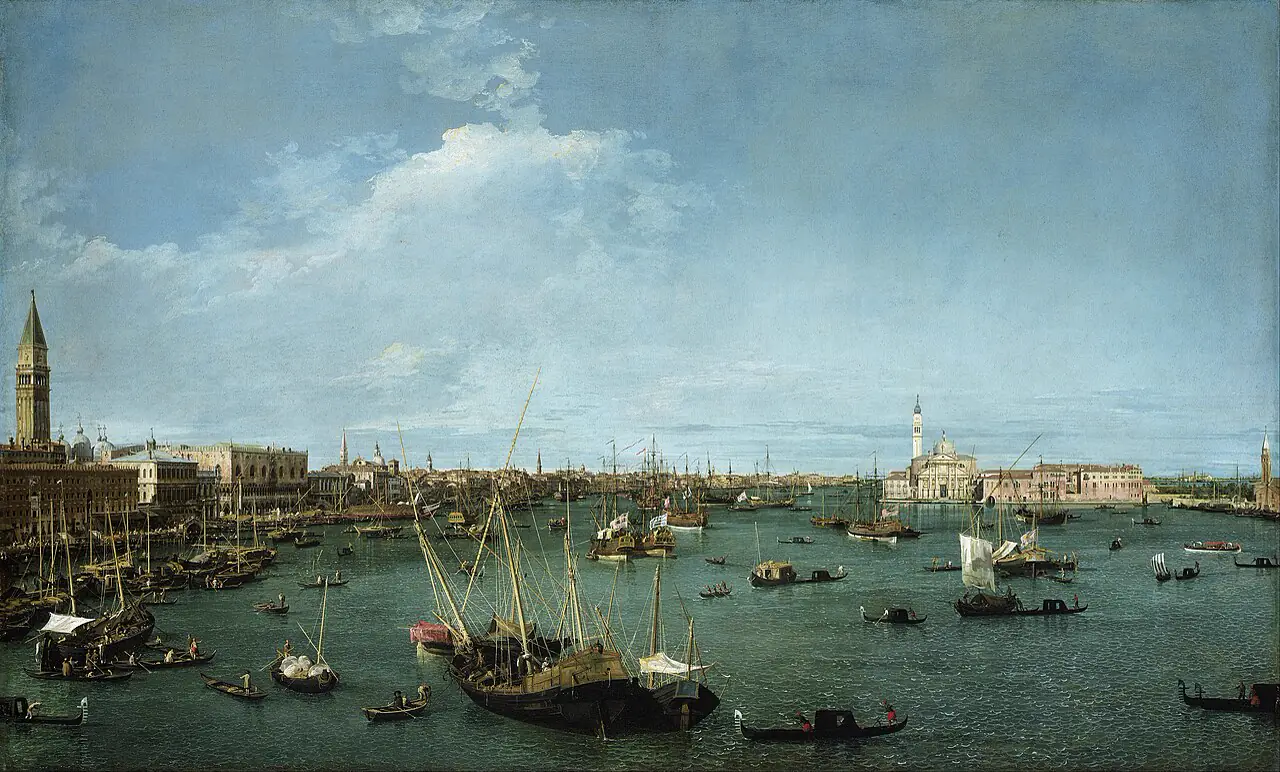
CanalettoBacino di San Marco, Venice, c. 1738Oil on canvas · Museum of Fine Arts, Boston
Venice’s visitors bought pictures and music. In 1739 Charles de Brosses paid Vivaldi for concertos, attended the Pietà’s performances, and wrote to a friend from a gondola in his dressing gown and slippers. Canaletto painted the city’s boats and crowded waterfront. Music could be heard from the water in the evening.
Anonymous; sometimes attributed to Vivaldi
La Primavera
Published with Op. 8, 1725
ItalianGiunt’è la Primavera e festosetti
La salutan gl’augei con lieto canto,
E i fonti allo spirar de’ zeffiretti
Con dolce mormorio scorrono intanto.
Vengon’ coprendo l’aer di nero amanto
E lampi, e tuoni ad annuntiarla eletti;
Indi tacendo questi, gl’augelletti
Tornan di nuovo al lor canoro incanto.
E quindi sul fiorito, ameno prato
Al caro mormorio di fronde e piante
Dorme ’l caprar col fido can’ a lato.
Di pastoral zampogna al suon festante
Danzan ninfe e pastor nel tetto amato
Di primavera all’apparir brillante.
Our translationSpring has arrived, and the little birds
joyfully greet it with their cheerful song;
and springs, at the breath of gentle breezes,
flow meanwhile with a soft murmur.
Covering the air with a black cloak,
lightning and thunder come, chosen to announce it;
then, when these fall silent, the little birds
return once more to their enchanting song.
And then upon the pleasant, flowering meadow,
to the dear murmuring of leaves and plants,
the goatherd sleeps, his faithful dog beside him.
To the festive sound of a shepherd’s bagpipe
nymphs and shepherds dance beneath their beloved roof
at spring’s shining appearance.
The goatherd sleeps with his faithful dog beside him. Vivaldi gives the sleeper to the solo violin and the dog to the viola; the poem’s last three lines become the final pastoral dance. Letters printed beside the sonnet lead directly to the corresponding passages in the instrumental parts.
Recommended recordings
The Four SeasonsGiuliano Carmignola, Venice Baroque Orchestra, Andrea MarconSony ClassicalCarmignola’s bowing is quick and incisive. With the small period-instrument band behind him, his smallest changes of attack can be heard clearly.
Stabat MaterAndreas Scholl, Ensemble 415, Chiara BanchiniHarmonia MundiScholl sustains the long alto lines at an even level throughout.
GloriaConcerto Italiano, Rinaldo AlessandriniNaïveSara Mingardo, a contralto, sings the Domine Deus, Agnus Dei. Alessandrini takes the surrounding choruses with sharp attack, and the music then returns to D major.
Lineage
Drew fromArcangelo CorelliGiuseppe TorelliVenetian opera and the ospedali
Bach arranged Vivaldi’s concertos for organ and harpsichord, keeping their orchestral returns and writing new figuration for the keyboard player’s hands. Johann Georg Pisendel came from Dresden to Venice in 1716, studied with Vivaldi and carried his music north. Printed parts from Amsterdam and manuscripts preserved in Dresden kept these pieces in circulation after the Venetian performances had ended.
Further reading
Michael Talbot, Vivaldi, second edition (London: Dent, 1993). biography
Life and works, including the operatic career and Venetian institutions.
Michael Talbot, revised by Nicholas Lockey, ‘Vivaldi, Antonio (Lucio)’, Grove Music Online (Oxford University Press, 2001; revised 2020). reference
Biographical reference, catalogue and bibliography; subscription required.