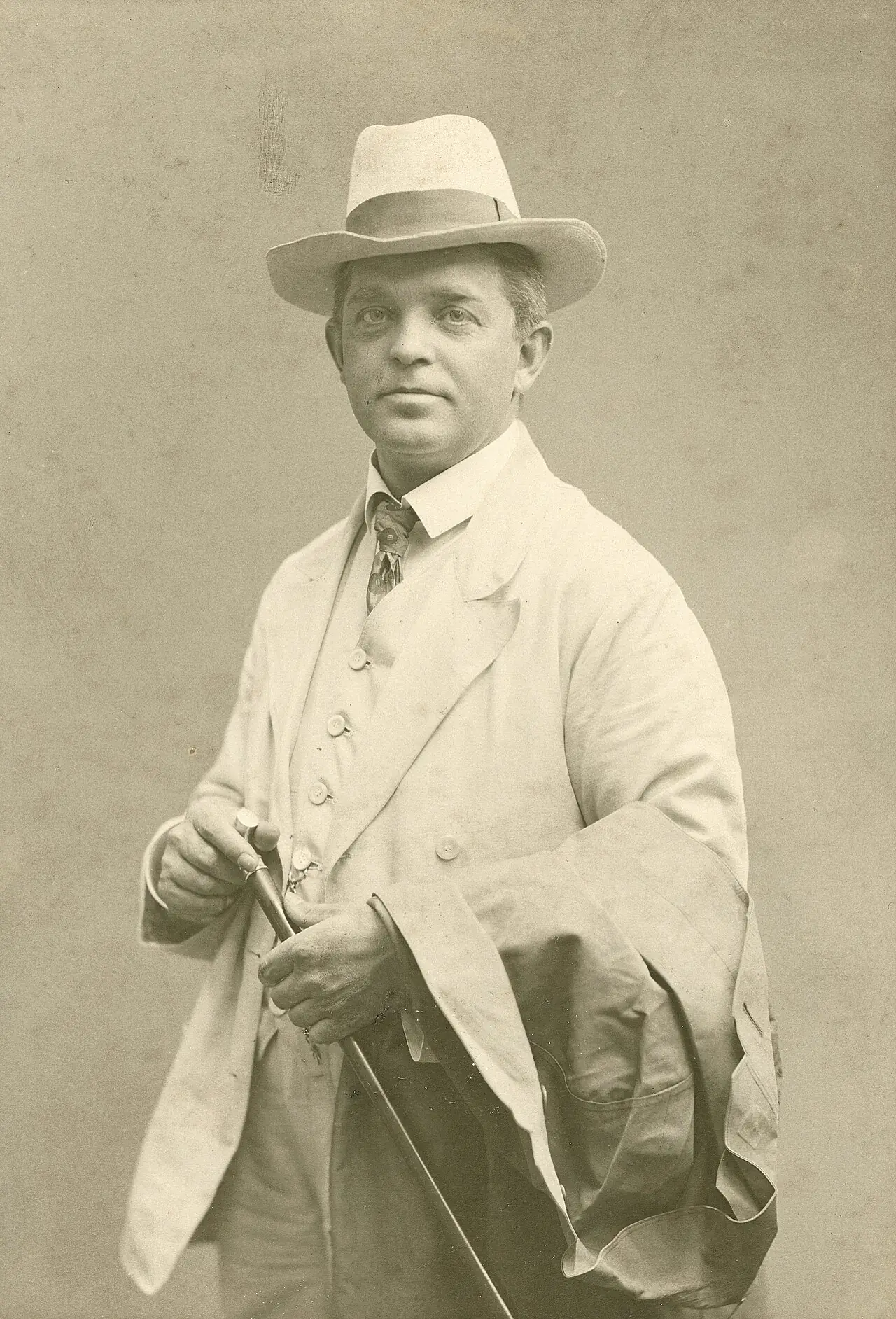
Born 9 June 1865, Sortelung, Nørre Lyndelse, Funen, DenmarkDied 3 October 1931, Copenhagen, Denmark
Danish composer, violinist and conductor, born on Funen and based in Copenhagen, who wrote six symphonies, the opera Maskarade, a wind quintet and a large body of songs and hymn tunes.
Military bandsman in Odense, 1879–83 · Copenhagen Conservatory, 1884–86 (violin with Valdemar Tofte, theory with Orla Rosenhoff)
Posts
Second violin in the Royal Orchestra, 1889–1905 · conductor at the Royal Theatre, 1908–14 · conductor of the Music Society from 1915 · director of the Royal Danish Academy of Music from 1931
Six symphonies, two operas, concertos for violin, flute and clarinet, chamber and organ music, cantatas, and songs and hymn tunes for voice and choir
“The point is to be able to say a pure fifth in such a way that no one thinks he has heard that interval before.”
Life
Carl August Nielsen was born on 9 June 1865 at Sortelung, a cottage in the parish of Nørre Lyndelse on Funen. He was the seventh of twelve children. His father, Niels Jørgensen, was a house painter who played the fiddle at dances; he was known as Painter-Niels, and the children took Nielsen as their surname. At six, when he had measles, Carl was handed a three-quarter-size violin that hung on the wall, taught himself a few melodies and played them for his father. Emil Petersen, the assistant teacher at the village school, taught him to play from notes. Petersen later told how he had once passed Painter-Niels’s house and found a boy of seven or eight hammering on blocks of wood laid out as a keyboard.
1879–91Odense, Copenhagen and Paris
Confirmed at fourteen, Nielsen was apprenticed to a shopkeeper whose business failed, and on 1 November 1879 he joined the band of the Sixteenth Battalion in Odense. In 1883 he showed a string quartet to Niels W. Gade in Copenhagen, and in January 1884 he entered the Conservatory on a scholarship, studying the violin and, with Orla Rosenhoff, theory and counterpoint. He left at the end of 1886. His Suite for Strings, Op. 1, was played at Tivoli on 8 September 1888, and in 1889 he joined the second violins of the Royal Orchestra, where he stayed for sixteen years.
A grant from the Ancker legacy took him abroad in 1890. In Dresden he heard Wagner’s Ring and wrote in his diary on 10 September, after Das Rheingold: “The musician who does not think Wagner great is himself very small.” In Paris in the spring of 1891 he met the sculptor Anne Marie Brodersen, and they were married in the English church in Florence on 10 May.
1894–1906First symphony, first operas
The Royal Orchestra under Johan Svendsen gave the First Symphony, in G minor, on 14 March 1894. That autumn Nielsen travelled to promote it, and in Vienna on 7 November Dr Eduard Schiff took him to Brahms. In the diary extract that Nielsen copied to Rosenhoff, Brahms ignored him, then asked in a sharp tone how things stood with Thorvaldsen’s Museum, an allusion to a story about Brahms’s visit to Copenhagen in 1868. Nielsen answered: “Well, it is still standing there, Herr Doctor.” Brahms asked to keep the symphony and the F minor String Quartet.
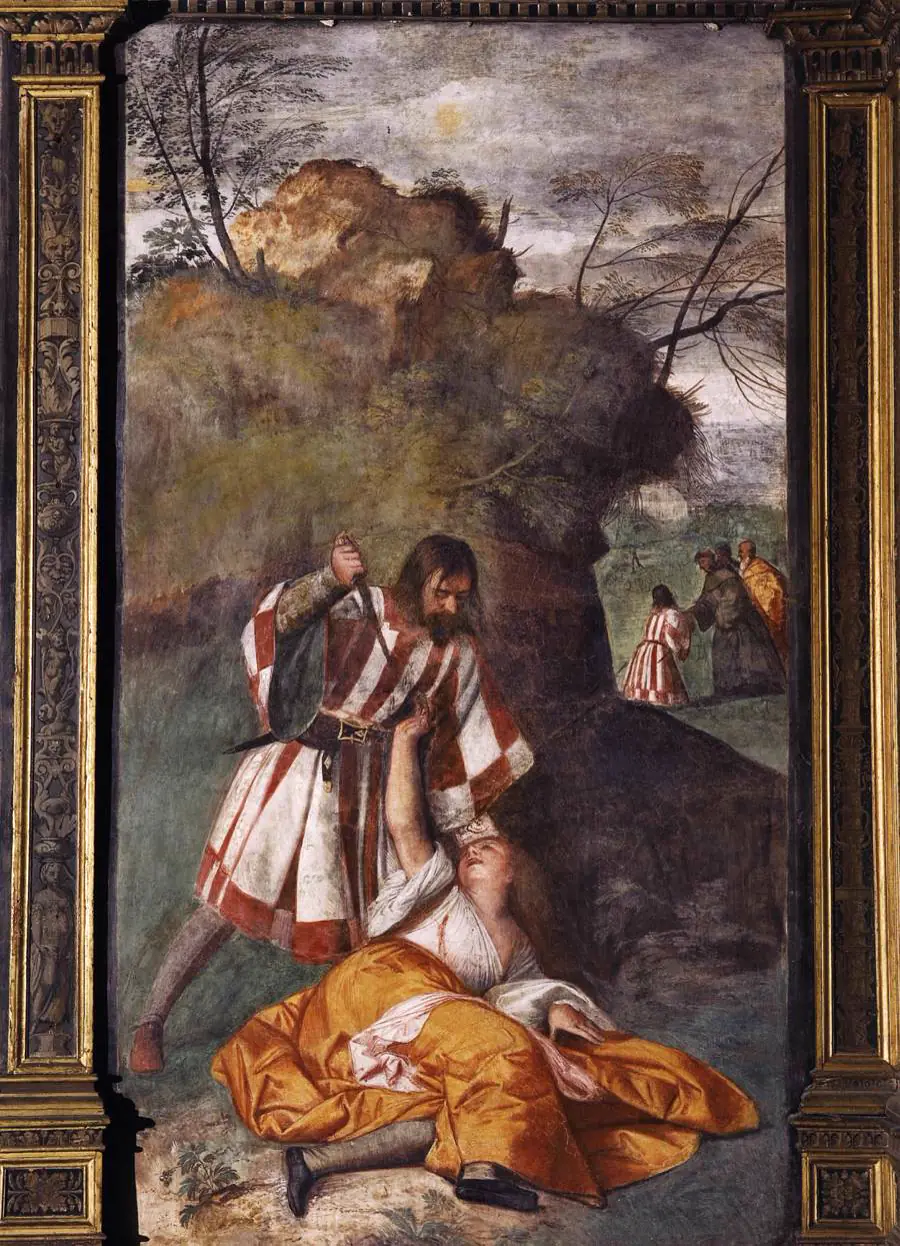
Hymnus Amoris was sung at the Music Society on 27 April 1897. According to the Carl Nielsen Edition, the idea came in 1891, on his honeymoon, when he and his wife saw a painting by Titian of a jealous husband killing his wife. The opera Saul and David followed at the Royal Theatre on 28 November 1902, and the Second Symphony, The Four Temperaments, three days later. Maskarade, a comic opera to a libretto by Vilhelm Andersen after Ludvig Holberg’s comedy Mascarade, was first performed at the Royal Theatre on 11 November 1906 with Nielsen conducting. According to the Dansk Biografisk Leksikon, everyone at the theatre expected a failure. The opera was given twenty times that season.
1908–16The Fourth Symphony
Nielsen was conductor at the Royal Theatre from 1908 to 1914. On 3 May 1914 he wrote to his wife about a new work. She was then in Celle, modelling the horse for her equestrian statue of Christian IX. The work would have “no programme” but would express “what we understand by the urge to life or manifestations of life”, “only life and movement, though different, very different, yet in a connection”. In April 1915 he told his friend Julius Röntgen that the symphony rested on the idea that “the most elemental being of music is sound, life and movement that cut the silence to pieces”.
Nielsen finished the score on 14 January 1916 and conducted the first performance at the Music Society in Copenhagen on 1 February. After the repeat performance on 14 April the critic Charles Kjerulf, who had not liked his earlier music, wrote an enthusiastic review in Politiken. Nielsen replied in a letter of 15 April: “Oh, if only I could tell you how rich I feel today, because I have won your deep interest completely.”
1920–22The Fifth Symphony and the Wind Quintet
Nielsen began the Fifth Symphony in the autumn of 1920, and the fair copy is dated 15 January 1922. It has two parts in place of four movements. Nielsen conducted the first performance at the Music Society on 24 January 1922, after five rehearsals instead of the usual three. Politiken printed an interview with him that day: “I roll a stone up a hill and use the strength I have in me to bring it to a high point. There the stone lies quite still. The forces are bound in it, until I give it a kick, and the same forces are released and the stone rolls down again.” The composer Victor Bendix wrote to him the next day that he had come away from the concert abusing “this unclean trench music” and added, “I hate it, but it holds me captive.”
In the autumn of 1921 Nielsen heard four members of the Copenhagen Wind Quintet rehearsing a Mozart piece with the pianist Christian Christiansen, and told the oboist Svend Christian Felumb that he would like to write a quintet for them. He had begun it before he left for Gothenburg on 1 February 1922 to conduct there, and on 2 March he wrote to his wife that he had got a little further with it. On 16 April he wrote to her: “I have worked hard at my new quintet, and in a couple of days it will actually be finished, for it amuses me greatly.” It was first played in private in Gothenburg on 30 April. The Copenhagen Wind Quintet (Paul Hagemann, flute; Svend Christian Felumb, oboe; Aage Oxenvad, clarinet; Hans Sørensen, horn; Knud Lassen, bassoon) gave it in public at the New Music Society on 9 October 1922. In a programme note Nielsen wrote that the instruments “talk over one another” at one moment and are “quite alone” at the next.
1922–31Last years
A heart attack in July 1922 did not end his conducting, and on 22 June 1923 he led the Fourth Symphony with the London Symphony Orchestra at Queen’s Hall. The Sixth Symphony was first played in public on 11 December 1925, and concertos for two players of the Wind Quintet followed, for flute in 1926 and for clarinet in 1928. From 1914 he also wrote simple strophic songs with the organist Thomas Laub, and he supplied fifty melodies or arrangements to the Folk High School Melody Book of 1922. Jens Vejmand, a setting of Jeppe Aakjær from 1907, sold in large numbers.
His memoir of boyhood, Min fynske Barndom, was published in 1927, and on 1 January 1931 he became director of the Royal Danish Academy of Music. He went into the National Hospital in Copenhagen on 1 October and died there ten minutes after midnight on 3 October. The funeral service at Vor Frue Kirke on 9 October used only his own music, and at Vestre Kirkegård the Royal Orchestra’s wind quintet played the closing chorale of the Wind Quintet.
Places
Every recorded place, joined in date order. Nielsen on the MapAll 23 places, with sources
Nørre Lyndelse, Funen · 1865 – November 1879 · childhood
Grew up in the parish. He played the violin from the age of six, herded geese at Bramstrup from eight or nine, and had lessons from the assistant teacher Emil Petersen. By 1879 the family had moved to a house called Petersborg, which is now a museum.
Born in a cottage at Sortelung, in the parish of Nørre Lyndelse, the seventh of twelve children. The cottage no longer stands; a memorial stone marks the site. Coordinates mark the village.
Military musician with the Sixteenth Battalion, from 1 November 1879, with violin lessons in the town. He left at the turn of 1883–84 for the Copenhagen Conservatory.
Copenhagen · January 1884 – December 1886 · studied
Student at the Conservatory on a scholarship, studying violin with Valdemar Tofte and theory and counterpoint with Orla Rosenhoff. He left at the end of 1886. Coordinates mark the city.
Dresden · 3 September 1890 – 18 October 1890 · heard
Heard Wagner’s Ring on his first stay in Germany, on an Ancker grant; his diary of 10 September records Das Rheingold. He left for Berlin on 18 October. Wagner, Der Ring des Nibelungen.
Berlin · 18 October 1890 – January 1891 · travelled
Met Sibelius, Christian Sinding and the violinist Joseph Joachim. Through the winter he divided his time between Berlin, Leipzig and Dresden, and left for Paris at the end of January 1891.
Vienna · 5 November 1894 – 15 November 1894 · travelled
Visited Brahms on 7 November 1894 with Dr Eduard Schiff. Brahms kept the First Symphony and the F minor String Quartet to look through. Nielsen left Vienna on 15 November.
Joined Anne Marie, who was copying sculptures in the Acropolis Museum, and finished the Helios overture in a study room at the local conservatory on 23 April 1903. They returned to Copenhagen at the end of July. Helios.
Guest conductor with the Gothenburg orchestra in the 1921–22 season, after an engagement in autumn 1918. He had begun the Wind Quintet before leaving Copenhagen for Gothenburg on 1 February 1922 and finished it here in April. He conducted the Fifth Symphony on 8 March 1922, and the quintet was first played in private on 30 April. Wind Quintet.
Spent much of the spring at Højbo, a house at Tibberup near Humlebæk lent by Vera and Carl Johan Michaelsen, and finished the first part of the Fifth Symphony at the beginning of March. Symphony No. 5.
Vestre Kirkegård, Copenhagen · 9 October 1931 · buried
The funeral service was at Vor Frue Kirke on 9 October. At Vestre Kirkegård the Royal Orchestra’s wind quintet played the closing chorale of the Wind Quintet as the coffin was lowered.
Nielsen once said that the task was to “say a pure fifth in such a way that no one thinks he has heard that interval before”. The Dansk Biografisk Leksikon calls the sentence the programme of his art and describes a melodic style built on feeling for the value of each interval and strict economy in using them.
♯Tonality
The First Symphony is in G minor but begins and ends on a C major chord, which the Dansk Biografisk Leksikon describes as unheard of in 1894. Robert Simpson called the tonal plans of Nielsen’s later symphonies “progressive tonality” or “emergent tonality”.
𝄞Counterpoint
Orla Rosenhoff taught him counterpoint at the Conservatory and gave him private lessons afterwards. The Dansk Biografisk Leksikon describes the choruses of Hymnus Amoris as the first in Denmark since Buxtehude to be written in large-scale polyphony, and says that in the symphonies Nielsen developed a contrapuntal combination of themes and a derivation and variation of motifs.
𝄾Percussion
The Fourth Symphony uses two pairs of timpani, the second placed opposite the first at the edge of the orchestra. In the Fifth the side drum plays against the orchestra in its own tempo, set by a metronome, and then improvises.
𝄢Songs
The songs to poems by J. P. Jacobsen of 1891 are mostly through-composed, with independent piano parts; the Ludvig Holstein songs of 1894–96 are mostly strophic. From 1914 he wrote strophic songs for singing in common, and his melodies fill the Folk High School Melody Book.
𝄋Wind instruments
The Wind Quintet is for flute, oboe (changing to cor anglais in the Prelude), clarinet in A, horn in F and bassoon. Nielsen planned a concerto for each of the five players and finished two, for flute and clarinet.
Works
A selection from the composer’s works.
1888
Suite for StringsOp. 1String orchestra
First played at Tivoli on 8 September 1888 under Balduin Dahl; the waltz was repeated. Published by Wilhelm Hansen in 1890.
1889–94
Symphony No. 1 in G minorOp. 7Orchestra
First played by the Royal Orchestra under Johan Svendsen on 14 March 1894. It begins and ends on a C major chord.
1894–96
Songs to poems by Ludvig HolsteinOp. 10Voice and piano
Six songs, among them Æbleblomst and Sang bag ploven (No. 4).
1896
Hymnus AmorisOp. 12Soloists, choir and orchestra; Latin text
First performed at the Music Society on 27 April 1897. The text was drawn up with the folklorist Axel Olrik and translated into Latin by J. L. Heiberg.
1899–1901
Saul and DavidOpera in four acts; libretto by Einar Christiansen
First performed at the Royal Theatre on 28 November 1902 with Nielsen conducting.
1901–02
Symphony No. 2, The Four TemperamentsOp. 16Orchestra
First conducted by Nielsen on 1 December 1902 and dedicated to Ferruccio Busoni.
1903
Helios overtureOp. 17Orchestra
Finished in Athens on 23 April 1903 and first played on 8 October under Svendsen. It follows the sun from dawn to dusk.
1905–06
MaskaradeComic opera in three acts; libretto by Vilhelm Andersen after Holberg
First performed at the Royal Theatre, Copenhagen, on 11 November 1906 with Nielsen conducting.
1907
Jens VejmandOp. 21 No. 3Voice and piano; poem by Jeppe Aakjær
The autograph is dated 25 June 1907. It sold widely as a single song and was among the first of Nielsen’s works to be recorded.
1910–11
Symphony No. 3, Sinfonia espansivaOp. 27Orchestra with wordless soprano and baritone
First played on 28 February 1912 with Nielsen conducting. In 1913 he conducted it in Stuttgart, Stockholm and Helsinki, and C. F. Kahnt published it in Leipzig.
1911
Violin ConcertoOp. 33Violin and orchestra
Begun in Grieg’s hut at Troldhaugen as a guest of Nina Grieg and first played on 28 February 1912, on the same programme as the Third Symphony.
1914–16
Symphony No. 4, The InextinguishableOp. 29Orchestra with two pairs of timpani
Four sections played without a break. First performed by the Music Society on 1 February 1916 with Nielsen conducting.
1914–15
Min Jesus, lad mit Hjerte faaHymn for choir and piano
Printed in Salmer og aandelige Sange in 1919. Nielsen used the tune again for the variations that end the Wind Quintet.
1915
En Snes danske Viser (A Score of Danish Songs)Voice and piano
Compiled with Thomas Laub; Nielsen wrote twelve of its twenty-three songs.
1920–22
Symphony No. 5Op. 50Orchestra
In two parts. First performed by the Music Society on 24 January 1922. Wilhelm Furtwängler conducted it at the ISCM festival in Frankfurt on 1 July 1927.
1921
Fynsk Foraar (Springtime on Funen)Op. 42Soloists, choir and orchestra; text by Aage Berntsen
First performed in the covered market at Odense on 8 July 1922 under Georg Høeberg, with about a thousand singers.
1922
Wind QuintetOp. 43Flute, oboe, clarinet, horn and bassoon
Written for the Copenhagen Wind Quintet. First played in private at Gothenburg on 30 April 1922 and in public in Copenhagen on 9 October.
His last symphony. Nielsen conducted the first movement alone at the Royal Swedish Academy of Music in Stockholm on 1 November 1925, and the Royal Orchestra gave the first public performance of the whole on 11 December.
1926
Flute ConcertoFlute and orchestra
Written for Holger Gilbert-Jespersen. It was played in Paris on 21 October 1926 with a provisional ending, and in Copenhagen on 25 January 1927 with the final one.
1928
Clarinet ConcertoOp. 57Clarinet and orchestra
Written for Aage Oxenvad and finished on 15 August 1928. First played in private on 14 September and in public on 11 October.
1931
CommotioOp. 58Organ
Finished by early March 1931. First played at Aarhus Cathedral on 14 August 1931 by Emilius Bangert.
In the score
Short examples, engraved and playable.
Wind Quintet, III — quotedHymn tune as theme of the variations
The flute part in the first eight bars of the Tema con variazioni, with the pick-up bar, marked Un poco andantino and p, from the first edition (Wilhelm Hansen, Copenhagen, 1923, p. 26). The oboe, clarinet, horn and bassoon play beneath it. The tune is the melody of Nielsen’s hymn Min Jesus, lad mit Hjerte faa. The tempo in this example is set for playback and is not Nielsen’s.
Op. 10 No. 4 — quotedSang bag ploven: vocal part
The voice in the pick-up and first three bars of the song to Ludvig Holstein’s poem, marked Allegro moderato and f, from the Wilhelm Hansen first edition (IMSLP); the piano part is omitted and the tempo is set for playback. The line moves by step, apart from a rising fourth into bar 1 and a falling third into bar 2, between E and C.
Sister arts
TitianThe Miracle of the Jealous Husband, 1511Fresco · Scuola del Santo, Padua
Titian painted the fresco in 1511. On their honeymoon in 1891 Nielsen and Anne Marie Brodersen saw a painting by Titian of a jealous husband killing his wife, and the Carl Nielsen Edition names this fresco as the likely picture. Both resolved to make a work about love in all its forms. Nielsen’s was the cantata Hymnus Amoris of 1896. Anne Marie never made the frieze she had planned, but she drew the title page of the printed score.
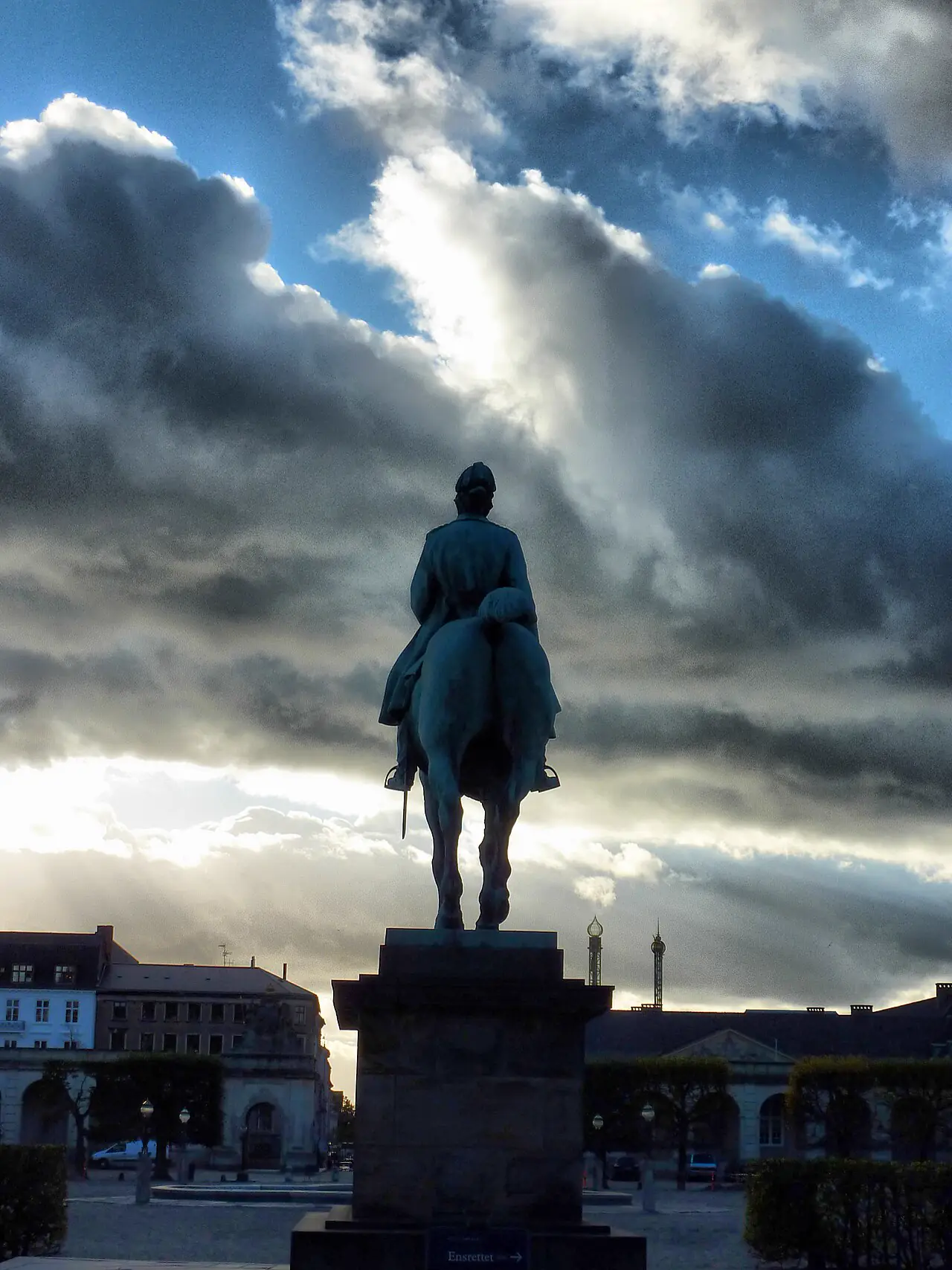
Anne Marie Carl-NielsenEquestrian statue of Christian IX, 1908–27Bronze, photographed in 2012 · Christiansborg riding ground, Copenhagen
Anne Marie Carl-Nielsen won the competition for the statue in 1908, and it was unveiled on 15 November 1927. On 3 May 1914 she was in Celle modelling the horse. Her husband wrote to her that day about the new symphony and added that he would like to see her turn the great stallion for him.
Jeppe Aakjær
Jens Vejmand (“Hvem sidder der bag Skjærmen”)
1905
DanishHvem sidder der bag Skjærmen
med Klude om sin Haand,
med Læderlap for Øjet
og om sin Sko et Baand?
Det er saamænd Jens Vejmand,
der af sin sure Nød
med Ham’ren maa forvandle
de haarde Sten til Brød.
Our translationWho sits there behind the screen,
with rags around his hand,
a leather patch before his eye
and a strap about his shoe?
Why, that is Jens the roadman,
who from his bitter need
must with his hammer change
the hard stones into bread.
The first of six stanzas, in the spelling of Aakjær’s collection Rugens Sange (1906). The poem is dated Jebjerg, 19 June 1905, and was first printed in Politiken on 26 June 1905. Nielsen set it in 1907 as No. 3 of the first volume of Strophic Songs, Op. 21, dedicated to Bodil Neergaard; the autograph is dated 25 June 1907. The song was published separately and sold very widely.
Recommended recordings
Wind Quintet, Op. 43Scandinavian Wind QuintetDacapo, 8.224001 · 1994Recorded in Copenhagen in March and May 1994 and coupled with wind quintets by Holmboe, Nørgård and Abrahamsen.
Where to hear more
Symphony No. 4, Op. 29, “The Inextinguishable”1914–16
Danish National Symphony Orchestra; Fabio Luisi · DR Koncerthuset (YouTube)
A live video from DR Koncerthuset, the orchestra’s home hall in Copenhagen, uploaded to the hall’s own channel on 28 March 2020. It runs about 36 minutes.
Johan Reuter, Stephen Milling, Niels Jørgen Riis, Dénise Beck, Anne Margrethe Dahl, Ditte Højgaard Andersen; Danish National Symphony Orchestra and Concert Choir; Michael Schønwandt · Dacapo, 6.220641-42 · 12–25 August 2014
A studio recording made at DR Koncerthuset and released in June 2015. The set runs to 145 minutes on two discs, with 37 tracks, beginning with the overture.
Inger Dam-Jensen, soprano; Morten Ernst Lassen, baritone; Ulrich Stærk, piano · Dacapo, 8.224218 · 4–6 February 2002
Twenty-three tracks recorded in the Black Diamond, the Royal Library, Copenhagen, and released in 2003, among them Irmelin Rose and the six songs of Op. 10, which include Sang bag ploven.
Nielsen heard Wagner’s Ring at Dresden in September 1890, on his first stay in Germany. In Vienna in 1894 he gave his First Symphony to Brahms, who later let him know through the critic William Behrend that he thought it good. According to the Dansk Biografisk Leksikon, Mozart was the one of the great classics who stood nearest to him, and the Wind Quintet began in a rehearsal of a Mozart piece. Knud Ketting writes that the idea of a symphony in one span is said to have come from Liszt’s B minor Sonata, which his friend Henrik Knudsen had played to him. Niels W. Gade and Johan Svendsen were the older composers of his student years in Copenhagen, and Svendsen conducted the First Symphony. Orla Rosenhoff taught him counterpoint. Mogens Wöldike, Nancy Dalberg and Knud Jeppesen were pupils of his.
The standard short life in Danish, with an account of the sources of Nielsen’s music and of its reception in the Danish tradition, a survey of the works up to Commotio, and a bibliography.
A long account in English, based on the diaries and letters, that follows the symphonies, the Wind Quintet and the songs through his life and describes the circumstances of each work.
Free scores of Nielsen’s symphonies, both operas and the chamber music, each with a preface on the work’s composition and first performances and a critical commentary.
A dated catalogue of every work, giving instrumentation, manuscripts, the date and place of each first performance, and the letters that mention each piece.
John Fellow (ed.), Carl Nielsen Brevudgaven (Multivers, Copenhagen, 2005–15); online edition with English translations (Royal Danish Library and Multivers, 2025). primary document
Nielsen’s letters and diaries: 7,380 letters and 492 diary entries by the site’s own count, with English translations. A source for what Nielsen said about a work at the time.
Cite this page
Contrapunctus. “Carl Nielsen.” Accessed 20 October 2026. https://mottopanikeiku.github.io/contrapunctus/composers/nielsen.html.