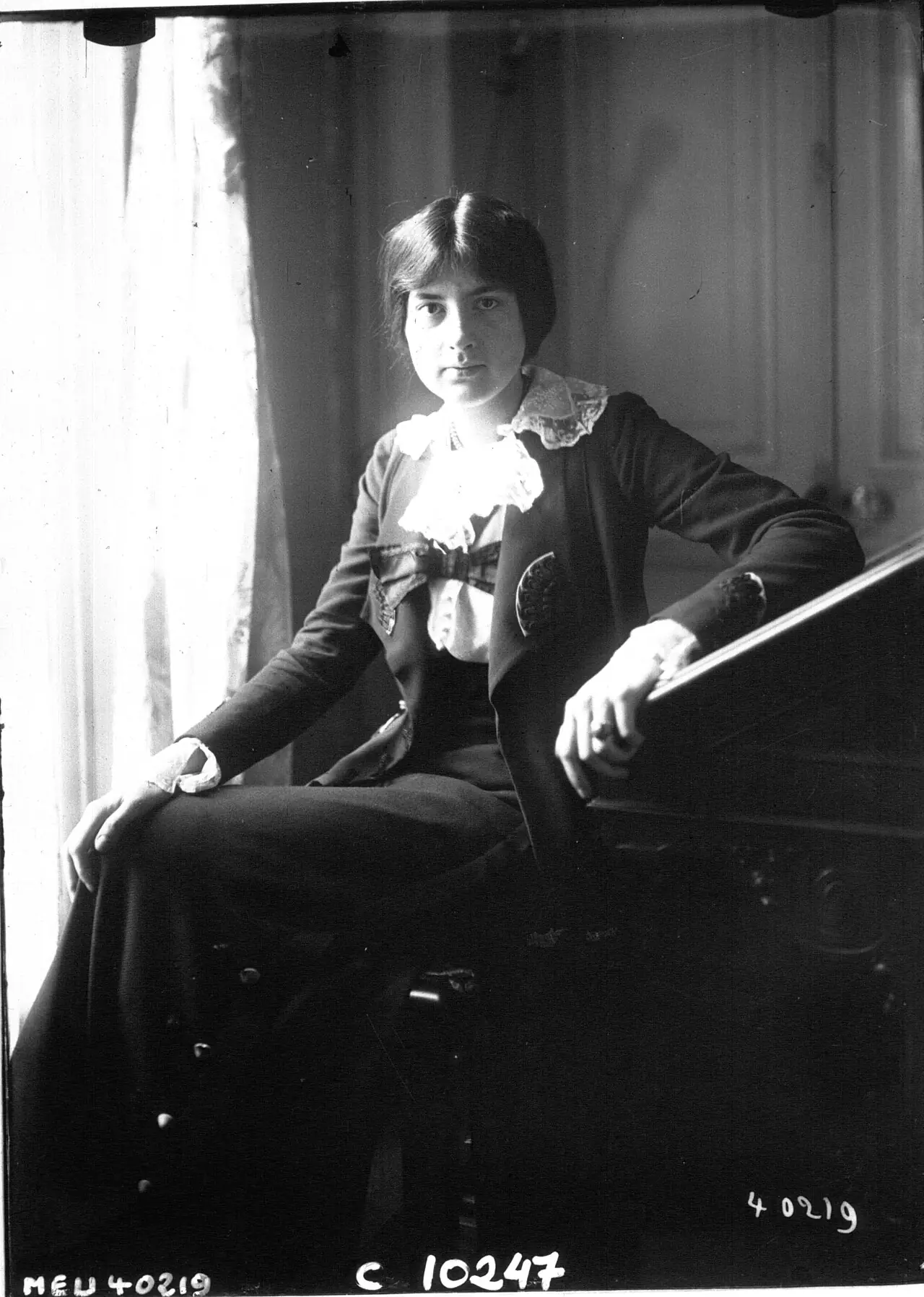
Ernest and Raïssa Boulanger’s younger daughter; Nadia’s sister
Trained
Paul Vidal for composition; Georges Caussade for counterpoint; Nadia at home
Distinction
First woman to win the Premier Grand Prix de Rome in composition, 1913
Output
Songs, psalms, chamber and orchestral music; unfinished opera La Princesse Maleine
Life
In May 1913 five young composers were shut away at the Château de Compiègne, writing a cantata about Faust and Helen of Troy. Someone had sent them champagne. Their joint letter of thanks to the composer Fernand Halphen, dated 31 May and written out by Claude Delvincourt, called them “your young colleagues imprisoned in the château to sing the loves of Faust and Helen”. Lili Boulanger was one of the signatories. She was nineteen, and this was her second attempt at the Prix de Rome, because illness had forced her to withdraw the previous year.
In July she became the first woman to win the Premier Grand Prix for musical composition. Thirty-one of the thirty-six voters of the Académie des Beaux-Arts supported her. Faust et Hélène is scored for a tenor Faust in love with a woman summoned from antiquity, a mezzo-soprano Helen and a baritone devil, with a substantial orchestra. The compulsory text was Eugène Adenis’s adaptation of Goethe. Lili dedicated the score to Nadia, who had won a second prize in 1908.
1893–1913Family, childhood and Conservatoire studies
Her father Ernest had won the same prize in 1835. By Lili’s birth in Paris on 21 August 1893 he was an elderly composer and singing teacher at the Conservatoire; her mother Raïssa had been his pupil. Nadia was six years older. Their grandmother Marie-Julie had sung at the Opéra-Comique for more than thirty years. Fauré visited the house, and by the age of six Lili could sight-read his songs with him at the piano.
She followed Nadia into Conservatoire classes and later studied composition with Paul Vidal. Her surviving schoolwork is already on the scale of public music. Pour les funérailles d’un soldat, written in 1912–13 to Musset’s poem, is for baritone and mourning chorus; the orchestral version uses brass and drums, with plucked double basses keeping the funeral tread. She wrote it before the war. The home key is B♭ minor, the key she later used again in Du fond de l’abîme.
1914Rome and Clairières dans le ciel
The prize brought a contract with Ricordi and a stay at the Villa Medici. In November 1913 President Poincaré received her at the Élysée; in February 1914 she went to Rome with her mother. Her Cortège for violin and piano moves between plucked strings and short piano chords. War sent her back to France; a second Roman stay in 1916 was interrupted by worsening health.
Clairières dans le ciel is a cycle of thirteen songs composed in 1914. Its texts describe a young woman laughing in a wet meadow, and Francis Jammes’s lover recalls her through flowers, a medallion and a glance. Boulanger chose thirteen of the twenty-four poems in his Tristesses, got his permission to change the title and dedicated the cycle to Fauré. The first song describes the girl’s long, ungainly grace. In Demain fera un an, the last song, the piano brings back music from earlier songs, and the text describes the meadow as a place to which the man cannot return.
She also set Maeterlinck in shorter songs. In Attente, the piano holds low F♯s under the prayer; Reflets moves on arpeggios. Her last separate song, Dans l’immense tristesse (1916), sets Bertha Galeron de Calonne’s poem about a child waiting for his dead mother. After the voice stops, the piano plays Dodo, l’enfant do, the French lullaby.
1915–17The Comité franco-américain and the psalms
In 1915 Lili and Nadia founded the Comité franco-américain du Conservatoire. They sent material help to composition students and former students serving in the war, including prisoners, and kept in touch with them. Letters and news passed between the front and Paris through their Gazette des classes de composition. In December 1915 Lili played her Nocturne with the violinist Émile Mendels at the Petit Palais, in a concert for soldiers.
The psalms belong to these years. Psalm 24, which declares that the earth belongs to the Lord, is set for brass, organ and chorus. Psalm 129 is about persecution. Psalm 130, Du fond de l’abîme, was begun in 1914 and completed in 1917. A tuba and solo cello play a low, chant-like phrase over percussion. When the chorus enters, it does little more than chant its words.
A contralto soloist enters. Harp and organ arpeggios accompany the words about mercy, and a tenor joins her. Then the chorus begins again. Boulanger also completed the Vieille prière bouddhique in 1917, setting a French version of a Buddhist prayer for tenor, choir and orchestra. The prayer asks for the happiness of every living being.
1917–18Last works and death, Mézy-sur-Seine
An operation in July 1917 did not bring about a recovery. She went on composing. D’un matin de printemps and D’un soir triste share their opening notes and dotted rhythms, and they differ after the opening. In the morning piece the material passes quickly between instruments, and the evening piece moves slowly under heavy chords. Both exist in chamber and orchestral versions. They were the last pieces she was able to write down herself.
To escape the bombardment of Paris, the sisters went to Madame Rivière’s house at Mézy-sur-Seine. There Lili dictated the Pie Jesu, a prayer for rest scored for voice, string quartet, harp and organ, to Nadia. She died on 15 March 1918, aged twenty-four. Nadia had the scores, among them major works that Lili had never heard performed.
After LiliNadia Boulanger, teacher and advocate
In November 1967 Nadia wrote to the young music writer Christopher Palmer: “She died in 1918 but her words are still guiding and helping me.” In the sixty-one years by which she outlived her sister, Nadia performed, published and defended Lili’s music. Her own compositions included songs, organ and chamber pieces, and the opera La Ville morte, written with Raoul Pugno. She went on composing for a short time after Lili’s death and stopped in the early 1920s.
At Fontainebleau, where she began teaching in 1921, and in her Paris flat, Nadia trained generations of musicians. Copland, Carter, Piston, Glass and Quincy Jones were all among her pupils. At 36 rue Ballu her Wednesday classes worked through Bach cantatas at the piano. She was also an organist and conductor, and in her concerts she programmed early vocal music alongside new scores. She died in 1979 and was buried with Lili in Montmartre.
Places
Every recorded place, joined in date order. Boulanger on the MapAll 14 places, with sources
Du fond de l’abîme begins with tuba and solo cello playing a chant-like phrase over low strings and percussion. The harmony is in B♭ minor. The bass is established at length before the voices enter above it.
𝄞One voice and many voices
In the psalms the scale changes when a soloist enters. Psalm 24 is set for brass and chorus at full force. In Psalm 130 the contralto’s first melody is an individual plea. The chorus interrupts her with its anxious question about who can stand before God. Later a tenor joins her, and for a moment two solo voices are heard together within the chorus.
♭Melody and harmony
A short melody can stay clear while the notes underneath make it increasingly uncomfortable. In Attente, the low F♯ pedal anchors a prayer whose harmony keeps moving; in Dans l’immense tristesse, bare fifths and B♭ minor surround the child’s waiting. That song’s piano postlude quotes a familiar lullaby.
𝄋The piano
In Clairières dans le ciel, a phrase heard in one song can return several poems later. Demain fera un an, the long final song, brings back music from earlier songs as Jammes returns to the meadow and its flowers. The piano repeats material from the earlier scene, so the person is not described again in the text.
𝅘𝅥Morning and evening
D’un matin de printemps and D’un soir triste begin with related notes and dotted rhythms. In the morning piece the attacks are short and the tune moves quickly; in the evening piece the same material is played at a slower tempo. The chamber and orchestral versions differ in detail: a piano chord fades, whereas strings can sustain the note.
Works
A selection from the composer’s works.
1912–13
Pour les funérailles d’un soldatBaritone, mixed chorus and piano or orchestra; poem by Alfred de Musset
A soldier’s funeral written before the war, in B♭ minor. In the orchestral version, plucked double basses keep a steady tread beneath the choir.
1913
Faust et HélèneMezzo-soprano, tenor, baritone and orchestra
The cantata that won the Prix de Rome, dedicated to Nadia. Its three voices are Faust, Helen of Troy and Méphistophélès. The text, by Eugène Adenis, was set for the examination.
1914
Clairières dans le cielVoice and piano; thirteen poems by Francis Jammes
Thirteen poems chosen from Jammes’s twenty-four Tristesses, with his permission to change the title. The final song brings back music from earlier in the cycle.
Begun in 1914, a prayer for the happiness of all living beings, set to a French text of a Buddhist blessing. She wrote it in the same years as her biblical psalms.
Pedal and friction — schematicFixed bass under changing upper chords
A schematic of a held bass under changing chords. The low D is held while D minor moves to E♭ major above it; the E♭ forms a dissonance against the D despite the distance between them. The return to D minor removes the clash. The notes are invented to demonstrate the device.
Sister arts
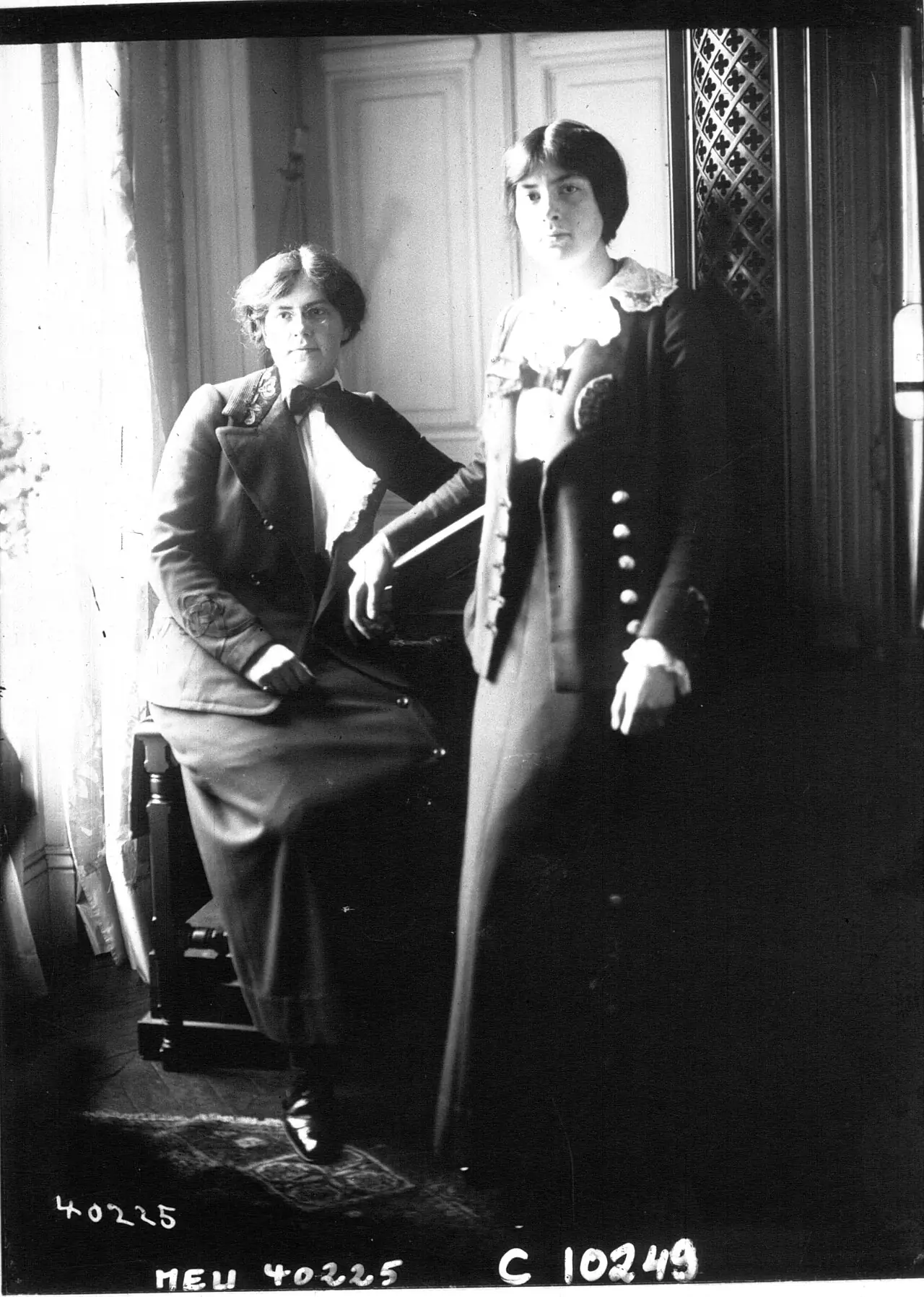
Agence MeurisseLili and Nadia Boulanger, 1913Press photograph · Bibliothèque nationale de France, Paris
The sisters together in the year of Lili’s Prix de Rome. Nadia had entered the same competition five years earlier and won a second prize. They worked together in lessons and performances, and on the last Pie Jesu, which Lili dictated and Nadia wrote down.
Francis Jammes
Elle était descendue
From Tristesses, 1906; set in 1914
FrenchElle était descendue au bas de la prairie,
et, comme la prairie était toute fleurie
de plantes dont la tige aime à pousser dans l’eau,
ces plantes inondées je les avais cueillies.
Bientôt, s’étant mouillée, elle gagna le haut
de cette prairie-là qui était toute fleurie.
Elle riait et s’ébrouait avec la grâce
dégingandée qu’ont les jeunes filles trop grandes.
Elle avait le regard qu’ont les fleurs de lavande.
Our translationShe had gone down to the bottom of the meadow,
and, as the meadow was full of flowering
plants whose stems like to grow in water,
I had picked those water-covered plants.
Soon, having got wet, she went to the upper part
of that meadow which was full of flowers.
She laughed and shook herself with the gangling
grace of girls who have grown too tall.
Her gaze had the look of lavender flowers.
At the opening of Clairières dans le ciel a girl gets her feet wet, goes back up the meadow and shakes herself, laughing. Boulanger chose thirteen poems from Jammes’s Tristesses; the final song returns to this meadow a year further on from the woman.
Recommended recordings
Faust et Hélène · Psalms 24 and 130 · D’un soir triste · D’un matin de printempsLynne Dawson, Ann Murray, Bonaventura Bottone, Neil MacKenzie, Jason Howard; City of Birmingham Symphony Chorus, BBC Philharmonic, Yan Pascal TortelierChandos · 1999The disc couples the prize cantata with two psalms and both late orchestral pieces. Ann Murray sings the contralto part in Psalm 130.
Clairières dans le cielMartyn Hill, Andrew BallHyperionHill’s tenor suits Jammes’s remembered lover. Ball is the pianist in the complete cycle, which ends with a long song; the 1994 recording also includes choral works.
Passed toNadia Boulanger’s preservation and performance workLater French choral repertory
Fauré came to the family home and played while Lili sang his songs. Vidal taught her composition; Nadia worked beside her and later kept her scores in circulation. The famous teaching line through Copland, Carter, Piston, Glass and Quincy Jones was Nadia’s. Lili’s psalms and her Pie Jesu are in the choral repertory.