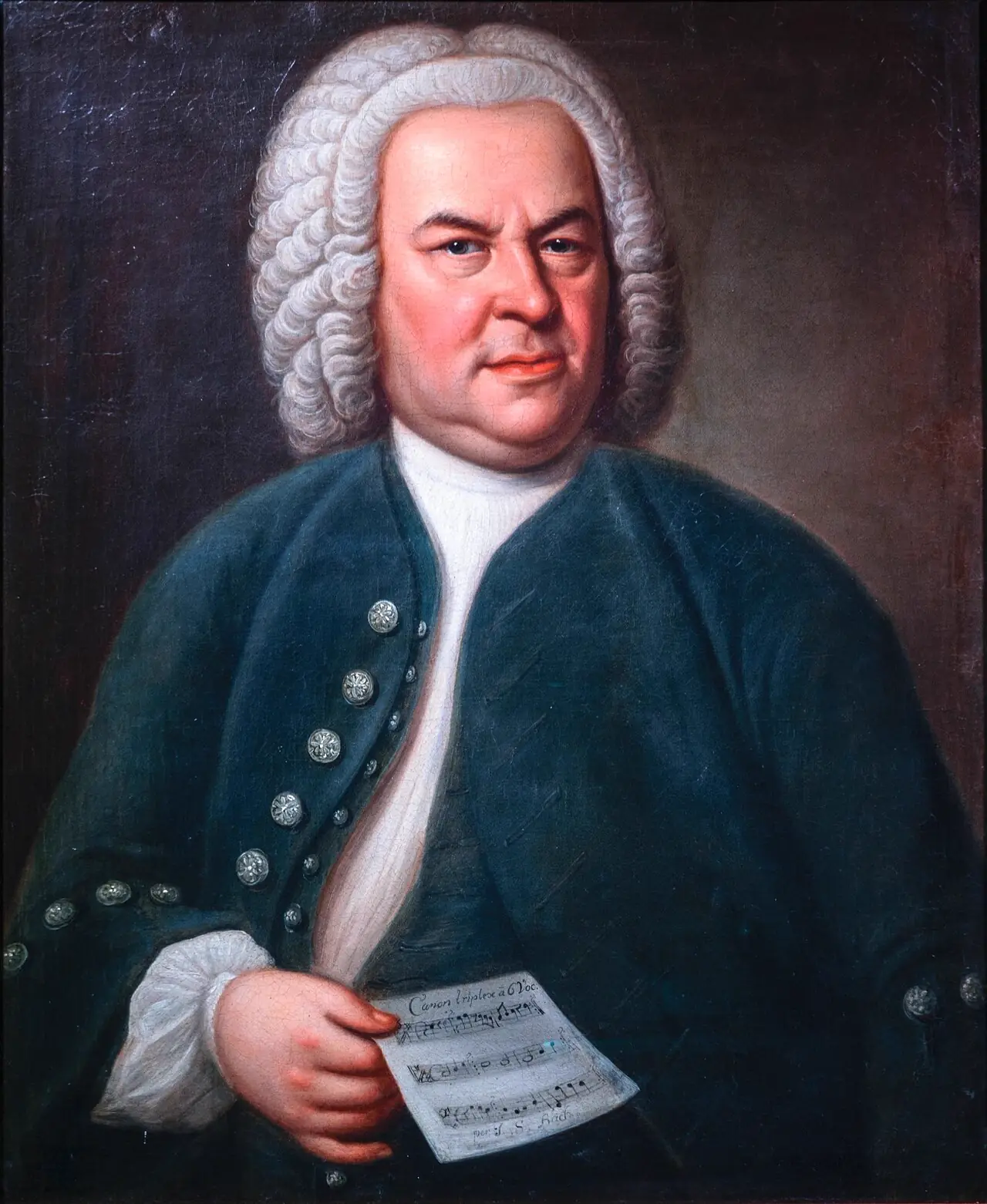
Recording
- V. CiacconaJascha Heifetz, violin · 195213:02
Jascha Heifetz plays the Chaconne, the long final movement of Bach’s Partita No. 2 in D minor, BWV 1004. The solo violin moves from broad chords to fast runs, modulates to D major, and ends on the D minor chord with which it began.
Listening notes · joins
- Opening chord and four-bar pattern
The violin begins with a D minor chord and a dotted rhythm, entering on the second beat of the bar. Bass and melody sound together. Over the next four bars Bach sets out the harmonies for the succession of variations that follows.
- Manuscript of six works, 1720
Bach gathered three sonatas and three partitas for solo violin in a manuscript dated 1720. In this partita the Ciaccona is the fifth and final movement, after an Allemande, Courante, Sarabande and Gigue.
- Death of Maria Barbara, 1720
When Bach returned from Carlsbad with Prince Leopold in 1720, he learned that his wife, Maria Barbara, had died after a short illness and had already been buried. Since 1994 the scholar Helga Thoene has argued that the Chaconne is her epitaph. The idea is disputed, and Bach left no word on it.
- Letter to Clara Schumann, 1877
In June 1877 Brahms wrote to Clara Schumann: “On a single stave, for a small instrument, the man writes a whole world of the deepest thoughts and most powerful feelings.” He sent her his version of the Chaconne for piano, left hand alone.
- Arpeggio passage
Bach wrote arpeggio above the chords. The player breaks them into a running pattern across the strings, with a bass note below and a melody at the top. The middle notes move between them.
- L’Enfant Plaza Metro, Washington, 2007
At 7:51 on the morning of 12 January 2007 the violinist Joshua Bell, wearing a baseball cap, began with this Chaconne at L’Enfant Plaza Metro station in Washington. In 43 minutes 1,097 people passed. Seven stopped to listen, and 27 left about $32 between them.
- Change to D major, bars 133–140
After a long span in the minor, F♯ enters and the violin moves into D major at bar 133. The dotted rhythm continues, with the melody placed low on the instrument.
- Heifetz recording, RCA 45, 1952
This Chaconne comes from a Jascha Heifetz recording issued on an RCA 45-rpm disc, ERA 9544, recorded in 1952. The two sides of the disc are joined here into one track, with no break at the side change.
- Chordal writing, bars 177–184
Broad dotted phrases return in the section in D major. After pages of quick single notes, the violin plays chords again. The upper line descends through a chain of appoggiaturas, each resolving into the next chord.
- Bach as violinist, Weimar, 1703
In 1703 the eighteen-year-old Bach spent about half a year as a violinist in Duke Johann Ernst III’s private orchestra at Weimar. Seventeen years later he dated a manuscript of six works for solo violin, and ended the D minor Partita with this Chaconne.
- Return to D minor, bar 209
At bar 209 F♮ returns and the music moves from D major back to D minor. The violin starts a new group of variations and soon breaks its chords into quick lines again. The opening theme returns once more later.
- Return of the opening chords
A last run of notes ends on D. The dotted rhythm of the opening returns, with its broad chords and upper A. Eight bars take the violin to the final D, held under a fermata.
Joins
- D minor spread across the strings
The quick descending line reaches a D minor chord. Bach marks the following chords arpeggio, and the bow distributes their notes across the strings. The bass and the upper melody stay at the outer edges of the pattern, and the inner notes move between them.
- The turn to D major
The minor-key variations close on D. At bar 133 the key signature changes to D major. The next phrase keeps D as its centre and adds F♯, the major third. The violin begins a lower, dotted melody in D major, with notes sounded beneath it on the other strings.
- F♮ brings back D minor
The major section closes on D. F♮ returns in the next chord, and the violin begins another set of variations in D minor. The bass stays on D at the join, and the upper line starts a new dotted phrase.
- The opening dotted rhythm returns
The violin’s last rapid run ends on D and pauses. The opening dotted rhythm returns on the second beat, with the D minor chords and the upper A. A final extension of that phrase leads to the held D under the closing fermata.