Carmen
2 recordings · 7 min
In the Hall
- Act I · Habanera — L’amour est un oiseau rebelleGeraldine Farrar, soprano; orchestra conducted by Walter B. Rogers · 9 December 1914, New York3:19
In the Habanera from Act I of Carmen, Carmen sings that love obeys no law, over a bass that repeats the same dance step. Geraldine Farrar sings both verses in French in this acoustic recording made in 1914.
Listening notes
- Habanera, Carmen’s entrance
The bass repeats the habanera rhythm throughout: a dotted quaver, a semiquaver, then two quavers. Above it the voice descends by semitones. Carmen enters with a song about a bird that nobody can tame.
- Refrain in D major
At the refrain, “L’amour est enfant de Bohème”, the music moves from D minor to D major and the bass keeps its dance rhythm. The words warn that anyone Carmen loves should beware.
- Borrowing from Iradier
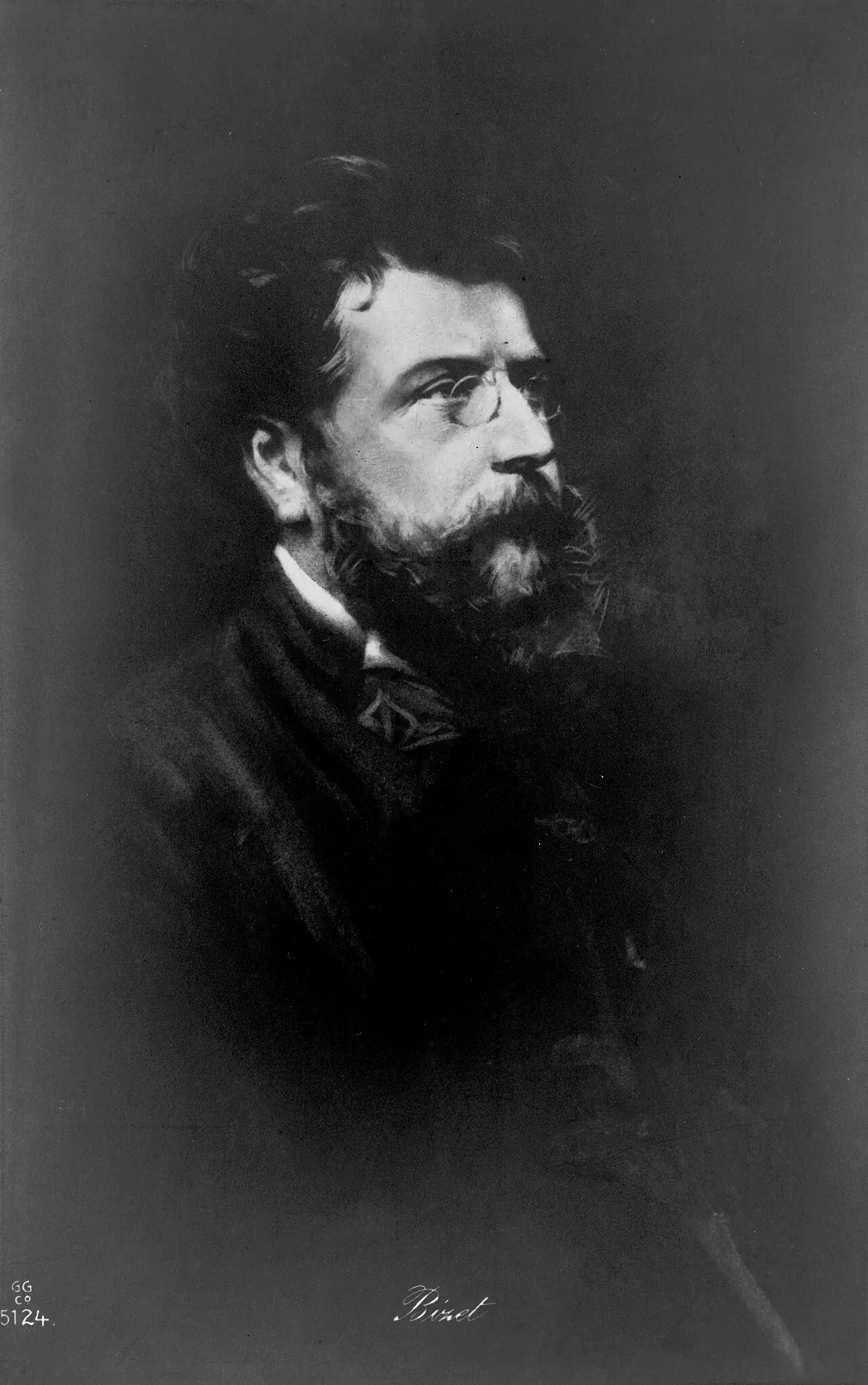
Bizet built Carmen’s entrance from Sebastián Iradier’s song El arreglito and wrote the Habanera’s words himself. Choudens’s vocal score acknowledged the Spanish source in a footnote beneath the opening bars.
- Closing refrain
The refrain returns, and the words about love now address “you” directly. The repeating bass continues under both verses, and Carmen stretches the phrase above it while the dance rhythm holds.
- Act II · Toreador Song — sung in ItalianPasquale Amato, baritone; Victor orchestra, Walter B. Rogers · 1911, Camden, New Jersey3:28
In this song from Act II of Carmen, Escamillo replies to a toast with a description of the bullring. Pasquale Amato sings both verses in Italian, each a minor-key narrative followed by a broad refrain in the major.
Listening notes
- Escamillo’s verse, F minor
Escamillo’s song opens with a fortissimo orchestral introduction, after which he describes the arena. The verse stays in F minor, set to short repeated figures.
- Refrain in F major
The refrain is in F major. At its first appearance in the score it is marked piano and “avec fatuité” (with self-satisfaction). In the stage score the other characters and the chorus join the refrain. This recording is a solo version.
- Amato’s Italian Carmen, 1911
Amato sings an Italian translation of a French opera set in Spain. His Victor disc 88327, recorded on 9 November 1911, puts a star singer, an orchestra and one substantial scene on a single record side. The Library of Congress catalogues it as an Italian-language vocal solo with harp and orchestra.
- Refrain after the second verse
After the second verse the broad refrain returns. In the opera it ties Escamillo to the crowd. The refrain returns later from the bullring, sung by the chorus during Carmen and José’s private confrontation outside.