Recording
- Rimsky-Korsakov’s concert versionMusopen recording; performers uncredited12:13
Rimsky-Korsakov’s 1886 concert version of Night on Bald Mountain depicts a witches’ sabbath that ends at the sound of a village church bell. Racing violins and threatening brass are followed by a long dawn.
Listening notes · joins
- Opening, violins alone
The two violin sections begin alone, pianissimo, with quick interlocking figures. The marking is Allegro feroce, fast and ferocious. Low strings soon enter with a pulse beneath them, and flute and oboe play their first held notes.
- Borodin meets Mussorgsky, 1856
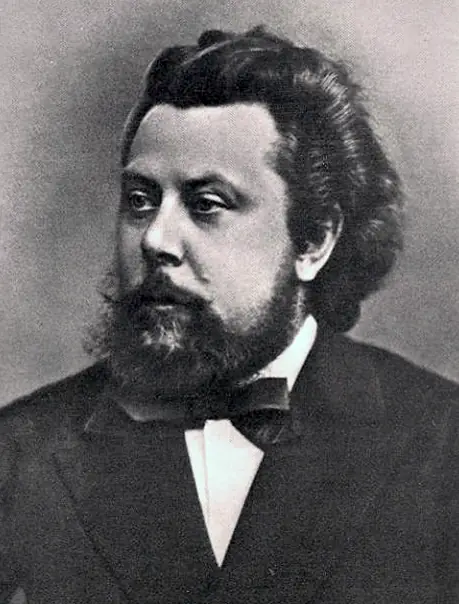
In autumn 1856 Borodin, an army doctor on duty at a Saint Petersburg military hospital, met the seventeen-year-old Guards officer Mussorgsky. That evening Mussorgsky, in a close-fitting uniform, with pomaded hair and immaculate nails, played extracts from Il trovatore and La traviata. In 1858 he petitioned to leave the army.
- Printed programme, 1886
The printed programme describes underground voices, spirits of darkness and Chernobog, the Black God. His followers celebrate a black mass and a sabbath. The sound of a distant village church bell breaks up the gathering, and day returns.
- Letter to Vladimir Nikolsky, 1867
In July 1867, weeks after finishing the score, Mussorgsky told the literary scholar Vladimir Nikolsky that he saw in this “sinful prank” an original Russian work, nourished on Russian bread. Balakirev rejected it and would not have it performed. Mussorgsky later returned to the music and recast it for the stage.
- Concert version, Saint Petersburg, 1886
Five years after Mussorgsky’s death, Rimsky-Korsakov assembled this concert piece from his friend’s manuscripts. Much of it came through the later choral version for The Fair at Sorochyntsi.
- Bell and tam-tam, première, 1886
In Mussorgsky’s last version, for his opera The Fair at Sorochyntsi, the sabbath is a sleeping peasant lad’s dream, and a village bell ends it. At the 1886 première the bell chosen at the bell-store went off pitch in the hall as the temperature changed. A tam-tam was used in its place.
- Clarinet solo, Meno mosso
Meno mosso, tranquillo. A solo clarinet plays dolce, sweetly, above divided violas and low strings, and the violins rest. D is held in the bass under the clarinet’s turns.
- Solo flute, rehearsal Z
A solo flute takes the next phrase, also marked dolce. The double basses play their low notes pizzicato while divided violas and bowed cellos sustain the harmony. The flute’s last notes are marked perdendosi.
- Repin’s portrait, hospital, 1881
In March 1881 Ilya Repin painted Mussorgsky in the Nikolaevsky Military Hospital in Saint Petersburg over four sittings. The sitter wore a hospital robe with crimson lapels. Mussorgsky died there on 28 March, a week after his forty-second birthday.
- Close in D major
Harp arpeggios and quiet wind chords bring the music to rest in D major. The strings return for the last soft chord, and the basses play a final pizzicato D. The score ends with a fermata over a rest.
Joins
- The bell holds D as the dance stops
The rushing strings descend and diminish. At Poco meno mosso (rehearsal W), a bell tuned to D begins its slow tolling. The cellos pluck D beneath quiet violin tremolo. The clarinets hold their chord and the flutes move in longer notes. The trombones, tuba, bass drum and cymbals stop playing at this point.
- Clarinet solo over low D
The moving violin figures stop. At Meno mosso, tranquillo, a solo clarinet plays over divided violas, cellos and double basses, with D held low. Harp arpeggios follow the end of its phrase, and a solo flute then takes up the dawn music.