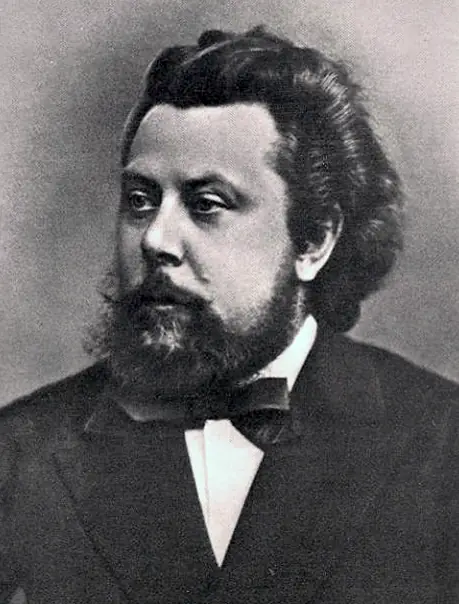
Pictures at an Exhibition
15 recordings · 32 min
In the Hall
- Promenade — Allegro giusto, nel modo russicoSkidmore College Orchestra, per the Free Music Archive and Internet Archive; not named on the Commons page1:41
Mussorgsky’s Promenade from Pictures at an Exhibition, marked Allegro giusto, nel modo russico, begins with a solo trumpet, and the brass then take up the phrase. The bars are of unequal length, five beats and then six, and the Promenade represents Mussorgsky walking between Hartmann’s pictures.
Listening notes · joins
- Opening phrase, trumpet and brass
The trumpet begins on G, falls to F and rises to B♭. The first bar has five beats and the second has six. The brass then play the same tune in chords.
- Hartmann memorial exhibition, Saint Petersburg, 1874
In Saint Petersburg in 1874, Vladimir Stasov gathered Hartmann’s drawings, paintings and architectural designs for a memorial exhibition. That June, Mussorgsky wrote a piano suite based on his visit. According to Stasov, the Promenade depicts Mussorgsky walking between the pictures.
- Close of the Promenade
The walking bass brings the Promenade back to B♭ major. The last chord leads straight into Gnomus, the first picture, which shows a wooden nutcracker.
Joins
- The bass reaches down to G♭
The melody reaches A♭ and a low G♭ sounds beneath it. The inner voice holds E♭ while the bass moves down to F and back to G♭ (bars 8–11). The melody keeps its rising shape above the new bass notes.
- Bass descent to F major
The bass moves from G♭ to B♭, then descends through A and G to F. F major chords are spread above it. The short phrases lengthen into a continuous line, with a bass note on nearly every beat.
- I. Gnomus — VivoSkidmore College Orchestra, per the Free Music Archive and Internet Archive; not named on the Commons page2:42
“Gnomus”, marked Vivo, is the first movement of Pictures at an Exhibition and depicts a gnome in the form of a wooden nutcracker. Rapid figures in the low strings alternate with woodwind passages, and the music breaks off abruptly several times.
Listening notes · joins
- Opening phrases, low strings and woodwinds
Low strings and woodwinds play a short, irregular phrase and stop on a held note. A second phrase follows and also stops. Mussorgsky writes fermatas over both notes and rests.
- Hartmann’s nutcracker toy
Hartmann’s gnome was a wooden nutcracker made to hang on the Artists’ Club tree, and nuts went into its mouth.
- Meno mosso, chromatic bass
Mussorgsky marks this passage Meno mosso. The wind theme is played over the strings, and the bass descends by semitones. In Lamm’s piano edition the passage covers bars 60–71, with the melody in octaves.
- Final run, bars 93–99
Another fermata follows, and then the final run. Mussorgsky marks it velocissimo and con tutta forza, as fast as possible and with all possible force. The piece ends on an E♭ minor chord.
Joins
- Fermata rest before the descending phrase
A whole bar of rest under a fermata separates the opening figures from the descending phrase, with a low E♭ sounding beneath it. In Ravel’s orchestration the new line begins in the upper woodwinds. Celesta and strings then join, the strings playing sliding figures.
- Change to four beats, heavier tempo
After another fermata, the metre changes from three beats to four. The marking is Poco meno mosso, pesante, slower and heavy, and the bass leaps from E♭ to A. The broad wind tune is set repeatedly against the quick three-beat figure of the opening.
- Chromatic bass descent in the Meno mosso
In the following Meno mosso the tune is expanded into high octaves. Beneath it the bass descends chromatically through E♭, D♭ and C. In Ravel’s orchestration the melody is given to the wind, set against the strings.
- Low trills and accelerando
The broad octave tune breaks off. Three-beat bars return, with low trills alternating between E♭ and A. Over them the earlier descending phrase returns, followed by muted brass. At Poco a poco accelerando the tempo gradually increases.
- Fermata before the final run
A forceful A♭ minor chord (A♭–C♭–E♭) takes an added F♭ and stops under a fermata. The final run follows, marked velocissimo, and rises to E♭ minor. One short chord and a rest end the movement.
- Promenade — Moderato comodo e con delicatezzaSkidmore College Orchestra, per the Free Music Archive and Internet Archive; not named on the Commons page0:57
This Promenade from Pictures at an Exhibition comes after the gnome and is in A♭ major, marked Moderato comodo e con delicatezza, “with delicacy”. A horn plays the familiar Promenade tune, and the woodwinds follow.
Listening notes · joins
- Promenade in A♭ major, horn
The horn plays the tune and the woodwinds reply. Mussorgsky marks this Promenade “with delicacy”. The tune keeps its alternating bars of five and six beats, now in A♭ major.
- Closing bars and attacca
The closing bars climb into high octaves and slow down. A high B♭ sounds softly above an E♭ major chord. Mussorgsky marks attacca, so the next picture begins without a break.
Joins
- The tune turns lower
The next phrase begins E♭–F–C and turns down through the walking tune. The lower line plays it first, and a chordal answer then climbs above it. The five- and six-beat bars continue, and E♭ chords recur within A♭ major.
- Low E♭ and A♭, then octaves
Low E♭ and A♭ notes mark the last steps in the bass. The tune then climbs into high octaves at ritardando, and the accompanying chords move underneath. The section ends very softly on E♭ major with B♭ above, followed by the instruction attacca.
- II. Il vecchio castello — AndanteSkidmore College Orchestra, per the Free Music Archive and Internet Archive; not named on the Commons page4:45
The second movement, “Il vecchio castello” (Andante), depicts a troubadour singing outside a medieval castle. In Ravel’s orchestration an alto saxophone plays the song over a repeated G♯.
Listening notes · joins
- Pedal G♯ in 6/8
The bass repeats G♯ throughout, in a rocking 6/8. Above it the bassoon opens the movement, and the alto saxophone plays the long melody, whose phrases range high above the held bass note.
- Troubadour before a medieval castle
Hartmann travelled in Italy and painted its buildings. Mussorgsky placed a singer, a troubadour, in front of a medieval castle, and the long melody is his song. The particular picture has not been identified.
- D major over the G♯ pedal
The tune expands into octaves and chords. At bars 31 and 40 a chord of D major sounds above the G♯ bass, so that its D lies a tritone from the note below. The G♯ pedal stays unchanged under every change of harmony.
- Ravel’s orchestration, 1922
In the summer of 1922 Ravel orchestrated Pictures for Serge Koussevitzky. He gave the medieval singer’s melody to the alto saxophone. Koussevitzky conducted the first performance of the new score in Paris that October.
- Return of the opening melody
The opening melody returns near the end and is broken into short phrases separated by rests. G♯ continues underneath. A final upward phrase reaches the upper G♯ in bar 106, and the bass ends on G♯ in bar 107.
Joins
- New chords over the same bass
The repeated G♯ continues as a pedal through bars 29–46, beneath a melody now played in octaves. A major and D major chords pass above it, and their notes are dissonant against the bass. The lowest part keeps the same rocking rhythm on G♯ while the harmony above it changes.
- The first song returns over G♯
The opening song returns in G♯ minor, marked espressivo, over the same G♯ bass. Its long line breaks up into separate chords divided by rests. The last upward leap of the melody reaches G♯, and the bass goes on for a short time below it.
- Promenade — Moderato non tanto, pesanteSkidmore College Orchestra, per the Free Music Archive and Internet Archive; not named on the Commons page0:30
This Promenade from Pictures at an Exhibition, marked Moderato non tanto, pesante, brings the theme back in B major on trumpet and trombones. Eight bars later it has thinned to a few bare notes, and the children’s picture Tuileries follows.
Listening notes · joins
- Promenade, trumpet and trombones
Trumpet and trombones bring back the Promenade, with the orchestra behind them. The Promenade is in B major and lasts eight bars. At the end the chords drop out, and a single line slows down and stops on C♯.
- End of the Promenade, pizzicato strings
In Ravel’s scoring the strings play pizzicato and slow to a halt. The next picture, Tuileries, shows the Paris park, “swarming with children and their nurses”.
Joins
- Promenade III into Tuileries
The next phrase begins F♯–G♯–C♯ in octaves. The chords stop and the final fragment slows, marked ritardando and diminuendo. Its last C♯ is unaccompanied. The score marks Tuileries to follow immediately.
- III. Tuileries (Dispute d’enfants après jeux) — Allegretto non troppo, capricciosoSkidmore College Orchestra, per the Free Music Archive and Internet Archive; not named on the Commons page1:02
“Tuileries (Dispute d’enfants après jeux)”, the third number of Mussorgsky’s Pictures at an Exhibition, is marked Allegretto non troppo, capriccioso and shows children quarrelling in the Tuileries gardens. In thirty bars a two-note taunt returns between scurrying figures, and a smoother tune comes between the quarrels.
Listening notes · joins
- Opening, wind calls and strings
Two-note calls alternate with semiquaver runs. Ravel gives the calls to the winds and the semiquavers to the strings. Mussorgsky marked the movement capriccioso.
- Middle tune, bars 14–19
The middle tune moves in longer notes and rises by semitones through A♯, B and B♯. Beneath it, D♯ falls to D♮ while F♯ is held.
Joins
- From short calls to a slurred phrase
A rising run leads into a longer melody beginning on A♯. Beneath it are D♯ and F♯; D♯ then moves down to D♮ as the melody rises through B to B♯. The short calls are followed by a slurred phrase, with semitone changes inside the B major key.
- Return of the two-note calls
Bars 25–30 bring back the short two-note calls, marked piano, followed by the opening figure at pianissimo. Quick runs interrupt them again. The last run ends on a short B major chord, a quaver, and rests fill the remaining beats of the bar.
- IV. Bydło — Sempre moderato, pesanteSkidmore College Orchestra, per the Free Music Archive and Internet Archive; not named on the Commons page2:19
“Bydło”, the fourth movement of Pictures at an Exhibition, marked Sempre moderato, pesante, depicts an ox-cart on enormous wheels. In Ravel’s orchestration a tuba plays the melody above a heavy bass.
Listening notes · joins
- Tuba solo in G♯ minor
The tuba plays the melody in G♯ minor over a bass of four quavers to the bar. Mussorgsky marks the music pesante — heavy. Ravel starts it quietly.
- Middle section, bars 21–34
In the middle passage the chords move higher, and the tune is harmonised with A major and D major chords. The bass climbs in steps. The quaver accompaniment continues beneath it without a break.
- Title and subject of Bydło
The title is Polish for cattle. The picture behind the music is Hartmann’s ox-drawn wagon on enormous wheels, which Mussorgsky explained privately to Stasov. The wagon does not appear in the title, which is only Bydło.
- Ending of Bydło
The melody breaks into fragments and the steps in the bass grow quieter. In Ravel’s orchestration only harp and plucked double bass are left at the end.
Joins
- A major chords above the rising bass
The G♯ minor phrase closes, and A major chords enter much higher above the bass. The bass rises A–B–C♯–D and the quaver accompaniment continues. Broad chords replace the single melodic line.
- The melody returns in G♯ minor
In bars 35–40 a D♯ in the bass leads back to G♯ minor. The first melody returns in octaves, marked con tutta forza (with all possible force). The accompanying quavers continue, and the tempo broadens under the marking poco allargando.
- The tune returns to the low octave
The tune drops back into its low octave and breaks into fragments. The key stays G♯ minor, with the same quavers underneath. Ravel reduces the ending to harp and plucked double bass; Mussorgsky’s final instruction is perdendosi, dying away.
- Promenade — TranquilloSkidmore College Orchestra, per the Free Music Archive and Internet Archive; not named on the Commons page0:41
This is the Promenade marked Tranquillo from Pictures at an Exhibition, which follows the ox-cart and returns in D minor. The flutes play the theme first, then the oboes and bassoons take it over before it moves down into the bass.
Listening notes · joins
- Flutes, oboes and bassoons
The Promenade theme passes from flutes to oboes and bassoons, marked Tranquillo, in D minor. The metre changes between bars of five, six and seven beats.
- Letter to Vladimir Stasov, June 1874
In June 1874, while composing Pictures, Mussorgsky wrote to Vladimir Stasov: “My physiognomy can be seen in the interludes.”
Joins
- The theme moves into the bass
In bars 5–10 of Lamm’s piano text, the D minor tune moves down into bass octaves, beginning A–B♭–E. The upper part follows, also in octaves. The texture then thins to isolated A notes and a quick group of chords before the next picture.
- V. Ballet des poussins dans leurs coques — Scherzino, vivo leggieroSkidmore College Orchestra, per the Free Music Archive and Internet Archive; not named on the Commons page1:18
The fifth movement of Pictures at an Exhibition, a Scherzino marked vivo leggiero, is based on Hartmann’s design dressing child dancers as chicks still inside their eggs. Mussorgsky set it with hopping figures and trills, and Ravel’s orchestration adds woodwinds, harps and plucked strings.
Listening notes · joins
- Scherzino, opening section
Grace notes fall on short chords. The marking is Vivo, leggiero (lively and light), and the harmony moves away from F major and back several times. Ravel scored the chicks for woodwinds, harps and plucked strings.
- Hartmann’s costume designs for Trilby, 1871
In Saint Petersburg in 1871, children danced in Petipa’s ballet Trilby, to music by Julius Gerber. Hartmann’s costume design enclosed them in eggshells, with their legs out underneath and canary heads on top like helmets.
Joins
- Trills above a held F
The scherzino ends on a held D♭ and a clipped C. The trio opens with a trill on a high F over a low F held for eight bars. Short offbeat notes sound in the register between them. The tempo stays quick.
- Return to the Scherzino
The trio’s last bass notes, C and A, lead back to the opening F major chords. At the end of the trio Mussorgsky marks a da capo, and Lamm’s piano edition reads “De Capo il Scherzino, senza Trio, e poi Coda”. The grace notes of the opening return, and the repeat of the Scherzino goes straight to the coda without the trio.
- Held D♭ into the coda
A D♭ is held across the first two bars of the four-bar coda. The last short figure moves from G♯ to A, and an F major chord marked pianissimo ends the dance. After the chord Mussorgsky wrote a rest under a fermata.
- VI. “Samuel” Goldenberg und “Schmuÿle” — AndanteSkidmore College Orchestra, per the Free Music Archive and Internet Archive; not named on the Commons page2:08
“Samuel” Goldenberg und “Schmuÿle”, marked Andante, is the sixth movement of Pictures at an Exhibition and portrays two figures, here in Ravel’s orchestration. Goldenberg has a unison melody and Schmuÿle a stream of repeated notes; later Ravel sets one muted trumpet against the whole string section.
Listening notes · joins
- Goldenberg’s theme in unison
Goldenberg’s phrase is broad and heavily accented. Low woodwinds and strings play it in unison, without a separate accompaniment. The line includes a leap from G♭ to A, an augmented second.
- Schmuÿle, muted trumpet
Schmuÿle enters on a muted trumpet, which repeats notes in quick groups. The score changes to Andantino.
- Two Hartmann portraits, Mussorgsky’s collection
Mussorgsky owned both of the Hartmann drawings behind this scene. One showed a wealthy Jewish man in a fur hat, the other a poor Jewish man from Sandomierz, the Polish town where Hartmann spent a month in 1868. Mussorgsky put the two separate portraits together in one movement.
- Ending in Ravel’s orchestration
Mussorgsky’s piano piece ends on a long final note. In Ravel’s scoring Goldenberg dismisses Schmuÿle more abruptly. A warmer idea is cut short by an emphatic ending.
Joins
- Muted trumpet enters over held D♭
Goldenberg’s phrase ends on D♭. That note is held beneath the next passage, and the melody moves to a high register in repeated notes. In Ravel’s scoring it goes to a muted trumpet over woodwind chords. Mussorgsky changes the marking from Andante to Andantino.
- Goldenberg’s theme returns under Schmuÿle
Andante, grave brings back Goldenberg’s tune in the lower parts. Schmuÿle’s repeated D♭ continues above it. Ravel gives Goldenberg’s theme to the strings and keeps Schmuÿle’s on one muted trumpet, so the two themes sound together.
- Fermata and slowing before the close
An accented chord cuts off the repeated notes, and a fermata holds the silence that follows. Over B♭ in the bass, the next phrase is marked con dolore — with sorrow — and slows (poco ritard in Lamm’s edition, bars 25–29). The clipped figures of the opening return for an emphatic final dismissal.
- VII. Limoges. Le marché (La grande nouvelle) — Allegretto vivo, sempre scherzandoSkidmore College Orchestra, per the Free Music Archive and Internet Archive; not named on the Commons page1:40
This movement shows gossip at the market in Limoges about a missing cow, new false teeth and a conspicuously red nose. Mussorgsky set the chatter in quick notes, and Ravel’s orchestration passes them between violins and woodwinds.
Listening notes · joins
- Opening phrase, violins
The violins open with a phrase in semiquavers. Woodwinds take it up, horns add accented interjections and the celesta joins in. Mussorgsky marked the movement sempre scherzando, and accents fall throughout the semiquaver figuration.
- Crossed-out programme, manuscript, 1874
In his 1874 manuscript Mussorgsky wrote out the market’s news in French. A man has recovered his cow, a woman has acquired porcelain teeth, and another man’s nose remains as red as a peony. He later crossed the passage out.
- Final bars, Meno mosso
A fermata stops the movement. The last four bars are marked Meno mosso, with a slower pulse and shorter notes, semidemiquavers passed across the orchestra. The score accelerates at the end and continues without a break into the Catacombs.
Joins
- E♭ to D major at bar 12
The E♭ phrase ends, and at bar 12 a D major chord (D–F♯–A), with F♯ in the bass, begins the middle passage. The key signature is cleared at this point, and the harmony is D major. The semiquavers continue. From bar 16 the bars shorten from four beats to three, so each new accent comes round more quickly.
- A chromatic slide back to E♭
Repeated Ds continue to the end of the middle passage in bars 25–27. Beneath them the bass descends in semitones from C♯ to E♭, with a diminuendo. The opening E♭ phrase then returns, marked mf, still in semiquavers.
- Fermata, Meno mosso, then attacca
Three accented figures end in a rest under a fermata. Meno mosso, sempre capriccioso then begins over B♭ in the bass, with E♭ major chords broken into semidemiquavers (bars 36–40 in Lamm’s edition). The last bar accelerates and rises chromatically, and attacca leads straight into the catacombs.
- VIII. Catacombae (Sepulcrum romanum) — LargoSkidmore College Orchestra, per the Free Music Archive and Internet Archive; not named on the Commons page1:53
Movement VIII of Mussorgsky’s Pictures at an Exhibition, Catacombae (Sepulcrum romanum), marked Largo, follows a picture of Hartmann exploring the Paris catacombs by lamplight. Mussorgsky wrote slow chords, each struck and held, and Ravel scored their echoes for brass, low woodwinds and double basses.
Listening notes · joins
- Opening bars, brass and basses
The first notes are B, then G, each held under a fermata. Ravel scores the vault for brass, low woodwinds and double basses. Abrupt changes from fortissimo to piano make one chord sound like the echo of another.
- Hartmann’s watercolour of the catacombs
Hartmann painted himself into this watercolour. He stands in the Paris catacombs with a friend and a guide, who carries a lamp, and a pile of skulls lies to their right. Hartmann died in 1873.
- F♯ pedal in the closing bars
The bass holds F♯ while the chords above it change. The last chord is dissonant and does not resolve. The score continues without a break into Cum mortuis, where the Promenade returns.
Joins
- G major turns to G minor
The descending bass reaches F♯ in bar 11 and stops under a fermata. G follows in bar 12, with B♮ above it. B♮ then falls to B♭, and by bar 14 the harmony has moved from G major to G minor. The brass chords stay slow throughout this change.
- The bass stops on F♯
After the large E♭ and C major chords, the bass holds F♯. An inner line rises through B♯, C♯, D, E and E♯. The last chord is held under a fermata and then diminishes. The F♯ does not resolve, and the score continues attacca into Cum mortuis.
- Cum mortuis in lingua mortua — Andante non troppo, con lamentoSkidmore College Orchestra, per the Free Music Archive and Internet Archive; not named on the Commons page1:51
In “Cum mortuis in lingua mortua” (Andante non troppo, con lamento), the movement of Pictures at an Exhibition, the Promenade theme returns over tremolo strings. In a note in his manuscript, Mussorgsky described Hartmann leading him towards skulls lit from within.
Listening notes · joins
- Walking tune in B minor
The familiar tune returns in B minor, marked con lamento. Ravel sets it among quiet woodwinds and trembling strings. The melody keeps the shape of a walk.
- Inscription in the 1874 manuscript
In his 1874 manuscript Mussorgsky wrote that Hartmann’s spirit led him towards the skulls: “the skulls are illuminated gently from within”. The title means “with the dead in a dead language”.
- Final chord in B major
The high F♯ tremolo holds while the lower phrases are separated by rests. The last chord, B–D♯–F♯, is in B major, where the movement began in B minor. It carries a fermata.
Joins
- High F♯ tremolo over the chords
The tremolo moves to high F♯ and stays on that note. Below it the score marks tranquillo, and long chords alternate with rising F♯ major arpeggios in the bass (F♯–C♯–F♯–A♯–C♯). The melodic phrases become shorter, with rests between them.
- IX. La cabane sur des pattes de poule (Baba-Yaga) — Allegro con brio, feroce — Andante mosso — Allegro moltoSkidmore College Orchestra, per the Free Music Archive and Internet Archive; not named on the Commons page3:32
The ninth piece in Mussorgsky’s Pictures at an Exhibition takes its subject from Hartmann’s design for a clock in the form of a hut on chicken legs; Mussorgsky portrayed its witch, Baba Yaga, flying through the air in a mortar. The movement leads without a break into The Great Gate of Kyiv.
Listening notes · joins
- Opening, F♯ and low G
F♯ and low G sound together, followed by a whole bar of silence. The Gs are soon repeated in hammered strokes. The marking is feroce (ferocious), and Ravel gives a trumpet theme against this, with other brass replying.
- Andante mosso, flute and bass
In the Andante mosso, a flute plays above a slower line in bassoon and double bass. The middle section opens with G and E alternating. Harp, celesta and strings accompany the low melody.
- Hartmann’s design for a clock
Hartmann’s sketch is a design for a metal clock in the form of a little hut on chicken legs, decorated with cocks’ heads. Mussorgsky added the hut’s owner, Baba Yaga, who flies about in a mortar hunting for victims.
- Earlier witches’ sabbath, 1867
Mussorgsky had already written a sabbath. Balakirev refused to perform his St John’s Night on the Bare Mountain, finished on St John’s Eve 1867. Orrin Howard of the LA Phil heard in Baba Yaga’s ride Mussorgsky’s “best Bald Mountain pictorialism”.
- Return of the opening, Allegro molto
At the Allegro molto the repeated Gs return in two-beat bars. The trumpet’s strident tune comes back, and the brass reply to it.
- Closing run and attacca
The closing semiquavers run up through octave after octave to G. The movement is marked attacca, and the G leads without a pause into the E♭ major opening of The Great Gate of Kyiv.
Joins
- Repeated G becomes rocking G–E figure
The hard repeated Gs reduce to a quiet figure rocking between G and E, and Andante mosso slows the pulse. Ravel brings flute, bassoon and double bass forward, with harp and celesta around them, and withdraws the heavy brass.
- From the tremolo to Allegro molto
The middle section ends with a tremolo on B, D♯ and G held under a fermata. A forceful G begins the Allegro molto, and the bars return to two beats. The repeated-note figure comes back, followed by the brass tune. In Lamm’s piano edition the passage runs from bar 122 to bar 145.
- Semiquaver octaves lead into E♭ major
The short phrases turn into continuous semiquavers in octaves. These run downwards, then climb to G, the third of the E♭ major chord that opens the finale. The last bar is marked attacca, and The Great Gate follows without a break.
- X. La grande porte de Kiev — Allegro alla breve. Maestoso. Con grandezzaSkidmore College Orchestra, per the Free Music Archive and Internet Archive; not named on the Commons page5:28
Hartmann’s gate was never built in Kyiv; Mussorgsky’s final movement sets it in E♭ major. The movement includes brass, a chant and pealing bells.
Listening notes · joins
- Opening theme in E♭ major, brass
The brass open in E♭ major with the main theme. Mussorgsky’s directions are Maestoso and Con grandezza, majestic and with grandeur. Broad chords support the melody, and softer woodwinds reply between its phrases.
- Hartmann’s design for the Kyiv gate
Hartmann’s design has tinted brick, an imperial eagle and a three-storey belfry with a cupola shaped like a Slavic helmet. The planned stone gates of Kyiv were never built. Mussorgsky’s movement includes writing for bells.
- Dedication to Stasov, 1874
Mussorgsky finished the suite on 22 June 1874. Five days later he inscribed the title page with a tribute to Vladimir Stasov, and a month after that he added a note that he meant to publish it. The suite appeared only in 1886, five years after his death, in Rimsky-Korsakov’s edition.
- Return of the gate theme, E♭ major
The gate theme returns in E♭ major, played by the brass. Strings and woodwinds play rising and falling scales around the brass melody.
- Ravel’s orchestration, Paris, 1922
In the summer of 1922 Ravel orchestrated Mussorgsky’s piano suite for Serge Koussevitzky. Koussevitzky conducted the first performance in Paris on 22 October. In 1930 he recorded it with the Boston Symphony Orchestra.
- Return of the Promenade
The Promenade theme returns within the bell passage (bars 97–110 in Lamm’s piano edition). In the orchestral version it was first played by a single trumpet. Quick figures above and below it continue the bell pattern.
- Main theme at Meno mosso
The main theme broadens at Meno mosso, sempre maestoso (slower, still majestic). Its chords sound against minim triplets. The bass and upper parts alternate across several octaves.
- Rising bass under repeated chords
Repeated chords continue in minim triplets while the bass rises from A♭ to B♭ and C♭. The triplet pulse holds through each change of harmony, and a crescendo begins.
- Final chords in E♭
The last statement broadens further, marked Grave, sempre allargando. Low E♭ sustains the full chords, and the closing pages span the whole range of the orchestra. The suite ends on E♭.
Joins
- E♭ major statement to A♭ minor chant
The broad E♭ major statement ends, and an A♭ minor chord begins the chant (bars 29–46 in Lamm’s piano edition). The score marks it senza espressione, without expression, and the notes move together in plain chords. In Ravel’s orchestration the brass-led tune is followed by quieter woodwinds.
- E♭ major returns with running octaves
The chant ends on the bare fifth A♭–E♭. E♭ major returns under a descending scale marked energico. In the orchestration, Ravel keeps the main tune in the brass while the strings and woodwinds play fast running figures around it.
- The chant returns a fifth higher
The running octaves climb to B♭ and stop. The chant then begins again in E♭ minor, a fifth above its first appearance. It keeps its long notes and the marking senza espressione, with G♭ in place of the G♮ of the gate theme.
- Low bell figures overlap
The hymn ends on a bare fifth, E♭ and B♭. Low A♭ and C♭ then alternate in the bass beneath repeated upper notes. Triplets enter, then quavers, and the bell figures overlap more closely as the note values shorten before the Promenade theme returns.
- Scale to low C; gate theme returns
A descending scale runs to low C and stops under a fermata. At Meno mosso, sempre maestoso the gate theme returns in E♭ major. Its first chord has G in the bass, and broad triplets now carry the melody across the orchestra.
- A♭ bass under F minor seventh
The gate theme closes on E♭. The bass then moves to A♭ beneath an F minor seventh chord (F–A♭–C–E♭), which is repeated in broad triplets. B♭ and C♭ follow in the bass while the chords continue to sound, and a crescendo begins.