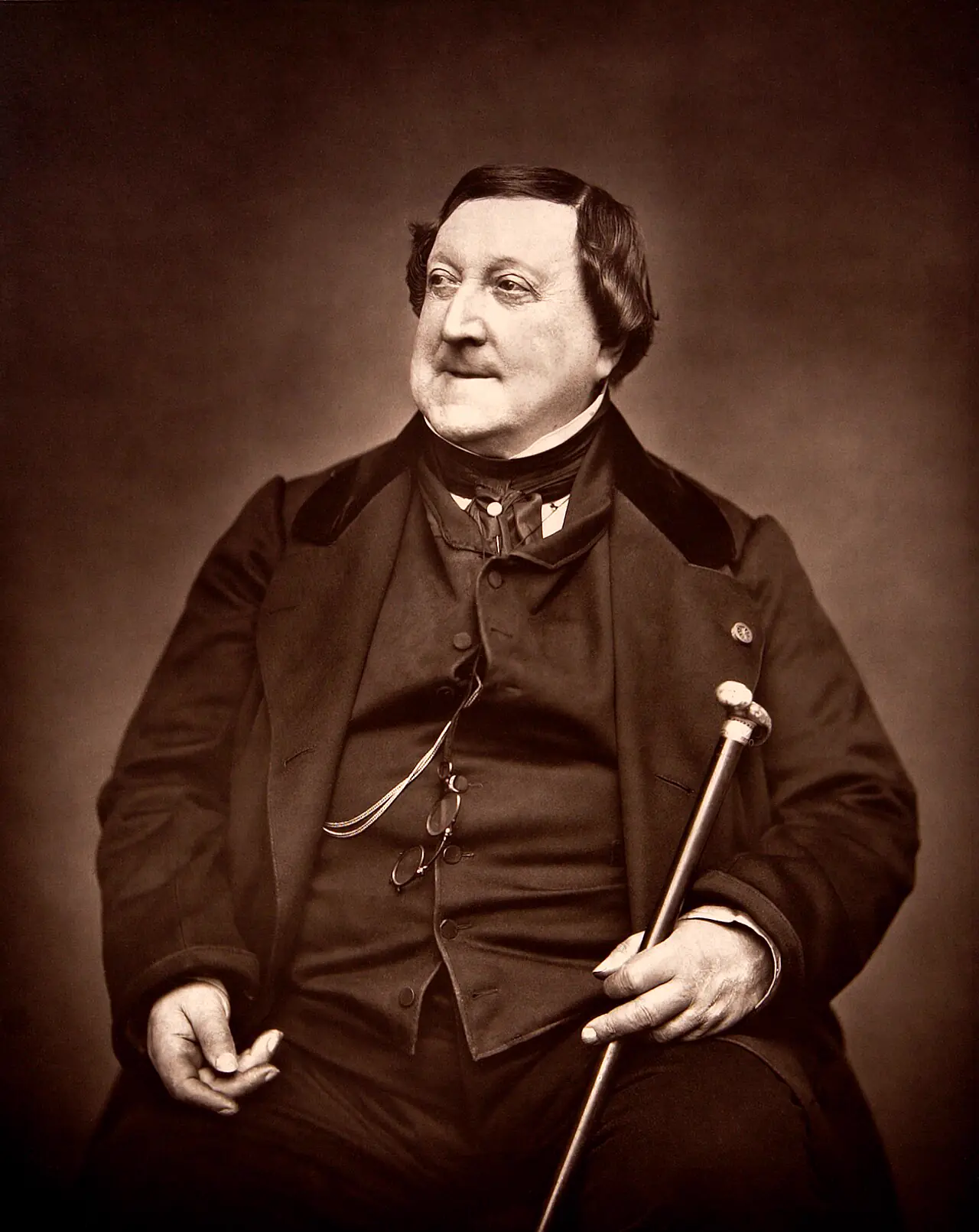
Guillaume Tell
11 min
Recording
- Overture · wind-ensemble transcription attributed to Wenzel SedlakUnited States Marine Band; Timothy Foley · 5–9 June 2000, Center for the Arts, George Mason University, Fairfax, Virginia11:02
The overture to Guillaume Tell has four sections: a slow dawn, an Alpine storm, a shepherd’s song and a gallop. The United States Marine Band plays a nineteenth-century wind transcription attributed to Wenzel Sedlak, in which bassoons and horns take over the parts of an opera orchestra.
Listening notes
- Opening, low wind
The overture opens slowly, with interweaving low melodies. Rossini gave this music to five solo cellos. In this wind version the bass comes from bassoons, contrabassoon and double bass.
- First performance, Paris Opéra, 1829
Guillaume Tell opened at the Paris Opéra on 3 August 1829. It is an opera in four acts about Swiss rebels resisting Austrian rule, and it includes Tell’s ordeal with the apple. The first act is set in a village in the canton of Uri.
- The storm
The storm begins. Quick, unsettled figures replace the long phrases of the opening, and the winds build gradually to a louder, fuller sound.
- Ranz des vaches
A broad tune returns the music to calm, and the flute plays decorations above it. This is the ranz des vaches, a Swiss herdsman’s call, with long notes below and quick ornaments over them.
- Fanfare and final march
A fanfare introduces the final march. The galloping rhythm returns repeatedly beneath the tune until the overture’s close.
- Brno source and Marine Band edition
The arrangement survives in a fifteen-movement Tell suite from the Augustinian monastery in Brno. For this recording the Marine Band adapted the flute part, removed two added trumpet parts and reinforced the bass with contrabassoon and double bass.