Paris, 1900–1913
From Satie’s first Gymnopédie to The Rite of Spring
Satie set a melody over two quiet piano chords; twenty-five years later, Stravinsky wrote a stamping dance for orchestra. Between them came Debussy’s sea and clouds, Ravel’s birds and plucked strings, and the Ballets Russes in Paris.
Begin plays the stations in order; Pause stops playback at the current station.Satie’s first Gymnopédie
Erik Satie · Trois Gymnopédies
I. Lent et douloureux
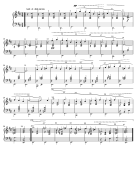
Satie played the piano at the Chat Noir cabaret, then at the Auberge du Clou, where he met Debussy. His first Gymnopédie, written in 1888, opens with a bass note on the first beat and a soft chord on the second. G and D alternate below. The melody enters after four bars, and its long F♯ is held over the changing chords. Later, a low E is held while the harmony moves beneath it. The first ending closes on D major before the music starts again.
Sources & recording
Robin Alciatore
Excerpt 0:02–1:30 · Full recording & listening notes
- Mutopia 37: Gymnopédie No. 1, piano score ↗
- Satie biographies: Montmartre, the 1888 pieces and Debussy’s 1896 orchestrations ↗
- IRCAM: Satie at the Chat Noir and the Auberge du Clou ↗
- Published Satie score alignment: compact repeat and first-ending bar times ↗
- Musée Marmottan Monet: hero painting, date, subject and collection ↗
- Wikimedia Commons: public-domain Monet image ↗
- The melody enters after four bars; its held F♯ sounds above the alternating G and D bass notes.
- The melody holds E while three different chords pass beneath it.
- The closing phrase falls from G to F♯; two full chords close the first half in D major.
Gongs in Paris; bells at the piano
Claude Debussy · Préludes, Book I
X. La cathédrale engloutie
At the 1889 Paris Exposition, Debussy heard Javanese gamelan, with gongs sounding beneath quicker instrumental patterns. In the Revue musicale S.I.M. in 1913, he wrote that its counterpoint made Palestrina’s seem like “child’s play”. His Pagodes of 1903 had already brought gong-like bass notes to the piano. Here Marcelle Meyer plays La cathédrale engloutie, published in 1910. Bare fifths rise slowly, with long spaces between them in which the notes ring. The left hand then begins rolling figures beneath the ascending chords, which represent the cathedral of Breton legend rising from the sea.
Sources & recording
Marcelle Meyer
Excerpt 0:00–1:46 · Full recording & listening notes
- Brent Hugh: Debussy’s 1889 gamelan encounter, layers, tuning and Pagodes ↗
- Julian Johnson, Royal Holloway: gamelan, Pagodes and Debussy’s essay of 15 February 1913 ↗
- La cathédrale engloutie: 1910 publication and score analysis ↗
- Marcelle Meyer recording guide: fifths and rising chords ↗
- Marcelle Meyer plays La cathédrale engloutie, in which bare fifths rise in the piano.
- The left hand begins rolling in triplets beneath the rising chords as the cathedral emerges.
- Paris · lived · documented
1887–1904
Worked as a composer, accompanist and critic after returning from Rome.
- Bayreuth · heard · documented
1888–1889
Attended Wagner performances in two festival seasons.
- Paris · heard · documented
1889
Heard Javanese gamelan and Vietnamese theatre at the Exposition.
Dated places on a present-day coastline.
This year on the MapInfluence
Debussy’s Nuages and Monet’s harbour
Claude Debussy · Nocturnes
I. Nuages — Modéré
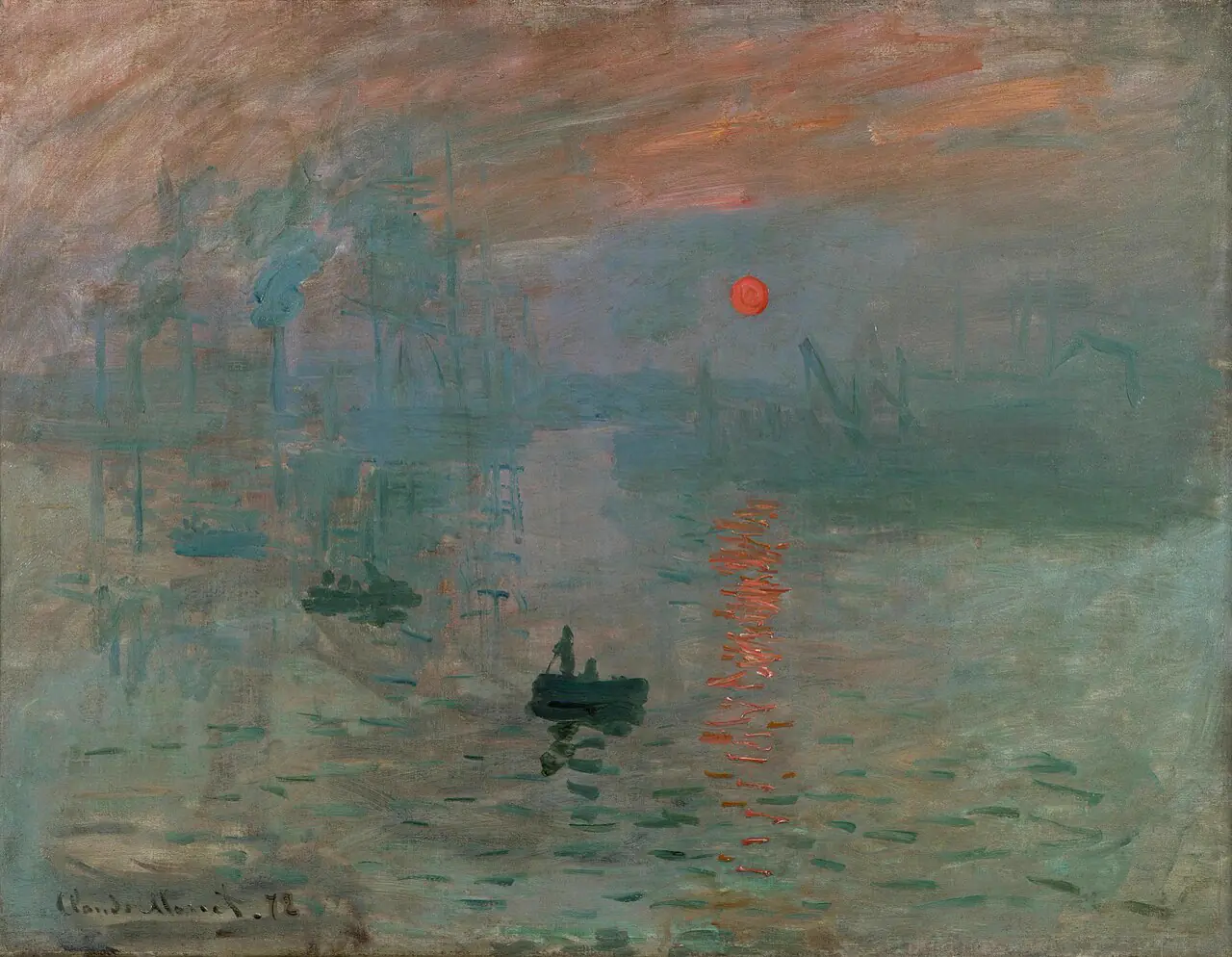
Paris first heard Nuages in December 1900. In the middle of the piece, flute and harp share a five-note melody over soft held strings. The cor anglais then returns with its earlier narrow phrase. Monet painted Impression, soleil levant from a hotel window in Le Havre in 1872. Dark boats are placed close to the viewer; the orange sun and its reflection stand out against the mist. Farther back, cranes and masts are barely visible in the morning haze.
Sources & recording
Orchestre de la Suisse Romande; Ernest Ansermet, conductor
Excerpt 4:28–6:12 · Full recording & listening notes
- LA Phil: Debussy’s Nocturnes programme and the 1900/1901 premieres ↗
- Musée Marmottan Monet: Impression, soleil levant, 1872 ↗
- Wikimedia Commons: public-domain reproduction of Monet’s painting ↗
- Nuages recording guide: middle section and return ↗
- Flute and harp play a melody built on five notes over quiet held chords in the strings.
- The cor anglais plays its earlier phrase again as the flute-and-harp tune dies away.
- The returning phrases grow shorter.
Ravel’s writing for strings
Maurice Ravel · String Quartet in F major
II. Assez vif — Très rythmé
Ravel finished his String Quartet in April 1903 and dedicated it to his teacher, Fauré. The scherzo opens pizzicato, with both violins, viola and cello plucking their notes. A bowed melody then enters in a long phrase over the continuing pizzicato. Debussy took an interest in how the four parts sat together. Writing to Ravel before the première in March 1904, he suggested a small change to the playing, that the viola could be a little quieter.
Sources & recording
String players of the United States Army Band
Excerpt 0:00–1:42 · Full recording & listening notes
- Stephen Walsh, Chamber Music Society: Ravel’s quartet, dedication and scherzo technique ↗
- Denis Herlin, G. Henle Verlag: Debussy’s March 1904 letter about the quartet’s balance ↗
- String Quartet recording guide: plucked and bowed phrases ↗
- Two violins, viola and cello play the dance pizzicato in short, separate notes.
- The bowed melody is played in long notes above quick plucked notes.
Hokusai’s wave on the cover of Debussy’s score
Claude Debussy · La Mer
I. De l’aube à midi sur la mer
The United States Air Force Band plays the opening of La Mer in Lawrence Odom’s concert-band transcription. A low B is held beneath the opening; short phrases enter above it, one at a time. Later, groups of two and three notes cross one another. When Durand published the score in 1905, its cover carried an adapted detail of Hokusai’s wave. In the complete print, narrow boats lie under the curling crest, and Mount Fuji stands far behind them.
Sources & recording
United States Air Force Band, Concert Band
Excerpt 0:00–3:00 · Full recording & listening notes
- Sibley Music Library: Durand’s 1905 edition and its Hokusai cover detail ↗
- Wikimedia Commons: Hokusai print, c. 1830–32, and public-domain reproduction ↗
- Boston Symphony: La Mer, composition and rhythmic organisation ↗
- United States Air Force Band recording: Lawrence Odom transcription credit ↗
- French Impressions, Klavier booklet: United States Air Force Band and Lawrence Odom’s transcriptions ↗
- Band recording guide: introduction and main-span timings ↗
- Odom’s concert-band transcription opens over a held low B, with short phrases above it.
- The low notes are held while shorter phrases begin to move above them.
- After the slow opening, the music moves faster; short calls enter over a running accompaniment.
- Groups of two notes cross groups of three in the quiet movement.

Influence
Ravel’s Oiseaux tristes
Maurice Ravel · Miroirs
II. Oiseaux tristes — Très lent
Ravel described the birds of Oiseaux tristes as lost in a dark forest during the hottest hours of summer. The piano begins high and alone, with a repeated B♭ and a short flourish. Beneath the next calls, the left hand moves in threes while the right hand divides its beat in two. A louder call is followed by a quiet answer. Ravel dedicated the piece to Ricardo Viñes, who first played Miroirs at the Salle Érard on 6 January 1906. When the opening call returns in D minor, held chords sound beneath it.
Sources & recording
Olena Havyuk-Sheremet, piano
Excerpt 0:00–2:22 · Full recording & listening notes
- Ravel, Miroirs: Demets first edition, Oiseaux tristes on scan pages 10–13 ↗
- PTNA Piano Encyclopedia: Oiseaux tristes and its simultaneous metres ↗
- IMSLP: Miroirs, dedications and 6 January 1906 premiere ↗
- Orchestre national de Lyon: Ravel’s forest image and the first performance of Miroirs ↗
- Oiseaux tristes recording guide: published passage timings ↗
- A high B♭ repeats softly, then opens into a small flourish; the left hand is silent.
- The left hand plays in threes beneath the right hand’s twos and the bird’s call.
- A loud call is answered quietly, at a distance, while the lower notes continue to turn.
- The opening call returns in D minor over soft held chords.
Karsavina as the bird
Igor Stravinsky · The Firebird
Infernal Dance of Kashchei
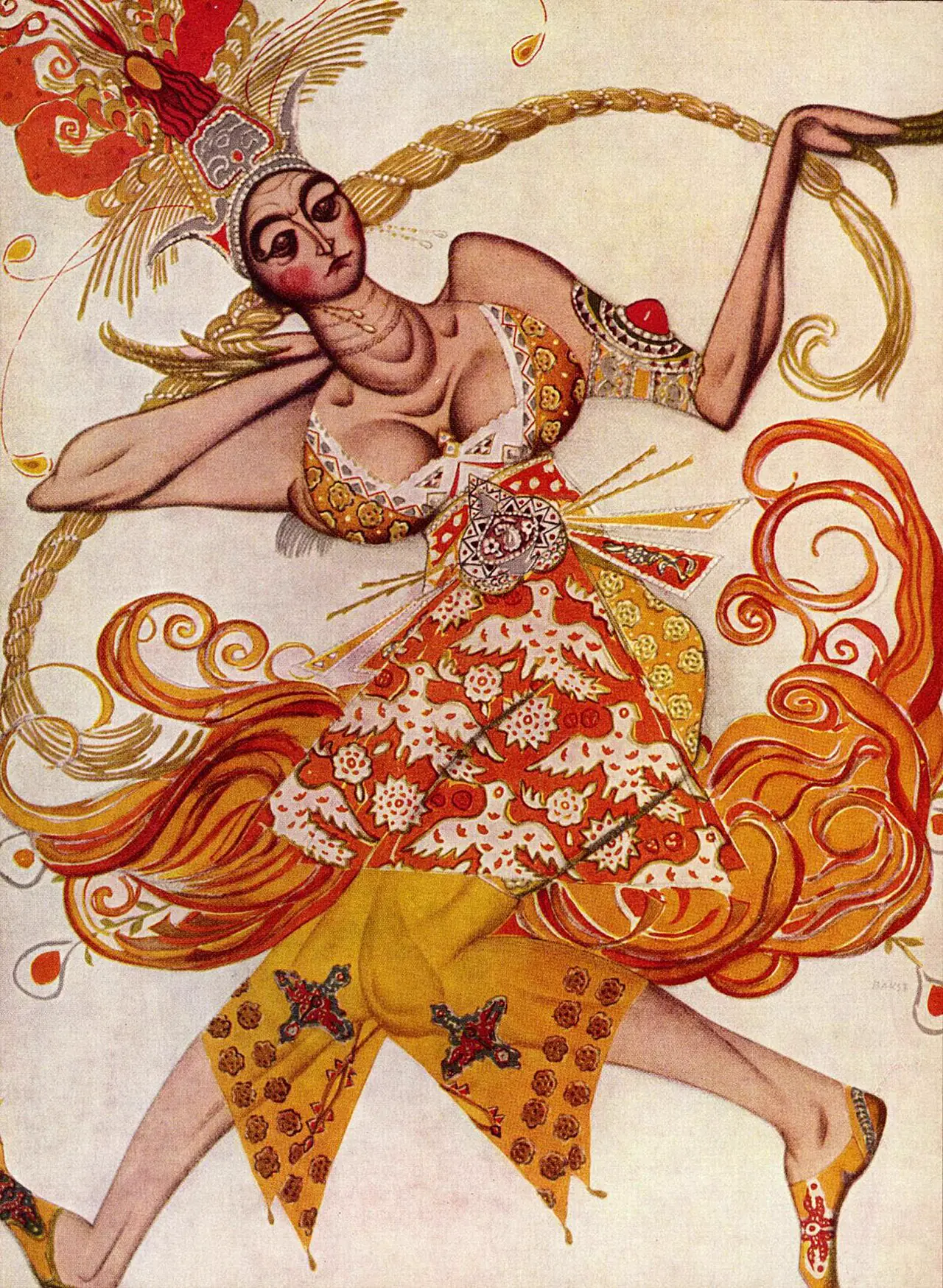
On 25 June 1910, Tamara Karsavina danced The Firebird at the Paris Opéra, with choreography by Michel Fokine for Diaghilev’s Ballets Russes. In the Infernal Dance, the bird forces Kashchei and his creatures to dance. The United States Marine Band plays Thomas Knox’s arrangement for concert band. Short figures cut across the pulse, and the accents are displaced. Bakst’s costume design shows the bird on paper, before a dancer wore it. A longer melody then extends across the beat, while Kashchei remains under her spell.
Sources & recording
United States Marine Band; Col John R. Bourgeois
Excerpt 0:00–2:24 · Full recording & listening notes
- Library of Congress: Ballets Russes collaboration and the first Paris season ↗
- Fondation Igor Stravinsky: Firebird premiere and Ballets Russes chronology ↗
- The Firebird: scenario and premiere production ↗
- Wikimedia Commons: Bakst’s 1910 costume design, public-domain image ↗
- Marine Band recording: Thomas Knox arrangement and performance credits ↗
- Infernal Dance recording guide: pulse and sustained middle paragraph ↗
- The Marine Band plays Thomas Knox’s arrangement of Kashchei’s forced dance, which is built from short phrases.
- Sharp accents fall across the steady pulse.
- After the clipped opening phrases, a longer melody runs across the beat.
The opening bassoon solo
Igor Stravinsky · The Rite of Spring
Part I. Adoration of the Earth
On 29 May 1913, Pierre Monteux conducted the première of The Rite of Spring at the Théâtre des Champs-Élysées. Nijinsky had choreographed the ballet for Diaghilev’s company. The music begins with a bassoon high in its range, playing a melody drawn from a Lithuanian folk-song collection. Other wind instruments enter around it, each with a separate line. In this recording Stravinsky conducts the Columbia Symphony Orchestra, in January 1960. Near the end of the introduction the wind parts thin out and the opening bassoon tune returns, briefly exposed, before the stamping begins.
Sources & recording
Columbia Symphony Orchestra; Igor Stravinsky
Excerpt 0:00–3:00 · Full recording & listening notes
- Pieter C. van den Toorn: premiere, Lithuanian tune source and opening construction ↗
- John McFerrin, Library of Congress: the documented disturbance and conflicting riot accounts ↗
- Parnassus label booklet: 5–6 January 1960 Columbia sessions ↗
- Adoration of the Earth recording guide: introduction and approximate dance boundary ↗
- A bassoon plays a winding melody high in its range; the other wind instruments enter one by one.
- Separate wind phrases overlap, cross and interrupt one another around the opening melody.
- The wind calls thin out before the dance, leaving space around the bassoon.
- Ustyluh Ukraine · lived · documented
1907–1914
Returned to his Ukrainian summer home to compose.
- Clarens Switzerland · lived · documented
1911–1914
Composed beside Lake Geneva, including much of The Rite of Spring.
- Théâtre des Champs-Élysées Paris · premiere · documented
1913-05-29
Monteux conducted Nijinsky’s controversial ballet.
Dated places on a present-day coastline.
This year on the MapAugurs of Spring: the repeated chord
Igor Stravinsky · The Rite of Spring
Part I. Adoration of the Earth
The strings repeat the same chord at the opening of Augurs of Spring, F♭ major against an E♭ dominant seventh. Horns play selected attacks harder. The opening bars keep a steady 2/4 while the accents shift, with unaccented strokes between them. In a letter to Nicholas Roerich on 26 September 1911, Stravinsky described an old woman in squirrel fur running in front of the dancers, stopping and interrupting their rhythm. He had her in mind while composing this dance. Around the repeated chord, shorter phrases pass across the orchestra, and the horns enter again.
Sources & recording
Columbia Symphony Orchestra; Igor Stravinsky
Excerpt 3:00–6:03 · Full recording & listening notes
- Pieter C. van den Toorn: Augurs, rehearsal 13, chord and accent analysis ↗
- Stravinsky, The Rite of Spring: full score, Part I, rehearsal 13 ↗
- Pieter C. van den Toorn: Stravinsky’s letter to Roerich, 26 September 1911 ↗
- Rite recording guide: Augurs cues and passage-level timing ↗
- The strings repeat their crowded chord; horns pick out certain strokes with extra force.
- The dance opens in 2/4, with quiet strokes filling the uneven gaps between the accents.
- The dance grows louder around its recurring figures, then grows quieter again.
- A repeated tread holds beneath the shorter phrases.
Press Begin to start playback.
← → stations · Space pauses · swipe to change station