Death and the Dies irae
A medieval funeral chant and its later uses
A plainchant hymn for one voice comes first. The Dies irae appears in works by Berlioz, Liszt, Saint-Saëns and Rachmaninoff, and Verdi set its Latin words in his Requiem.
Begin plays the stations in order; Pause stops playback at the current station.A hymn for one voice
Gregorian chant · Pange lingua gloriosi corporis mysterium
Traditional plainchant hymn
Gareth Hughes sings Pange lingua unaccompanied, with a breath between the Latin phrases. The stanza melody of the Eucharistic hymn returns with new words for each verse.
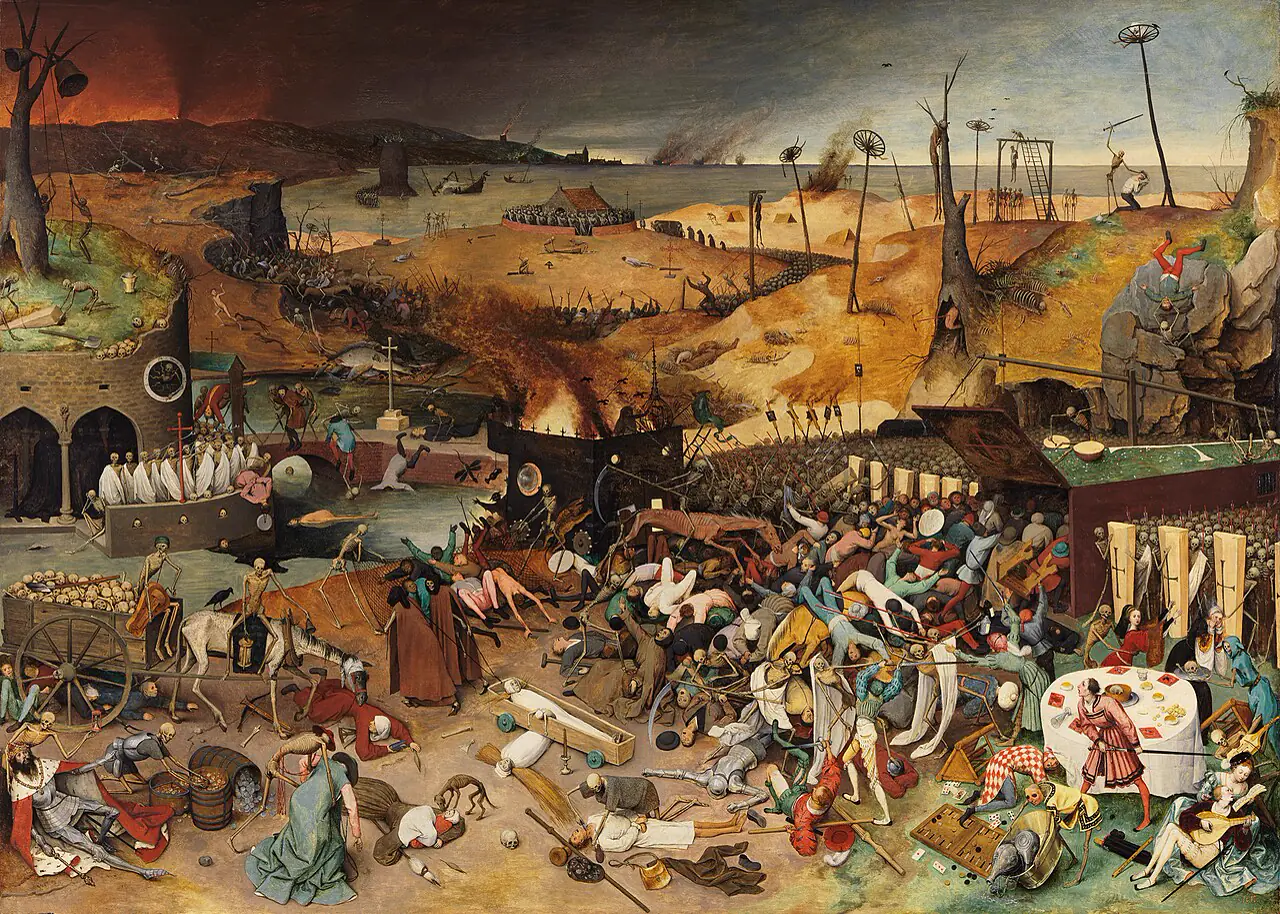
At Catholic funerals the Dies irae was sung to a sterner melody. Its first eight notes in the Vatican Graduale are F–E–F–D–E–C–D–D. Berlioz later set that melody low in his orchestra. In Bruegel’s The Triumph of Death, skeletons have already crossed the landscape, driving the living before them.
Sources & recording
Gareth Hughes, voice
Excerpt 0:00–3:25 · Full recording & listening notes
- GregoBase: Dies irae, Graduale Romanum (Vatican, 1908), p. 83*, chant and transcription ↗
- Commons: Gareth Hughes’s Pange lingua recording ↗
- Hugh Henry, Catholic Encyclopedia: Aquinas’s Eucharistic hymn ↗
- Commons: Bruegel, The Triumph of Death, date and public-domain reproduction ↗
- Google Arts & Culture: Bruegel’s The Triumph of Death ↗
- Hector Berlioz: programme and note on the Dies irae’s funeral use ↗
- Gareth Hughes sings Pange lingua, the Latin Eucharistic hymn, in a single unaccompanied line.
- The stanza melody returns with new Latin words.
- The melody continues through the closing stanzas to the hymn’s final prayer.
Funeral bells in the witches’ sabbath
Hector Berlioz · Symphonie fantastique, Op. 14
V. Songe d’une nuit du Sabbat
Bells toll C and G in the finale of Berlioz’s Symphonie fantastique, in which the artist dreams of his own funeral, surrounded by witches and monsters. The Dies irae enters in the low register of the orchestra, its first statement given to four bassoons and two ophicleides, the keyed brass instruments in Berlioz’s score.
The chant is first played in long notes. The same tune is then repeated in quicker note values and passes to higher woodwind and brass. In his 1845 programme Berlioz called this a ‘burlesque parody’ of the funeral music.
Sources & recording
Igor Markevitch, Orchestre Lamoureux
Excerpt 3:00–5:35 · Full recording & listening notes
- Hector Berlioz: original programmes, movement V ↗
- The Hector Berlioz Website: finale analysis, Dies irae from bar 127 ↗
- Berlioz: finale orchestral score ↗
- Hector Berlioz: French text of the 1845 programme, movement V ↗
- Deep bells toll C and G around the approaching funeral chant.
- The Dies irae sounds low and broad, scored for four bassoons and two ophicleides.
- The chant’s long notes shorten as the melody passes through the wind and brass.
- Paris · studied · documented
1821-09–1830-12
Medical student, then private pupil of Le Sueur and Conservatoire student under Reicha from August 1826.
- Salle du Conservatoire, Paris · premiere · documented
1830-12-05
First performance, conducted by Habeneck; Harriet Smithson, who had inspired the work, did not attend.
Dated places on a present-day coastline.
This year on the MapInfluence
The witches’ dance
Hector Berlioz · Symphonie fantastique, Op. 14
V. Songe d’une nuit du Sabbat
The witches’ round begins low in the strings, with cellos and double basses entering together. Violas answer, then violins, each group starting while the earlier players continue. The tune’s quick rise and accented turn return in different parts of the orchestra.
Later in the movement Berlioz brings the Dies irae in over this dance. In this passage the round stays in the foreground and grows louder as winds and brass join the strings. Towards the end of the passage the activity dies down into held notes, followed by quiet horn calls.
Sources & recording
Igor Markevitch, Orchestre Lamoureux
Excerpt 5:35–8:10 · Full recording & listening notes
- Hector Berlioz: programme distinguishing the round from the chant and their combination ↗
- Berlioz: finale score, Ronde du Sabbat from bar 241 ↗
- The Hector Berlioz Website: the finale’s contrapuntal construction ↗
- The string parts overlap, each new entry beginning before the earlier one has finished.
- Woodwinds, brass and percussion join the imitative writing in the strings.
- The fast dance thins out into held notes, and then the horns bring back the chant.
Liszt’s B minor Sonata
Franz Liszt · Piano Sonata in B minor, S. 178
Liszt’s B minor Sonata begins with low Gs and a falling scale. The piano then leaps into octaves and plays a repeated note. A few minutes later come broad D major chords marked Grandioso.
Liszt had heard the première of Berlioz’s Symphonie fantastique in 1830 and transcribed it for piano in 1833. In Totentanz he wrote variations for piano and orchestra on the Dies irae. In the Sonata, beneath the broad Grandioso melody, the accompaniment continues to strike repeated quavers.
Sources & recording
Jorge Bolet
Excerpt 0:00–3:28 · Full recording & listening notes
- The Hector Berlioz Website: Liszt at the première and the 1833 transcription ↗
- John Mangum, Los Angeles Philharmonic: Totentanz and its Dies irae variations ↗
- Alan Tang: B minor Sonata, opening motifs and Grandioso ↗
- Contrapunctus: Berlioz and Liszt ↗
- Low Gs and falling scales begin Liszt’s B minor Sonata, with silence between the phrases.
- The piano plays leaping octaves, then strikes a repeated note.
- Broad D major chords open the Grandioso; repeated quavers continue beneath the melody.
- Altenburg, Weimar · lived · documented
1848–1861
Villa he shared with Princess Carolyne for twelve years, where he composed and taught; Hans von Bülow was among his pupils.
Dated places on a present-day coastline.
This year on the MapInfluence
Chant and round combined; col legno
Hector Berlioz · Symphonie fantastique, Op. 14
V. Songe d’une nuit du Sabbat
Berlioz’s Symphonie fantastique returns for its final rush. The wind and brass play the funeral chant in long notes while the strings race through the witches’ round. Later, violins and violas turn their bows over and strike the strings with the wood (col legno), which produces a dry rattle.
In Saint-Saëns’s Danse macabre of 1874, Death plays a solo violin and the xylophone imitates rattling bones. The woodwinds quote the Dies irae during the dance. The score grew out of a song setting of a poem by Henri Cazalis. Berlioz’s sabbath ends with the strings bowing again and the full orchestra hammering out C major.
Sources & recording
Igor Markevitch, Orchestre Lamoureux
Excerpt 8:10–11:13 · Full recording & listening notes
- Brian McCurdy, Library of Congress: Saint-Saëns, Danse macabre, its chant quotation and instrumentation ↗
- Hector Berlioz: the programme’s combination of chant and round ↗
- Berlioz: finale score, including col legno at bars 444–460 ↗
- After the quiet horn calls, Berlioz’s orchestra builds towards the chant and round together.
- Wind and brass play the funeral chant in long notes while the strings play the witches’ dance in fast figures.
- Violins and violas strike their strings with the wood of their bows (col legno), which produces a dry rattle.
Verdi: the chorus and judgement
Giuseppe Verdi · Messa da Requiem
Dies irae — opening number of the sequence
Verdi’s Dies irae opens with four orchestral blows, and rushing figures lead to the entry of the chorus. The ancient Latin words describe the day of judgement, and Verdi set them to a new tune. The Requiem was first performed in the church of San Marco in Milan on 22 May 1874.
After the opening, the voices drop to a quiet dynamic at ‘Quantus tremor’ (‘how great the trembling’), where the choir repeats syllables. The orchestra keeps moving underneath.
Sources & recording
Orchestra and Choir of Teatro Reale dell’Opera di Roma (current Commons attribution; disputed)
Excerpt 0:00–2:02 · Full recording & listening notes
- Verdi, Requiem: Eulenburg score, opening Dies irae and following Tuba mirum ↗
- GregoBase: the plainchant melody for comparison with Verdi’s independent setting ↗
- Commons: recording part 03, opening Dies irae ↗
- Teatro dell’Opera di Roma historical archive: the Requiem’s first performance ↗
- Verdi’s setting of the Latin judgement scene opens with four orchestral blows and rushing figures.
- The orchestra plays more quietly, and the chorus’s words are heard clearly over the accompaniment.
- ‘Quantus tremor’ — ‘how great the trembling’ — breaks into quiet, repeated syllables.
- Villa Verdi, Sant’Agata, Busseto · lived · documented
1851-05-01–1901-01
He and Strepponi moved in on 1 May 1851; he farmed the estate and lived here until his death.
- San Marco, Milan · premiere · documented
1874-05-22
Conducted the Manzoni Requiem here on the first anniversary of the writer’s death.
Dated places on a present-day coastline.
This year on the MapRachmaninoff’s Prelude and Böcklin’s painting
Sergei Rachmaninoff · Prelude in C♯ minor, Op. 3 No. 2
Rachmaninoff plays his C♯ minor Prelude in this 1919 recording. It opens with three low notes, A–G♯–C♯, and the answering chords are played very quietly. The right hand then plays running triplets, with a descending melody carried inside them.
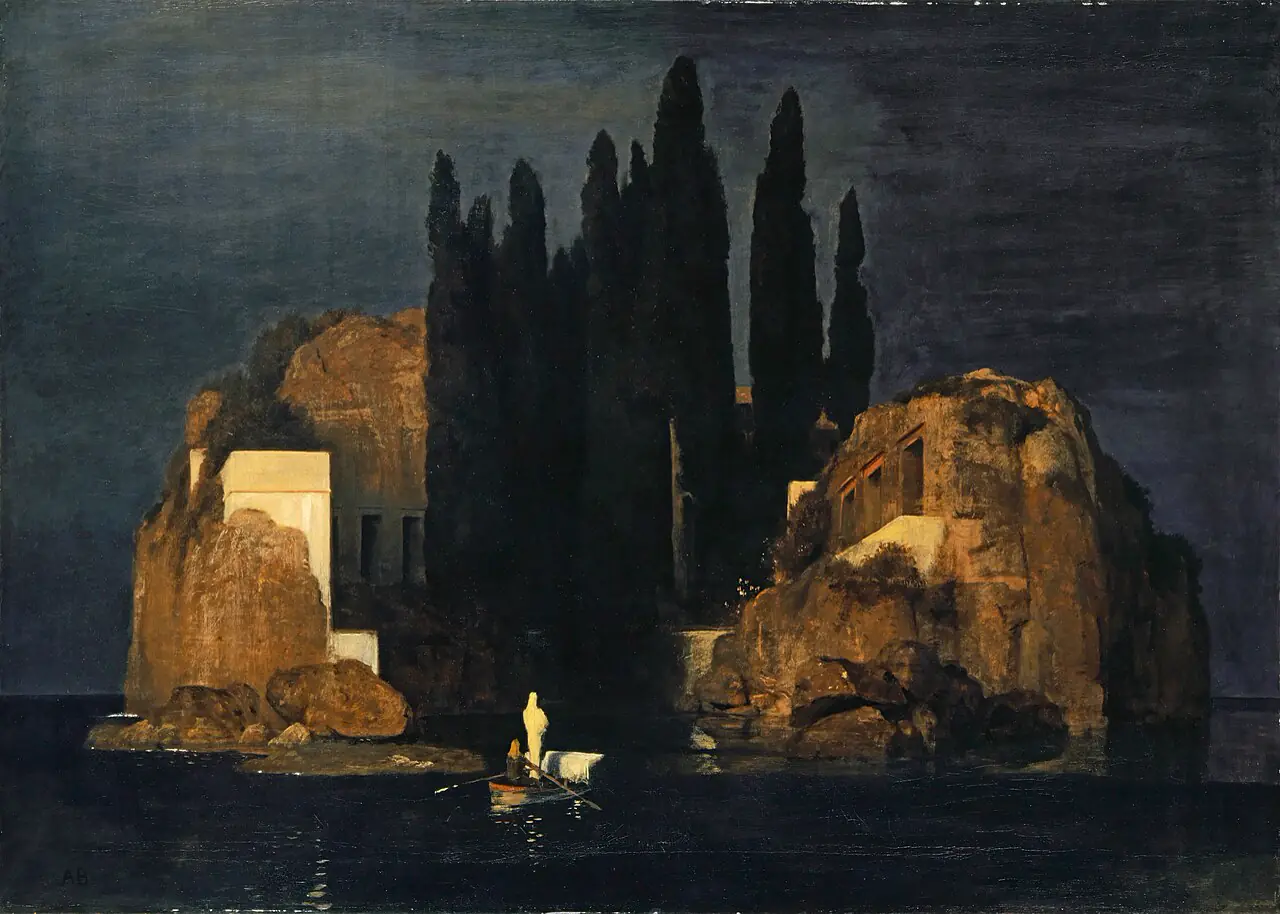
Böcklin’s Isle of the Dead shows a white-cloaked figure and a coffin in a boat approaching the island. Rachmaninoff saw a black-and-white reproduction of it in 1907. His orchestral Isle of the Dead uses the Dies irae in fragments and in longer phrases. In the Prelude, the triplets lead to a return of the three opening bass notes.
Sources & recording
Sergei Rachmaninoff
Excerpt 0:00–2:18 · Full recording & listening notes
- Timothy Judd: Isle of the Dead, the monochrome reproduction and Dies irae material ↗
- Commons: Böcklin’s first version, Basel, 1880 ↗
- Rachmaninoff: C♯ minor Prelude, Mutopia score ↗
- Commons: Rachmaninoff’s 1919 Edison Prelude recording ↗
- Kunstmuseum Basel: Böcklin’s first Isle of the Dead and its white-cloaked figure ↗
- Lucy Parham, Pianist: the Prelude’s chords, triplets and bell sonorities ↗
- Rachmaninoff’s C♯ minor Prelude opens with A–G♯–C♯ in low octaves, followed by quiet chords.
- A descending melody sounds inside the right hand’s running triplets.
- The Prelude’s triplets lead to the return of its opening chords.
Places on record · 1909
- Ivanovka · lived · documented
1890–1917
Returned to the Satin family estate to compose, later owning and managing it.
- Dresden · lived · documented
1906-11–1909
Moved with his family to compose away from Moscow’s musical demands.
- Moscow · lived · documented
1909–1917
Returned to Russia; led the Moscow Philharmonic Society from 1911 to 1913.
- Moscow · premiere · documented
1909-05-01
Conducted his symphonic poem after Böcklin.
- Northampton Massachusetts · travelled · documented
1909-11-04
Opened his first American tour with a recital at Smith College.
- New York City · premiere · documented
1909-11-28
Played the Third Concerto under Walter Damrosch at the New Theatre.
Dated places on a present-day coastline.
This year on the MapInfluence
The Prelude’s loud return and coda
Sergei Rachmaninoff · Prelude in C♯ minor, Op. 3 No. 2
At the return in the C♯ minor Prelude, the quiet opening chords are spread across four staves, two for each hand, and marked fff pesante, very loud and heavy. The three-note opening figure is now played in these chords.
In the Rhapsody on a Theme of Paganini of 1934, Rachmaninoff gave the piano another melody of this weight. Variation VII sets the Dies irae in chords against Paganini’s tune in bassoons and plucked cellos. After its climax the Prelude grows quieter. A low C♯ is held beneath changing chords, and the final C♯ minor chord fades to ppp.
Sources & recording
Sergei Rachmaninoff
Excerpt 2:18–3:47 · Full recording & listening notes
- Calvin Dotsey, Houston Symphony: Paganini Rhapsody, variation VII and its two materials ↗
- Rachmaninoff: C♯ minor Prelude, four-stave return and coda ↗
- Hector Berlioz: chant and round combined ↗
- Lucy Parham, Pianist: the Prelude’s bell-like climax and quiet ending ↗
- Running triplets lead to the Prelude’s huge return, written on four staves.
- A low C♯ sounds in the bass of the coda, with quieter chords above it.
- New York City · exile · documented
1918-11-12–1942
Established his American base; bought 33 Riverside Drive in 1921.
- Villa Senar · lived · documented
1933–1939
Composed and rested at his Hertenstein home on Lake Lucerne.
- Lyric Baltimore · premiere · documented
1934-11-07
Played the Paganini Rhapsody with Stokowski and the Philadelphia Orchestra.
Dated places on a present-day coastline.
This year on the MapInfluence
Press Begin to start playback.
← → stations · Space pauses · swipe to change station