Vienna, 1900
Mahler, Schoenberg and the Vienna Secession
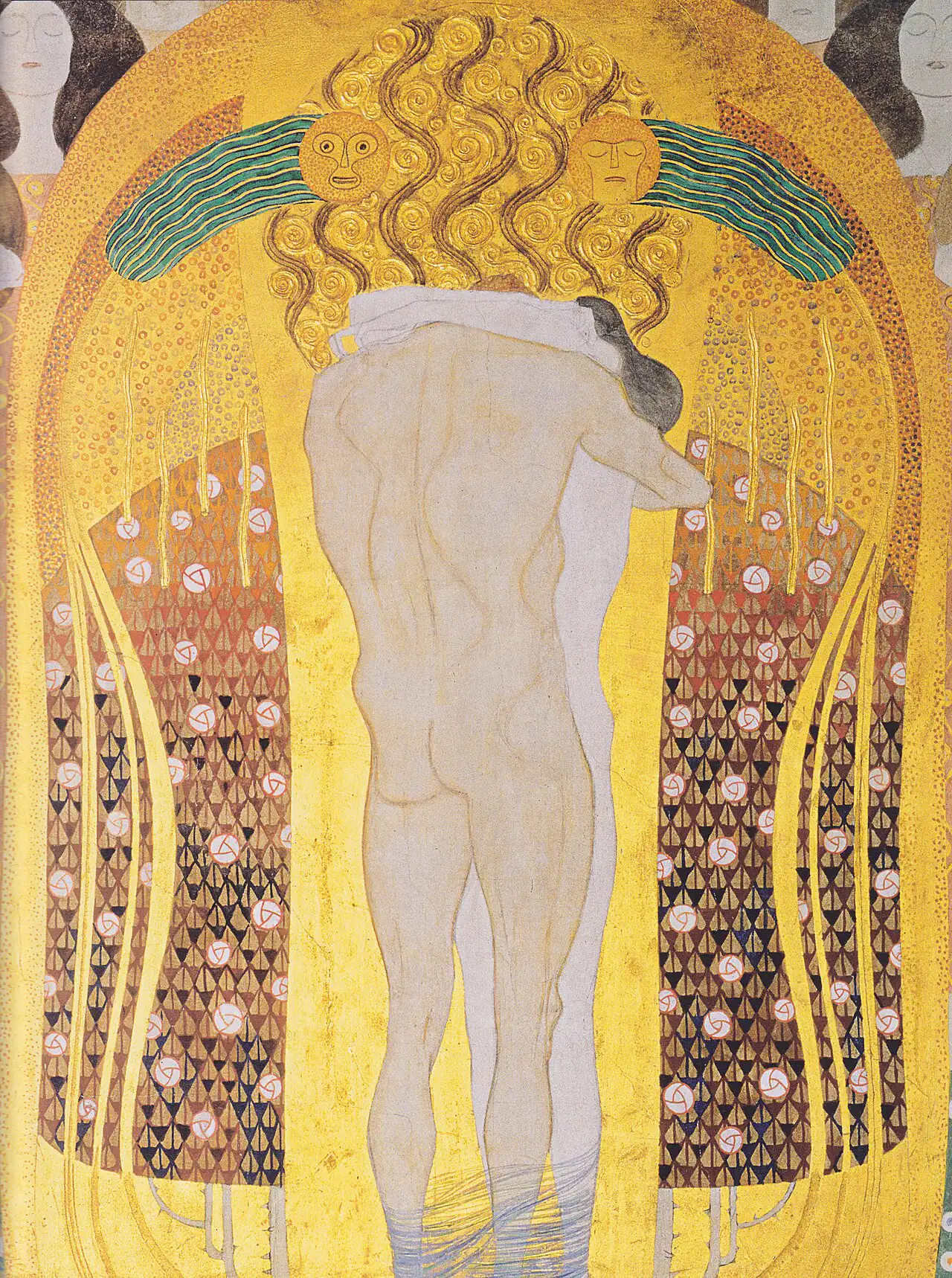
In 1902 Mahler conducted Beethoven at the Secession, where Klimt had painted monsters, figures of longing and a final embrace. Six years later, in Vienna, part of the audience laughed while a soprano and the Rosé Quartet performed Schoenberg’s setting of words about air from another planet.
Begin plays the stations in order; Pause stops playback at the current station.The gilded dome
Gustav Mahler · Symphony No. 5
IV. Adagietto — Sehr langsam
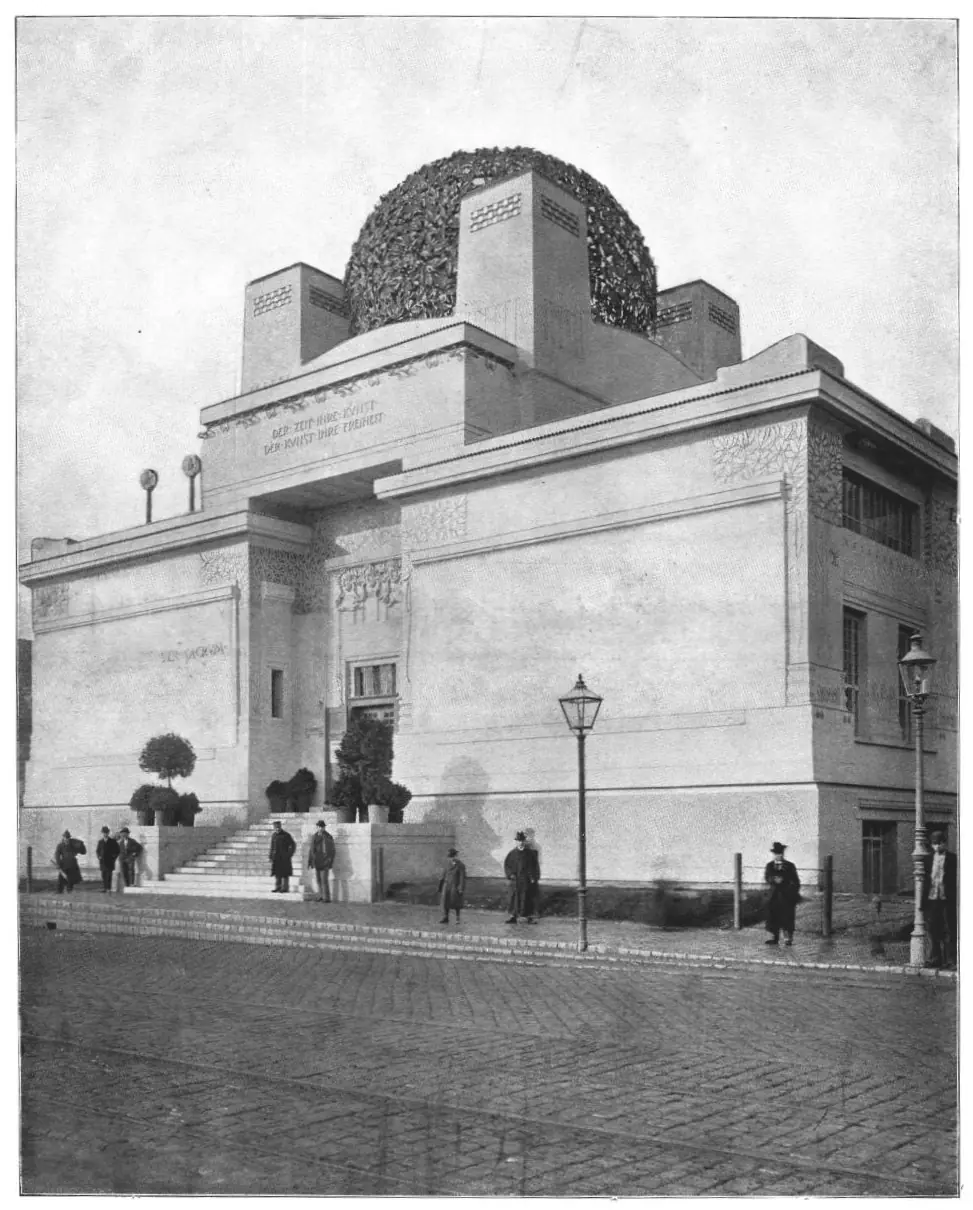
The Vienna Secession’s new building opened on 29 October 1898, after six months of construction. Joseph Maria Olbrich’s gilded dome stood over the entrance, and behind it lay a glass-roofed hall for the artists’ exhibitions. A few years later Mahler scored the Adagietto of his Fifth Symphony for strings and a single harp. The movement begins with soft violas and plucked harp notes. The first violins enter quietly, then extend their melody over the changing chords. Mahler marked their line seelenvoll, soulfully. Each appoggiatura is held before it resolves.
Sources & recording
Peabody Symphony Orchestra, Baltimore
Excerpt 0:00–4:36 · Full recording & listening notes
- Vienna Secession: building history and Olbrich’s design ↗
- Commons: Secession building around 1900 — historical photograph and public-domain status ↗
- Mahler, Symphony No. 5, IV: Peters full score, pp. 178–182 ↗
- Mahler Foundation: Adagietto, scoring and form ↗
- The first violins begin their long melody over the harp’s broken chords.
- The violas and cellos play the phrase while the first violins stop.
- The violin phrase broadens as the lower strings rise beneath it.
Places on record · 1900
- Vienna · worked · documented
1897–1907
Directed the Hofoper; also led the Vienna Philharmonic from 1898 to 1901.
- Maiernigg · lived · documented
1900–1907
Composed in his summer-house hut on the Wörthersee.
- Paris · travelled · documented
1900
Conducted the Vienna Philharmonic at the Paris Exposition.
Dated places on a present-day coastline.
This year on the MapBeethoven at the Secession
Gustav Mahler · Symphony No. 5
IV. Adagietto — Sehr langsam
In April 1902, twenty-one artists filled the Secession with a tribute to Beethoven. Max Klinger’s statue occupied the main hall, and Klimt’s frieze ran around three walls, ending in an embrace. At the preview on 14 April, the day before the exhibition opened to the public, Mahler conducted a wind arrangement from the finale of the Ninth Symphony. In Mahler’s Adagietto, the middle section becomes more flowing. The harp largely stops, and the first violins play on the G string. Their line rises.
Sources & recording
Peabody Symphony Orchestra, Baltimore
Excerpt 4:36–6:55 · Full recording & listening notes
- Vienna Secession: the 1902 Beethoven exhibition and the frieze’s programme ↗
- Mahler Foundation: XIVth Secession exhibition and Mahler’s 14 April performance ↗
- Mahler Foundation: the Adagietto’s middle section ↗
- Commons: Klimt’s concluding Beethoven Frieze panel ↗
- Mahler, Adagietto: Peters full score, pp. 180–181 — Fließender, G-Saite and harp rests ↗
- The more flowing middle section begins with the first violins playing on the G string.
- The strings carry the melody while the harp rests.
Places on record · 1902
- Vienna · worked · documented
1897–1907
Directed the Hofoper; also led the Vienna Philharmonic from 1898 to 1901.
- Maiernigg · lived · documented
1900–1907
Composed in his summer-house hut on the Wörthersee.
- Krefeld · premiere · documented
1902-06-09
Conducted the first complete Third Symphony.
Dated places on a present-day coastline.
This year on the MapScore sent to Alma
Gustav Mahler · Symphony No. 5
IV. Adagietto — Sehr langsam
In his conducting score, Willem Mengelberg recorded a story about these pages. Mahler sent the Adagietto to Alma Schindler as a declaration of love; she understood and asked him to come. Mengelberg added that both of them had told him about it. The melody returns here with the harp after a long interruption. The strings pause, then rise once more. Near the end, the violins play high above the rising cellos. The harp stops first; the bowed strings hold the last F major chord until it dies away.
Sources & recording
Peabody Symphony Orchestra, Baltimore
Excerpt 6:55–10:21 · Full recording & listening notes
- K. Dawn Grapes, Fort Collins Symphony: Mengelberg’s annotation ↗
- Mahler, Adagietto: Peters full score ↗
- Commons: the Peabody Symphony Orchestra recording used here ↗
- The opening melody returns with the harp’s broken chords.
- The violins hold the phrase in a high register above the rising cellos.
- The harp has stopped; the strings hold the closing F major.
Alto and brass in exchange
Gustav Mahler · Symphony No. 2 “Resurrection”
IV. Urlicht — Sehr feierlich, aber schlicht
At the end of an early orchestral manuscript of Urlicht, Mahler wrote the place and date: Steinbach, 19 July 1893. The song became the fourth movement of his Second Symphony. Its poem came from the second volume of Des Knaben Wunderhorn, published in 1808, and Mahler set it for alto. Her first short phrase is answered by brass chords in the manner of a hymn. The score asks for solemnity and simplicity. Later the voice leaves a phrase unfinished, and the oboe completes it with a turn.
Sources & recording
Barbara Schubert, the DuPage Symphony Orchestra
Excerpt 0:00–2:40 · Full recording & listening notes
- Mahler Foundation: Urlicht manuscript, earlier song and symphonic setting ↗
- Deutsches Textarchiv: Des Knaben Wunderhorn, volume II, 1808 ↗
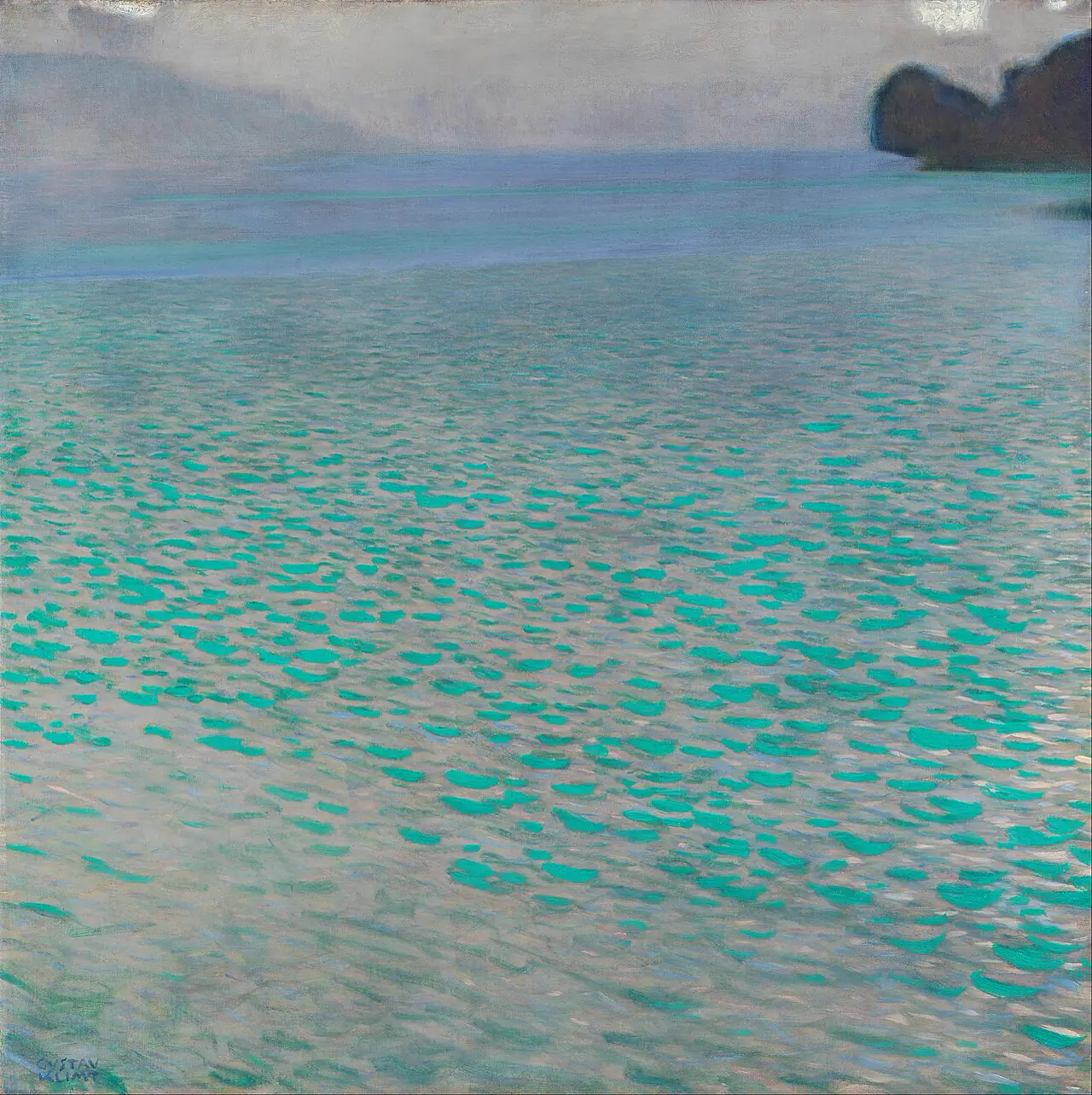
- Commons: Klimt, Attersee, 1900 ↗
- Lew Smoley, Mahler Foundation: Urlicht, brass chorale and oboe turn ↗
- The alto’s opening phrase is answered by hymn-like brass chords.
- The oboe completes the phrase with a turn.
Places on record · 1893
- Hamburg · worked · documented
1891–1897
Led the Stadttheater and composed Wunderhorn songs.
- Steinbach am Attersee · lived · documented
1893–1896
Spent summers composing in a lakeside hut, completing the Second and Third symphonies.
Dated places on a present-day coastline.
This year on the MapThe finale’s string introduction
Arnold Schoenberg · String Quartet No. 2, Op. 10
IV. Entrückung — Sehr langsam
In the finale of Schoenberg’s Second Quartet, the strings begin alone. The four lines rise and move around one another. Schoenberg described this introduction as a departure from earth, in which the traveller passes through clouds, escaping gravity and the troubles left below. He wrote the quartet in 1907–08. Its earlier movements still have named keys, but in this movement the pull towards a home chord weakens. The two violins, viola and cello play a succession of new combinations of notes before the soprano enters with George’s poem.
Sources & recording
Carmel String Quartet; Rona Israel-Kolatt, soprano
Excerpt 0:00–1:14 · Full recording & listening notes
- Therese Muxeneder, Arnold Schönberg Center: Quartet No. 2, introduction and tonal organisation ↗
- Arnold Schönberg Center: compositional chronology ↗
- Charles Wilson, Chandos CHAN 9939 booklet, pp. 8–11: the finale’s rising, circling muted strings ↗
- Muted strings rise and circle through changing combinations of notes.
- Vienna · worked · documented
1903–1911
Taught privately and at the Schwarzwald School; Berg and Webern became pupils.
Dated places on a present-day coastline.
This year on the MapThe soprano enters
Arnold Schoenberg · String Quartet No. 2, Op. 10
IV. Entrückung — Sehr langsam
“Ich fühle Luft von anderem Planeten” — “I feel air from another planet.” The soprano begins with the opening line of Stefan George’s Entrückung, from his 1907 collection Der siebente Ring. In the poem, familiar faces fade in the darkness, and the trees and paths the speaker loved grow so pale that he hardly knows them. Schoenberg gave the words to a fifth musician, the soprano, who joins the two violins, viola and cello. The strings go on playing their own lines while she sings. In his performance instructions he asked for the passage to be as light as breath, with the voice set apart from the strings by its colour.
Sources & recording
Carmel String Quartet; Rona Israel-Kolatt, soprano
Excerpt 1:14–2:48 · Full recording & listening notes
- Arnold Schönberg Center: George’s poems, scoring and Schoenberg’s balance instruction ↗
- Commons: Carmel Quartet and Rona Israel-Kolatt, 2007 recording ↗
- Arnold Schönberg Center: George’s original poem and Der siebente Ring (1907), pp. 122–123; English opening translated here ↗
- The soprano enters with George’s words about air from another planet.
- The singer and strings continue their separate lines within the same phrase.
Laughter in the Bösendorfersaal
Arnold Schoenberg · String Quartet No. 2, Op. 10
IV. Entrückung — Sehr langsam
From 1902, Freud’s waiting room at Berggasse 19 hosted the Wednesday Psychological Society. Six years later, on 21 December 1908, the Rosé Quartet and Marie Gutheil-Schoder gave the first performance of Schoenberg’s Second Quartet in the Bösendorfersaal. In his note for the Kolisch Quartet’s private recording, written in Los Angeles in 1936–37, Schoenberg remembered what happened. After the second movement began, “the greater part of the audience started to laugh”. The interruptions continued through both George settings. Gutheil-Schoder had to keep singing through them.
Sources & recording
Carmel String Quartet; Rona Israel-Kolatt, soprano
Excerpt 2:48–5:52 · Full recording & listening notes
- Sigmund Freud Museum: the first waiting room and Wednesday Psychological Society, from 1902 ↗
- Arnold Schönberg Center: Schoenberg’s 1936–37 Los Angeles note for the Kolisch Quartet recording, quoted on the premiere ↗
- Arnold Schönberg Center catalogue: 21 December 1908, Bösendorfersaal, Marie Gutheil-Schoder and the Rosé Quartet ↗
- The melody changes direction as the voice and strings exchange short phrases.
- The voice and strings grow louder, then drop back to quieter phrases.
- A rise of closely spaced notes falls back to quieter playing.
Mahler and Freud in Leiden
Arnold Schoenberg · String Quartet No. 2, Op. 10
IV. Entrückung — Sehr langsam
On 26 August 1910, Mahler met Freud in Leiden. His marriage to Alma was in crisis, and three earlier appointments had been cancelled. Freud was on holiday in the Netherlands, about to leave for Italy. Ernest Jones’s biography describes the two men walking through the city for four hours while they talked. In the quartet, the soprano is still singing George’s poem, with its chasms and clear, distant heights. The strings begin quietly again, grow louder and fall back. A further rise leads towards the end of her part.
Sources & recording
Carmel String Quartet; Rona Israel-Kolatt, soprano
Excerpt 5:52–7:52 · Full recording & listening notes
- Mahler Foundation: the 26 August 1910 Leiden consultation and Jones’s account ↗
- Arnold Schönberg Center: Quartet No. 2, composition dates and instrumental coda ↗
- Commons: the quartet recording used here ↗
- Arnold Schönberg Center: George’s Entrückung, including its final images of chasms and heights ↗
- The strings begin again quietly, and their small figures grow louder.
- The voice and strings rise once more before the soprano’s part ends.
- Dobbiaco · lived · documented
1908–1910
Returned each summer to compose near Toblach.
- New York City · worked · documented
1908-01–1911-04
Conducted the Metropolitan Opera, then the New York Philharmonic from 1909.
- Leiden · travelled · documented
1910-08
Consulted Sigmund Freud during a walking conversation.
- Munich · premiere · documented
1910-09-12
Conducted the Eighth Symphony at the Neue Musik-Festhalle.
Dated places on a present-day coastline.
This year on the MapThe instrumental coda
Arnold Schoenberg · String Quartet No. 2, Op. 10
IV. Entrückung — Sehr langsam
The soprano stops and the four string players continue alone. This was the passage that finally quietened the audience at the premiere. Recalling it in Los Angeles in 1936–37, Schoenberg wrote: “Perhaps even my enemies and adversaries might have felt something here.” Three years after the quartet’s first performance, he dedicated his Harmonielehre, a book on harmony, to Mahler’s memory. The quartet had already moved far from the F♯ minor of its opening. At the end of this long coda the strings reach F♯ major and hold the chord.
Sources & recording
Carmel String Quartet; Rona Israel-Kolatt, soprano
Excerpt 7:52–10:27 · Full recording & listening notes
- Arnold Schönberg Center: instrumental coda and Schoenberg’s 1936–37 Los Angeles recollection, quoted here ↗
- Contrapunctus recording guide: Entrückung’s F♯ major ending and timing evidence ↗
- Universal Edition: Harmonielehre and its dedication ↗
- Mahler Foundation: Schoenberg’s 1911 memorial dedication to Mahler ↗
- Charles Wilson, Chandos CHAN 9939 booklet, pp. 8–11: the quartet’s F♯ minor opening and final F♯ major ↗
- The four strings continue alone after the soprano’s last phrase.
- The coda moves towards its final F♯ major.
- The last major chord is held, then fades.
Press Begin to start playback.
← → stations · Space pauses · swipe to change station