The Firebird (L’Oiseau de feu)
4 min
Recording
- Infernal Dance of KashcheiUnited States Marine Band; Col John R. Bourgeois4:16
The United States Marine Band, conducted by John R. Bourgeois, plays Thomas Knox’s concert-band arrangement of Kashchei’s Infernal Dance from The Firebird. In the ballet the dance is the Firebird’s spell on the sorcerer and his creatures.
Listening notes
- Infernal Dance, scenario
In the ballet scenario, the Firebird enchants Kashchei and his subjects into an infernal dance. The music is built from short, angular phrases that break off and start again.
- Semitone and tritone motifs
The tune moves by semitones between neighbouring notes, then jumps a tritone. Bowman traced these two motifs through rehearsal figures 133–141 and 161 of the ballet score.
- First performance, Paris Opéra, 1910
On 25 June 1910 Tamara Karsavina danced the Firebird at the Paris Opéra. Michel Fokine provided the choreography for Diaghilev’s Ballets Russes. Stravinsky was twenty-eight.
- Four-note descending motif
One of Kashchei’s recurring motifs descends chromatically through four neighbouring notes, as at rehearsal figures 141 and 160. The fragment is short and passes easily from one phrase to another. It is heard alongside Kashchei’s wide leaps.
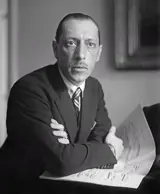
- Stravinsky as “Mr. Fireberg”
In Expositions and Developments, his 1962 book with Robert Craft, Stravinsky recalled a stranger in an American railway dining car who addressed him as “Mr. Fireberg”. He did not date the encounter.